
The Dowser's Path and More
Season 17 Episode 2 | 27m 44sVideo has Closed Captions
Dowsing rods reveal a buried past, viral videos turn five acres into a global business and more.
Dowsing rods reveal a buried past, viral videos turn five acres into a global business, following in the footsteps of greatness and, the sport of old-school cornhusking. Bill Bolte demonstrates how dowsing, a centuries-old technique still stirs the earth, revealing traces of the past that time almost erased. Noah Young, a Kenesaw farmer is turning his 5 acre farm into an internet sensation.
Problems playing video? | Closed Captioning Feedback
Problems playing video? | Closed Captioning Feedback
Nebraska Stories is a local public television program presented by Nebraska Public Media
The Dowser's Path and More
Season 17 Episode 2 | 27m 44sVideo has Closed Captions
Dowsing rods reveal a buried past, viral videos turn five acres into a global business, following in the footsteps of greatness and, the sport of old-school cornhusking. Bill Bolte demonstrates how dowsing, a centuries-old technique still stirs the earth, revealing traces of the past that time almost erased. Noah Young, a Kenesaw farmer is turning his 5 acre farm into an internet sensation.
Problems playing video? | Closed Captioning Feedback
How to Watch Nebraska Stories
Nebraska Stories is available to stream on pbs.org and the free PBS App, available on iPhone, Apple TV, Android TV, Android smartphones, Amazon Fire TV, Amazon Fire Tablet, Roku, Samsung Smart TV, and Vizio.
Do you have a Nebraska Story?
Do you have a story that you think should be told on Nebraska Stories? Send an email with your story idea, your name, your city and an email address and/or phone number to nebraskastories@nebraskapublicmedia.org. Or, click the link below and submit your information on nebraskastories.org.Providing Support for PBS.org
Learn Moreabout PBS online sponsorship(upbeat music) -[Narrator] Coming up on Nebraska Stories.
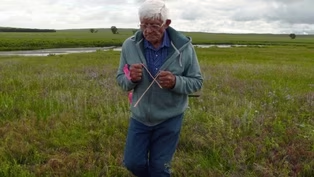
Dowsing rods reveal a buried past.
(upbeat music) Viral videos turn five acres into a global business.
(upbeat music) Following in the footsteps of greatness (upbeat music) and the sport of old school Cornhusking.
(upbeat music) (gentle music) -[Bill] I think it's just a gift that some people have.
Some don't.
(gentle music) It's unexplainable to what it is, how it works.
I do not know.
I just know that when I cross a trail, they will cross.
If I cross a body in the cemetery, they cross.
(gentle music) To me, it's got something to do with magnetics.
(gentle music) I know it's not proven scientifically.
A lot of people do not believe in it.
(gentle music) I don't know how to explain it otherwise.
(gentle music) It works for me.
(gentle music) -[Narrator] Out here, they say the past leaves a mark.
If you know where to look and how to read the land.
(gentle music) Today, Bill Bolte is searching for what time has nearly erased.
Trailheads from the 1800s.
(gentle music) That once carried herds north from Texas, bound for Railheads, military posts and tribal lands.
(gentle music) -[Bill] This is a map of Cherry County, 1885, and it shows the Ogalala cattle trail crossing (gentle music) the Fort Kearney trail right here, going to the west, and then crosses the North Loop River about a half mile north of where we're standing today.
And they're taking the cattle on up towards Valentine.
(gentle music) -[Narrator] Dowsing has taken Bill across Nebraska, Kansas and Oklahoma, (grass crunching) and the ancestral trails once walked by the Pawnee, Ponca, and Sioux.
(grass crunching) - And this would be the south side of the North Loop River.
And this would be where the cattle would have crossed.
Going north here.
You can see the indentation in the side of the bank where they would caved it off or trampled enough that it still shows up today.
And then I get on the trail here, and as we come down the bank, as they would have you hit the water.
When they got to the water why, it wouldn't magnetize or de-dowse anymore than the rods to open up.
This would have been where the edge of the river bank was at the time they came through here.
(birds chirping) -[Narrator] Bill first learned to dowse as a boy taught by a well man.
At the age of seven, he rediscovered the practice decades later while locating underground utility lines for the public power district.
(gentle music) -[Bill] Before that, we did not have Digger's hotline to do it for us, so we used dowsing rods to find underground lines, telephone, gas, anything like that that we might hit with an auger, trencher or whatever.
(gentle music) (car door clanking) (engine reving) (gentle music) I was led to dowse graves by Sexton.
(gentle music) Somebody wanted to purchase the lot, and he was cautious about somebody being buried there.
We decided if there is somebody buried in this grave so he wouldn't sell that lot.
-[Narrator] In places where markers vanish and records fade.
Dowsing is a quiet way to protect history, ensuring graves remain undisturbed.
(gentle music) -[Bill] Now we're on the back side of the headstones.
And this is where the body will be.
(gentle music) There's one.
Here's the second one.
(gentle music) And then there's the third one.
(gentle music) -[Narrator] For Bill and his neighbor, Kyla Greving, finding forgotten resting places of loved ones is nothing unusual.
- I started dowsing probably about three years ago.
Bill was actually the one who got me into it.
I honestly don't know why or how it works.
(gentle music) I do believe that it might be a little hereditary.
I know my grandfather used to dowse for a lot of people, and I have recently tested a theory with my own father and my uncle.
(gentle music) They can do it as well.
I know that, like my ability to tell the gender is a little bit more powerful compared to theirs to determine the gender.
If it sways north south, it's a male, and if it's east west, it's a female.
This one is marked and it says mother.
(birds chirping) We sway east west.
(grass crunching) (birds chirping) There's the mother.
(grass crunching) (birds chirping) Father.
-[Bill] Now we're on the unmarked one.
(grass crunching) (birds chirping) -[Kyla] I don't think that there's a scientific explanation.
I think either you believe you can do it or you can't.
I do know that there are several people who are unable to dowse, so I don't know.
I don't really know how to explain it and why it works.
If they haven't tried it, how do you know if it's a superstition or if it's an actual art?
(birds chirping) I guess over the years, dowsing has just taught me that there are things in life that is unexplained.
(gentle music) There isn't always an explanation.
(gentle music) -[Bill] There is a starting point in any point somewhere.
(gentle music) And when I find a trail, it's 100 years old.
It's like touching the past.
(gentle music) Here we come across to the Ogallala cattle trail.
(gentle music) And if I back up, get off of it (gentle music) so my rods aren't crossed.
I come over here and they cross over here.
And this would be the Fort Kearney trail that they used.
(gentle music) It would have been a freighting trail going to the Black Hills or to one of the Indian reservations.
This would be the corner of the intersection where the flag is at right now.
(gentle music) We know that this was a cattle trail because oral history tells us so.
Also because of the map of the 1885 that the surveyors marked it on.
When the surveyor first came through here, they were asked to mark any unusual, and this would have been one of the things that were unusual to mark, especially trails.
(gentle music) I think, you know, match what was on the 1885 map.
(gentle music) -[Narrator] Critics call it superstition, others a lost art.
But Bill has his proof trails confirmed by maps and landforms, graves verified by families and records, and old village sites later validated by archeologists.
(gentle music) -[Bill] Some of the places I have walked, I wonder how they did it 8, 10 miles and set up camp weather conditions.
Any time of the year, practically, except bitter cold.
It's a good feeling to know that I can walk where these people used to walk.
(gentle music) (upbeat music) -[Narrator] At the Shiloh Farm they grow flowers, fruits and vegetables, raise chickens, sheep and a bunch of other animals.
(baaa baaa) But none of this pays the bills for Noah Young and family.
This is the money maker.
-[Noah] Here's five things that should never be planted together.
Cauliflower and cucumbers are both heavy feeders, so if you plant them together they're going to be fighting over nutrients like two toddlers over a juice box.
So by planting them together, you're basically creating a fungal free for all.
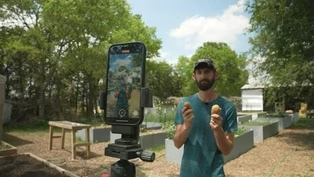
(upbeat music) My name is Noah Young from Kenesaw, Nebraska, and I'm a first generation farmer/rancher.
(upbeat music) And I do social media for a living.
-[Narrator] Millions of people follow the Shiloh Farm on social media for funny educational videos about Noah's farming journey.
- A little bite.
It's like our family tradition.
First strawberry of the year.
We always share it.
Otherwise, we fight over it.
(kids laughing) -[Narrator] This started in 2020 when Noah and his wife, Sierra, decided to turn their small five acre hobby farm into the foundation for what you might call a marketing business.
-[Noah] I wanted to keep education at the forefront of everything, but I also just love entertaining people and making people laugh.
So I think I tried to blend those two together and it just worked.
Just like companies are willing to spend millions of dollars on the Super Bowl commercial to reach millions of eyes.
They can do the same thing by coming to an influencer like myself, who reaches millions of people every month, and we get paid by brands and companies to create advertising products for them.
Oh yeah, tons of drama Llama.
What state y'all from?
Kentucky.
What is your number one ag commodity?
Soybeans.
We sell $1.4 billion worth of soybeans last year.
-[Narrator] Noah also gets paid to be an influencer at events.
Plus gets income from the platforms he posts on.
Depending on the amount of traffic for each video.
-[Noah] There's drama in the garden.
Oh yeah.
-[Narrator] This video about things not to plant together.
778,000 views on TikTok and 438,000 on YouTube in just a week.
-[Noah] You ever wonder how.
-[Narrator] 23 million people saw a video he posted a while ago about seedless watermelons?
- And this odd set of chromosomes will result in the fruit being sterile and not producing any seeds.
Perfect and cut.
It's totally wild.
Like the idea that people from all around the world have seen my face, or the fact that I have more followers than there are people in Nebraska is just wild to me.
It's truly hard to comprehend.
- We're walking around somewhere and they'll come and like whisper to me and be like, "Is your husband the Shiloh Farm guy?"
Like.
Yep.
I mean, you could go talk to him.
He'd love to talk to you.
(upbeat music) - Somebody will stop me at a grocery store and I'd be like, oh my gosh, I love your videos.
Yeah.
There's drama.
-[Sierra] Yeah, it's kind of awkward sometimes when people are like, oh, you guys are big shots.
We're really this is just everyday life for us.
- Oh looks great.
-[Narrator] For Noah, Sierra and their four kids, who are also very involved in the operation.
-[Mike] What do you think of your dad's videos?
- I like them.
- I like them too.
- The roots are all soggy and the plants like, I don't know how to swim.
-[Mike] Is he silly sometimes?
- Yeah, yeah.
-[Narrator] It's a business making choices about what to raise based on what's good for content creation.
- Yep, go ahead and put it in.
-[Narrator] But they also consume and sell their product.
Just as important it allows the young family to spend time and create something together.
Including content.
Noah hopes, is a positive thing for the millions who follow his adventures.
-[Noah] I want them to be feel upbeat and feel like it was worth their time to watch my video, and that they actually walked away from that, either laughing, feeling better, or learning something.
I hope to just inspire people to look at farmers in a different light when they're eating their food in New York City, and they have no idea where it came from.
I'm hoping that whether it's my face or some other farmer that I've introduced them to, I hope they think about the personality behind the plate and what they're eating.
(upbeat music) -[Announcer] Number 13, Neal Mosser!
(crowd cheering) -[Neal] Throughout my like childhood, my dad has always had me around basketball.
He coached for a while.
And then he always had me watching basketball.
And then when I finally got to the age where I had the ball in my hand, I just fell in love with it and kept going.
-[Narrator] Millard North's career three-point leader and single-season free-throw percentage record holder, Neal Mosser grew into an all around talent on the court.
(crowd cheering) -[Stu] He was basically as a freshman, a spot up three-point shooter, but he developed his game.
He rounded it out.
He got better on defense.
He got better attacking the basket.
And I think great-grandpa would be very pleased with that.
-[Narrator] Neal comes from a long lineage of standout basketball players dating back to his great-grandfather, Hall of Fame coach and namesake Neal Mosser.
To say the game is in his blood would be an understatement.
- I wouldn't say there was pressure, but they definitely put the ball in my hand at a early age just to see how I liked it.
It had a huge impact in sharing like these stories of my great-grandpa, and even my grandparents.
It's just the long lineage in our family.
Just hearing these stories makes it even more special.
-[Narrator] In the history of Nebraska high school sports, few coaches, if any, can match the record of developing top tier athletes over a 20 year span like Neal Mosser did.
His style went well beyond just coaching.
(upbeat music) - He's a mentor, he's a teacher, (upbeat music) he's a family man, and a competitor.
-[Stu] Neal Mosser was a coach ahead of his time.
(upbeat music) He coached in an inner city school, was not afraid to break the color line, defended his athletes to the core, and he is one of the legendary coaches in Nebraska high school sports history.
He was a stabilizing factor within the school.
I think he was well respected.
Again, he would defend his kids.
-[Neal] He was all for his team, and he was not gonna let anybody mess with his team, whether it was refs, whether it was other people, whether it was fans, coaches.
Those guys were his dudes, and he wasn't gonna let any anybody get to them.
-[Stu] He was one of those pillars of Tech High that, even though the school closed in the mid-80s, will be remembered forever in Omaha history.
(upbeat music) -[Narrator] Omaha Technical High School, founded in 1923, integrated both academic and vocational training to nearly 3,000 students before closing its doors in 1984.
It was the largest high school ever built in Omaha.
It stretched about two city blocks.
It had first OPS swimming pool, and they had one of the best basketball gyms for seating.
So a lot of the key games are played in the Tech gym.
(movie film clicking) -[Narrator] Bob Gibson, (upbeat music) Bob Boozer, (upbeat music) Ron Boone, (upbeat music) Fred Hare, Joe Williams were just some of the famous names Neal coached.
With all the wins recorded, it didn't come without challenges.
-[Stu] It was the makeup of his team (upbeat music) being most in a inner city setting.
African American Black players, they felt discrimination at times.
They would have issues even going out in the state and finding accommodations at night.
He'd have to vouch sometimes that they were with him (upbeat music) to get hotel rooms.
-[Mitch] Starting five African Americans on a basketball team wasn't something he thought about from a political standpoint.
He was competitive and wanted to win.
-[Stu] The most notorious infamous situation was the '62 state final Lincoln Northeast, Omaha Tech.
There was a charge block call that went against Tech.
(upbeat music) It escalated from there.
There was pandemonium in the gym afterwards.
That played an impact both within the team and within basketball at large for what came the following year and maybe Nebraska's greatest team of all time.
(upbeat music) Tech only lost two games that year.
And they came to state, and the title game was 91-73 over a very good Creighton Prep team.
So it was a relief, maybe some vindication, you know, not only for that '62 team but for all these teams.
-[Mitch] I'm not sure he was out there beating his chest, being an advocate.
He was doing what he thought was right and right for kids and supporting and advocating for student athletes.
-[Neal] He definitely challenged societal norms at that time, so I mean, just that shows the type of person he was.
I think what he would, if he was sitting here today, his biggest achievement was he loved his wife.
Very family oriented.
He would dote on his four sons and very proud of the fact that they all graduated from college and all became educators.
-[Narrator] He'd also be proud of his great grandson and his accomplishments in high school.
From playing in four straight title games to winning two of them, the younger Neal continues to be thankful for his opportunities and for his connection to Nebraska high school history.
-[Neal] It was great.
My first year, I didn't know really what to expect with a loaded team behind a lot of talent.
I got to learn from those older guys.
Won the state championship.
It was great.
And then we just kept going back, and it just kept becoming more special to me as I started playing more and building different relationships with different teammates.
But every single team we had something special that the last team didn't, so it was fun.
-[Announcer] Long three by Mosser.
Makes it dead on.
-Big shot by Mosser.
-Really big shot.
(crowd cheering) (upbeat music) (upbeat music) -(cornstalks rustling) -(bangboard thumps) - [Narrator] It's a beautiful September Saturday in Nebraska, and these huskers are preparing to take to the field, but they won't be slinging pig skin at Memorial Stadium.
These fierce competitors are going old school in a battle of the bangboards at the annual Nebraska State Hand Cornhusking Contest.
- [Duane] Well, somebody said there's gonna be a corn pickin' contest today, and I thought I'd join the crowd.
- [Narrator] Today's crowd is a bit smaller than during the heyday of corn picking contests.
The 1936 National Championship in Ohio drew about 160,000 people.
At the time, it was considered the fastest-growing sport in the US.
Sherman Henriksen of rural Lincoln took home Nebraska's first national title, husking 38 bushels of corn in 1933.
(corn stalks rustling) -[Harrison] I'm a fairly competitive person, and something like this, it's not super difficult, but it's pretty fun.
Like, once you really get into it, it's a pretty fun sport, I guess.
(guitar music) (wagon clatters) - [Narrator] Before farming became mechanized, shucking corn by hand and pitching ears into horse-drawn wagons was how harvesting was done.
(guitar music) (bangboard thumps) - Whoa, whoa.
- [Duane] I grew up pickin' a load of corn with my dad every morning before school.
Oh, yes, I know what corn pickin' is.
(guitar music) (corn stalks rustling) You wanna keep your eyes on the ears of corn ahead of ya.
You never look at the wagon because your ears will tell you if the ear hits the bangboard.
(bangboard thumps) And the way you do it, you pick it.
You get it like this, (guitar music) and you don't throw it like this.
You flip it.
-(corn rustling) -(bangboard thumping) - [Paul] The big thing was 100 bushel a day.
"Boy, I'd like to get 100 bushel a day."
And I did it once, only once.
(guitar music) I was young.
But I think it might've been a little bit dark almost when I went out there and it was probably dark when I quit.
(guitar music) - [Narrator] Nebraska is one of nine states still holding cornhusking contests.
And it is a timed event.
Depending on the class a picker is in, they can husk anywhere from 10 to 30 minutes.
-- [Judge] Cut.
-Three, two, one, go!
-[Narrator] The person who picks the most weight of husk-free corn wins.
And there's quite a process involved in deciding the winner.
-(leaves rustling) -Nice.
-(bangboard thumps) -Whoo!
(corn rumbling) - [Patti] They empty the wagons into the big metal tubs.
They weigh the metal tubs.
(machinery running) And any gleanings that are in the bags they forgot to pick or they miss the wagon, those count against them also.
And so you take the gross weight and you minus the ounces of the husk and the minus the pounds of the ears, and that's what they have for the day.
(fiddles play "Star Spangled Banner") (violins play "Star Spangled Banner") - [Narrator] Gothenburg and Holdredge have hosted the contest in the past, but it's found a permanent home at the Stuhr Museum in Grand Island.
-[Announcer] The event is important, certainly for the competitors, and we are very grateful for the competitors that are here.
All of you should be very proud because right here where you stand in this state is how we taught the world how to feed itself.
(upbeat country music) - [Narrator] Taking on the State Hand Cornhusking Contest presented some unexpected challenges to the Stuhr Museum.
-[Chris] This event was in jeopardy of just falling off the face of the state, so to speak, and not being held.
We didn't have some of the resources that we needed.
So we partnered with several folks and they came in strong and we were able to do it.
-[Bryan] Some of our growers helped us with the ground prep to get it ready for planting.
The horse teams came in and broke all the sod and the prairie grass.
(chains jingling) I'd always loved farming and being around agriculture.
It's just a passion that I've always had.
And I felt like with the last name of Corn, I kind of had to do something in ag, so it was just a perfect fit.
(country music) -[Chris] We do living history at Stuhr Museum.
That's what we're known for.
And if this isn't living history, I don't know what is.
I mean, it's modern-day interpretation of something that's happened a hundred years ago.
(corn stalks rustling) From a historical perspective, I desperately wanted this to happen here.
(corn stalk rustling) - [Narrator] And happen, it did.
(upbeat country music) -[Brynn] I got first.
(clicking sounds) I think I got 18 ears, I think.
I think so.
(distant chatter) (corn rustling) -[Harrison] I picked 260 pounds of corn in 30 minutes.
And then I placed third out of three, but I was pretty close for second, so.
And they're both previous national champions.
So I felt like I did okay.
- [Duane] I was tardy once in 13 years and never absent, so.
(guitar music) I made sure I went to school so I didn't have to pick corn all day.
(companion laughs) -[Patti] Dwayne Frazier, he had a gross weight of 39 pounds.
He had 0.5 ounces of husks against him, and he had 3.2 pounds of ears against him.
- [Harrison] I think history is kind of a big part of our world.
(guitar music) Our generation is really straying away from the old techniques and manual labor.
And I think it's fun to look back and see how the older generations used to farm this land and make their money.
(guitar music) (guitar music) (upbeat music) (upbeat music) - [Narrator] Watch more Nebraska stories on our website, Facebook and YouTube.
Nebraska Stories is funded in part by the Margaret and Martha Thomas Foundation, and the Bill Harris and Mary Sue Hormel Harris Fund for the presentation of cultural programming.
(upbeat music) (upbeat music) (upbeat music) (upbeat music)
Video has Closed Captions
Clip: S17 Ep2 | 9m 7s | Dowsing rods reveal a buried past. (9m 7s)
Video has Closed Captions
Clip: S17 Ep2 | 4m 25s | This Nebraska farmer is growing a crop of followers (4m 25s)
Providing Support for PBS.org
Learn Moreabout PBS online sponsorship















Support for PBS provided by:
Nebraska Stories is a local public television program presented by Nebraska Public Media