Prairie Yard & Garden
The Family Haven
Season 35 Episode 13 | 28m 45sVideo has Closed Captions
Jodi and Jesse Hughes have created a special haven for friends and family to enjoy.
Jodi and Jesse Hughes have created a special haven for themselves, friends, and family to enjoy. They have raised vegetable beds for their garden produce, a lovely water feature that enhances their peaceful landscaping, wooded trails for ATV recreation and their very own schoolhouse for entertaining.
Problems playing video? | Closed Captioning Feedback
Problems playing video? | Closed Captioning Feedback
Prairie Yard & Garden is a local public television program presented by Pioneer PBS
Production sponsorship is provided by Shalom Hill Farm, Heartland Motor Company, North Dakota State University, Friends of Prairie Yard & Garden, and viewers like you.
Support provided by:


Prairie Yard & Garden
The Family Haven
Season 35 Episode 13 | 28m 45sVideo has Closed Captions
Jodi and Jesse Hughes have created a special haven for themselves, friends, and family to enjoy. They have raised vegetable beds for their garden produce, a lovely water feature that enhances their peaceful landscaping, wooded trails for ATV recreation and their very own schoolhouse for entertaining.
Problems playing video? | Closed Captioning Feedback
How to Watch Prairie Yard & Garden
Prairie Yard & Garden is available to stream on pbs.org and the free PBS App, available on iPhone, Apple TV, Android TV, Android smartphones, Amazon Fire TV, Amazon Fire Tablet, Roku, Samsung Smart TV, and Vizio.
Buy Now

Visit the Prairie Yard & Garden Website
Do you love gardening? Consider becoming a friend of Prairie Yard & Garden to support this show and receive gifts with your contribution. Visit the link below to do so or visit pioneer.org/donate.Providing Support for PBS.org
Learn Moreabout PBS online sponsorship(bright music) - I have mentioned before how great it is when people contact me with show ideas.
Last fall, I had a phone call from a lady who said her neighbor has a beautiful yard that we should consider for a show.
She gave me the name and contact information for Jodi and Jesse Hughes who have made their yard into a family haven for fun and relaxation.
I'm Mary Holm, host of Prairie, Yard and Garden, and let's all go explore this special yard together.
- [Announcer] Funding for Prairie, Yard and Garden is provided by Heartland Motor Company, providing service to Minnesota and the Dakotas for over 30 years in the heart of truck country.
Heartland Motor Company, we have your best interest at heart.
Farmer's Mutual Telephone Company and Federated Telephone Cooperative, proud to be powering Acira, pioneers in bringing state of the art technology to our rural communities.
Mark and Margaret Yackel-Juleen in honor of Shalom Hill Farm, a nonprofit rural education retreat center in a beautiful prairie setting near Windham, Minnesota.
And by friends of Prairie Yard, and Garden, a community of supporters like you who engage in the long term growth of the series.
To become a friend of Prairie, Yard and Garden visit pioneer.org/pyg.
(upbeat, happy acoustic guitar and piano music) - My dictionary defines the word haven as a place that provides favorable conditions.
Oftentimes, families get so busy with both parents working outside of the home, and children involved with school and community activities that we need a haven in our yards to rest, relax, and have fun.
I am so glad that when I called Jodi, and asked if we could come and enjoy their haven, she said, "Sure."
Thanks, Jodi, for letting us come to visit.
- Thank you for stopping by.
- How long have you lived here?
- I have lived here about 19 years.
But my husband was born and raised here.
- [Mary] What was it like when you came?
- [Jodi] (chuckles) Well, it was definitely the old time kind of country home.
And it was white with red trim and the red roof.
And so slowly over the years, we've redone the inside and the outside, and most of it, we did ourselves.
- [Mary] Where did you start with the planting?
- We had it where the water feature was kind of just a little kidney bean shaped thing that just had a few plants in there.
We got at this idea that we wanted a water feature.
We love the sound of water.
We don't have a lot around the farm place, and so, like you said, you named it, the haven.
We wanted to make one for ourselves here.
- Did you get professional help to design the planting area, or did you just experiment?
(Jodi laughs) How did you do it?
- Well, I did have one gal kind of help me with kind of the flow of the walkway.
But all the plants we've put in there, either from people give them to us, or we'll go to the schools that have the plant sales.
And then we'll plop them in, and they'll get three times bigger than we thought they would be.
And they'd be right up front.
You're like, okay, that has to be moved in the fall.
Yeah, it's a lot of trial and error, but a lot of the plants came from friends.
We're getting them on sale.
We found out though that sometimes you get what you pay for.
You have to be careful, especially like with trees.
We found that you really do need to find a reputable place for those, because they're gonna be in your yard for a very long time, and you wanna make sure they're healthy.
- Were there a lot of mature trees when you came, or have you planted a lot since you've come?
- The line behind you was here when we first got, when I got here.
It wasn't here when Jesse was first born, but his mom planted that in there.
And we had a lot of Ash trees, and they were very mature and very beautiful.
But every time a storm came by we were losing branches.
When we put on the addition, then we had to take a few of them down, But we made sure that we've been planting since year one that I moved here.
We've been, oh my gosh.
I wish we counted how many trees we've put into this place.
- [Mary] Well, it seems like you have a lot of shade here.
So do you have, are the plants that you buy a lot geared towards shade?
- [Jodi] Yes.
Most of them, mainly because I like Hostas.
I like plants that stay in one spot.
I don't like the ones that, I mean, I love seeing them at other people's places, but I don't like taking care of like, daisies, that take off, or lavender.
They're beautiful, but I like the container type things, and Hostas are just, they're great for that.
And they're easy to just cut off in the fall.
They're low maintenance.
- [Mary] Then you also added the water feature?
- [Jodi] Yes.
That was a couple of kids helping us out.
And Jesse doing that whole thing and a tractor lifting.
The boulders are only as big as the tractor could carry.
- [Mary] (laughs) How did you decide on the shape, and the style of the water feature?
- [Jodi] Well, everything around here is really flat, so we couldn't really build it up too high, or else it wouldn't look natural to the setting.
So it's only probably up about two or three feet.
And we just made a, we bought a kit online with a big, huge rubber membrane.
And then we landscaped around it, and we put in all the rocks.
When the guy came to pour the cement he said, "There's not one straight line here anywhere."
And I go, "But there's none in nature, either."
So I really thought that was a compliment.
(chuckles) - [Mary] Now your water feature doesn't have a pond area.
Was that intentional?
- [Jodi] Yes.
For two reasons.
One, we have a one year old grandson.
I just hear horror stories about ponds.
And the other thing was, that I don't wanna clean a pond, and we didn't really want fish.
So we thought it'd just be easier if it just went into the rocks and then was recirculated up around again.
- What do you have to do with the pond in the fall to get it ready for winter?
- My husband takes out the pump, and then we just kind of blow all the leaves out of there and everything.
It's really easy.
I was down my uncle's place in Omaha.
He has a water feature and he tests the pH.
He does this and that and everything.
I was like, and has filters.
And yeah, we don't do that.
(water gurgling) We just take the pump out, put it back in.
- Then how early in the season, can you start using that?
- As soon as the ice is out of the pump house, 'cause it usually fills up with water, and it's a big block of ice.
And so when that's gone, then Jesse can put the pump back in and we can start it up.
- [Mary] Jodi, did you install lighting here too?
- Well, it's just it, yes.
It's above ground lighting though.
We didn't put in any special electrical things except for one outlet that we run everything from.
And we started off with just little solar lights.
And then we wanted that outlet for Christmas lights, so we could put your Christmas lights out.
But one of them that we had was the red and green star shower.
And we had it in the summertime.
You know how you don't always pick up all your Christmas stuff, you know, after Christmas.
So we had it out and it is actually really pretty up into the trees at nighttime when you're sitting by the bonfire and the water feature is running.
And you just see these little green speckles in the trees and when the wind blows, it kind of looks like fire flies up there.
So we did that and we have a couple of lighting in the water feature itself.
And if you put the lights under the water, then the light that they cast will be wavy, instead of just a bright spotlight.
So we we've tried to do that too.
But otherwise most of it's done with solar lighting.
- [Mary] Were the lights difficult to install?
- The solar lights are just one that you buy from the stores and you just put into the ground, So those are really easy.
And I place them, as plants grow, I move them, so that they get better visibility.
The ones in the water, no.
You just do it at nighttime, and place them where you think you kind of get the best effect.
Same with the star showers.
You just plug them in and, and face them where you want.
So it is very easy.
- What do you use this beautiful area for now?
- Oh, most of the time having company over.
We'll sit out here at a bonfire and listen to the water, turn off the yard light and just look up at all the stars and everything.
I think it's every time Jesse's family comes up here, this is where we end up gathering.
'Cause there's a lot of space for everybody to sit around and just hang out.
- [Mary] And do you have other areas too, that you use for your family?
- [Jodi] Yes.
We love ATVs.
And so we cut a path into the wind break.
And then we also have a raised bed vegetable garden.
- [Mary] Can we go see those?
- [Jodi] Yes, definitely.
(gentle acoustic guitar music) - The smell of pancakes and waffles in the morning is unmistakable, but it's the maple syrup that makes breakfast something special.
Maple syrup is more than a breakfast treat.
You can use it for a variety of scrumptious dishes like maple baked beans, a delectable glaze for salmon, or as a sweetener in salad dressing.
You can even use maple syrup as a substitute for sugar in many desserts.
While many people think of Vermont for maple syrup, some of the best syrup in the country is produced right here in Minnesota.
You can find many delicious brands at your local farmer's market.
I'm joined by Carol Johnson who is going to teach us how to make a maple custard that you can serve during the holidays.
Or any special day when a sweet treat will finish the meal on the right note.
Carol, there are so many choices for maple syrup if you go to the store, but why is it good to use local syrup?
- Because our climate and our soil type make delicious maple syrup.
The recipe is real easy.
You just need these five ingredients, maple syrup, cream, vanilla, salt, eggs.
Mix that put it in a ramekin.
And then the ramekins are put in a bath of hot water and baked.
- Carol is this custard something we eat alone, or can we use it for something else?
- It has several other uses.
Like you can use it as filling in a cake.
You can use it in a pie, but it certainly is good eating alone, also.
- And for this recipe and more information on Minnesota maple syrup go to minnesotagrown.com.
There you'll find a host of local producers where you can get some of the most delicious syrup in the whole country.
(gentle acoustic guitar music) - [Jodi] Well, Mary, these are our raised beds.
- [Mary] And then do you grow most of your vegetables in these raised beds?
- [Jodi] Yes, except for the viney things.
They go down on the ground over behind the beds.
- [Mary] Why did you decide to use raised beds?
- (chuckles) Well, I get tired of picking weeds, bending over to pull weeds and bending over to look for beans and everything like that.
Usually around August, I would just mow over the whole thing, because I got tired of it.
And so my husband, for Mother's Day, made me a set so that they're the right height, so I can sit there and pick the weeds right out of them, and I have no more excuses.
- [Mary] What did you use to build the beds?
- [Jodi] Well, this is our second set of beds.
We had another one that it wasn't quite as heavy duty, and we found out that soil is heavier than we thought.
And so a few planks would start falling down, and yeah, they lasted about three years.
And so my husband and the kids made really heavy duty ones out of these, and they're much more supported underneath.
And I try with my soil to put vermiculite and pearlite in it.
It can add aeration, but also not be as heavy into these beds.
- [Mary] I noticed that there seems to be a plastic liner on here too.
Why is that?
- [Jodi] I didn't want the water and the soil to corrode the wood.
So I have them on the sides, and then we have the weed mat that water actually goes through on the bottom.
So then I also know when I'm done watering, I'll see water trickling out the bottom.
So I know they're saturated, or you know, they have a good water supply, then.
- That's what my next question was gonna be is how do you water?
- Well, we did try with the soaker hoses and that was fun.
They worked great.
You turn them on and the hoses would just water everything.
But putting them away for winter, taking them back out in the spring, and we have a lot of rust in our water that we kind of get in there.
So we just went back to, let's put a sprinkler out.
- [Mary] I noticed that underneath here you have some stone pads.
Is that to help keep them from sinking?
- [Jodi] Yes, yes, because when you have, like I said, these get really heavy.
And when you only have a four by four area going onto the soil they do start sinking.
So we put the stone underneath.
So wherever my husband mows, I go back with a rake and rake it all up, and throw it on top of here, and it's my cheap mulch.
There's not a lot left by the end of the season, and it just gets tilled in.
I would like to be more like a no-till gardener, but I'm not there yet.
What we do here is the next spring we'll add more compost, and maybe a little bit of Miracle Gro.
And then I just take a trowel and my hands and start, it's fun playing in the soil in the beginning of spring, you know, and just mix it all up.
- [Mary] How do you fertilize the beds?
- In the spring I'll add the compost and the Miracle Gro.
And sometimes during the season, if they're looking a little peaked I'll add some more.
The one problem with adding the mulch from the grass is it has weed seed in it.
So it does, but I mean, really all I do is this, and it's gone.
(laughs) It's pretty easy.
It's actually kind of getting away from everything, come out here and just pull a few weeds.
- [Mary] Are there some plants that do better than others in the raised beds?
- [Jodi] Yes, I don't put potatoes up here.
And there's certain ones, like the vines, so cantaloupe, and watermelons, and things like that I'll go put over there.
- Do you have any trouble with critters since it's a raised bed?
- Well, since our dog has gotten older, we now have deer around here.
And so we have a mama deer and her fawn, and she thought that the broccoli cauliflower tasted really good, and totally nipped them to the bud.
So a friend of mine, who is also a master gardener told me to put in Irish Spring, and to cut it up into bigger chunks.
If it's smaller chunks then the water will, as it rains it will disintegrate faster.
So I guess something about the smell they don't like.
And so I put those around.
And then I also put, I went online, and it said coyote urine.
It's not as smelly as you think it would be.
(chuckles) And it's in granules, and I just kind of sprinkle it around.
But now that they're bigger she hasn't done any damage to the garden at all.
And as a scientist, I should have only tried one, to see which one was working.
I don't want to wait 'til the middle of the season to figure it out, so I just put them both out.
- At the end of the year, do you do anything special for the fall or for overwintering here?
- I try to leave as much of these stalks and leaves on the top.
I don't kill out any of the ants that are there.
The weeds, by the end of the season I'll let them grow, because the roots are really good at structuring the soil.
And they add a lot of microbiology to the soil.
So I try to not really touch it in the fall and winter.
Then in spring then I dig them up and start again.
That's why I said, I'd like to try no-till, but just not there yet.
Another reason why I leave my residue on the surface overwinter, is so that I can remember where I planted things.
Because I want to rotate what plants I put in there.
I know that I need to rotate through these beds, and I've seen a lot better results when I do that.
- [Mary] Because they're raised beds, do these warm up faster than the ground?
- [Jodi] That's a good question.
I would think they would, but I've never stuck a thermometer in to find out.
I'm a soil scientist, I should try that.
- [Mary] (chuckles) How early do you usually plant your beds?
- [Jodi] Some people start everything inside like their peas and stuff.
And I'm more of a casual gardener, a hobbyist.
So I will come out here around Mother's Day, a little after Mother's Day.
So for a present my husband and the kids take me out to buy all my plants and everything.
And that's when we plant them.
But this year, that was a little early.
And so I had to replant.
And then the deer came by, and I had to replant again.
(laughs) Jesse helps me with getting them ready, like putting the compost in and more vermiculite, and just kind of lightening up the soil and getting it ready.
But the rest of it I do myself.
He has another 20 acres he has to take care of.
(easy going jazzy piano music) - I have a question.
I love orchids.
Are orchids native to Minnesota?
- That's a good question.
There are orchids native to Minnesota.
Most people don't even realize that.
The state flower, Showy Lady Slipper is in fact, an orchid.
And we have several Lady Slippers in the state that are native.
We have about 46 species in Minnesota that are native.
Most people don't know we have orchids, because most orchids are really hard to find.
A lot of orchids are really rare.
And a lot of the orchids we do have in Minnesota are very hard to get to.
They're in very interesting landscapes.
Here at the arboretum we're working on conservation.
We'd like to bring orchids to the arboretum, a lot of these native orchids to arboretum to show people that they don't have to try and get out there to these hard places to see orchids.
But also, to show them that we're doing conservation work.
Because there are a lot of rare orchids, we're interested in banking seed, and conserving the genetics, and just the beauty of these native species.
And so the reason why they're so hard to find, there's actually multiple reasons why they're hard to find.
It really depends on the species.
Some are hard to find, because they're just really rare.
Even if you find a population of them, there may be just one or two flowering plants in the whole landscape and that's it.
So you have to track down one plant.
And you can see how dense the vegetation is in a bog.
Trying to find a single flowering plant is gonna be tricky.
Another reason why some orchids are hard to find is the flowers are green in some orchids.
And so you're looking for a green flower, on a green plant in a green background, which makes it hard to find too.
And some orchid flowers are tiny, tiny, tiny, only about a millimeter long.
So they are just very hard find.
- [Announcer] Ask the Arboretum experts has been brought to you by the Minnesota Landscape Arboretum in Chaska, dedicated to enriching lives through the appreciation and knowledge of plants.
(easy going jazzy lounge piano music) - So what we did here, this is the old part of our Grove that's been here for many years.
And behind us or ahead of us here we have an area that we replanted only 10 years ago, with some Elm, as well as seedless Cottonwood, some evergreens.
So it's kind of a work in progress.
We've cut some trails here through the woods.
And the kids on the ATVs really like cutting through the old part of the woods, especially, you get at night, they're out running around a little bit and have really enjoyed it.
It's all, like I say, a work in progress.
We've been planting trees for many years, and it's really turned out well.
We just kinda made a path, you know, kind of set out where we wanted to not take down any big trees.
So just, just cutting some brush, you know, flush cutting to the small trees with the chainsaw and clearing out trails just wide enough for the ATV.
Then as the years went by now, we have a UTV, so we widened a little bit.
So we have it wide enough to go through here with the ranger.
- [Mary] How far does the trail go?
- [Jesse] We have a couple of short ones here through the old part of the woods.
And then we also mow paths through the wind break that surrounds the property as well with the tractor and mower.
So we got another path to kind go around the outside of the farm as well.
- How do you keep it up?
I mean, do you have to do a lot of clean up in the spring after the winter?
- It's not too bad, we do.
There are a few brand will come down over the winter, and then clean them up.
And then otherwise just mowing a couple times a year.
Now we're trying to keep as much natural habitat out here as we can.
We even have a doe out here with a little fawn.
So we we're trying to, like I say, keep it as natural as we can without disturbing too much.
But just a little bit of mowing, and some picking up branches now keeps it maintained pretty well.
Now that, of course, they get older, and a little aren't around quite as much as they were when they were younger.
Now, Jodi and I will take the ranger out, and especially you get to this time of the evening, or sunset and do a little drive through here.
(UTV rumbling) - [Mary] Well, I'm sure that that is just a fun thing to do in the evenings or on a weekend, and kind of nice to get away from your job, too.
- It is, it is.
Like you say, it's kind of a haven.
And we like it that way, where we can enjoy our time here.
Like you say, away from the job and out in the country.
(bright, happy acoustic guitar and piano music) - Janice, how was the schoolhouse added to the yard and why?
- Well, my mother went to this school in the '20s, in the 1920s.
And, you know, they closed the country schools in the '70s.
So then it sat there.
And I lived on this farm with my kids and I thought, "Oh, I really think I should try and get that school."
They were selling the land.
So I talked to the owners and I said, "Would you wanna sell me that school?"
'Cause they would've destroyed it.
And they said, "Yes."
So I moved it home and I was all excited, because it was my mother's old school house.
So then I got the bright idea, like in antiques, like my mother did and my dad, I thought, okay, I'll have country school antiques.
So I started looking for antiques in flea markets and auctions and wherever, 'til I got a pretty much filled with antiques.
So that was my fun, kind of a at home hobby.
- [Mary] So was it in pretty good shape, or did you have to do a lot of remodeling?
- [Janice] Some, put a new roof on it, and it's been painted, so it was so much fun.
But 10 years I sold antiques out of it for 10 years.
- [Mary] How did you move this big building?
- Well, I had to hire some professional movers, you know, to move it.
And we got the foundation built first, of course.
And it wasn't as hard as I thought, 'cause it was only three miles from here.
It wasn't very far to move.
So anyway, it just worked out so slick.
It really did.
Yeah.
- [Mary] So do you have people that actually stop in and say "I went to school here?"
- [Janice] Oh, yes, yes, my son has!
Yes, yes.
When I lived here, too, they will say that, yes.
And this is a district 21 in Westbank Township.
And a lot of people, claim it's so close to the road, they see it.
I'm sure too.
I don't know if they stop as much now as they did at first, you know.
But yeah, it's been a fun thing I think for a lot of people.
- [Mary] And I bet people are so happy that it was preserved.
- [Janice] I think so too, because it's really a historic building.
It really is.
Yeah.
It's part of our history, you know, the country school.
- [Mary] Now tell us what is the school used for now?
- [Janice] Being it's a family who lives here.
It's just for the kids have fun in it.
And my son I think has a pool table in there, and it's kind of a recreation when we have family gatherings, the kids just love it.
And of course, they like to ring the bell.
But it's just fun.
It's just a fun thing now.
And I'm glad because it's being used for something.
- [Mary] So does the building have heat and electricity, too?
- [Janice] Oh yes it does.
It has.
It had a little parlor stove, and it had electricity, but on every window you could see where they would hang the kerosene lamps.
- [Mary] And what is it used for now?
- [Janice] That's probably the same thing for the family gatherings.
Kids come and play, they run in and out and they love to ring the bell.
It's like a playhouse, kind of, you know.
- Okay.
- [Janice] And they had stoves, of course.
And then I've heard some stories that probably the kids would warm their lunch on the stove.
Sit their sandwich or whatever on the stove, in the school and warm them, so I don't know.
Then they had a big water cooler, but they must have had wells at the school, because that water cooler sat in the entryway with a little spigot on it.
And I think it was made out of a crock stoneware, and then they'd get their water out of that.
But I'm sure they must have had a well, or they wouldn't have had water, you know.
- [Mary] Having the warming the lunch up on the stove gives a whole new meaning to hot lunch, doesn't it?
(laughs) - [Janice] Yeah.
There you go, right.
- [Mary] So what did they use for light then?
- Well, like you see, if you look around, you'll see there's a lot of windows for natural light.
And then they also had the small kerosene lamps that kind of would turn on, you know, a holder that would hold them that they'd light if they needed light.
But unless they had a party at night, and a program for the parents, then they would probably turn on the electric lights.
And also most of them had a piano, because I think a lot of the teachers probably knew how to play the piano.
Because I know a lot of them would have a piano too, so they could have a little music.
And I don't know if the teacher taught piano.
She probably didn't, but she could have.
She could have taught piano too.
We don't know that.
- [Mary] Did they have like Christmas programs, and holiday programs too?
- Yes, Christmas, the kids would dress up, put on a little play and all of us mothers, see I was a mother and my daughter and my son were there.
We'd bring some bars and they'd have a little lunch after.
And they'd always is put on programs for the parents on special occasions, yeah, they would.
- [Mary] Well, thank you so much for showing us your school.
This was so nice.
- Well, you're welcome, Mary.
I enjoyed having you here.
I really did.
This is one of the best parts, and the most fun of the school, is of course ringing the bell.
(bell gongs) - [Announcer] Funding for Prairie, Yard and Garden is provided by Heartland Motor Company, providing service to Minnesota and the Dakotas for over 30 years in the heart of truck country, Heartland Motor Company, we have your best interest at heart.
Farmers Mutual Telephone Company and Federated Telephone Cooperative, proud to be powering Acira pioneers in bringing state-of-the-art technology to our rural communities, Mark and Margaret Yackel-Juleen in honor of Shalom Hill Farm, a nonprofit rural education retreat center in a beautiful prairie setting near Windham, Minnesota, And by friends of Prairie, Yard and Garden, a community of supporters like you who engage in the long term growth of the series.
To become a friend of Prairie, Yard and Garden visit pioneer.org/pyg.
(bright and happy piano music)
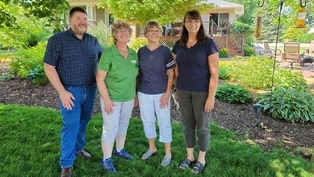
Preview: S35 Ep13 | 29s | Jodi and Jesse Hughes have created a special haven for friends, and family to enjoy. (29s)
Providing Support for PBS.org
Learn Moreabout PBS online sponsorship

- Home and How To

Hit the road in a classic car for a tour through Great Britain with two antiques experts.












Support for PBS provided by:
Prairie Yard & Garden is a local public television program presented by Pioneer PBS
Production sponsorship is provided by Shalom Hill Farm, Heartland Motor Company, North Dakota State University, Friends of Prairie Yard & Garden, and viewers like you.