
The Fight to End Oil Drilling in Los Angeles
Season 7 Episode 3 | 25m 36sVideo has Closed Captions
South L.A. fights urban oil drilling as one former site becomes housing and green space.
Los Angeles sits atop the largest urban oil field in the world, with dozens of wells located near homes and schools. Supported by growing scientific research, South L.A. residents have pushed back against oil drilling linked to serious environmental and health risks. This episode highlights one hard-won victory while examining what it takes to address L.A.’s broader oil legacy.
Problems playing video? | Closed Captioning Feedback
Problems playing video? | Closed Captioning Feedback
Earth Focus is a local public television program presented by PBS SoCal
The Fight to End Oil Drilling in Los Angeles
Season 7 Episode 3 | 25m 36sVideo has Closed Captions
Los Angeles sits atop the largest urban oil field in the world, with dozens of wells located near homes and schools. Supported by growing scientific research, South L.A. residents have pushed back against oil drilling linked to serious environmental and health risks. This episode highlights one hard-won victory while examining what it takes to address L.A.’s broader oil legacy.
Problems playing video? | Closed Captioning Feedback
Where to Watch Earth Focus
Earth Focus is available to stream on pbs.org and the PBS app.
Providing Support for PBS.org
Learn Moreabout PBS online sponsorship-Nearly half a million Angelenos live within a half a mile of an oil well, as Los Angeles continues to be the largest urban oil field in the country.
-This is the photo of us, youth.
We were 14 to 17-year-olds, and our lawyer, and we were suing the city of Los Angeles for environmental racism in violation of the California Environmental Quality Act.
-LA County has backed off from oil drilling and is beginning to decommission old oil wells and ban new ones.
Communities are still experiencing the negative health effects of being in close proximity to oil drilling, but they are finding solutions to a healthier future.
[music] -Los Angeles was built on oil, both physically and economically.
By the mid-1920s, it had become one of the largest oil-exporting regions in the world.
-I've lived in South LA long enough to know that I need to be very alert to and wary of these innocuous notices that come in the mail from the city planning department.
We received a notice that the oil company was planning to drill three new wells.
Some neighbors and I, we purpose to go door to door and just talk with every neighbor to make sure that they were aware of the expansion that was being planned and to listen about how the oil drill site was impacting them.
The stories we heard were incredible.
Ms.
Kuse shared about how she was sprayed with oil as she was out watering her lawn.
Sunny, who lived next door to the drill site, shared how closed windows could not keep the diesel exhaust and petroleum fumes out of his two-year-old daughter's bedroom.
For fear for her health, he and his wife were planning to leave the neighborhood.
I met with Oscar, who shared how just the deafening din of thousands of feet of pipe being driven into the ground had robbed residents of the peaceful enjoyment of their home.
We began to connect those dots and just realized this facility, which we were never very fond of, as you can imagine, was having an enormous impact on our neighborhood.
[music] -In 1900, the population of Greater LA was a few hundred thousand, and in the 19-teens and '20s really begins to take off.
By the time we get to the '50s and '60s, there are many millions of people living in LA, and many of the neighborhoods that are in and around oil fields are established already.
-I think in those early days, there was this interesting push-pull where some residents wanted the activity because they could actually profit from it.
That was before there was really an understanding of some of the health impacts.
Also, I think when there wasn't a lot of regulation and when there wasn't a lot of understanding about very safe ways to operate, when you'd have spills and explosions and things like that.
As we started to go further into the LA history, that's when you start really seeing some policy decisions that I think really led to the landscape that we have right now.
What we have in LA is a situation where we have neighborhoods that tend to have more people of color and minorities.
You started seeing things like redlining, where certain neighborhoods were deemed less attractive or less valuable or less deserving of home loans.
Also, racially based covenants, which excluded people on the basis of race from buying homes in certain areas.
There have been studies now that show that there is a correlation between those neighborhoods and oil drilling activity.
-The first oil well in Southern California was a tunnel that was dug horizontally into Sulphur Mountain.
There, they could see oil seeping out of the mountain, so they literally just dug a tunnel to follow it.
A few years later, in 1892, Edward Doheny was driving his wagon through downtown LA and realized there was tar on the wheels.
Doheny was the first to use what at the time was modern drilling technology.
They sharpened the end of a tree trunk and used that as their drilling apparatus to dig a hole that was several hundred feet deep.
They managed to puncture one of these reservoirs, and oil came flowing up out of it.
That was really the first commercially successful oil well in the LA area.
Once the Doheny well was shown to be productive, everyone with a piece of property nearby realized they could also drill a well.
What followed was this mad rush to drill holes to try and get in on the action before your neighbor drilled a well and drained because they're all tapping the same reservoir.
There's this rapid rush to tap the reservoir and have everyone get rich.
I don't think there is a recognition of how harmful it could be to humans.
It was quite useful as a fuel for weatherproofing and so on.
I think the recognition that it was also toxic came about decades later.
By the time we appreciate the dangers of oil to humans, the LA oil fields are fully developed, and we have people living around and amongst them throughout the basin.
At that point, it's probably hard to reverse course.
This is a graph of the population of LA through time.
You can see it really starts to take off after 1900 in the teens and '20s.
Of course, this is the same time that oil fields of Los Angeles basin were being developed.
A lot of this population growth was related to the booming oil field business in Los Angeles.
An oil field consists of many wells drilled into that reservoir to extract the oil.
Generally, when we close an oil field, that involves ensuring that all of those holes that we've poked into the ground are sealed so that oil can't seep out on its own.
That involves pumping cement down all of the wells to make sure they're tightly sealed.
This was the first field that was developed by Doheny.
Here's Dodger Stadium for reference.
The red color shows you roughly where the oil deposit is located, and the black dots show you all of the individual wells that have been drilled over time.
You're really struck by not only how many there are, but how dense they are.
It must have looked like a forest of oil derricks back in the heyday of exploration.
Today, virtually all of those wells are closed.
Only a single well is still producing oil from the Los Angeles field, that's shown here in the blue arrow.
-Working-class communities were initially supportive of the industry because it promised jobs.
As they started to witness oil spills and explosions in their neighborhoods, along with long-term damage to land, water, and human health, they started to push back.
-In the early 1960s, the oil company demolished all the homes that were here to make way for this oil drill site.
In 2000, the oil company went to the city of Los Angeles and said, "We want to rehab these properties, turn them into dense, multifamily housing."
For decades, the oil company would park tanker trucks here, less than 10 feet from homes.
These tanker trucks, they would deploy thousands of gallons of acid.
They'd pump it into the ground, dissolving the geology, creating pathways to bring oil to the surface.
Meanwhile, those ambient fumes would kill plants right outside the drill site.
Residents lived here.
Their homes were sprayed with oil, and many times, the oil company had to repaint their homes.
Neighbors on every side had toxic impacts from this facility.
-This drill site is wide open.
There's not monitoring here.
-Despite 250 complaints, many health-related to government agencies, the oil site remained open until four EPA inspectors felt ill and experienced severe headaches during an inspection.
That's where this story takes another turn.
It appears this site, and nearly all the other ones in LA, haven't been subjected to an environmental impact report in nearly 30 years.
-We can think about the health effects from living by urban oil wells in two big categories.
One is acute effects that you may experience.
This can be going outside and getting a headache, feeling dizzy, or having an asthmatic episode.
Also, coughing and wheezing, elevated blood pressure are different types of short-term health impacts that communities have been experiencing that live near these sites.
Then we can also think about chronic impacts, long-term increases in your risk for hypertension or heart disease, more asthma hospitalizations.
Then we also have seen higher risk of cancer.
We see linkages between your proximity to oil and gas wells and the risk that a child may develop cancer.
-The building here in the back is the apartment building that I grew up in.
It's an affordable housing building owned by Esperanza Community Housing.
I lived there for 10 years of my life.
It's a photo where you can see all the pipes and the tubes, and the entire facility from the AllenCo oil site.
This is the photo of me underground inside of AllenCo Energy.
They have 21 underground wells, and the worker gave us an entire tour of the facility.
I learned that the workers, because they're exposed to the emissions themselves for so long, that they often lose their sense of smell, and that's a common symptom of being exposed to hydrogen sulfide for long periods of time.
-Crude oil, also known as petroleum, is a complex mixture made up of tens of thousands of different compounds.
It forms from natural organic matter that's been buried and heated under just the right conditions.
Once formed, that petroleum is buoyant, rising up through the subsurface and moving through layers of rock.
If it's caught by impermeable rock formations along the way, it gets trapped, forming a petroleum reservoir.
That's what we drill into, but if it's not trapped, it can leak out naturally, creating surface seeps like what can be found at the La Brea Tar Pits.
-Oil starts as living organisms, phytoplankton living in the ocean, for example, that get buried in sediments that eventually become sedimentary rocks that get buried within the earth and heated.
As they're heated, the organic molecules that make up that life breaks down and turns into other molecules that we call hydrocarbons that make up oil.
It's less dense than water, so it will rise through the subsurface and eventually either reach the surface, in which case it's an oil seep or a tar seep, or it can be trapped by geologic structures that we would call reservoirs.
That then can accumulate a deposit of oil that would be economically worth exploring.
The LA basin and the surrounding regions have all three of those components of an oil system.
They have an excellent source rock that's known as the Monterey Formation.
It is widespread throughout Southern California and very organic-rich.
We have active plate tectonics.
This gives us our earthquakes that we know so much about.
This also has folded up basins and valleys and pushed that Monterey Formation deep enough to be heated.
Then that same tectonics has generated a lot of traps, so folds and faults in the geology where that oil can accumulate in reservoirs.
The LA basin is a really prolific oil field.
It has something like 68 named fields within it.
You could think of a field as a single deposit of oil that's all interconnected.
The amount of oil that it contains is really enormous.
Something like 15 billion barrels of oil have been produced from the area over its lifetime, with as much as perhaps 5 billion more yet to be produced.
That would put it in the top 20 worldwide oil-producing basins.
Many people know that LA has oil fields.
They don't, I think, often realize just how big it is.
[music] -Here we have our air quality sensors.
This is a pod that was designed by the University of Colorado at Boulder to measure a variety of pollutants that communities that are living near oil and gas sites may be experiencing.
With these sensors, we work with community residents to help us find locations for the sensors.
With it, we measure carbon dioxide, ozone, nitric oxides, methane, and then non-methane hydrocarbons.
With this, we're able to get measurements that are more related to traffic pollution as well as those more specific to oil and gas extraction.
These are placed up on posts about breathing height.
They also measure pollutants about every 30 seconds.
We place about 20 monitors throughout the neighborhoods in South LA to continuously monitor for air pollutants.
We see adverse impacts to folks' lung function, both when they're living near an active or an idle site.
However, we see the effect is worse when you're near an active site.
When we're considering how oil wells may impact local air quality, we see that around a half a mile is where we see the highest concentration of pollutants associated with the oil well compared to farther away.
However, this reach may be farther than a half a mile, but a lot of the evidence to date has suggested that this is the really important zone of influence.
-My grandma developed asthma when she was 70 years old.
My mom developed it when she was 40.
My sister has thyroid issues.
My brother had asthma as well, and so many of us were experiencing symptoms inside of our apartment.
My nosebleeds became so severe I couldn't sleep in my own bed anymore.
I would sleep in a chair to prevent choking on my own blood.
I developed body spasms so severe my mom would carry me from one place to the other.
I had headaches, stomach pains.
I had heart palpitations, and I wore a heart monitor.
I developed asthma.
That's something I'm always going to have to live with now.
-The body of research on this issue continues to grow, and the scientific and health findings are clear.
While my district is disproportionately burdened by oil drilling, in fact, over half of the oil wells in unincorporated LA County are in the second district.
It truly is a countywide issue.
Collectively, these motions take initial steps to deal with the impacts of oil drilling in unincorporated LA County and get us the information we need to make informed decisions about a long-term oil drilling phase-out plan.
-I think the health risk between these different kinds of oil operations aren't fully explored yet.
By research, we have evidence from communities living nearby of them still experiencing odors, headaches, respiratory health issues when they're living near these idle sites.
That's because some of these air pollutants may still be leaking or being released into the nearby environment.
Some of the work that we've done specifically in South LA, we observe more reductions in lung function among people living near an active site compared to an idle site, but we observe it in both communities.
-Solutions lie in communities coming together and advocating for safer spaces and a future that looks a little greener.
-Part of what we wanted to do today is bring what's behind that wall out into the light and work together to call the city to ensure justice and just treatment for our community.
-Oversight over the oil industry is pretty complicated.
There are cities, there's the county, there's also the state.
Then, depending on what particular aspect of the industry we're talking about, who oversees it can vary.
For instance, the state really has oversight over drilling operations themselves as well as well closures.
On the other hand, if it is in an incorporated city, it would have land use control.
They would be the ones that actually permit the drilling operations.
In LA County, when it's a public health issue or something related to public health code, our county public health department would have jurisdiction.
It's pretty variable depending on the specific issue that we're talking about.
We would expect that if a well is abandoned, you really have a blank slate in terms of what you can do with that land.
We are a very urban area, and there are a lot of needs.
There's a lot of interest in developing more green space, more housing, areas where we can have better transportation or jobs, and things like that.
In an ideal world, we are left with a site where the community can really be part of making that decision.
-Residents worked together to shut down this oil drill site.
In 2019, we won the closure of the facility.
Where we're standing now is where the old oil well cellar used to be.
We figured that the oil company wasn't going to be very excited to negotiate the acquisition with us.
We formed a partnership with the LA Neighborhood Land Trust.
Then we reached out to our local elective leaders.
We received a $10 million state grant for the acquisition through Assembly Member Reggie Jones-Sawyer.
We gave those funds to the LA Neighborhood Land Trust, and they took the lead in negotiating the acquisition of this drill site.
All the oil wells have been plugged, capped, cut off, but we need to retain access to them in the future in case they were to leak again.
What used to be the oil drill site will be a new community park.
Over here, we're going to build a community center to house programs for our neighborhood.
On the opposite corner, we're going to build multifamily housing to create new homes for families in our community.
[music] -As communities come together to advocate for change in their neighborhoods, the policy will take time, but the voices have been heard.
-I never thought my activism would lead me to where I am today.
The Los Angeles Times wrote a story about my community, and that story captured the attention of former US Senator Barbara Boxer.
She came out and had a press conference with us where she pled AllenCo Energy to cease operations, and they did.
Shortly after, they temporarily closed in 2013, which was made permanent in 2020.
I'm very proud to say that AllenCo Energy has been temporarily shut down for six years, going on seven this November.
[applause] -We then noticed we weren't the only community being affected by oil extraction, so came the birth of STAND-LA, Stand Together Against Neighborhood Drilling Los Angeles.
STAND-LA fights tirelessly to pass an ordinance to establish a 2,500-foot health and safety buffer zone between oil extraction and sensitive land for our health, our safety, and our environment.
This photo is a historic day.
This is when Mayor Eric Garcetti signed the ordinance of the Los Angeles City Council and County Board of Supervisors, voting unanimously to ban all new oil and gas exploration in the city and county, and also phase out the existing sites over 20 years, which is historic because Los Angeles is the largest urban oil field in the nation.
I tirelessly fight for my community because I believe everyone has the right to breathe clean air despite their age, gender, ethnicity, socioeconomic status, zip code.
-We have such a strong advocacy community that's been working on this issue for years.
As those neighborhoods and the residents in them were really understanding the impact that they're having, seeing them around them, they were able to organize their specific coalitions, like the STAND-LA Coalition, that is very adept and savvy at figuring out the levers that they can pull.
They've done a lot of work to develop policy statements and coalesce around specific pushes, and then reach out to decision makers to move policy forward.
They've been very successful with that over the past few years.
-I became an activist out of survival.
We would organize community meetings within our own community and apartment, and we were constantly finding ways to mobilize and organize ourselves and make noise about this toxic monster that was 30 feet from our homes.
-More and more, climate is just becoming the overriding crisis of our time, as well as biodiversity loss.
A lot of my office's goals and my goals are really focused on what do we do to make Los Angeles a model for climate resilience?
That means addressing the suite of hazards that we have.
I think a lot of that comes through more greening and getting reconnected to the nature that's in LA, and so to the extent that we can increase parks and open space and green spaces while also balancing those other needs of housing, and jobs, and transportation.
When I think about a future Los Angeles, I want to see one where communities are thriving.
I think less pollution, more greening are key to that vision.
-In the acquisition of the Jefferson Drill Site now for redevelopment, it's amazing the kind of dreaming that you can do, and that's what we're beginning to see here.
We've created a model for how communities can take on these multi-billion-dollar toxic polluters and prevail.
I can't wait to see that vision take root in this place.
I hope that we're creating a model by which other drill sites will be repurposed for the blessing of the communities in which they're located.
-Nalleli and her leadership inspired the enactment of SB 1137, banning all new oil wells within 3,200 feet of communities in California.
Richard and his neighborhood shut down the Jefferson Drill Site.
Even with this hopeful activism, there's still work to do as multiple other sites like Wilmington, Long Beach, Los Angeles City, and other fields continue to operate.
[music]
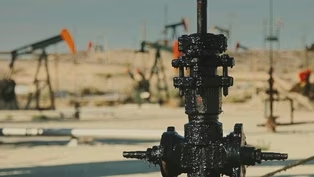
The Fight to End Oil Drilling in Los Angeles (Preview)
Preview: S7 Ep3 | 30s | South L.A. fights urban oil drilling as one former site becomes housing and green space. (30s)
Providing Support for PBS.org
Learn Moreabout PBS online sponsorship














Support for PBS provided by:
Earth Focus is a local public television program presented by PBS SoCal