
The Highway Toll on People of Color/Symbol of Racial Divide
Season 5 Episode 50 | 26m 46sVideo has Closed Captions
The Highway Toll on People of Color/A Symbol of Racial Divide | Episode 550
Are Detroit’s highways relics of structural racism from the past? A simple cinder block wall, built 80 years ago, still stands at Detroit’s northern border, the Birwood Wall. Plus, Detroit’s rich history of boxing around the city has produced numerous champions including Joe Louis, Thomas “Hitman” Hearns and Hilmer Kenty to name a few. Episode 550
Problems playing video? | Closed Captioning Feedback
Problems playing video? | Closed Captioning Feedback
One Detroit is a local public television program presented by Detroit PBS
The Highway Toll on People of Color/Symbol of Racial Divide
Season 5 Episode 50 | 26m 46sVideo has Closed Captions
Are Detroit’s highways relics of structural racism from the past? A simple cinder block wall, built 80 years ago, still stands at Detroit’s northern border, the Birwood Wall. Plus, Detroit’s rich history of boxing around the city has produced numerous champions including Joe Louis, Thomas “Hitman” Hearns and Hilmer Kenty to name a few. Episode 550
Problems playing video? | Closed Captioning Feedback
How to Watch One Detroit
One Detroit is available to stream on pbs.org and the free PBS App, available on iPhone, Apple TV, Android TV, Android smartphones, Amazon Fire TV, Amazon Fire Tablet, Roku, Samsung Smart TV, and Vizio.
Providing Support for PBS.org
Learn Moreabout PBS online sponsorship- [Will] Just ahead on One Detroit, a look at some of the people and places that have contributed to Detroit's place in history.
We'll take a look at the painful legacy of the city's Birwood Wall and how the community has transformed this symbol of racism into a symbol of hope.
Also a story about the historical link between race and the city's highways.
Plus Detroit's rich history of producing boxing champions.
It's all coming up on One Detroit.
- [Announcer] From Delta faucets to Behr paint, Masco Corporation is proud to deliver products that enhance the way consumers all over the world experience and enjoy their living spaces.
Masco, serving Michigan communities since 1929.
- [Announcer] Support for this program is provided by, the Cynthia & Edsel Ford Fund for Journalism at Detroit public TV, The Kresge Foundation, Community Foundation for Southeast Michigan.
- [Announcer] The DTE foundation is a proud sponsor of Detroit Public TV.
Among the state's largest foundations committed to Michigan focused giving.
We support organizations that are doing exceptional work in our state.
Visit DTEfoundation.com to learn more.
- [Announcer] Business Leaders for Michigan, dedicated to making Michigan a top 10 state for jobs, personal income, and a healthy economy.
Also brought to you by... And viewers like you.
(upbeat music) - [Will] On this week's One Detroit we're examining the diverse history of Michigan's largest city.
Coming up, you can't talk about the sport of boxing without mentioning the Champions made in Detroit.
We'll take a look at what makes Detroit boxers knockouts in the ring.
Plus we'll pay a visit to a longtime structure in Detroit with a painful past.
One Detroit delves into the racist history of the Birwood Wall, and how it offers hope for healing today.
But first up, a history lesson on the connection between highways and racism.
Over the years, the construction of freeways have destroyed many thriving African-American communities here in Detroit and across the country.
(soft music) - You could look at any other part of the country and you would say you can't have a strong region without a strong city.
I would say racism here was so deep that they were willing to kill the city in spite of themselves.
- [Reporter] Detroit, the crossroads of half the population of the United States is, but minutes away.
- Starting in the late 1950s, construction on the I-75 and I-375 highways cut through some of Detroit's most prosperous black neighborhoods of Black Bottom and Paradise Valley, which rivaled New York's, Harlem and Tulsa Oklahoma's, Black Wall Street.
Thousands were displaced erasing generations of wealth.
Some call these highways Detroit's largest monument to racism.
This is Detroit historian, Jamon Jordan.
- Historically the building of these freeways affected the whole country.
It didn't just affect Detroit.
But largely one of the major areas that they affected almost everywhere they went was African-American communities.
- [Will] But could there be a way to rebuild the wealth and opportunity for the next generation of black Detroiters?
I spoke with freelance writer, Nithin Vejendla, whose recent article on Detroit highways being racist appeared in the Detroit Free Press.
- Start with how a freeway could possibly be a symbol of racism.
- So you look at the construction of freeways, and they were rather primarily through black neighborhoods.
'Cause at that time, and still even now black communities had less power, had less political power to be able to resist these kind of really disruptive changes.
And because of racist redlining policies, land and houses and homes in black neighborhoods were worth far less than homes in white neighborhoods.
- The winner of the- - [Will] Detroit, wasn't the only city being dissected by highways.
In fact, the man who set the national trend for city planning started in New York city.
His name was Robert Moses.
(audience clapping) - [Reporter] Robert Moses, New York city construction coordinator is a world famous highway planner, a man who knows his business.
(audience clapping) - [Will] In a 1974 biography, it was said Moses suggested suburbs make the water in their community pools colder to keep black people from swimming with whites.
Closer to home, it was Detroit mayor, Albert Cobo, who put together the plans to build the freeways that in 1956 would decimate Black Bottom and Paradise Valley.
- And there are arguments, did he do it because he's a racist and Detroit's black, then what was left of a black community or did he do it because it was the most feasible place to put a freeway.
And so arguments go both ways.
But looking at the history of Cobo, his acts, his policies and his ideas about the African-American community, it's pretty clear that this was not a coincidence.
- [Will] This is Wayne State University law professor and director of the Damon J. Keith Center for Civil Rights, Peter Hammer.
- Think about structural racism and think about how structural racism is defined at Keith Center.
We're looking at the inter-institutional dynamics that produce and reproduce racially disparate outcomes over time.
when the freeways were started everybody thought this, white people particularly, thought this is development.
And it was also thought of necessary for part of a nationaL plan of interstate networks and also for the creation and cohesion of the suburbs.
Now you have to sort of imagine that thats the city underwriting its own demise, right?
So the expressways were thought, well, these are easy ways for Detroiters to go out to the suburbs and come back.
They were also easy ways for Detroiters to go out in the suburbs and never come back.
- [Reporter] Sleeves rolled up, Detroit levels and shifts and carves the contours of a new city.
And a new spirit of progress matches the vision of its people.
- What was I-75 before it was I-75, right?
And it was Hasting Street.
And Hasting street ran up and down Paradise Valley, which was the most important and most concentrated African-American business district and living district anywhere in the city.
So Tulsa has got a lot of attention lately for very legitimate reasons.
And they called that the Black Wall Street, and that was destroyed by a race riot.
Detroit's Black Wall Street was destroyed by, "development and the construction of the expressways and the destruction of Paradise Valley."
And people who run up and down I-75 today have no clue.
- [Reporter] Detroit is borrowing funds to build more miles of expressway and build them today instead of years from now.
- [Will] The question now, can Detroit reverse the process?
That is, remove freeways.
Cities like Milwaukee and San Francisco already have.
- You look at San Francisco, San Francisco's Embarcadero Freeway was heavily damaged in an earthquake in 1970.
Instead of repairing it they simply just removed it.
And when they did that, you know, traffic didn't significantly increase.
It didn't cause massive traffic jams and it significantly improved quality of life for a lot of people.
- [Will] I spoke with civic engagement, expert and Dean of the school of architecture at the University of Detroit Mercy, Dan Pitara.
- What is the economic impact, you know, to the extent that you can speak on it, of undertaking such a project?
- Think about what a scale of a project like this would do.
And think about the numbers, the thousands of jobs that could truly be generated across the decade of time from planning, engineering, survey.
It really is, we're talking thousands upon thousands of jobs that are possible.
Which then means that we have to then not just plan for the jobs, but plan for the preparing and working with people to be ready for those jobs.
- The Michigan department of transportation was to soon start the removal of I-375 in downtown Detroit, but the project was delayed because of the pandemic.
Do you think that removing the highways is an opportunity to address some of these, you know, historically, you know, systemically racist issues?
- No, I don't think you could make any credible connection to removing highways today and undoing, the harm that was done.
- The fielding in of I-375 is not harming the African-American community, but it won't bring Black Bottom back.
- [Will] Many believe that undoing the damage to black American communities in cities like Detroit means investing in black neighborhoods at the same scale and with the same resolve white suburbs received during urban renewal.
- Its just a matter of who has the power, all right?
- Right.
- Which means that at the end of the day, if you're not changing the belief system, right, the sort of highly racialized belief system that have created this history, then you have no chance of digging yourself out of the hole.
So a lot of effort has to be of really intentionally reshaping the white mind, right?
In a way that can transcend the sort of white supremacist heritage that we have received.
- [Will] Regarding that stretch of freeway, connecting the Chrysler Freeway to the Downtown Riverfront, I-375, what some can't help but see as a major symbol of racism will remain for a few more years.
Maybe then the many millions of dollars needed will return to state coffers, allowing for it to be filled in and receive a proper burial.
(soft music) - [Interviewee] If you see it today, you happen upon it, you just assume it's there for decorative purposes.
- [Narrator] A cinder block wall with a few different names, the Wailing Wall, the Birwood Wall, the Mile Wall.
It's just south of Eight Mile Road, built by a real estate developer to separate people by race, 80 years ago.
- I thought about it a lot.
- [Narrator] Torre May's been here 20 years.
- Just makes you angry.
- [Narrator] One Detroit partner, Bridge Detroit teamed up with NBC News to tell the wall story, which caught former Detroiter Johnnie Smith.
She's with her children visiting from California.
- Actually there was a writeup about the Eight Mile Wall, and I thought it'd be very interesting to have the kids come and see how Detroit was segregated not many years ago.
- Detroit was growing really, really rapidly.
- Erin Einhorn and Olivia Lewis spent six months investigating the legacy of the wall.
- How did you get onto this story in the first place?
- Yeah, actually, it was last summer, during the height of the protests and George Floyd had been killed.
And then there were all these other viral videos.
And we were really struck by how differently people were viewing these events, like completely different lenses.
You know, specifically white folks were viewing it very differently from black folks.
We were just kind of talking about, well, why is it?
And it's actually pretty obvious why that is.
You know, like here in one of the most diverse countries in the world, most Americans live in a segregated neighborhood.
- [Narrator] In 1941 the developer had to keep his houses separate from an adjacent black neighborhood to get a government loan.
Up went a wall between Birwood and Mendota streets, the embodiment of redlining; lending money but leaving out African-Americans.
- If you lived in that house.
- [Narrator] More recently, Elizabeth Warren made a campaign stop here, and Gerald van Dusen wrote a book about it.
- Do you think most Detroiters even know about this wall?
- Most people living in Mendota and Birwood don't know about the origins of the wall.
That's what I found quite stunning.
People were so used to when they moved in having this concrete backing, they assumed it was a lot like the kind of barriers you see maybe behind stores, you know, running maybe east and west on eight mile.
- I knew about the wall.
My mom had told me about the wall.
I was younger 'cause she grew up in a neighborhood close by.
- My family also has ties to the neighborhood.
My father grew up half a mile south of the wall.
Some of the people we interviewed for the story were my fathers, you know, elementary school classmates.
And this was actually for me, a pretty revealing discovery.
I think all of the white folks that we interviewed, none of them knew that the wall was there when they were kids growing up.
- There's been stories done about this wall before, but yours had some new information that probably was a revelation to a lot of people in Detroit.
- You know, I think one of the things that was really interesting about our story and what makes it a little bit different is that, there is this ongoing story about one family.
- [Narrator] The Cruz family came from Alabama in 1918 to the area near Eight Mile Road.
It was Greenfield township back then they settled here in a tar paper shack.
- We talk about a family who comes to Detroit, sets up their own neighborhood essentially, and is fighting for housing rights and access to housing early on.
And then to see that play out over decades, I think is really important.
- When we were getting started on this project, you know, we were trying to figure out well, okay, who built the wall?
And we talked to experts and nobody seemed to know.
And this was surprising because the wall, as you said, gotten a lot of attention in recent years, but missing from that narrative has been who built the thing.
- [Narrator] A Dive into the archives, revealed the developer, a prominent Detroiter from a prominent family, even today.
- James T McMillan and his two sons were the people who built the wall.
James T McMillan's grandfather was James McMillan who represented Michigan in the United States Senate around the turn of the 20th century.
- Its important to know who was behind things, just so that we can go back and see how history played out.
I think that people want to know, not only who was responsible, but to hold people accountable and see how can we move forward and how have we moved forward?
And so, I don't think it's necessarily always a standpoint of blame, but how can we learn from this and do better in the future.
[Narrator] During the war Detroit attracted more factory workers causing a massive housing shortage.
As the Birwood Wall went up, so to the Sojourner Truth Federal Housing Project meant for African-American war production workers on the Northeast side.
Trouble was white People showed up when they tried to move in.
That particular incident, the riot, maybe even that is lost to history.
for a lot of people in Detroit.
- Pretty much.
Pretty much lost as well.
It still stands.
And I went over there one day fairly recently, and I was talking to the current manager of the public housing unit.
They had no idea of the history of that structure and what had taken place during the war years.
- [Narrator] Gerald van Dusen wrote a book about the Sojourner Truth Riot too.
A riot instigated in part by a priest at a nearby Polish Catholic church.
- And the arrests were primarily of blacks, even though whites were doing just as much of the pushing and pulling and rock throwing and the like.
- [Narrator] As the country United against the Germans and Japanese in Detroit, the arsenal of democracy, a fight was on to keep society segregated.
- And the rule simply said, this, that if you're gonna put up housing, public housing, if the neighborhood is predominantly black, then the housing will be exclusively black.
If it's predominantly white, it'll be exclusively white.
If it's a mixed neighborhood, well, theoretically it could be mixed, but never was it mixed.
It was gonna be one or the other.
And typically it was in a mixed neighborhood.
It was white.
- [Narrator] Sojourner Truth became a rallying cry, a conflict over housing and race heard nationally.
- The Birwood Wall incident, the Sojourner Truth incident, and then the hate strikes at the Packard plant and other factory plants really precipitated the race riot of 1943, the biggest riot of the war.
- You know, I was driving recently down a broad Boulevard that had a grassy median down the middle, right near the border of Detroit and Grosspoint and thinking like, "Oh, I understand why this was here."
A lot of those broad boulevards with grassy medians were built for the same exact reason this wall was built.
We have all these legacies and all these different places, and we may not even know they're there.
(soft music) (crowd cheering) - It made me very happy to be from Detroit, Kronk because Detroit support me so well.
I couldn't do another way because I love the feel.
I love the feel, I love the emotion that Detroit put into everything for me.
They showed me how to, what it was like to be a champion in Detroit.
And what it was like to be a champion in Detroit.
Its just a wonderful thing, a great feeling.
- So, I didn't really know that much about boxing except for Muhammad Ali, because I started high school, he won the Olympics.
He got the gold medal in 1960.
So that's what got me aware of boxing as a sport.
I followed his career because I thought he was so interesting.
And then when I got involved with myself in boxing, working with Tommy Hearns and the Kronk Gym in 1978, I was impressed at how much I thought Thomas Hearns reminded me of Muhammad Ali.
His slick moves his dominance in the ring, his personality.
Although he wasn't making up poems and rhymes, I could see a similarity in their greatness.
You just see greatness in certain people.
And so, as it turned out, unbeknownst to me, we would all be coming together in the early eighties because Muhammad Ali owned a company called MAPS, which was Muhammad Ali Professional Sports.
And they ended up promoting some of Tommy Hearn's fights, his title fights.
And so I finally got to meet this amazing man.
Okay, I was writing for a daily paper as a journalist and I did an interview with Thomas Hearns very early on in his career.
And as I did with Muhammad Ali, I fell in love with this fighter who was so gracious and so humble, but so great in the ring.
And I admired that so much.
And then when I had the opportunity to work with him and learn the sport from a different angle, not just as a fan, but actually spending time in a gym and watching what it takes to become a professional fighter.
You don't play backseat.
It is a sport, but it's a hard sport one-on-one.
And you have to put so much into it.
And I have so much respect for the people that do that, men or women that take that sport out.
- I was watching TV one day and Muhammad Ali came on TV and he started boxing, and he won them.
Just seeing how (indistinct) and being a man, being a supporter of.
And I thought that was nice, that was special, that was different becoming the first man in boxing history to win titles in seventeen different divisions.
That's a big achievement myself.
And then, well, in times I won.
Winning titles is not an easy thing to do.
- The state of Michigan, that's our bragging rights, other than, you know, baseball, anything.
We won more championship than all sports in boxing.
And you know, and everybody only knows Tommy Hearn, That's all.
We won more championships than Tommy Hearn.
And I are in the eighties with Kronk, with Tommy Hearns, Harold McKinney, you know, I thought we were rougher than a lot.
I mean, (indistinct), that we was rougher than to a lot of people.
When you fought somebody from Kronk, you know, they came to fight.
From Detroit, Kronk, they came to fight.
- Well, my great uncle box, my uncle box, my brother box.
So by the age of four, I was introduced to boxing just early at the age.
That's early age.
Right?
So I know boxing.
I remember four, my brother doing a hundred pushups, me working out with my brother, five, six, seven.
My uncle, he was involved with the Kronk gymn, around that era with Thomas Hearns, Milt Macquarie, Steven Cory, part of the whole Kronk escort team.
It was just like normal, you know.
But stepping outside of Detroit, it's a big thing.
It's a huge thing.
- I think here in the Detroit area, we've produced more world champions than any other state.
All you have to do wherever you're traveling in the world, doesn't matter whether you're in boxing or you're on vacation or whatever.
And you sit down and have a sandwich or a drink, and someone sits next to you and strikes up a conversation.
And they say, "where are you from?"
"I'm from Detroit."
The next question that comes out of their mouth, "Oh man, can you tell me about Detroit boxing?
Can you tell me about the Kronk gym?
Can you tell me about James Tony?"
You know, that's the first thing people from out of town will ask you once you tell them that you're from Detroit.
- I mean, we all boxed each other hard.
We got Dural, Tommy, Elmore, everybody that was in that area, yeah.
We all boxed each other hard.
but nobody got bragging rights on.
- For me, having guys in my camp, at the same time I was in the gym, for me it was the best thing for me because them guys helped me become who I am.
Them guys put the hard work in as well as I put the work in.
- Detroit gonna keep coming.
Like Detroit is not gonna like bag up, sit down.
And Detroit, if they fight the best they gonna work for it.
You know what I'm saying?
They ain't gonna, "Oh, I'm fighting the best.
I don't want to."
like, whatever you put in front of them, that's what they going to do guys.
And they gonna fight whoever.
Either win, lose, or draw, they gonna fight them.
It don't matter who it is.
- When Detroit boxers box, they box, they're passionate.
You know, literally we go hard.
Like being from Detroit, I know this about myself, I go hard at everything I do, my work, my professional.
There's something about that Detroit spirit.
So it's not a negative, it's a positive.
- I think Detroit boxers are tough just because of the way they come up.
It's an industrial city.
It's a blue collar city.
And I think there's a lot of young talent here.
There always has been.
And I think that these kids today that go into the gyms that wanna fight, it's a great way to get them off the streets and it teaches them discipline, self-defense.
You certainly have to be on your game if you're gonna fight.
You're not on a team.
It's just one against one.
And Detroit's been known to have tremendous talent.
- Being involved in with the Metro Detroit Golden Gloves, I was able to see on a national level, Detroit and boxing.
Detroit is just a whole... We have a whole different vibe.
It's different.
So it's unexplainable.
I can't explain it.
I think it's just the spirit of Detroit.
- It was very uplifting to come to the golden gloves this year and see how that, how much the new officers have brought up the organization over the last few years.
I'm very very proud of the work that they've done.
And I see in the future, if this is gonna happen, that we're gonna go back to the old days where we used to have two or three rings with two or three bouts going on at the same time.
One of the things back here, you go back to the seventies and the eighties were, Detroit boxing was dominant in the world.
And the reason for that was, we had a great amateur program.
And from the amateurs, they were going into the pros.
And I see a rejuvenation of that happening.
I see a great amateur program that's going on right now.
And it's just a matter of time before they go into the pros.
And I think in the next five years, Detroit boxing will be dominant on the world boxing scene again.
(bell chimes) - [Narrator] That'll do it for this week's One Detroit.
Thanks for joining us.
Make sure to come back for One Detroit arts and culture on Mondays at 7:30pm and head to onedetroitpbs.org, for all of the stories we're working on.
(slow music) You can find more @onedetroitpbs.org or subscribe to our social media channels and sign up for our One Detroit newsletter.
- From Delta faucets to Behr paint, Masco corporation is proud to deliver products that enhance the way consumers all over the world experience and enjoy their living spaces.
Masco serving Michigan communities since 1929.
- [Announcer] Support for this program is provided by the Cynthia & Edsel Ford Fund for Journalism at Detroit Public TV, the Kresge Foundation, Community Foundation for Southeast Michigan.
- [Announcer] The DTE foundation is a proud sponsor of Detroit Public TV.
Among the state's largest foundations, committed to Michigan focused giving.
We support organizations that are doing exceptional work in our state.
Visit DTEfoundation.com to learn more.
- [Announcer] Business leaders for Michigan, dedicated to making Michigan a top 10 state for jobs, personal income, and a healthy economy.
Also brought to you by... And viewers like you.
(soft music)
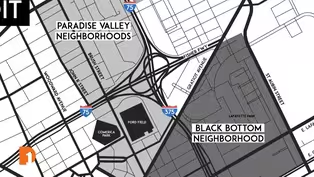
The Highway Toll on People of Color
Video has Closed Captions
Clip: S5 Ep50 | 7m 40s | The Highway Toll on People of Color | Episode 550/Segment 1 (7m 40s)
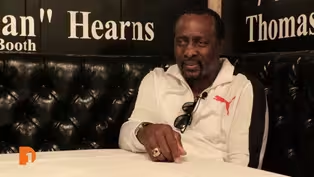
The History of Detroit’s Celebrated Boxing Scene
Video has Closed Captions
Clip: S5 Ep50 | 7m 55s | The History of Detroit’s Celebrated Boxing Scene | Episode 550/Segment 3 (7m 55s)
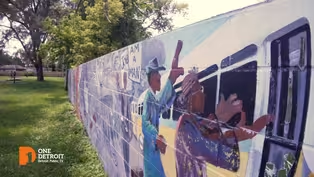
A Symbol of Racial Divide: The Legacy of the Birwood Wall
Video has Closed Captions
Clip: S5 Ep50 | 7m 15s | A Symbol of Racial Divide: The Legacy of Detroit’s Birwood Wall | Episode 550/Segment 2 (7m 15s)
Providing Support for PBS.org
Learn Moreabout PBS online sponsorship
- News and Public Affairs

Top journalists deliver compelling original analysis of the hour's headlines.

- News and Public Affairs

FRONTLINE is investigative journalism that questions, explains and changes our world.












Support for PBS provided by:
One Detroit is a local public television program presented by Detroit PBS