Smart Start: A KET Special Report
The Impact of Early Learning
Clip: Episode 1 | 6m 54sVideo has Closed Captions
A panel of experts discuss the impact of early learning.
A panel of experts discuss the impact of early learning.
Problems playing video? | Closed Captioning Feedback
Problems playing video? | Closed Captioning Feedback
Smart Start: A KET Special Report is a local public television program presented by KET
Smart Start: A KET Special Report
The Impact of Early Learning
Clip: Episode 1 | 6m 54sVideo has Closed Captions
A panel of experts discuss the impact of early learning.
Problems playing video? | Closed Captioning Feedback
How to Watch Smart Start: A KET Special Report
Smart Start: A KET Special Report is available to stream on pbs.org and the free PBS App, available on iPhone, Apple TV, Android TV, Android smartphones, Amazon Fire TV, Amazon Fire Tablet, Roku, Samsung Smart TV, and Vizio.
Providing Support for PBS.org
Learn Moreabout PBS online sponsorshipJoining us now is a panel of early childhood education experts and those in the field who deal with this every day.
We're glad to have with us Dr. Jennifer Porter.
She's a pediatrician from Louisville with extensive work in early childhood development.
Dr. Whitney Stephenson, director of Early childhood for Fayette County Public Schools, and Ashley Brant, director of early care and education for the Metro United Way.
Thank you all for joining us for this important discussion.
I'll just ask each of you and I'll start with you, Dr. Stephenson.
There is a common belief that a child's education should begin in kindergarten.
We've been taught that for many years.
But more and more research shows that early learning those first few years have a greater impact on a child's development.
In a sentence or two.
Explain why that is and what are the factors that can lead to putting a child on a bright, successful academic path?
So as you mentioned, the research, we know that children's brains are being built during that time.
And, you know, the interactions that they have with the adults in their lives are part of that building of that brain.
Or the main reason that, you know, all of those snaps are happening, all of those interactions are building.
What's going to take that child to the future?
And so that's why we have to make sure that the adults in the children's lives understand that and know that in their help helping build those children's brains.
Dr. Porter, what would you add to that?
Just to add to that, you know, parents are the first teachers, I would say that in the office said you're your child's best advocate, but you're also their first teacher.
The when they start to babble, those are cries for communication and you should answer them even though you might not understand them.
That's how you build their brain and get them to be ready for kindergarten.
So when the kids are babbling and you don't make any sense out of that, what should a how should a parent respond?
Do they babble back or do they talk in full sentences?
Sentences their sentences even though the child can't process?
Why is that so important for the adult to respond in full sentences?
Because eventually the child will respond back with words, and that's that beginning of building their brain to be able to do that.
Right.
So the tendency is to also go into the baby, talk with your child.
If you do that.
How how bad is that?
I don't think it's horrible the cadence or the tone of your voice to speak.
And that higher tone is good, but speaking for words is just fine.
But we all do a little baby talk sometime, right?
Well, same question to you, Miss Brant.
Yes.
Well, I echo exactly what they have already said, but I think also here in Kentucky, we're fortunate to have a statewide screener that we utilize on every child when they enter kindergarten called the Brigance.
And so we know and we have data showing where children are starting on that first day of kindergarten.
And that data shows that children who are ready on that first day are more likely to be on track at third grade for their reading and their math scores.
So we know being prepared on that first day is crucial for a really long term outcomes for that child.
So that birth to five is crucial to ensuring readiness on day one of kindergarten.
Right.
And so what should the readiness look like?
What should parents be doing specifically with their child?
So when they do take the Brigance, when they're entering kindergarten, they perform well?
Yeah.
I mean, everything from playing outside, gross motor skills, jumping, hopping, fine motor skills, using clay, Play-Doh, building those that hand strength, pre writing skills, cutting with scissors.
I know that can be scary for parents, but it is a pretty writing skill.
Gets them to react.
Right?
Exactly.
Communication like we were talking about that back and forth, having conversations, constantly talking with their child and then, you know, reading and just really having an ongoing dialog, observing the world around you to build that child's brain.
So, you know, when you're driving to school, how many read cars do you see when you're at the library looking at all the different books that have a blue color and just really embodying those things that are super easy day to day, they don't cost anything and they're just really creating that environment for a child that's rich in all of those different aspects that help them develop their brain.
And a parent shouldn't fear that I don't have a degree in early childhood education, right?
That if you just do the simple things you just talked about, you know, the colors as you're driving along and and counting the cars, I mean, those are very valuable tools.
Exactly.
Yes.
And as was said, a parent is a child's first teacher.
They know their child better than anybody.
So they really know what their child needs.
And they don't need to have an early childhood degree.
They just need to be themselves and support their child and the needs that they have.
Yes.
Well, Dr. Porter, parents are the child's first educator, but pediatricians are also the partners in that education.
So what are the things you tell, particularly new parents, to help them understand what they need to do to put their child on a successful educational journey?
Well, I try to tell them when they come for that first visit, even the newborn visit.
Reading to your child is important.
It seems like they're not listening or parents, when they become toddlers, they're frustrated.
They're eating the books.
They're, you know, they're turning the page.
They don't want to let me read.
I'm like, all of those are valuable experiences.
If you open the book and then they close it, then talk about what's on the back cover.
Talk about the colors.
It's not always about the words that are in the book, but using it as a tool for learning.
Pointing out colors or counting how many bears there are or pointing out the words This is a dog.
And then eventually they will start to pick up on those things.
You'll get to the point where they want to just sit in the chair and cuddle and read those books.
But until you get there, you know, use that little bit of time and it doesn't have to be 2 hours a day.
And literally a book at bedtime as part of your routine can start that process, right.
Talk to us about serve and return interactions.
Okay.
This is a term that most of us aren't familiar with, but we know you are.
Explain.
So as I mentioned in my previous statement, even that babbling is a serve and return right when the child babbles and then you talk to them and then they babble again.
You don't know what they say, but that's a early example of serve and return as they get older.
It's those questions why, who, what, where and where that.
They get tired of.
You do it.
It's it's a way for them to understand their world and understanding that all these things are new and wonderful for them.
And even though it might be annoying at 7:00 in the morning when you want them to get their shoes on so you can get them to daycare, so you can go to work.
All of those things help to build their brain so that when they get to that point, when it's time to read or to do math, that they have that proper foundation.
And curiosity, building their curiosity and giving them the freedom to be curious and not judging them for their curiosity, which can be difficult when you're trying to get out the door sometime, right?
Biggest Factors for Kindergarten Readiness
Video has Closed Captions
Clip: Ep1 | 7m 32s | A panel of experts discuss the biggest factors in kindergarten readiness. (7m 32s)

The Challenges of Universal Pre-K
Video has Closed Captions
Clip: Ep1 | 9m 29s | A panel of experts discuss the challenges involved with universal pre-K. (9m 29s)

Child Care Industry's Impact on Kentucky Economy
Video has Closed Captions
Clip: Ep1 | 10m 34s | A panel of experts discuss the child care industry's impact on the Kentucky economy. (10m 34s)
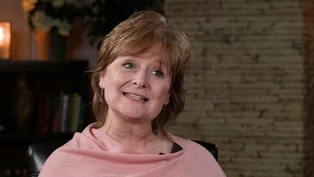
Donna Grigsby, M.D. (Full Interview)
Video has Closed Captions
Clip: Ep1 | 33m 32s | Full Interview with Chief of Division of General Academic Pediatrics. (33m 32s)
The Importance of Child Care Funding
Video has Closed Captions
Clip: Ep1 | 5m 54s | A panel of experts discuss the importance of child care funding. (5m 54s)
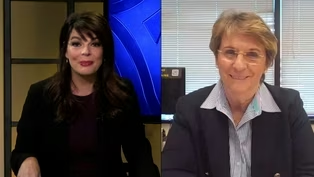
Video has Closed Captions
Clip: Ep1 | 27m 48s | Full Interview with Director of Early Childhood Initiative, Bipartisan Policy Center. (27m 48s)
The Need for Child Care Funding
Video has Closed Captions
Clip: Ep1 | 6m 47s | A panel of experts discuss the need for child care funding. (6m 47s)
Setting a Foundation for Learning
Video has Closed Captions
Clip: Ep1 | 8m 47s | A panel of experts discuss how early education sets a foundation for learning. (8m 47s)
The Status of Kentucky's Early Childhood Education Workforce
Video has Closed Captions
Clip: Ep1 | 4m 47s | A panel of experts discuss the status of Kentucky's early childhood education workforce. (4m 47s)
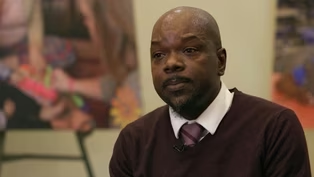
Vaughn Nebbitt (Full Interview)
Video has Closed Captions
Clip: Ep1 | 8m 27s | Full Interview with Vice President of Early Childhood Services Family & Children's Place. (8m 27s)
Providing Support for PBS.org
Learn Moreabout PBS online sponsorship

- Home and How To

Hit the road in a classic car for a tour through Great Britain with two antiques experts.












Support for PBS provided by:
Smart Start: A KET Special Report is a local public television program presented by KET