Smart Start: A KET Special Report
The Importance of Child Care Funding
Clip: Episode 1 | 5m 54sVideo has Closed Captions
A panel of experts discuss the importance of child care funding.
A panel of experts discuss the importance of child care funding.
Problems playing video? | Closed Captioning Feedback
Problems playing video? | Closed Captioning Feedback
Smart Start: A KET Special Report is a local public television program presented by KET
Smart Start: A KET Special Report
The Importance of Child Care Funding
Clip: Episode 1 | 5m 54sVideo has Closed Captions
A panel of experts discuss the importance of child care funding.
Problems playing video? | Closed Captioning Feedback
How to Watch Smart Start: A KET Special Report
Smart Start: A KET Special Report is available to stream on pbs.org and the free PBS App, available on iPhone, Apple TV, Android TV, Android smartphones, Amazon Fire TV, Amazon Fire Tablet, Roku, Samsung Smart TV, LG TV, and Vizio.
Providing Support for PBS.org
Learn Moreabout PBS online sponsorshipJoining us now is a panel of early childhood education experts and those in the field who deal with this every day.
We're glad to have with us Dr. Jennifer Porter.
She's a pediatrician from Louisville with extensive work in early childhood development.
Dr. Whitney Stephenson, director of Early childhood for Fayette County Public Schools, and Ashley Brant, director of early care and education for the Metro United Way.
I want to go back to you, Miss Brant, and ask you about why you mentioned this, about the access issue.
And we know that so many children perhaps are not in Louisville or Jefferson County or maybe they are in a child desert right where there's not enough slots or what's available is not affordable.
Right.
I mean, these are really big barriers for parents and caregivers.
So why is right now such a critical time for us to be talking about child care funding?
And there are several factors that why this discussion is even more important this particular time because of federal funding going away.
But it's been a big problem for child care centers to get adequate funding, and they're in thin margins and the affordability kind of break all that down for us.
Yes.
So before COVID child, the child care ecosystem was already broken then.
It just is not a system that is that works well.
So COVID then really shown the light on that because a lot so many child care centers, especially here in Kentucky, they were mandated to close for about three months for the health and safety of our citizens.
And then families really realized, you know, wow, this is such a need.
And and I hope that realization continues as we continue these conversations.
But you're right, at this point in time, there's a lot of different factors playing into this.
So the federal funding that had come down through American Rescue Plan dollars has officially ended.
There was a large amount of that funding dedicated to direct payments to child care providers across the state.
So those dollars are now over.
We are lucky that we have one more what they call sustainment payment that will carry us through the next legislative session that starts in January.
So budget is going to be a huge discussion as we enter that legislative session, a budget priority for supporting child care providers across our state.
So the you know, we often say that the business model of child care just doesn't work.
And that's sort of an understatement.
I mean, I would argue that it's not even really a business model.
You're not making money.
You know, that's not really a business.
So more of a charity, right?
Exactly.
So it's really right now the way that child care operates, as we do have public dollars through our child care assistance program that families who are income eligible can qualify for, and then that pays for their cost of child care.
Above and beyond that, it all of the costs relies on the family to pay.
And so you basically have this model where the cost of quality for a child care provider to operate to pay their educators not just a living wage, but a wage where they can thrive and be a part of the community as well.
It's that expense is too high for what parents can pay.
So you have this imbalance of what the actual cost is versus what families can afford.
And a lot of that falls on those middle class families who don't quite qualify for subsidy but aren't making enough to really afford high quality child care.
So and I often say that, you know, I don't know any child care provider in our community who wants to who doesn't want to pay their staff more, who doesn't want to create a quality environment.
But we it's we often say it's it's not magic.
It's money.
They need resources.
So I hope, you know, as we enter this next legislative session that we are having a lot of conversations with legislators around how the state of Kentucky can really support that ecosystem with budget supports as well as legislate of pieces.
There are some pieces that we've had put in place in the last couple of years, like the easy cap program, employee child care partnerships, Assistance Partnership.
Which many people don't know even exist.
Right, Exactly.
So and that's a program where families who don't qualify for a cap that their employer can enroll in this program and the employer contributes a certain amount, and then the state will match that.
So if an employer is paying $200 a month, the state will match $200 a month, and then that $400 is going directly to the child care provider to pay that tuition for the child.
So that eases the burden on the parent as well as creates a really strong revenue stream for the child care provider themselves, because they know that they have that money coming in consistently.
So I think there are legislative pieces we can look at and that we are talking with legislators around.
But honestly, we also need to be having the budget conversation, which I know is difficult at times, but we do need resources and funding to support the ecosystem right now so that that many of our providers are able to stay open once that final payment ends.
Well, and it's also a workforce issue, right?
I mean, educators in early childhood are also they're paying taxes and they're contributors to society.
And there has been a conversation about more professionalization of early childhood education, not in terms of what the educators are doing, but how they're viewed and rewarded as such.
So it's a multi-tiered conversation and we thank you for breaking it down for us, all of you.
We appreciate your input today.
Biggest Factors for Kindergarten Readiness
Video has Closed Captions
Clip: Ep1 | 7m 32s | A panel of experts discuss the biggest factors in kindergarten readiness. (7m 32s)

The Challenges of Universal Pre-K
Video has Closed Captions
Clip: Ep1 | 9m 29s | A panel of experts discuss the challenges involved with universal pre-K. (9m 29s)
Child Care Industry's Impact on Kentucky Economy
Video has Closed Captions
Clip: Ep1 | 10m 34s | A panel of experts discuss the child care industry's impact on the Kentucky economy. (10m 34s)
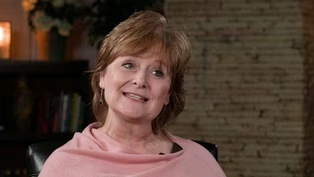
Donna Grigsby, M.D. (Full Interview)
Video has Closed Captions
Clip: Ep1 | 33m 32s | Full Interview with Chief of Division of General Academic Pediatrics. (33m 32s)
Video has Closed Captions
Clip: Ep1 | 6m 54s | A panel of experts discuss the impact of early learning. (6m 54s)
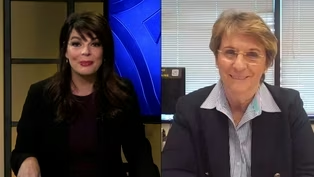
Video has Closed Captions
Clip: Ep1 | 27m 48s | Full Interview with Director of Early Childhood Initiative, Bipartisan Policy Center. (27m 48s)
The Need for Child Care Funding
Video has Closed Captions
Clip: Ep1 | 6m 47s | A panel of experts discuss the need for child care funding. (6m 47s)
Setting a Foundation for Learning
Video has Closed Captions
Clip: Ep1 | 8m 47s | A panel of experts discuss how early education sets a foundation for learning. (8m 47s)

The Status of Kentucky's Early Childhood Education Workforce
Video has Closed Captions
Clip: Ep1 | 4m 47s | A panel of experts discuss the status of Kentucky's early childhood education workforce. (4m 47s)
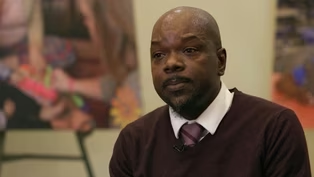
Vaughn Nebbitt (Full Interview)
Video has Closed Captions
Clip: Ep1 | 8m 27s | Full Interview with Vice President of Early Childhood Services Family & Children's Place. (8m 27s)
Providing Support for PBS.org
Learn Moreabout PBS online sponsorship














Support for PBS provided by:
Smart Start: A KET Special Report is a local public television program presented by KET