
The Latest on Efforts to Prevent Invasive Carp From Reaching Lake Michigan
Clip: 8/19/2026 | 9m 16sVideo has Closed Captions
Monitors recently found hundreds of young silver carp just 80 miles downstream.
Juvenile invasive silver carp were recently discovered just 80 miles from Lake Michigan. While adult invasive carp have previously been found that far north, the presence of young carp indicates a spawning event occurred, possibly even further upriver.
Problems playing video? | Closed Captioning Feedback
Problems playing video? | Closed Captioning Feedback
Chicago Tonight is a local public television program presented by WTTW
WTTW video streaming support provided by members and sponsors.
The Latest on Efforts to Prevent Invasive Carp From Reaching Lake Michigan
Clip: 8/19/2026 | 9m 16sVideo has Closed Captions
Juvenile invasive silver carp were recently discovered just 80 miles from Lake Michigan. While adult invasive carp have previously been found that far north, the presence of young carp indicates a spawning event occurred, possibly even further upriver.
Problems playing video? | Closed Captioning Feedback
Where to Watch Chicago Tonight
Chicago Tonight is available to stream on pbs.org and the PBS app.

WTTW News Explains
In this Emmy Award-winning series, WTTW News tackles your questions — big and small — about life in the Chicago area. Our video animations guide you through local government, city history, public utilities and everything in between.Providing Support for PBS.org
Learn Moreabout PBS online sponsorshipElectricity sound and even an underwater bubble wall are all part of the plan to keep invasive carp from entering the Great Lakes.
But the future of the cart barrier is in limbo.
At the end of July, the U.S.
Army Corps of Engineers issued a stop work order on the construction of the Brandon Road in or Basin project.
Meanwhile, carp are closer than ever to Lake Michigan over the weekend.
Monitoring crews found hundreds of young silver carp just 80 miles downstream.
Joining us now with more are Joel Braun, Meyer, president in CEO at the Alliance for the Great Lakes and Katie O'Reilly.
An invasive species specialist at the Illinois, Indiana Sea Grant.
Thanks to both for joining us here.
So, Katie, what could happen if invasive carp make it into Lake Michigan?
So the big concern is that if invasive carp do, in fact, make it into Lake Michigan.
>> They are just really great at what they do, which is eating and reproducing.
And so eat the same things that a lot of our native fish species eat, which is plankton these little microscopic plants and animals.
And without that, that could lead to the collapse of the fishery in the Great Lakes, which is about a 5 billion dollar fishery and obviously supports jobs throughout the Great Lakes Basin today be eating up all the food that the native fish eats, leaving them nothing to eat.
Absolutely them, of course not great for Why is it concerning that the cart found over the weekend are juveniles instead of adults?
This is >> a significant step in the invasion process that we haven't previously observed.
So we've seen a cart a little bit closer to the lake over the years.
But those have been sort of one-offs and the fact that we're seeing juveniles this close to the lake now >> indicates that they are actively reproducing, which is a step.
That means things just get a little bit tougher to control them.
If they've got this established population, if their brief producing, does that also kind of signal They're doing great.
They're getting what they need.
Exactly that that indicates they're doing.
And, you know, they have a great year.
Things are going well for them and that, you know, the conditions are right that they can keep potentially moving further upstream.
what do we know about why the Brandon Road project was paused?
>> Very little right now.
And I think the combination of the juveniles being found, plus a stop work order means alarm bells should be going off across the region and they're starting to across the Great Lakes States.
This project, this one that's been supported with bipartisan support for almost a decade.
Congress is behind that.
The states are behind it and as of now, we have no explanation as to why the stop work order has been issued.
Literally.
Construction crews are ready to start installing technologies into the channel in front of the Brandon Road Lock and Dam and take the next step on the project.
And that's not happening.
Who are some of the different stakeholders on this project?
Sure.
what's great about this project, again, bipartisan, lots of congressional support, the states of Michigan and Illinois have both put in their own budget money into the project, along with the Army Corps of Engineers.
And so it really is the closest thing to a universally supported project in the Great Lakes you might find.
And that's because everybody understands how bad it can get if an invasion happens.
Right?
Great Lakes states have been through this.
They've seen the impacts on the fishery and on the boating industry, which is a 16 billion dollar industry across the Great Lakes and bigger than all of that, it's part of the culture.
It's part of the way of life.
Great Lakers don't want to deal with another invasive species that's taking money out of their pockets and keeping them from enjoying the Great Lakes that we all love.
>> I imagine, you know, all of the stakeholders, 8 different agencies across different states across 5 different lakes.
I imagine that was no small lift to get everybody on board with with that isn't inexpensive project.
Yeah.
More than a more than a decade of negotiation.
Hard fought compromises made but everybody's on the same page and pulling forward, except as we've learned, the White House, there's one place that has power to actually bring people back to work and start construction up tomorrow.
It's our president and the White House that oversees the Army Corps of Engineers.
And so right now, we have no understanding of why the work has stopped.
But as far as we know, this is a this is a stop work that could be lifted tomorrow.
Katie.
Earlier I mentioned the bubble wall which sounds like fun.
If you're a toddler, not alone.
If not so Tell us how the plan, berry or or how the barrier actually works to to deter the cart.
Yeah, absolutely.
So the Brandon Road project is actually >> somewhat of a gauntlet for carp.
It is us sort of a stacked system of multiple different deterrents.
So you mentioned the bubble wall.
There's also sound which deters That's part of the reason you see them in those viral videos jumping out of the waters are really sensitive to sound.
>> There are electricity like some of the electric barriers that are further upstream.
So the idea is that by stacking all of these different deterrents, it reduces the possibility that they can get through any one of them like, you know, if it gets through one, it will get stopped by another.
So it really is an improvement on what we have currently existing in just pure electricity was the Chicago area.
So important for controlling invasive species like heart.
>> The Chicago area is really a lynch pin that, you know, the connection between the Great Lakes and the Mississippi River Basin is here.
You know, we have the connection through the Chicago waterway system, the of the Illinois River.
And so because that's, you know, so critical for commerce.
It's also critical for moving things that we don't necessarily want to get to places like fish that can play Do the expected cost of the project just over a billion dollars?
What would you expect the cost would be of not moving forward with it.
>> We know that their costs are compounding right now because workers are sitting idle and were actually that's a specialized every day of delay.
>> Has more days of delay the compound because you have to have staging and got the equipment in place and all that stuff.
All that's been pulled off the table by this White House to lay.
And so right now we're adding to the cost of the project.
But I want to emphasize that this caught this this project that as it was originally designed is worth every penny.
The Great Lakes region has a lot of experience in putting big dollars to work to clean up the messes that have that have compromised the Great Lakes in the past, whether it's pollution, whether it's invasive species, because we know the payoff.
It's a great, great lakes that everybody can enjoy.
So getting people back to work, getting the dollars that Congress and the states and so many other people have agreed need to be spent to stop invasive carp from getting into the Great Lakes.
That's job one right now.
It's also much cheaper to prevent.
It's been it is to clean it absolute of the accident or the problem happens.
Katie had a car cut to Illinois in the first place.
>> So the cards actually are originally from Asia brought over to the U.S.
and like the 60's and 70's to be used as a kind of biological control of algae and fish ponds, which is a good, you know, think sense at the time.
Unfortunately, the Mississippi River, as we know, often floods and a lot of those fish ponds got connected to the Mississippi River during times of flood Hartman did into the Mississippi River, which sort of acts as a superhighway.
And since then, we've seen them progress up up through Illinois.
What does carpet monitoring in the waterways here?
Look like so Kurt monitoring here in Illinois is really an all hands on deck effort.
It's the Illinois Department of Natural Resources, the U.S.
Fish and Wildlife Service, academia.
They're all working throughout the, you know, spawning season, which is everywhere from spring fall to really intensively monitors specific sites on the river so that we can find potential new, citing such as juveniles are, Leon, which is really critical to the prevention piece of this.
>> So you mentioned, you know, some, you know, fishermen, other folks, they know what it's like to can sort of get a muscle through muscles.
Probably not a good work invasive species.
You know, invading what?
What was that like?
What has that been like?
>> Well, what what was can happen before we can even flash back to 20?
0, 9, in 2010 when the adult invasive carp are found in the Chicago area and the panic that ensued among the states.
>> Realizing how close these these fish were.
And that was just those are the adults.
Now, 16 years later, and that led to, by the way, the creation of this project that we're talking about today, right?
The reason that we all came together and are willing to make that investment is because we saw what could happen if the car close.
16 years later, the project to supposed to be being built.
And now we're seeing these juveniles showing up even closer to Lake Michigan than they ever have before.
So alarm bells should be going off.
We don't want to get back into a panic situation like we had in 2000 and time and in 2010.
But what we've got in front of us is an opportunity to see a problem coming and actually stop it before it gets You could.
The barrier in about 30 seconds, couldn't stop other fish.
In addition to part.
>> Yes, so there's been a lot of research see if the same deterrence that deter invasive carp will act also deter potentially invasive fish.
Also native fish, which could lead to, you know, some this connections between them, but also things that are a little bit smaller.
Things like invertebrates crayfish, the mussels, for example.
So there's there's definitely benefits across the board.
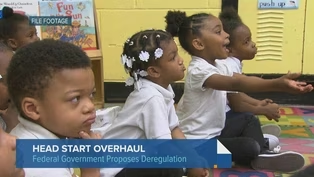
What Changes to Head Start Could Mean for Illinois Families, Providers
Video has Closed Captions
The federal education program provides early education and services to low-income children. (10m 44s)
Providing Support for PBS.org
Learn Moreabout PBS online sponsorship New Episode
- News and Public Affairs

Top journalists deliver compelling original analysis of the hour's headlines.
 New Episode
- News and Public Affairs

Today's top journalists discuss Washington's current political events and public affairs.


 New Episode
 New Episode
 New Episode
 Recently Added
 New Episode
 New Episode


 New Episode
Support for PBS provided by:
Chicago Tonight is a local public television program presented by WTTW
WTTW video streaming support provided by members and sponsors.