Call The Doctor
The Many Forms of Arthritis
Season 34 Episode 13 | 25m 9sVideo has Closed Captions
Learn about the many forms of arthritis and how to best be able to live with it.
Millions of people deal with the pain, stiffness and fatigue of arthritis. The term arthritis is used to refer to a disorder that affects our joints or the place where two bones meet. It's a common ailment, sometimes mild, sometimes severe, and it doesn't just strike the elderly population.
Problems playing video? | Closed Captioning Feedback
Problems playing video? | Closed Captioning Feedback
Call The Doctor is a local public television program presented by WVIA
Call The Doctor
The Many Forms of Arthritis
Season 34 Episode 13 | 25m 9sVideo has Closed Captions
Millions of people deal with the pain, stiffness and fatigue of arthritis. The term arthritis is used to refer to a disorder that affects our joints or the place where two bones meet. It's a common ailment, sometimes mild, sometimes severe, and it doesn't just strike the elderly population.
Problems playing video? | Closed Captioning Feedback
How to Watch Call The Doctor
Call The Doctor is available to stream on pbs.org and the free PBS App, available on iPhone, Apple TV, Android TV, Android smartphones, Amazon Fire TV, Amazon Fire Tablet, Roku, Samsung Smart TV, and Vizio.
Providing Support for PBS.org
Learn Moreabout PBS online sponsorship(upbeat music) - [Announcer] The region's premier medical information program, Call the Doctor.
- [Narrator] There's a good chance, someone you know, struggles with arthritis.
The CDC reports that arthritis affects 58.5 million US adults, or about one in four, and some children too.
Arthritis is the swelling and inflammation of joints, which can cause pain, stiffness, and fatigue, sometimes mild, other times quite severe.
And there are different kinds of arthritis to consider.
We've asked some of the area's best minds on the topic to help us through, right now on Call the Doctor.
- Hello and welcome to Call the Doctor.
I'm Julie Sidoni, I'm the news director here at WVIA and I'll be the moderator for the show this season.
As you heard, we're talking this episode about arthritis, which is common, but also perhaps commonly misunderstood.
There are many forms of arthritis, varying degrees of severity, and it doesn't affect only older people.
We've invited some experts to help us out, some orthopedic specialists and a physical therapist to help us wade through.
I know I say this at the beginning of every single episode, but we know there's not a way we're gonna get through everything we need to know about arthritis in 25 minutes, but let's at least get to some of the most common questions.
And I'd like to start by introducing our panelists or actually have them introduce themselves.
So we'll start with you, sir.
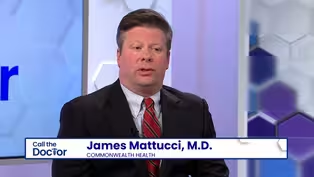
- Hi, my name is Jim Mattucci.
I'm an orthopedic surgeon.
I practice in Kingston, Pennsylvania, and I work for the Commonwealth Health System.
- [Julie] That's great to have you.
- Thank you.
- Hi, thanks for having me, I'm Doug VanderBrook.
I'm an orthopedic surgeon specializing in hip and knee replacements with Geisinger based out of Wilkes Barre.
- [Julie] Okay, great, welcome.
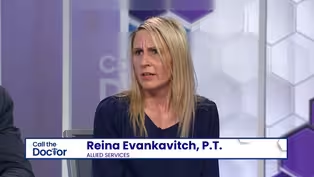
- Hi, I'm Reina Evankavitch and I work at a skilled nursing.
- All right, welcome to all of you.
I know you all deal with arthritis in some way, shape and form, but I think there's some different perspectives to get here.
So let's start with the very, very most basic question.
I guess we'll start with you, just an explanation about what arthritis is.
- Well, arthritis is simply the inflammation or destruction of a joint.
And it can be any joint in the body.
There are certainly more joints that we see more than others, and it typically causes pain and disability in multiple patient populations, men and women, young and old.
There are several types of arthritis and the most common being osteoarthritis, which affects a great deal of people throughout the world.
- How would you say Dr. VanderBrook is evaluated or diagnosed, 'cause I imagine there are people who have different types of joint pain and it's not all arthritis, of course.
What steps do you take or would a doctor take to figure out exactly what they're dealing with?
- Sure, many patients are referred to us already carrying a concern or a suspicion of our arthritis.
Patients know themselves that things are becoming more difficult.
Ambulating, walking around, it becomes stiff knees, stiff hips, and then they come to us either with x-rays or without x-rays to be evaluated.
And x-rays are typically the first line of evaluation, other than our physical exam to really diagnose and classify the degree of the arthritis that the patients have.
- What are you looking for on that X-ray?
- So there's various things to look for as Dr. Mattucci said that, it's an inflammatory process within the joint.
So as time progresses that joint space narrows, there are specific characteristics based on the different types of arthritis, which you had mentioned in the introduction, but most commonly osteoarthritis has a pretty classic joint space narrowing and then bone spurs that form on the margins or on the sides of the joints.
- What about Reina, some common symptoms or things that people might be complaining about when it comes to arthritis?
What do you most typically see?
- We see a lot of stiffness in the joints.
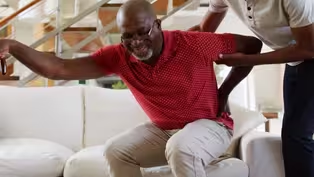
We see some trouble moving, some trouble, getting up from a chair, some trouble walking, some decreased motion in the joint.
So that's some typical things and some pain.
- Does it commonly happen if you're seated for a while or you first wake up in the morning or your joints are not moving and then suddenly you're trying to move them?
- That's where you seem to see it more.
So is maybe after resting for a while and being a little bit more sedentary.
That's when you might see it a little bit more.
So maybe the first thing waking up in the morning, you might be a little bit more stiff.
- Before we get into the many ways arthritis can be treated, I think we should touch on at least the different forms.
I know it's very common arthritis, but that seems like a one term that really means a whole lot of different types of issues.
What types of arthritis are there most commonly?
- Well, as we touched on...
There's first of all, osteoarthritis or in the old days what they called rheumatism, which is just the aging of joints and the wearing away of the particular cartage or lining of joints, which is a process that happens because of age, weight, stress, injury.
But then there are also inflammatory arthritis and most common being rheumatoid arthritis and psoriatic arthritis, which are diseases that are more autoimmune, where the body kind of fights itself against itself, which causes synovitis, and destruction of the joint from within.
Doug and I, as orthopedic surgeons, we tend to see these people later and typically they've had medical treatment already.
So we're typically dealing with the later manifestations and we treat a lot of them the same way, by the time we see them.
- You do just an internet search and things like gout and lupus and all of those types of issues come up.
And I realize that's not osteo, but that's more in the rheumatoid realm.
But why would people see those types of issues when they're searching for say joint pain or joint stiffness?
- Because those are forms of arthritis.
Actually, originally the description of arthritis, is based off of presentation of gout.
That's how it was defined initially.
And those processes cause inflammation within the joint, like we had touched on, but that inflammation causes softening of the particular surface or the cartilage, and it's that softening of the cartilage, no matter the underlying reason for it, that leads to the degeneration of these joints.
- So I'm just gonna make up an example.
I'm a tennis player and I use that same shoulder over and over and over.
That's an example of perhaps something that could turn into arthritis or is that a different thing altogether?
- I think, well, shorter arthritis is kind of its own thing.
I mean, why people get shorter arthritis is a little different than when we deal with the weightbearing joints, such as knees and hips, which is what we deal with the most.
That's more related to the everyday pounding on these weight, et-cetera.
Over years short arthritis can be related to injury.
It can be related to genetics.
It can be related to trauma, of course.
So it's a little bit different in a non-weight bearing joint than in a weight bearing joint.
- I see, so it's kind of a different thing.
- It's kind of its own world.
It's certainly a type of osteoarthritis and we certainly treat it, but it's a little different realm and a little different causes than the weightbearing joints.
- Reina who typically comes to you for help.
So if someone has arthritis and someone has referred them to a physical therapist, who are your typical patients and what might you... What are some of the steps you would take them through to kind of help their mobility?
- Absolutely.
Initially, I tend to work with the geriatric population.
So initially we would do an evaluation and we would take like range of motion measurements.
We would also see how they do like performing activities of daily living, such as like getting up from their bed, sitting up, standing up, walking, maybe going up and downstairs, and just evaluate those things and then just see how we could progress them over time to hopefully get them back to a more mobile way of living and just home.
- So as simple as you took two steps today and seemed to do all right, let's try for more tomorrow and keep it.
- Absolutely.
So is it almost...
I mean, I don't wanna say, is it learnable, but can you sort of teach your joints how to get back into shape a little better?
- I absolutely believe so, I believe you could.
The more movement the better, because like we were saying before, if you get stiff, it makes it harder to move and then you don't wanna move as much.
So as you continue to move, it will help those joints.
- Are there arthritis patients will stick with you for a second here, who come to physical therapy and that is all they'll ever need.
- There is, 'cause normally what we try to do is manage the arthritis in a more conservative way and that's where we come in.
So whether it be with moist tea, bracing, stretching, strengthening, so we'll try the most conservative method first.
And that's where physical therapy comes in.
- You were both nodding, you're both nodding.
- Oh no, I agree.
And I think strength is a big part of it too, because a lot of these folks, especially in the older populations, they lose strength.
They lose the ability to get off a toilet.
They lose the ability to get up and go up and downstairs.
And I think strength loss leads to other problems like falls.
So I think that, as a son of a physical therapist and someone who's been around the field for my whole life, I think that when you talk about function, you have to talk about keeping people flexible, but also keeping them strong.
And it's very easy to over time become weak, especially in the thigh muscles and the buttock muscles, the muscles that really propel us.
And I think it's really important, especially in the older population, but even in younger people with arthritis to maintain that and to improve that as time goes on.
- That's kind of important 'cause I think people think of stiff wrists and my knee or my ankle hurt, but we're talking about an elderly population, people who really need to keep up that lower body strength just to walk, just to move.
- Sure.
- I agree with that completely.
And you touched on the keeping these patients in active, in motion, these patients in motion stay in motion, these elderly individuals or even younger folks that have bad arthritis, it doesn't matter what the x-rays look like.
If they're active functioning people, they're gonna perform a lot better, a lot longer with that arthritis and not need as aggressive treatment as soon.
- [Mattucci] No doubt.
- What about things like medication and injections?
Still we're past physical therapy I suppose, but before we get to the surgery component, if it gets that far, what might you recommend to a patient?
I realize that's a big question, but what might you recommend?
- I wouldn't say it's necessarily past physical therapy.
I think a lot of these things are most effective when used together, but there's certainly a role for the therapy and then anti-inflammatory medications to reduce the inflammation.
'Cause as we said that this is an inflammatory process of the joint.
So that's the generator of pain.
If we can reduce the inflammation, the pain's gonna go away or be improved within the joint, they're gonna move more freely and then you move on to the injection options.
And Jim can certainly talk about injection options 'cause there's several of 'em there.
- Yeah, there's a lot.
I mean the most traditional was a corticosteroid injections, which we use and practice all the time and in my hands I've...
I don't know how many thousands of injections I've given, especially in these, which is probably the most common joint we inject.
But then there are things like hyaluronic acid, which are gel type injections that have been developed over the last 20 to 25 years that people use.
I think the efficacy of some of those injections is differs in different parts of the research and different parts of the literature that you look at.
But all these things in conjunction with exercise, physical therapy, oral medications, it all kind of goes together.
The idea is you wanna keep the person mobile, keep them strong and keep them as pain free as possible for as long as you can.
- Obviously not everybody who has arthritis will end up needing surgery, but how do you know when that time has come?
Is that largely based on the patient's pain tolerance or is it something that you see on a scan and say, I don't know if I like the look of that, we gotta get in there and see what it is or is it a both?
- I think it's both, but I think it's more how the patient feels, as I always tell patients, you don't operate on x-rays, you operate on patients.
And I've had people with lousy look at x-rays who look at me and say, doc, I don't feel that bad.
And I think you have to really do a patient by patient.
I do a lot of conservative care of people's knees and hips over years, sometimes over years I've had people that I've injected and seen for a decade or more before they ended up having a joint replacement.
So I think sometimes it's knowing what they expect.
I think it's building relationship with a patient and I think it's really listening to what the patient has, what their symptoms are and what they need.
And I think that's a big part that there are people who take care of elderly parents, take care of grandkids, still have jobs.
And I think you have to do it within the constraints of what a person's life is like.
But I think what we're always looking for when we talk about surgical options is progression and worsening.
The injections aren't working as well as they used to, the medication doesn't work as well.
I went to therapy, I feel stronger, but I'm having more pain.
And those progressions over time is kind of what we look for.
- But is it true that almost all arthritis will just keep getting worse?
Is there ever a situation where it doesn't or it kind of stays where it is?
Dr. VanderBrook.
- It's a stepwise progression.
It will continue to decline the... You had mentioned that you don't treat x-rays, but the x-rays are never gonna look better, is what I tell a lot of patients.
The image that you see the day of your visit, is the best it's ever gonna look.
The next one's gonna look worse.
And that's just because it's such a stepwise progression.
The cartilage is not gonna regenerate itself, not yet.
We don't have that technology, but there's ways to mitigate like the medications and the injections.
And then with the arthritis like rheumatoid or psoriatic, there's the immunomodulator medications, which can be effective.
At reversing some of that effect of the damage on the joints, but not regrowing cartilage necessarily.
- That's pretty daunting to hear though, if you were in your I don't '20s, '30s, '40s, hey, here's an x-ray of your joint and that's not ever gonna look any better.
- Yeah, I mean, we certainly see that, we see young...
I think we see younger people with arthritis.
- [Douglas] Yeah.
- They've had surgery 25 years ago.
They had an injury a long time ago, they're heavy.
And we're seeing people in our '30s and '40s, but significant arthritis and it's, how long can you keep them doing well?
And I think some people level off for years and some people rapidly decline and sometimes it's hard to predict who those people are.
- True, and we have the opportunity at that point to counsel them on how to mitigate those risks.
Like we said, to prevent the rapid progression, hopefully they can get to 50, 60, before they need a joint replacement, not at 35 or 40.
- Now you've brought up weight a couple times.
So Reina, I'd love to ask about how lifestyle affects any of this.
And I know you again, see mostly elderly older patients, but if someone is younger, is there something that they can do to mitigate?
I mean, you can't prevent it, but is there something you can do to help yourself not be susceptible to that kind of pain?
- Well, I think what they kind of touched on already was just weight, is a big factor, just because when you have all that pressure on those joints, it's going to create that wear and tear a little bit faster.
I also say continued mobility, just continued movement.
Staying active, that's very important.
Regardless of what age you are, strengthening.
- Is there a magic number?
Probably not, but is there a weight where if someone comes in and you say, gosh, 10 pounds down would really help you here?
Or is there a formula to that somehow?
- I think that's kind of controversial how much weight loss is.
I mean, there are patients that come in that where relatively young with significant arthritis, where their weight is obviously an issue.
And if you had to guess, that weight loss might help them, but sometimes the horses out of the barn already, sometimes the severity of arthritis is there already and you really can't go backwards.
But I think what happens with weight loss a lot of times is, weight loss improves function, improves breathing and allows a person to get stronger.
And so sometimes we can get past some of those things and buy some time, try to make that person as good as we can for as long as we can.
A lot of it comes down to conversation with your patients.
I think people come to a surgeon I'm getting surgery, and I've done this for 21 years in our area, and there's a lot of folks that don't need it or don't need it now, or are surprised when I tell them, I don't think you need it right now.
I think we can do things to make you better.
I think Doug, probably sees the same thing.
So I think it's really talking to the patients you see, building a little bit of a relationship with them over time and really again, managing expectations and trying to help them to go as long as possible without any type of surgical intervention.
- How do you counsel your patients, Dr. VanderBrook?
'Cause you're gonna live with this long term, right?
So aside from treating it, you have your medications, injections and surgery is an option of course.
But how do you counsel people on how to live with this, for in some cases, decades?
- Yeah, I start by laying out the spectrum of options that we define what the problem is that they have, why it's occurred, if we can determine that and then say that you don't have to do anything, first of all, it's arthritis.
That's not why they presented to me as a surgeon because they're obviously coming, 'cause they're in pain, but a lot of people just need to know what the problem is.
They don't necessarily need to treat it.
Arthritis will slow you down and it's painful, but I've yet to see it kill anybody.
So there's nothing we have to do, but then you lay out the options and you make an informed decision with the patient and set expectations, like you said, setting expectations, realistic ones is part of the biggest, part of the practice to have good outcomes.
- I agree, and the other thing is, I think it's also the other part of it, which is some people come and say, I forgot a horrible knee or horrible hip, but I'm too old to get something done, which is the other part of the spectrum.
I'm 81 and everyone's telling me, I'm too old to get this done.
And, we've done young people, well, we've also done old people.
I've done knee replacements on people in their '90s, and certainly in their '80s.
So again, it's expectations of what people know and don't know.
And sometimes people get bad education from friends, family, other physicians.
And sometimes it's saying, well, if you're not getting better, you're getting worse.
We can do something surgically to help you.
So there there's that part of it as well.
- I'd like to pose the same question to you, how you counsel your patients on ways to live with arthritis.
- Well, I typically try to the most conservative method and stuff and sometimes we'll try like the bracing.
Sometimes we try the range of motion.
We do exercise programs.
So then even after they leave like our practice and stuff, well, we might have like an exercise program for them to continue to strengthen train at home within their own home setting and stuff too.
- And do you find if people, for instance, do their physical therapy as they're supposed to or regularly, will you see that in an evaluation?
- Yes.
- How, tell me how?
- Yes, those are the ones that might have a little bit more trouble trying to stand up, little bit less motion in the joints that we're evaluating and you'll be able to tell, just even with they're walking, like just their steps might be a little bit smaller.
Say if they have arthritis in their knees or their hips and stuff.
And even just the speed of your walking is affected.
- That's something you can pretty easily tell.
- Absolutely.
- And again, I saw both of you go- - Absolutely.
- It's certainly a long-term commitment as patients.
It's not a one time deal to fix it with therapy.
You have to go a number of visits.
I mean, weeks months to see these long-term outcomes.
And I find this very effective in patients that commit to it.
But it's tough to convince a lot of people to commit to it.
- And we have only a few minutes left here and I know we've done an entire show on joint replacement already, but I think it's worth pointing out, that should arthritis get so bad, there are options.
So could you talk a little bit about the different types of surgery, surgical options that are there?
- Well, I mean the ultimate surgery is joint replacement and Doug's practice is mostly in hips and knees as his mine and they're great operations, and the efficacy of these operations is very, very good.
There is arthroscopy, which is an arthroscopic where we go in and clean out the joint, the efficacy of that, and a lot of people come in and that's what they want.
They want the simple 20 minute procedure where we go in there and clean out the knee.
But the reality is, for most arthritics it's at very best of temporizing measure.
We see a lot of folks to get to the point where there really is nothing else, but joint replacement and frankly, knee and hip replacements do really well.
- [Douglas] They do.
- And we've done many people in their '30s and again, I've done people in their '90s and it really makes life a lot better for a lot of people.
I think people sometimes are pleasantly surprised, how well they're doing and how good they feel.
- Yeah, I rarely find someone who comes back and tells me they wish they had waited longer.
Everyone says, I wish I did this 10 years ago for the most part.
And like we had mentioned it's a continuum in setting the expectations for the patients and the physical therapy is a good tool to use before surgery, but after surgery it's even more crucial to maintain these joints and get that function out of them those first two or three months after surgery.
- So physical therapy seems to be a really key point here.
Reina, do you see people who've had surgery and are kind of post that, but also people who have never and maybe should have.
- We've seen both ends of the spectrum and stuff.
And so we try to maintain as much function as we can, regardless of whether it's before the surgery or after the surgery.
So either maintaining or regaining.
- Maintaining or regaining, that's a good way to put it.
What would be something maybe a misconception or a message that you would really like people to hear from this episode?
If they happen to see it, maybe they have a thousand questions about arthritis, but what's the takeaway?
- Well, I think number one, you need to find a doctor you're comfortable with that treats arthritis and not be afraid to ask questions and become educated.
And I also think the thing about age, I think that some people think they're too young or too old, and you don't know if you don't ask the question, and you need to ask the questions from someone who does this.
No problem sitting down with the patient and educating them.
Sometimes that visit makes a big difference in the long-term, no matter what and how the treatment course goes, whether it's therapy, whether it's injections, whether it's ultimately joint replacement.
I think to have that relationship with a doctor where you get your questions answered and not be afraid.
And sometimes it's not the family doctor who can answer the questions.
Sometimes seeing a specialist is for that purpose.
So I think one of the misconceptions is, I'm too old, I'm too young.
I can't do this.
And so I think just sometimes hearing it from someone who does it, goes a long way.
- And what about you?
- Yeah, I agree with that.
When I sit down with patients, I give them all the options up front.
I tell 'em all the spectrum of options and we make a decision together.
I've never talked a patient into getting a joint replacement.
I'll lay out the risks and benefits of it.
And I rarely make the decision on the first visit.
You need a rapport with these people.
You need to know them, to know a lot of family members and such, and they need to be comfortable with you.
It's a common surgery, there's over a million done a year, but it's a big surgery, it's a major surgery.
- It is.
- Sure.
- I encourage people to bring their spouses with them.
I think that's important, because you really need that family support system for most folks.
I think that's also really important.
- I'm sure that's something you see all the time.
- Absolutely.
- Absolutely.
And I just think it's very important just to continue that movement and just educating the patient of like the benefits of that continued movement 'cause even postop.
Sometimes they don't really wanna move.
- [Julie] Yeah, sure - They're in pain and you try to educate them on the importance of that continued movement, of like getting up and with the goal, hopefully to go home.
- More movement, right?
Yeah, well next time we'll bring a rheumatologist on and we'll really hash it out.
I really thank all of you for being here.
It was really very informative and that's gonna do it, for this episode of Call the Doctor.
It goes fast, right?
I told you if you've missed a portion of the show, you can find it at our website, wvia.org.
Thanks for being here.
I'm Julie Sidoni for all of us at WVIA, we'll see you next time.
(upbeat music)

Clip: S34 Ep13 | 30s | Douglas VanderBrook, M.D. - Geisinger Health System (30s)
Preview: S34 Ep13 | 30s | Watch Wednesday, May 25th at 7pm on WVIA TV (30s)
Providing Support for PBS.org
Learn Moreabout PBS online sponsorship
- Science and Nature

Explore scientific discoveries on television's most acclaimed science documentary series.

- Science and Nature

Capturing the splendor of the natural world, from the African plains to the Antarctic ice.












Support for PBS provided by:
Call The Doctor is a local public television program presented by WVIA