
The Noise Comes Out At Night
Clip: Episode 1 | 3m 47sVideo has Closed Captions
Audio recordings help document the biodiversity and many frogs at night in the Kimberley.
There are around 40 species of frog that we know of in the Kimberley, and a quarter of those are found nowhere else on Earth. Native to the land, Mark Coles Smith records the biodiversity of this region at night to bring the hidden faces to light. As he notes, "I think there are tones and harmonics and textures in nature and in the wilderness that are really unique."
Problems playing video? | Closed Captioning Feedback
Problems playing video? | Closed Captioning Feedback
The Noise Comes Out At Night
Clip: Episode 1 | 3m 47sVideo has Closed Captions
There are around 40 species of frog that we know of in the Kimberley, and a quarter of those are found nowhere else on Earth. Native to the land, Mark Coles Smith records the biodiversity of this region at night to bring the hidden faces to light. As he notes, "I think there are tones and harmonics and textures in nature and in the wilderness that are really unique."
Problems playing video? | Closed Captioning Feedback
Where to Watch The Kimberley: Australia’s Wild West
The Kimberley: Australia’s Wild West is available to stream on pbs.org and the PBS app.
Share Inspiring Moments From The Film
Explore the PBS Giphy collection for The Kimberley.Providing Support for PBS.org
Learn Moreabout PBS online sponsorshipMark Coles Smith: During the day, the temperatures out here can become unbearable.
So it's no wonder many animals choose the night life.
[Insects chirping loudly] Mark: So maybe just here on the border, before this-- Man: Is that a laughing frog?
Mark: Over here.
Mark Coles Smith: Even though you can't see as much at night, what you hear is a completely new world.
Documenting these sounds helps us to understand what lives out here.
Mark: There's so many frogs.
[Both laughing] And it can feel like they're right under your feet, and you look and you just... you can't see them anywhere.
[Frogs calling] Ian: My happy place for sure, being out in the bush here and out in the wet.
I've been doing it since I was a little kid, and I love it.
If you walk out into a wetland like this here now and hear so many different species of frog calling, it's a sure sign of a healthy functioning ecosystem.
Each species of frog, you know, has its own call, its own sound.
[Croaking] Ian: So you can identify.
You don't have to go and actually find and see the frog, you can just hear and listen to the biodiversity and know what sort of species live there.
Mark: How many frog species do you think are in this wetland at the moment?
Ian: Probably ten or twelve calling tonight.
[Frogs calling] Mark Coles Smith: There are around 40 species of frog that we know of in the Kimberley, and a quarter of those are found nowhere else on Earth.
[Croaking] Ian: It's certainly a pretty special thing to come to really remote places like this, and you can hear these amazing choruses of sounds.
It's just as noisy as a city, you know, but it's the sounds of nature.
It's magic.
[Owl calling, frogs croaking] Mark Coles Smith: The audio recordings help us document the biodiversity of this region.
[Animals and insects calling] Mark: I think there are tones and harmonics and textures in nature and in the wilderness that are really unique.
And as a sound designer, I draw a lot of inspiration from spending time on Country.
No location is ever the same.
To hear the world, like, as you walk through it is one thing, but then to hear it through, you know, like magnified microphones, like... I think I can hear, like, 100 frogs in my ears right now.
It's--it's pretty, uh, it's pretty incredible.
Mark: It sounds like... one of those laughing frogs, eh?
[Laughing frog calling] Are you laughing at me?
He's like, "What are you doing in the swamp?"
[Laughing frog calling] Mark: I've been listening to Country for a very long time.
I think a part of that listening, the reason behind it is because I care about this Country, and because I love it very much, and because I feel, uh... a deep amount of appreciation that it exists in the complexity and depth and richness that it does.
But I've also grown up in a culture that doesn't just listen to Country, it speaks to Country.
And...and I've tried to share some of the language of that conversation through music.
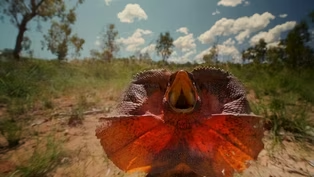
The Mating Ritual of Frilled Lizards
Video has Closed Captions
Clip: Ep1 | 2m 27s | Male frill-necked lizards compete with one another to win the love of a lucky lady dragon. (2m 27s)
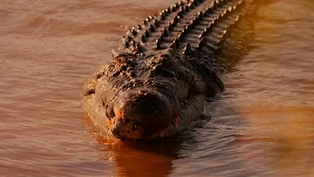
Saltwater Crocodile vs Wallaby
Video has Closed Captions
Clip: Ep1 | 4m 47s | Lacking water in the dry season, wallabies risk it all against the saltwater crocodile. (4m 47s)
Providing Support for PBS.org
Learn Moreabout PBS online sponsorship New Episode
- Science and Nature

Explore scientific discoveries on television's most acclaimed science documentary series.



 New Episode
 New Episode






Support for PBS provided by: