
The Prairie Ecologist and More
Season 17 Episode 4 | 24m 55sVideo has Audio Description
Photographer captures nature, Speakeasy Steakhouse, crash landing in Loomis
The Prairie Ecologist protecting ecosystems, the prairie. Down the Road from Ordinary - Sacramento has grain bins, and The Speakeasy, an unassuming steakhouse serving up fine dining in an unexpected place. Explorer I expedition crash-landed in a local farmer’s field during their daring attempt to reach the stratosphere.
See all videos with Audio DescriptionADProblems playing video? | Closed Captioning Feedback
Problems playing video? | Closed Captioning Feedback
Nebraska Stories is a local public television program presented by Nebraska Public Media
The Prairie Ecologist and More
Season 17 Episode 4 | 24m 55sVideo has Audio Description
The Prairie Ecologist protecting ecosystems, the prairie. Down the Road from Ordinary - Sacramento has grain bins, and The Speakeasy, an unassuming steakhouse serving up fine dining in an unexpected place. Explorer I expedition crash-landed in a local farmer’s field during their daring attempt to reach the stratosphere.
See all videos with Audio DescriptionADProblems playing video? | Closed Captioning Feedback
How to Watch Nebraska Stories
Nebraska Stories is available to stream on pbs.org and the free PBS App, available on iPhone, Apple TV, Android TV, Android smartphones, Amazon Fire TV, Amazon Fire Tablet, Roku, Samsung Smart TV, and Vizio.
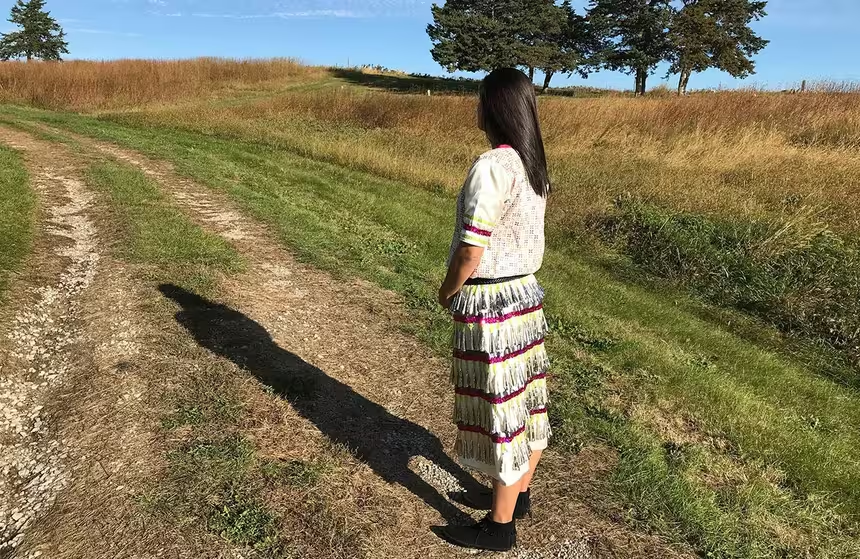
Do you have a Nebraska Story?
Do you have a story that you think should be told on Nebraska Stories? Send an email with your story idea, your name, your city and an email address and/or phone number to nebraskastories@nebraskapublicmedia.org. Or, click the link below and submit your information on nebraskastories.org.Providing Support for PBS.org
Learn Moreabout PBS online sponsorship(upbeat music) -[Narrator] Coming up on Nebraska Stories.
A photographer captures nature's smallest wonders.
The speakeasy a hidden gem where the steak does the talking.
And how a Nebraska town became part of one very strange crash landing.
(upbeat music) (upbeat music) (upbeat music) (car door opening) (door ajar dinging and rustling) (door clicking shut and rustling) -[Chris] I've been working in prairies and around prairies for more than 30 years.
Almost every time I go out, I see something I haven't seen before.
Prairies for most people, which is a place that people don't think about very often, or they just walk past them, mostly drive past them without thinking twice.
(birds chirping) Close up photography lets me take pictures of the things that are hidden in those prairies.
It helps me get people excited about prairies or interested in an ecosystem that they wouldn't think about.
Also, it helps me tell the story of what they need from a conservation standpoint, whether that's land management or just making sure that a prairie doesn't get plowed up, or making sure that we take care of the landscape around it.
(buzzing) (birds chirping) My name is Chris Helzer.
I'm the director of science and stewardship here in Nebraska for The Nature Conservancy.
(birds chirping) I do a lot of things.
I'm an ecologist and land manager.
In addition to that, I'm a photographer and a writer, both for The Nature Conservancy, but also on my own.
(birds chirping) The Niobrara Valley Preserve is 56,000 acres of land that the Nature Conservancy owns along the Niobrara River.
It is mostly grassland.
There's a lot of sandhills, grassland, but it also includes about 25 miles of river frontage.
(birds chirping) So there's a lot of different things here, all in one place.
(birds chirping) (serene music) As a scientist, when I walk around, I'm looking at things that I can quantify.
(serene music) I'm measuring how many flowers I see, or counting the species of plants or insects, or I'm looking at the way that our land management, like fire or grazing, is affecting the ecosystem or the plant communities.
(serene music) And then as a photographer, as soon as I pick up a camera.
(serene music) It opens up kind of a different world.
(serene music) There's a switch in my brain that flips, and now I'm exploring.
I'm looking more artistically.
I'm looking at light.
I'm looking at composition.
I see flies on a flower.
Or I'll see a grasshopper hiding behind a stem of grass.
(serene music) The grasshopper right here is called the sage wart grasshopper because its favorite food is sage wart.
(serene music) And it's the exact same color as the sage plant.
In fact, even the texture of the plant and the grasshopper patterning is really, really similar.
So you hardly ever see them when they're on their plant because they just blend in so well.
But if you walk through a patch of the plant and you can see them jump, that's the best chance to see them.
(serene music) All right.
I either got it or I didn't.
(insect chirping) Thank you for being accommodating, little friend.
When you see someone's face, you relate to it in a very different way.
And it gives insects and other small animals like that a personality that makes them a character that you can relate to.
(insect chirping) Hopefully, if I can show them face-to-face in their environment, that'll change the way people think about them.
(insect chirping) I don't think we even know how many insects you can find in a prairie.
There are so many that we haven't discovered yet and named, and the populations go up and down so much year to year.
They're really hard to study.
(wings flapping) People who never really stop and walk around the prairie are missing most of what's in there.
And especially if you stop and just just pause and watch.
You see all these things that start to move.
You see changes through time, whether that's through a day or across seasons.
(serene music) I've lived in Nebraska most of my life.
I grew up in western Nebraska and then Lincoln.
It wasn't until I was a sophomore in college that the idea of prairies in Nebraska really hit me.
(serene music) I was surrounded by prairies in my childhood, even when I was in high school and in Lincoln, I went fishing, and I would drive through prairies and walk through prairies to get to the lakes that I was fishing in.
I just never paid any attention to them.
So it's sort of become a mission of mine to get them into the mindset of Nebraskans.
Help Nebraskans feel proud about the prairies we have.
Half of our state is basically prairie or some kind of grassland.
We are known for some of our grasslands internationally.
The livestock production.
We get out of them, (serene music) the species that we are providing habitat for.
I mean, that's part of who we are in Nebraska.
(serene music) I really hope that when people look at my photos, they'll see what lives in the prairie.
I hope that when they see a prairie or they think about a prairie, they're thinking about the photos that they've seen of mine that show grasshoppers, spiders, katydids, bison, and prairie dogs.
They'll see what lives there.
And then when they think about prairie, they'll think about all of those things.
I'm really lucky that I get to work in places that are really beautiful.
What keeps me up at night is all the things that I haven't found yet.
I'm sure I'll be really excited about photographing and I get to find new ones every day, which means there's a long list out there still waiting for me to find them.
(serene music) (western music) (western music) (western music) -[Ryan] I always get a kick out of when people pull up because they're like, if you bring a new person.
They're like, where are you taking me?
Like, we're cruising along on a gravel road.
It's pitch black out and there's just this little dot with light.
(western music) It's the Speakeasy, like a steakhouse in the middle of cornfield.
Pretty much.
Yeah.
My father would tell me he'd have people refuse to come in.
They bring him in, they're like, "no, we're not going in there."
(western music) But they say, never judge a book by its cover.
(western music) (phone ringing) (soft background chatter) (phone ringing) -[Erica] We're definitely a very busy restaurant.
- We'll see you at 7:30.
-[Erica] Yeah.
So the phone starts ringing.
Everybody's calling to make reservations.
Oh, I'm sorry about that.
When Ryan came, we really kept the staple of the menu, like the steaks and the prime rib.
But his knowledge of cooking and of beef just elevated it so much.
And at first, people didn't know quite what to think about that.
But I would say from the time I've started until now, the business has over quadrupled, at least.
- Yeah, we get people from all over the place.
- Oh gosh, I've talked to people from Canada.
- They literally are coming from all over the United States.
I've had them from coast to coast.
- We'll have people from India, from Great Britain, all over the world.
(jazz music) - I think you have to be there.
-[Erica] You get a lot of people here, they're celebrating birthdays.
Big birthday today.
- Thank you!
50!
-[Erica] Anniversaries.
They maybe came with their families when they were kids and they're back visiting.
You said they're coming back now with their kids.
The other day I had a customer that came in.
They hadn't been here for 40 years, and they were probably in their late 70s, and they said they felt like they were coming home.
-[Taylor] I've worked at the Speakeasy for a little over two years now.
I love it.
Everybody who works here, it's like family.
So it's just great.
(soft jazz music) -[Erica] They are surprised a lot of the times, especially when you drive up outside and you see it's just this little, you know, kind of rundown building on the outside.
And then they walk in and you have a nice restaurant with the white linens and it's just kind of got a little nostalgic feel to it.
(soft jazz music) -[Dale] I really enjoy their Sacramento strip, and I like Ryan, and the staff has great service and friendly, and, (people chatting) plus the stories about, everything being haunted is kind of interesting too.
(eerie music) -[Taylor] Uh-huh.
Faceless Fred.
(eerie music) We've had weird things happen, you know, just here and there.
Like one time my hands were very full, and I was walking through these, swinging doors here, and they just floated open for me.
So a little bit of a gentleman, maybe.
-[Erica] The story behind Fred is that he was a gentleman that ran this building during the 20s, and he was not a well-liked man in the community or by his wife.
- What should I ask What happened to him?
-[Erica] He was slaughtered and thrown in our well.
- Oh, I'm really sorry, I asked.
- Well, the story is he cheated on his wife and she found out.
So she cut his face off and shot him and threw in the well.
Oh, people come in all the time for it.
- We want to meet him!
-[Ryan] It's pretty funny.
They always got to ask.
- A lot of people that are interested in the paranormal.
Initially they'll come because they're really interested in that ghost story, but then they end up coming back because they just had a great dinner.
- I love it.
It's my favorite.
Well, there's none left, but I order dessert first thing when I get here because it's my favorite.
And then I'm too full at the end, so I always order it first.
-[Erica] I think that obviously we have an amazing menu here.
We have an amazing chef.
The food is wonderful.
So you're going to get a great meal when you're here.
But I also think that they come because they do feel like they're at home.
I think it's a very comfortable, familiar place for them to be.
-[Taylor] Yeah.
It's great.
Like like it says, it's a Speakeasy.
It's kind of underground.
You'll you can drive by it ten times and never know it's here.
If you don't know, you know, in the outside of the building, it looks just like a regular old building in this town.
And you walk in and the vibes are immaculate.
(jazz music) (wind howling) (wind howling) -[Howard] Sometimes you couldn't hardly see across your yard, just so dense with dust.
(wind howling) You kind of wondered, how did we exist?
(wind howling) (wind howling) -[Nathan] In the early 1930s, there's a proto space race that has emerged between the Soviets, the United States and independent French aviators to reach the highest levels of the stratosphere and prove that human beings can ultimately survive at high altitude, and then eventually space.
(gentle music) (birds chirping) The Explorer I project was a collaboration between the National Geographic Society and the Army Air Corps, the precursor to the Air Force today.
The National Geographic Society paid for the construction of the gondola, the balloon, the scientific equipment.
(ambient music) The Army Air Corps would provide the infrastructure, the pilots, the technical know-how to actually operate this balloon.
(ambient music) This private-public partnership between these two entities (ambient music) allowed for an expensive and successful expedition to happen in the middle of the Depression.
(ambient music) (ambient music) (ambient music) They needed a place that would have ideal weather conditions, (ambient music) but then also, on the ground, you needed something that would protect the balloon as they were inflating it.
(ambient music) You can't have that thing flailing around, 'cause it takes a while to get all the hydrogen into the balloon.
(birds chirping) (ambient music) They ultimately settle on the Stratobowl outside Rapid City, South Dakota.
(ambient music) They built a military base at the Stratobowl.
Had a hospital, two radio stations, barracks, and then thousands of hydrogen containers (ambient music) just lining the rims of the Stratobowl.
(ambient music) Miles upon miles of rope that is required to control the balloon.
(ambient music) The balloon itself requires under three acres of fabric, (ambient music) which took five months to fabricate it.
(ambient music) It was linen that was rubberized and then produced by hand by the Goodyear Zeppelin Company.
(ambient music) The gondola itself was produced by the Dow Chemical Corporation.
It was a magnesium alloy and it weighed 700 pounds.
(ambient music) (ambient music) They picked some of the most talented men in the Army Air Corps.
(ambient music) One of the men has the parachute record at this point in time, 24,000 feet.
(ambient music) You've got the first human being to photograph and see the curvature of the earth.
(ambient music) You've got men who have been in the air, (ambient music) who have been in balloons, high-altitude situations.
(ambient music) Some have combat experience in the First World War.
(ambient music) (ambient music) These are men who are trained, who are experts.
(ambient music) They know what they're doing.
(ambient music) They're very well aware of the dangers of what could happen.
(soft music) (soft music) Hydrogen, like helium, is a lighter-than-air gas.
(soft music) Very abundant, but has the unfortunate side effect of being very explosive, as we all know from the Hindenburg explosion, which happens a couple of years later.
(soft music) (soft music) (soft music) (soft music) They are constantly checking the weather.
They work all through the day and then all through the night.
They've got to put all the pieces together.
They've got to get the batteries in, as well as radio equipment, all sorts of different sensors.
They load cold-weather clothing because this is not an insulated gondola.
They are going to pass through some very, very cold portions of the atmosphere.
(soft music) They are getting everything prepped and ready to go.
(soft music) (soft music) (soft music) And they just lift and lift and lift.
(soft music) They begin to drift south.
(soft music) They're going over northwestern Nebraska.
There are spotter airplanes that are following them.
(soft music) The equipment is working, they're making their observations and everything is going real fine.
(soft music) There's suddenly a shutter.
(soft music) A tear forms in the envelope, and they realize that they're not going to be able to make it to the 75,000 feet that they wanted.
(soft music) They need to slowly and have a very controlled descent if they're going to survive.
(soft music) (machine whirring) They're about 5,000 feet above Loomis, Nebraska.
(machine whirring) They are in preparation to jump.
(soft music) Somebody steps on Captain Anderson's parachute and releases the parachute in the gondola.
And so he has it bunched up in his arms and is at the top of the parachute, and he and Major Kepner are having a debate about whether he can just heave his parachute out and will it catch?
Will it land?
Will he survive?
(soft music) The balloon explodes, and the gondola just becomes a bomb.
(soft music) Captain Anderson just heaves his parachute out.
It catches.
(soft music) Major Kepner kicks Captain Stevens out one of the portholes.
(soft music) (soft music) and then Kepner is the last one to land.
(soft music) The gondola lands about 150 feet before them, just exploding all over Reuben Johnson's cornfield.
(soft music) At the time, everyone in the nation was glued to their radio sets listening to this live.
(soft music) After the crash happens, Major Kepner makes his way to the Johnson farmhouse, gets on the phone and calls headquarters.
He's talking with headquarters, and then a voice breaks in and says, "It's NBC.
You're going live.
Tell everybody what's going on."
(twangy music) And in this moment, thousands of people are descending upon this cornfield north of Loomis.
(twangy music) Everybody in central Nebraska wants to be a part of it.
(upbeat twangy music) There's no crowd control.
(upbeat twangy music) People are pocketing pieces of the envelope.
(upbeat twangy music) There's a gentleman who takes an entire hatch and later donates it to the State Historical Society in Lincoln where it remains.
(upbeat twangy music) They're taking the scientific equipment, they're taking really whatever they can get their hands on 'cause they want to be part of this event.
They want to have a souvenir.
(upbeat twangy music) (upbeat twangy music) This becomes a problem.
(upbeat twangy music) The National Geographic Society and the Army Air Corps want everything back so they can figure out what happened.
(upbeat twangy music) There are calls that are put out in all of the local papers saying, "Did you take something?"
The "Kearney Hub" leads this effort, and locals are sending things back to the National Geographic Society.
(upbeat twangy music) The cause of the crash is ultimately determined fault with the envelope.
That it froze, opened, it cracked and tore, and the National Geographic Society sends stuff back.
(upbeat twangy music) Today, the Nebraska Prairie Museum, Fort Kearney Museum in Kearney, as well as History Nebraska all have artifacts from this expedition.
(upbeat twangy music) (upbeat twangy music) -[Howard] My dad was a souvenir seeker.
He took something that he shouldn't have, but at the same time, we, today, get to share in what it was.
This is little tiny pellets of lead, and this was used as ballast in the balloon.
I was four years old and my parents, they were out observing.
I thought, "What would cause them to be looking up at the sky for something?"
They had gotten news by the radio about this balloon coming across from South Dakota, and I remember, finally I said, "Oh, I can see that white spot up there."
(soft music) We were four miles northwest of the crash site, (soft music) so my dad went to the site, came home, he put it in the bottle.
(soft music) It's been in his bottle for 90 years.
(soft music) (soft music) But I also remember days in that period of time, we had severe dust storms.
(soft music) Some days it'd last for days and days, (soft music) and sometimes almost blackouts, just dust.
(soft music) -[Nathan] It was a media sensation.
It has been forgotten and remembered and forgotten and remembered.
People in central Nebraska, in the darkest of their days, finding support or comfort or connection into a wider world that they could be part of something, they could be part of something greater.
(soft music) (soft music) (soft music) (soft music) (soft music) (upbeat music) (upbeat music) - [Narrator] Watch more Nebraska stories on our website, Facebook and YouTube.
Nebraska Stories is funded in part by the Margaret and Martha Thomas Foundation, and the Bill Harris and Mary Sue Hormel Harris Fund for the presentation of cultural programming.
(upbeat music) (upbeat music) (upbeat music) (upbeat music)
Video has Audio Description
Clip: S17 Ep4 | 5m 46s | The Speakeasy, a hidden gem where the steak does the talking. (5m 46s)
Video has Audio Description
Clip: S17 Ep4 | 6m 44s | A photographer reveals life at insect scale (6m 44s)
Providing Support for PBS.org
Learn Moreabout PBS online sponsorship

- News and Public Affairs

Top journalists deliver compelling original analysis of the hour's headlines.













Support for PBS provided by:
Nebraska Stories is a local public television program presented by Nebraska Public Media