Chicago Stories
The Rocky Rise of Hancock Tower
Clip: 10/16/2026 | 6m 36sVideo has Closed Captions
The John Hancock Center was one of the city’s most improbable success stories.
The John Hancock Center was the city’s boldest idea yet and one of its most improbable success stories. But building the behemoth was not without its problems.
Problems playing video? | Closed Captioning Feedback
Problems playing video? | Closed Captioning Feedback
Chicago Stories is a local public television program presented by WTTW
Lead support for CHICAGO STORIES is provided by The Negaunee Foundation. Major support is provided by the Abra Prentice Foundation, Inc. and the TAWANI Foundation.
Chicago Stories
The Rocky Rise of Hancock Tower
Clip: 10/16/2026 | 6m 36sVideo has Closed Captions
The John Hancock Center was the city’s boldest idea yet and one of its most improbable success stories. But building the behemoth was not without its problems.
Problems playing video? | Closed Captioning Feedback
Where to Watch Chicago Stories
Chicago Stories is available to stream on pbs.org and the PBS app.
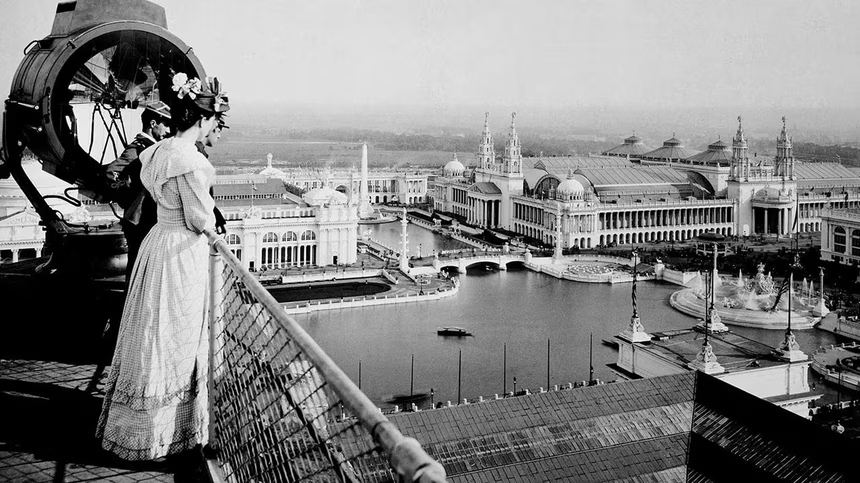
Chicago Stories - New Season!
Season 6 includes: The World’s Fair of 1893, Toy Town, Skyscrapers, and Home of the Irish.Providing Support for PBS.org
Learn Moreabout PBS online sponsorship- [Narrator] It is no surprise that the city that helped invent the skyscraper, and refused to stop reinventing it, would eventually build sky high.
And despite near calamity during construction, one building stands out as being quintessentially Chicago.
- The Hancock Building, that represents Chicago better than almost anything, because it's burly, because it's mercantile, because it's taller than everything else, because it takes no prisoners.
It's just got a kind of great Chicago kind of solid character to it.
- [Narrator] The 100-story giant owes much to Chicago's proud architectural tradition, but even more to newcomers who came to build something unique.
- The John Hancock Center is an incredible story.
It involves a developer from the East Coast, Jerry Wolman, owner of the Philadelphia Eagles.
- [Narrator] In 1964, 37-year-old developer Jerry Wolman was the youngest team owner in the NFL when he bought a full city block on North Michigan Avenue, a neighborhood of old residences and quaint shops.
- He wants to develop a complex there, which builds on the advances of Marina City in that it would mix different uses, office, residential, retail.
- [Narrator] Shooting for the stars, Wolman turned to the Chicago-based office of the world's largest architectural firm, Skidmore, Owings & Merrill, known as SOM.
Its top designer was Columbian-born architect Bruce Graham.
- One of the finest architects walking the planet.
- [Narrator] Graham worked closely with SOM's up-and-coming engineer, Fazlur Khan.
Khan was born in Bangladesh and studied engineering at the University of Illinois.
He didn't set eyes on a skyscraper until he was 21.
- Fazlur Khan is one of those very rare individuals who I think a lot of people would say is like right up against the edge of what makes a genius very modest as a human, but smart as hell, and understood that if you were going to go really tall, which Chicago went really tall and really big at the same time, you're going to have to do it differently.
That combination of Bruce Graham and Fazlur Khan doesn't come along all that often.
But when it does, you get magic.
- [Narrator] Graham told Khan, "If you create a structure, we'll make architecture out of it."
Easy to say, harder to do.
Khan envisioned a brand new way to support a tower.
He called the structure a tube.
Unlike the more traditional steel frame with many columns inside the building, the tube used narrowly spaced columns on the edges of the tower and distinctive X-shaped cross bracing to push the weight of the building to the exterior.
- [Reed] And it is much stronger to resisting those wind forces.
- And that enables the developers to build this building for something like 60% or less of the cost.
It also opens up floor space on the inside because you don't have this cage eating up real estate.
- Our tall buildings are tubes.
Great idea.
Happened here.
- [Narrator] Still, engineers could not be certain that a building of that height was capable of withstanding gravitational forces and Chicago's fierce winds.
Khan's team ran simulations on computers years before it became standard practice.
- It's a massive step forward.
I mean, because IBM, after World War II, IBM has created a corporate computing machine.
They're huge.
You know, they take up huge rooms, they heat the room to about 100 degrees.
Having that extra partner made an enormous difference.
- But as the frame rose, computers could not save it from a manmade catastrophe deep underground.
- The foreman comes on site one day and sees that one of the columns has dropped, not very much, like an inch and a half, but that's enough to stop the whole project, because it means that they don't know what's happening underground.
- Of course, the first response is, "You're crazy, you don't know what you're doing, okay?"
And eventually, you know they became convinced that yeah, it moved.
- Then they knew there was a problem.
And of course, you know, with due diligence, they stopped work on the job.
- [Narrator] They discovered several concrete columns set into bedrock to support the building had been compromised in the rush to build, causing them to sink.
- So they dug it out, and they found, and this is very interesting, there was nothing holding the Earth from caving in.
- It was a very costly delay.
- [Narrator] Engineers fixed the mistake, but the delay bankrupted Wolman.
- The insurance company that had put the money up took the project over, saw it through to its completion.
- [Narrator] Chicagoans looked on warily as the dark monolith rose over the next three years.
When it was finished in 1969, the city looked up in awe.
- The John Hancock Insurance Company then very rightly asked if they could put their name on the building.
- So it's big at the bottom, and it stays pretty solid all the way up, and then it's got its belt and suspenders on its outside so you can see it all the way.
It is a magnificent building.
- [Narrator] It swayed up to eight inches in high winds, but stood proud.
At 1,128 feet, even more with its antennae, it became the tallest building in Chicago and an engineering triumph.
- A real symbol of the city, its mixture of blue collar, toughness, and black tie elegance.
I've often compared it to a Prohibition Era gangster wearing a tuxedo.
 New
New10 Unsung Heroes of the Chicago Skyline
Video has Closed Captions
Explore 10 skyscrapers that deserve more attention, from Art Deco gems to modern towers. (5m 37s)
 New
NewThe Daring Feat of the Auditorium Building
Video has Closed Captions
When the Auditorium Building opened in 1889, it was the tallest building in Chicago. (5m 2s)
 New
NewJeanne Gang’s Mark on the Chicago Skyline
Video has Closed Captions
Architect Jeanne Gang has added two distinctive buildings to the Chicago skyline. (5m 58s)
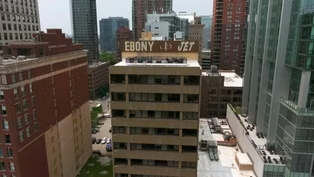 New
NewJohn Moutoussamy and the Johnson Publishing Building
Video has Closed Captions
The Johnson Publishing building was the first high-rise in Chicago designed by a Black architect. (3m 4s)
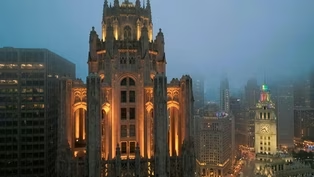 New
NewThe Wrigley Building and Tribune Tower
Video has Closed Captions
Across Michigan Avenue from one another are two Chicago icons. (4m 50s)
Providing Support for PBS.org
Learn Moreabout PBS online sponsorship











Support for PBS provided by:
Chicago Stories is a local public television program presented by WTTW
Lead support for CHICAGO STORIES is provided by The Negaunee Foundation. Major support is provided by the Abra Prentice Foundation, Inc. and the TAWANI Foundation.