Chicago Stories
The Wrigley Building and Tribune Tower
Clip: 10/16/2026 | 4m 50sVideo has Closed Captions
Across Michigan Avenue from one another are two Chicago icons.
Across Michigan Avenue from one another are two Chicago icons: the Wrigley Building, and Tribune Tower. The latter emerged from a competition to design the most beautiful building in the world.
Problems playing video? | Closed Captioning Feedback
Problems playing video? | Closed Captioning Feedback
Chicago Stories is a local public television program presented by WTTW
Lead support for CHICAGO STORIES is provided by The Negaunee Foundation. Major support is provided by the Abra Prentice Foundation, Inc. and the TAWANI Foundation.
Chicago Stories
The Wrigley Building and Tribune Tower
Clip: 10/16/2026 | 4m 50sVideo has Closed Captions
Across Michigan Avenue from one another are two Chicago icons: the Wrigley Building, and Tribune Tower. The latter emerged from a competition to design the most beautiful building in the world.
Problems playing video? | Closed Captioning Feedback
Where to Watch Chicago Stories
Chicago Stories is available to stream on pbs.org and the PBS app.
Chicago Stories - New Season!
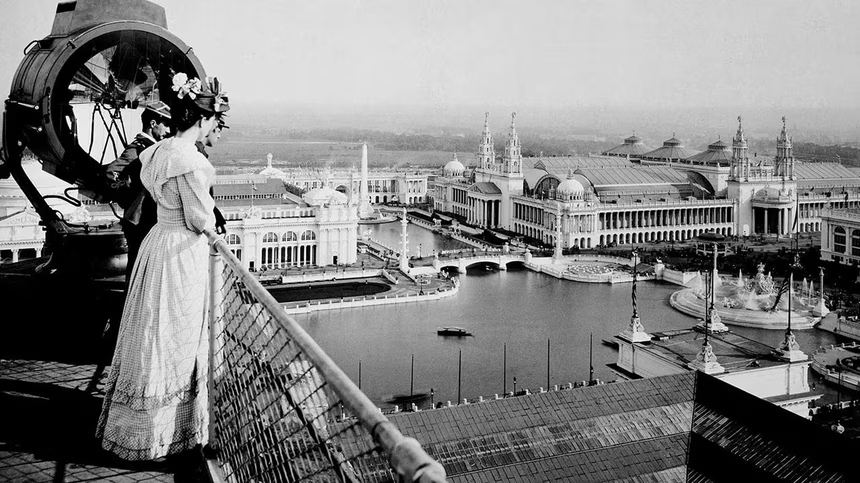
Season 6 includes: The World’s Fair of 1893, Toy Town, Skyscrapers, and Home of the Irish.Providing Support for PBS.org
Learn Moreabout PBS online sponsorship(traffic roaring) - [Narrator] The skyscraper began to take on a new shape.
Chewing gum magnate William Wrigley's 1921 building showed off the look, rising to an impressive 438 feet, thanks to its famous clock tower.
- The Wrigley Tower does become this symbol of capitalistic achievement, and of course the symbol that Chicago north of the river had arrived.
- And they see the buildings basically as large billboards that can not only house their workers, but that can also essentially be part of their marketing scheme, that the skyline can become part of their advertising.
- The city's skyline becomes not a skyline of church towers, right, devoted to God, but rather skyscrapers devoted to money.
- [Narrator] The Wrigley Tower stood proudly north of the river, where land was cheaper and poised for growth due to the newly opened Michigan Avenue Bridge.
Soon, others would follow.
- Colonel Robert McCormick was the editor and publisher of the Chicago Tribune and a man of great ambition and foresight.
- [Narrator] Colonel Robert McCormick returned from serving in World War I to take over the family newspaper.
- He was looking at the skyscraper as a corporate marketing tool, an icon that represented his business.
- [Narrator] Eager to make his mark, McCormick launched an international competition to design new headquarters for his newspaper, a monument to the free press and the Tribune itself.
He offered a $100,000 prize for the most beautiful office building in the world.
- Ah, the Chicago Tribune competition, what an amazing thing for the city of Chicago and for the history of architecture.
- More than 263 entries poured in from 23 countries around the world.
A brilliant range of designs.
- You had really strict modernist designs coming from Bauhaus, architects in Europe, and then you had pretty conservative classical designs done largely by American architects.
- The winning entry by John Meade Howls and Raymond Hood is a neo-Gothic spectacular with flying buttresses that don't really hold anything up, but create a tremendous crown, a distinctive presence for the city.
- Why does it look like a Gothic castle from centuries past when it's in the middle of a new city right by the lake?
- I think that they wanted something flamboyant, something that really would go on every postcard that would come out of Chicago, and the Tribune Tower truly did that.
- [Narrator] At 465 feet, the Tribune literally towered over the Wrigley building.
But many preferred the runner up.
- It's a story of not the first place winner.
It's a story of the second place winner.
- [Narrator] That was designed by Eliel Saarinen, an architect from Finland at a time when there wasn't a single skyscraper in Europe.
- Saarinen's entry introduces a trim vertical look of refined setbacks and ornament that is at once solid, but also soaring.
- [Narrator] Louis Sullivan, nearing the end of his life, praised Saarinen's design.
- Sullivan himself calls it a pearl, something that foreshadows the future.
You can go to almost any American city and find a knockoff of Saarinen's Tribune Tower entry, whether it's San Francisco, whether it's Houston, whether it's New York, Chicago, anywhere.
- [Narrator] Including a building that in 1930 became the city's tallest, the 605-foot Chicago Board of Trade, towering over the financial district.
- That building is doing everything it was designed to do, which is to look straight up at it.
I've watched people do it all the time.
They stand there and they immediately do this and I always kind of like, you know, walk by like, yes.
- That view straight south on LaSalle Street into that building becomes the quintessential vision of Chicago.
- It creates a very important kind of exclamation mark of capital right on the street of Capitol in Chicago.
- Capped by a beautiful statue of Ceres, the goddess of grain and agriculture.
 New
New10 Unsung Heroes of the Chicago Skyline
Video has Closed Captions
Explore 10 skyscrapers that deserve more attention, from Art Deco gems to modern towers. (5m 37s)
 New
NewThe Daring Feat of the Auditorium Building
Video has Closed Captions
When the Auditorium Building opened in 1889, it was the tallest building in Chicago. (5m 2s)
 New
NewJeanne Gang’s Mark on the Chicago Skyline
Video has Closed Captions
Architect Jeanne Gang has added two distinctive buildings to the Chicago skyline. (5m 58s)
 New
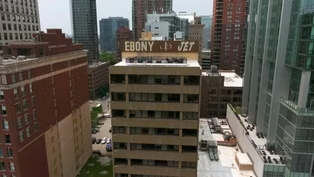
NewJohn Moutoussamy and the Johnson Publishing Building
Video has Closed Captions
The Johnson Publishing building was the first high-rise in Chicago designed by a Black architect. (3m 4s)
 New
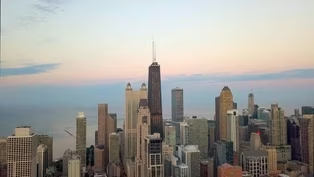
NewThe Rocky Rise of Hancock Tower
Video has Closed Captions
The John Hancock Center was one of the city’s most improbable success stories. (6m 36s)
Providing Support for PBS.org
Learn Moreabout PBS online sponsorship







Support for PBS provided by:
Chicago Stories is a local public television program presented by WTTW
Lead support for CHICAGO STORIES is provided by The Negaunee Foundation. Major support is provided by the Abra Prentice Foundation, Inc. and the TAWANI Foundation.