
The Russian Thing
Episode 2 | 55m 55sVideo has Closed Captions
When the Soviet Union falls, Russia welcomes US astronauts to their space station Mir.
When the Soviet Union falls, Russia welcomes US astronauts to their space station Mir. But co-operation between former the Cold War enemies is threatened by a run of disasters onboard.
Problems playing video? | Closed Captioning Feedback
Problems playing video? | Closed Captioning Feedback
The Russian Thing
Episode 2 | 55m 55sVideo has Closed Captions
When the Soviet Union falls, Russia welcomes US astronauts to their space station Mir. But co-operation between former the Cold War enemies is threatened by a run of disasters onboard.
Problems playing video? | Closed Captioning Feedback
Where to Watch Once Upon a Time in Space
Once Upon a Time in Space is available to stream on pbs.org and the PBS app.

Share Inspiring Moments From The Film
Explore the PBS Giphy collection for Once Upon a Time in SpaceProviding Support for PBS.org
Learn Moreabout PBS online sponsorshipINTERVIEWER: Does that mean you're like the 92nd Russian to ever go up to space?
Absolutely right.
['Swan Lake' by Pyotr Tchaikovsky] ['Swan Lake' continues] ['Swan Lake' continues] ['Swan Lake' continues] ['Swan Lake' continues] ['Swan Lake' ends] [chuckles] [both chuckle] [laughs] [soft music] [soft music fades out] [both laugh] [elegant music] [both chuckle] [crowd clamors] REPORTER: This is the middle of the checkpoint.
The police are making no attempt to stop people.
The gates have been thrown open, and thousands of people are pouring over to take a look at the West.
In some cases, their first look.
And the elation is enormous.
[cheering and applause] REPORTER: Several thousand demonstrators marched in Moscow today demanding the abolition of the Communist Party's right to rule.
[thrilling music] JERRY LINENGER: So I was an astronaut candidate training.
And they had brought up at one of the weekly meetings that there's going to be something going on.
We're going to do some cooperative flights with the Russians.
Might want to start looking into it a little bit.
Who's interested?
INTERVIEWER: Would you say it was a popular idea in the astronaut corps?
No, I would not say it was popular in the astronaut corps when they said, you know, we're going to start engaging the Russians.
I'm an old Cold War kind of guy.
Growing up, the whole time they are the enemy.
You know, the Soviet Union is stirring up trouble all over the world.
So my entire life from, you know, day one in the space race, going up into the military and US Navy, it was the foe was Russia.
And I think guys like Mike Foale understood it better than I. This is diplomacy.
Mike had a different cultural background.
Smart guy.
Sharp guy.
My background was that I had gone to a British boarding school and then Cambridge University as a scientist.
WOMAN: Up on the top... MICHAEL FOALE: So I always thought I was an unusual astronaut applicant because I don't have the American accent.
But I did have the American citizenship through my mom.
My military colleagues, they were not happy about collaborating with Russia, but because I'm a physicist and a geek and I like rocket science.
You know, I'm just curious to see this former enemy, to understand how the Russian space systems worked.
MALE SPEAKER: In Ukraine.
near Kyiv, nuclear warheads are taken off short range missiles to be destroyed.
But as military production and research are cut back by arms control treaties and hard times, there's widespread concern both here and in the West that top former Soviet nuclear scientists may be taking work in Libya, Iran or Iraq.
MICHAEL FOALE: The very highly educated Russian rocket scientists who worked also with the nuclear weapons industry within the former Soviet Union, those people were not being paid.
The government had no money to pay.
The United States became concerned that the weapon knowledge would go to rogue states, as Americans call them.
They knew they needed to keep Russia's space program active, productive, and not spreading nuclear weapons and rocket technology beyond its borders.
What we Americans were aware of was that the Russians were really good at putting people into space and letting them live there for six months at a time.
But the Mir space station program, which was their crown jewel of space, was now struggling to survive.
So the program that was invented was what Americans called Shuttle Mir and what Russians call Mir Shuttle.
And it would allow the United States to pass money to Russia.
All this meant that now NASA astronauts and Russian cosmonauts would have to start working together.
JERRY LINENGER: I tell you, it's near Moscow.
It's a place called Star City.
It's got a gate around it.
And there's guys with machine guns.
And it used to be kind of a KGB place.
So it took a while before I said yes, I'm interested.
I had to look into it a bit, but I was... let me say this, I'm a new astronaut, and if there's flights to go to space coming up pretty soon, that's something I'm interested in.
So I kind of put my name into the, you know, mix there and said, yeah, I would be interested in doing the Russian thing, as that's what we called it, basically.
"The Russian Thing" was kind of the title around the astronaut corps.
[indistinct chatter] MICHAEL FOALE: Commander Jim Weatherby said, I'm trying to find astronauts who were willing to go to Russia.
We'd heard stories about what Russia was like at that time in 1995.
There was all kinds of theft out in the open on the streets of Moscow.
We know that there were criminal gangs roaming there.
And then Jim said, well, anyway, we've been invited to Moscow and to visit Star City for a week.
And, I went, okay, I'm a tourist.
I'm cool, you know, and arrived there.
And you can just see all the disused cars, and there are prostitutes on the street and things, and I'm looking at my crew.
We're all pretty jetlagged, I think.
Wow, this is pretty rough.
The driver says, let's turn on some music.
They turn it on immediately.
They have Depeche Mode.
We're hearing this Depeche Mode as we driving down the highway down into central Moscow towards Red Square.
And I'm thinking, oh, things are looking up.
[laughs] ['Just Can't Get Enough' by Depeche Mode] ♪ When I'm with you, baby ♪ ♪ I go out of my head ♪ ♪ I just can't get enough ♪ ♪ I just can't get enough ♪ ♪ All the things you do to me ♪ ♪ And everything you said ♪ ♪ I just can't get enough ♪ ♪ I just can't get enough ♪ MICHAEL FOALE: We were driven to an office.
And a secretary comes out.
She says, oh, Dr.
Foale, so nice to meet you.
Isn't it just wonderful that you and your family are going to be living here in six weeks time?
And I go, what?
For a year and a half?
That was how I learned that the decision had been made to send my family to Russia without me actually saying yes.
That's our new house, the big yellow house, as the Russians call it.
The Russians had looked in a catalog or something and said, how do Americans want to live.
WOMAN: This is our bedroom.
This is where the kids take a bath in our big bathroom.
MICHAEL FOALE: Each morning we'd walk out of that cottage and they just looked out of place.
They looked wrong.
And I thought, what was there before?
And I asked people at the desk, I said, what was there before?
And she said, oh, it was a beautiful park.
All the children would play there.
It was such a happy place and the trees were beautiful.
And then they cut it all down for the Americans.
I was pretty distressed to hear that.
[indistinct dialogue] JERRY LINENGER: Training was kind of similar.
It's a much simpler system.
Shuttle has, for example, 2,000 switches.
The Soyuz capsule was much simpler, more analog.
Some of the trainers were older men that had been doing this for, you know, the last 30 years.
For them, and I understood, when they're sitting there addressing a U.S.
astronaut trying to teach me something that they don't want to be my friend.
You know, they were brought up on, these are the guys we're in competition with.
These are the enemy.
And why is a U.S.
naval officer sitting here in front of me anyway?
And what's he doing in Star City, Russia?
[indistinct Russian dialogue] [light music] MICHEL FOALE: They have you stand like this.
And they have you close your eyes.
And as soon as you move your foot, you fail.
[indistinct chatter] [soft music] [indistinct Russian dialogue] [soft emotive music] [indistinct Russian dialogue] [droning pitch] On this journey, I am just a tourist.
I'm a guest to watch my future hosts on the Mir space station.
Vasily and Sasha be launched into space, and I will join them later on a shuttle.
Jerry Linenger is on the Mir at the time.
And so we're driving to this place that has enormous historical significance, because it's where the very first human, Yuri Gagarin, was launched into space.
[ethereal music] [indistinct Russian dialogue] [indistinct Russian dialogue] [indistinct Russian dialogue] [priest reciting prayer] [soft music] [soft dramatic music] [indistinct Russian dialogue] [ethereal music] [indistinct Russian radio chatter] JERRY LINENGER: I was already experienced a month aboard when Sasha and Vassily showed up.
Sasha Lazutkin, military engineer.
Sharp guy.
Vasily Tsibliev MiG fighter pilot.
Sharp guy.
Sasha Lazutkin, it was his first flight ever.
And he was given a broken down space station.
It's like grandma's basement.
Best way to describe it.
Just musty, moldy smelling.
Different than the shuttle.
Cluttered.
So it's just bags, you know, velcroed or bungee corded to the side, just leftover gear.
Broken down equipment.
So I had a lot of chuckles, I guess when I first got on board.
Like, there is nothing in here that works any longer.
JERRY LINENGER: Our oxygen system was breaking down pretty much once a week, and so we were using backup systems.
And Sasha Lazutkin went over to go start up a little canister which supplies supplemental oxygen.
The last thing I remember is him going over into a different module, inserting the canister.
Then I flew away, went up on the ceiling, laptop computer, typing in some data from a metallurgy experiment I was doing.
[dramatic music[ JERRY LINENGER: And then I hear blang, blang, blang, blang, blang.
Master alarm going off again.
Now, I've been hearing master alarms two or three a day my first month on Mir.
So it was nothing unusual.
I very casually entered the last of the data, pushed off, go to turn the corner to get back into the base block.
I could see where the flame was coming and it was a big flame coming out two, three feet in length.
Blow torch-like in intensity, sparks flying off the end of it.
But I have never seen smoke spread like it spread out in that space station.
Within the first 30 seconds or so, can't see the five fingers in front of my face.
Knew I needed to get a respirator on in order to survive.
Felt my way along the wall, located the respirator, starting to feel a little tunnel vision, little peripheral, you know, vision.
Not looking real clear from needing oxygen.
Locate that respirator, flick the lever over to activate it.
[inhales] Mask just collapses around my face, and I think to myself, you know, I'm in big trouble if I can't get this thing working.
DAN RATHER: The crew aboard the Russian space station Mir, including a visiting American astronaut, had to put on protective masks and break out the fire extinguishers overnight to fight a blaze in an air filtering unit.
There was some fire damage to the equipment, and crew members suffered throat irritation.
14 minutes into the fire, 1-4 minutes into the fire, fire is out.
INTERVIEWER: Did you consider how existence, your existence, is tenuous out there?
Yeah.
I had many moments where I said, you know, this could be the end of my life.
And that's where I started writing little letters to my son every night.
"I love the heck out of you, John.
A father's love for his son.
I'd do anything for you.
I'm told that when you see my picture, you point to it and say, 'Mommy.'
you haven't learned the word 'daddy' yet.
That is my fault.
But us fathers are pretty good at excuses -- work, tired, football's on TV.
So instead of saying I was in space, let me instead just ask for your forgiveness.
For times not spent together.
And while I'm at it, mommy's too.
Love and miss you both, Dad."
[no audible dialogue] JERRY LINENGER: Yeah!
[laughing] MICHAEL FOALE: I suddenly get an email.
Jerry had sent this report, describing what turned out to be an incredibly serious event.
And he's making a very serious point to NASA management saying, I don't think we should continue.
And I remember looking out the window thinking, huh, is this going to stop me flying in space?
INTERVIEWER: Did it make you doubt whether you should be going?
No, I didn't doubt whether I should be going up.
I just was unsure what my management were going to decide.
But why would you not doubt?
My take on taking risks is if the danger has already happened, it's not going to happen again.
MALE SPEAKER: British astronaut Michael Foale looked supremely confident as he walked out to the shuttle, blowing a kiss to NASA staff.
He's been described as the most important piece of cargo on board Atlantis.
MICHAEL FOALE: My feelings about the value of continuing the program really was, it's hard here.
It's not comfortable.
But what we're doing in the big picture is worthwhile.
MISSION CONTROL: Headed downwind level to the 8.5 minute ride to orbit.
Mike Foale headed to the Mir space station.
JERRY LINENGER: It's kind of like, you know, someone's coming to visit you and you know they're coming, so we'd better clean up a little bit.
We don't want all the dust balls all over the place.
The Russians were a bit more extreme.
As a matter of fact, it wasn't just Sasha and Vasily saying, we'd better clean up and make it nice.
I think they had orders from down below.
And so you try to spruce things up.
But it's pretty superficial because you might stuff something behind a panel.
But that piece of gear still needs to get fixed.
RADIO: Yelena, come on in.
MICHAEL FOALE: So it was very exciting.
I can hear loud Russian disco music, stuff I like.
And I can smell food.
Meat and potatoes.
My stuff.
Man, it smelled great.
And already Jerry's giving me vibes... [laughing] that things aren't so good.
[laughing] And he said something very soon after this.
He said, don't believe what you see.
[laughs] I definitely warm liked it.
Things might seem good now, but when we close this hatch, you're going to have to make that space station work for you.
RADIO: [indistinct] ready to close the hatch.
And we wished them well.
Had a great flight.
[indistinct Russian dialogue] It was, you've got the Mir.
I am back on U.S.
soil.
I'm sucking down fruit cocktail, dehydrated.
I'm not eating borscht anymore.
Don't get me wrong, it was a great moment and I was glad to be going home.
But on the other hand, I appreciated the time I had, the privilege I had to be up in space for five months.
MALE SPEAKER: U.S.
astronaut Jerry Linenger is back on earth, not a moment too soon.
In about three weeks, he is due to become a father for the second time.
FEMALE REPORTER: What was the first thing he said to you?
He doesn't quite talk yet.
I think he said "mama" maybe.
[laughter] MICHAEL FOALE: My fears about not being accepted, not being well understood, sort of diminished.
[indistinct Russian dialogue] I practiced my Russian a lot, and at some point, maybe the day after the shuttle left, I was getting my stuff ready.
Sasha floats in and says, Michael, how are you doing?
Come on, have some tea.
You know, stop that now.
And I realized that Jerry had never done that.
INTERVIEWER: Jerry had never joined them for tea?
Not like that.
So I said, thanks, Sasha.
So I floated after him and we just chilled.
[indistinct Russian dialogue] [light electronic music] MICHAEL FOALE: I had a laptop that had a camcorder input, and I could play tapes through the camcorder to the laptop and see it on screen.
- INTERVIEWER: Like films.
- Yeah.
So I invited Vasily and Sasha to come in and watch the movie with me.
And I obviously had chosen these movies.
Guilty.
But I had chosen 2001, The Right Stuff.
Total Recall, I remember.
especially when they shoot at the Mars dome and it depressurizes.
[gunshots] [explosion] [shouting] Sasha said to me later on, he had a premonition when he saw that.
I was curious And I just said, oh, so you've done this before?
He said yes, it wasn't good.
It almost hit us.
And... Vasily was kind of rude about why he was having to do it.
I said, I'm not sure it's a good idea to do this again.
MICHAEL FOALE: I see Vasily is at the controls, and I look at the TV screen, and then I see the Mir is in a weird orientation for a vehicle that's trying to dock with it.
It just looks wrong.
And... the next couple of seconds, I then noticed that Sasha and Vasily are both very quiet, but the Mir looks pretty big in the TV screen, and it's getting bigger.
[music intensifies] MICHAEL FOALE: The station just shudders around me.
[indistinct Russian dialogue on radio] I hear the alarm go, ba, ba, ba, ba.
And it's the depressurization.
Losing the air in the station to the vacuum of space.
And then my ears start to pop.
I go, oh, okay, I get what's going on.
We are leaking.
The air is moving out of the station.
I was worried about getting into the Soyuz quickly enough so that we weren't all unconscious, because we are all going to pass out pretty soon.
[deep sigh] MICHAEL FOALE: And so at that point, the depressurization emergency is over.
And we kind of breathe a sigh of relief.
But we didn't have much respite because as we go into darkness, another alarm goes off.
[alarm blares] MICHAEL FOALE: And then we hear the fans stop and then the lights go out.
And that has slow consequences but deadly ones, if it persists.
[heavenly music] [music crescendos] [soft ethereal music] MICHAEL FOALE: The space station was now dead and tumbling.
And we were going into darkness on the dark side of the earth.
I knew as a physicist how you apply thrusters to a rotating body to make it stop rotating and point somewhere.
And so I just made the comment, could we use the Soyuz thrusters to point the Mir to the sun?
The tough part about all of this is you can only fire a thruster for maybe ten minutes before you use up the fuel, all the fuel, and then you can't come home.
[chuckles] And so we had to now discuss, what is this strategy?
How do you know how fast you're tumbling?
MICHAEL FOALE: You look out the window.
You shut one eye and you put it against the star.
And if the star moves past your thumb in one second, you know you're rotating at about half a degree per second.
Vasily's in the Soyuz through a tunnel and another tunnel.
We are completely confused as to which way he should be moving the thruster to get the effect I wanted in the module where I had my thumb.
And so we had to do this three or four times, trial and error, and we went the wrong way.
We made it worse one time, before we got it worked out.
MICHAEL FOALE: I believe that we as a crew saved space station Mir that day.
Now the management would say, we the crew almost destroyed the space station Mir that day.
[laughing] - INTERVIEWER: Yeah.
- But I dispute that.
- INTERVIEWER: You saved it.
- We saved it.
MALE SPEAKER: With a series of mishaps and near disasters that have befallen Mir, conversations with Mission Control have been tense.
But there was a welcome break from that routine on Sunday.
RADIO: Michael, this is [indistinct].
Good to see you.
MALE SPEAKER: The two Russian cosmonauts and astronaut Michael Foale were able to briefly turn their backs on technical difficulties to have a lighthearted conversation with those back on Earth.
MICHAEL FOALE: We as a crew were able, after all of this drama that was reported in the press, finally, they could see our faces and we could see our family's faces.
MICHAEL FOALE: So after the collision, about a month or two after the collision, I had the very sad task of saying goodbye to Vasily and Sasha.
You're aware that you've lived this adventure and they're leaving.
[no audible dialogue] [majestic music] [indistinct chatter] [indistinct Russian dialogue] MALE SPEAKER: The Russian cosmonauts who had such a tough time aboard the Mir space station took on a new challenge today: convincing a nation of skeptics and critics that they do have the right stuff.
[applause] MICHAEL FOALE: I tried to anticipate what's going to happen to them and, you know, I knew it might not be good for them how they would be received, but I knew that what Vasily and Sasha had done was heroic.
[light music] [birds chirping] [pensive music] [light dramatic music] GINGER KERRICK: We were so excited because this marked that the first step in our ISS.
Our adventure begins.
[phone rings] Phone rings.
GUS GARDELLINI: He opens the conversation by saying, I'm thinking about buying a space station.
I'd like you to help me.
What?
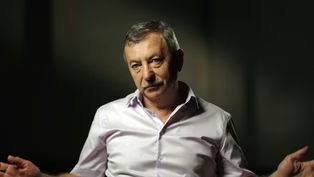
The Collision That Sent the Soviet Space Station Tumbling
Video has Closed Captions
Clip: Ep2 | 1m 26s | Sasha Lazutkin and Michael Foale recall an out-of-control vessel hitting Mir. (1m 26s)
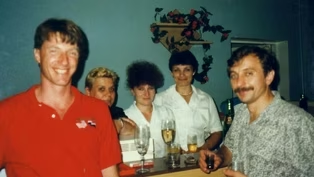
Video has Closed Captions
Clip: Ep2 | 1m 36s | Sasha Lazutkin and his wife Lyudmila talk about the arrival of American astronauts at Star City. (1m 36s)
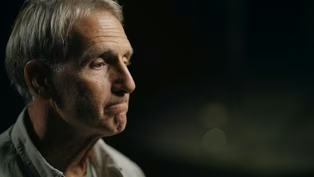
Jerry’s Letter to His Son From Space
Video has Closed Captions
Clip: Ep2 | 1m 34s | Jerry Linenger shares a letter he wrote to his young son while aboard space station Mir. (1m 34s)
Providing Support for PBS.org
Learn Moreabout PBS online sponsorship New Episode
- Science and Nature

Explore scientific discoveries on television's most acclaimed science documentary series.
 New Episode
- Science and Nature

Capturing the splendor of the natural world, from the African plains to the Antarctic ice.


 New Episode







Support for PBS provided by: