
The Sea and the Coastline
Episode 102 | 58m 16sVideo has Closed Captions
Highlights include an anglerfish that camouflages itself to ambush its prey.
Highlights include an anglerfish that camouflages itself to ambush its prey.
Problems playing video? | Closed Captioning Feedback
Problems playing video? | Closed Captioning Feedback
Wild And Wonderful Denmark is a local public television program presented by CET and KSPS PBS
Distributed nationally by American Public Television
The Sea and the Coastline
Episode 102 | 58m 16sVideo has Closed Captions
Highlights include an anglerfish that camouflages itself to ambush its prey.
Problems playing video? | Closed Captioning Feedback
How to Watch Wild And Wonderful Denmark
Wild And Wonderful Denmark is available to stream on pbs.org and the free PBS App, available on iPhone, Apple TV, Android TV, Android smartphones, Amazon Fire TV, Amazon Fire Tablet, Roku, Samsung Smart TV, LG TV, and Vizio.
(bright music) ♪ (birds squawking) ♪ (narrator) An absolutely unique view.
♪ Denmark's largest herd of gray seals are resting on a rock near the Island of Christiansø... ♪ ...in the easternmost part of Denmark.
♪ But the herd does not live here permanently.
It's made up of almost nothing but males, and many of them are ready to mate.
(waves crashing) (dramatic music) So now, when the breeding season has begun, it's necessary to search... ♪ ...for some females to mate with.
(vocalizing) ♪ (narrator) A journey has begun.
The herd spreads out in all directions.
♪ Some of the seals go searching in other countries that border the Baltic Sea, but we'll meet one of the seals again, somewhere else in Denmark.
(underwater echoing) (intense theme music) ♪ (vocalizing) ♪ (orchestral music) ♪ (narrator) They're hard to spot with the naked eye.
♪ Nevertheless, the microscopic plankton organisms are an important part of subsistence in the seas that surround us.
♪ If you've ever swallowed seawater, you've also swallowed plankton.
A single mouthful can contain millions of these fascinating creatures.
♪ In general, the Danish seas are filled with creatures that many of us never get to see.
♪ The border region between the sea and the land consists of more than 8,700 kilometers of coastline and covers everything from peaceful beaches to chalky white cliffs.
Denmark's seas and coasts contain more life, more colors, and greater adventures than can be seen at first glance.
♪ (mellow music) ♪ A playful whale is hunting in the Danish coastal waters.
♪ And it's not alone.
♪ These small whales often get together in hunting packs when they're searching for food.
♪ With its 160 centimeters in length, the harbour porpoise is smaller than its distant cousin, the dolphin.
In fact, it's one of the world's smallest whales, and one of the only whales that breeds in Danish waters.
In the Danish Strait's Great Belt and Little Belt, conditions are good for the harbour porpoise.
The saltwater from the Kattegat Sea area mixes with the brackish water from the Baltic Sea in a life-giving exchange of water and nutrients.
This attracts a flood of fish, which the small whale hunts with a special technique.
The harbour porpoise emits high-frequency signals that reflect back when they hit prey.
These sounds are beyond the human hearing range and can only be heard with technological assistance.
Whales and bats are among the few animals in the world that use echolocation.
(bright music) Despite its modest size, the porpoise eats quite a lot, putting away up to six kilos of fish per day.
So, for a change, the whale sometimes plays with its prey.
♪ (soft music) ♪ Sea creatures use different strategies for hunting or to avoid being hunted.
♪ A snake pipefish breaks its camouflage between the seaweed.
A small, spotted catshark is in pursuit of shellfish, while a hooknose lies in wait on the seabed.
♪ Above, other animals patrol the open waters on their constant hunt for food.
♪ Especially the spiny dogfish with its over 100 sharp teeth lined in five rows.
♪ Down in the sand under the deep water of the Kattegat, a monkfish is camouflaged so well that the other inhabitants cannot see it at all.
(playful music) ♪ Fortunately for the hermit crab, the monkfish is not fond of shellfish.
♪ It's waiting for a bigger catch.
(ominous music) ♪ The monkfish has a modified fin in the front of his head that it waves in the sea current as a lure for curious fish.
♪ Its powerful wide jaws have rows of fang-like teeth that angle inwards.
When the prey approaches, it strikes with exceptional speed.
♪ (somber music) ♪ The monkfish can be up to two meters long and weigh up to 50 kilos.
♪ It's superior in size and speed, almost no matter which prey it targets.
Things are different for another sea hunter.
(soft music) ♪ It may look like a lazy bones, but the starfish is in motion, just at a more leisurely pace.
This becomes more apparent if it's sped up by a factor of 25.
(bright music) ♪ A single starfish has left the group.
It has picked up the scent of a great scallop.
So it's full-speed ahead across the sea sand.
(soft music) ♪ The starfish uses its well-developed sense of smell when hunting, but at the ends of its arms, it also has primitive eyes.
The great scallop has eyes, too.
In fact, up to 200, but that's not much help when the enemy attacks from behind.
♪ It's a slow motion life or death struggle.
The starfish attempts to pull apart the shells, but the scallop is not defenseless.
By opening and closing its valves to suck in and eject water, it's able to move.
This is risky, though.
As it sucks in water, it's vulnerable, and this defense is very energy consuming.
As it snaps shut, the scallop ejects water from its valves, but it does not move very far.
The starfish sets off in pursuit and the hunt continues.
(orchestral music) ♪ (dramatic music) ♪ It's exhausting for both parties.
Which one will give up first?
♪ In the end, they're both tired out on the seabed.
The starfish chooses to withdraw and looks around for an easier victim.
(soft music) ♪ The scent of a dead cockle drifts across the seafloor, and the starfish adjusts its meal plan.
♪ The starfish catches hold of the cockle, injects its stomach through the crack, and digests the clam in its own home.
♪ (waves crashing) ♪ (somber music) ♪ In Southeastern Denmark, a beach forest bursts into leaf above a sudden, steep drop into the Baltic Sea.
♪ Møns Cliff rises out of the sea, a huge whitewashed wall 128 meters high.
(birds squawking) It's also the home of the peregrine falcon, the world's fastest bird.
♪ At a speed of up to 400 kilometers an hour, the falcon dives down to its prey.
♪ For a period of 30 years, the peregrine falcon had disappeared from Denmark, but around the turn of the century, it returned and has been on the increase since.
The steep cliff and privacy from people give the bird good conditions for hunting and breeding.
(bird squawking) Some even become permanent residents and will not migrate south when winter winds whip the leaves off the beech trees* and cover the cliff with a cool blanket.
(majestic music) ♪ The cliff has not always risen above the east side of Møn Island.
It began as a prehistoric seabed in the Cretaceous Period millions of years ago and was pressed up from the depths by the glaciers during the Ice Age.
♪ Even today, Møns Cliff hides countless fascinating fossils from the underwater world of the past.
♪ Above the water, it's nighttime.
(water bubbling) But under the surface, there's no rest.
Otherworldly sea creatures crawl out from their hiding places.
The night is their domain.
(piano music) ♪ While a codfish sleeps with open eyes, some of the seabed fauna around it are getting dressed.
The long-legged spider crab's walk-in closet is a garden of eelgrass.
Some big cnidaria live here, and they are the crab's favorite accessories.
♪ The long-legged spider crab is a master of disguise.
It applies algae to its body to camouflage itself from predators.
With its claw, it pinches the polyp and fixes it to its leg.
♪ Others are more discreetly dressed.
A small starfish serves as an accessory on a whelk.
And the great spider crab has covered itself all over with fungi.
(soft music) But not all underwater creatures need camouflage at night.
♪ On the seafloor near the coast, an excavation is underway.
A newcomer is building a summer residence.
♪ Denmark's biggest crustacean, the European lobster, does not mind moon lighting.
(solemn music) ♪ In fact, it's active only at night.
In the winter, the water is warmer in the deep, and that is where this male has spent many cold, dark months.
Now that it's spring, temperatures are warmer in the shallow waters, and he has returned to the coast.
♪ He's not the only one, though.
A fellow member of his species is also looking at this location.
♪ Lobsters are not interested in cohabitation.
They're very territorial.
♪ And there's a big demand for prime locations, so when uninvited guests show up, the scissor-like claws are put to use.
♪ The insistent guest is turned away.
♪ And the resident returns to the privacy of his home.
(orchestral music) ♪ He'll spend the summer here and have snacks on the terrace.
♪ When winter comes and the warmth leaves the shallow waters, the lobster retreats to the darkness of the depths.
♪ (waves crashing) To the far north, on the tip of the Jutland peninsula, is Grenen.
A long sandbar where the Danish land and coast end and where two seas meet.
(bright music) ♪ The Skagerrak Strait and the Kattegat Strait.
♪ The very special light and natural landscape* have always attracted people.
Residents as well as painters and visitors.
Some only get a quick glimpse from above.
Millions of birds pass over this distinctive landscape in the spring on their northbound journey, and again in the autumn when they go back south.
♪ In the headland of Skåne, approximately 380 different bird species have been registered, more than anywhere else in Denmark.
♪ Under the sands of Skåne, another animal rules.
One day, it will grow wings, too, and be able to view the landscape from above.
(soft music) ♪ But for now, it's still a strange little larvae preparing to catch its lunch.
♪ It digs a funnel-shaped trap in the sand and hides at the bottom, awaiting its prey from the nearby pinewoods.
Hoping that it turns up soon.
♪ A whole colony of red wood ants is hard at work.
Food and supplies have to be hauled back home to the hill.
♪ But some of the ants venture out on a longer hike.
♪ Out of the woods and down to the sandy beach.
♪ The terrain is porous, and it's easy to lose one's footing.
♪ This is just what the antlion larvae has been waiting for.
♪ An ant has spotted a dry straw, a convenient find.
(ominous music) But in an inconvenient place.
♪ With its mandibles, the antlion grabs hold of the ant's leg.
The larvae tries to pull its prey down under the sand, but the straw is in the way.
It loosens its grip and tries to get a better hold, and that is just the opening the ant needs.
♪ Another ant is approaching the trap... ♪ ...and loses its foothold in the shifting sand.
(sand rattling) ♪ (dramatic music) It lands safely, though.
♪ But the larvae has another trick up its sleeve.
♪ It tries to bring down the ant by stirring up sand.
♪ In the end, the ant's fate is sealed.
(mellow music) All summer long, the larvae feasts on the many ants.
♪ But when frost sweeps across the beach and the cold winds blow through the sand dunes, the larvae hibernates underneath the sand.
♪ Next year, when the spring sunlight warms up Skåne again, something remarkable happens.
Once again, the small animal breaks out of the sand.
(bright music) ♪ (narrator) But now the larvae has transformed into a beautiful antlion, a winged insect that looks like a dragonfly.
♪ About 15 kilometers southwest of Skåne, there's more sand, about four million cubic meters worth.
(soft music) ♪ Råbjerg Mile is the mini Sahara of Denmark.
♪ But the sand does not stay in place.
This little dessert drifts with the wind, moving about 15 meters a year across the headland of Skåne towards the east coast of Jutland.
♪ It has been doing this for more than 300 years.
Originally, it started as beach sand drifting with the wind from the North Sea.
Like a huge, ruthless organism, it devours everything in its path.
Even trees are smothered by the sand.
♪ About 200 years from now, the Råbjerg Mile will reach the Kattegat Strait and gradually disappear, blowing with the wind back to the waves.
♪ This heavy moving sandscape has left the landscape changed, pressed it down to the groundwater, and created a wet low-lying area spotted with small lakes.
(bird squawking) (distant waves crashing) (calm music) In the easternmost part of the kingdom is an archipelago called Ertholmene.
The only two inhabited islands, Christiansø and Frederiksø have a population of less than 100 people altogether.
But every spring, the residents get the company of many hundreds of common hiders.
(squeaking) Ertholmene is a good place to brood.
There are no foxes here and no loose cats or dogs.
♪ But in the middle of the Baltic Sea, peace has its price.
Food is scarce, so in the 26 days that the birds have been brooding, they have lost almost half their body weight.
(chirping) ♪ Eiders feed mainly on blue muscles and crustaceans, and to find enough of them for the ducklings and adults, they have to leave Ertholmene and head for the bigger island, Bornholm.
(upbeat music) ♪ (quacking) ♪ The ducklings have a long journey ahead of them, so the females team up like a kind of crèche to help each other keep an eye on their many young ones.
♪ The first obstacle is to take a high dive from the cliff into the deep water.
♪ And the jump off Christiansø is not easy in the rock-filled water.
(dramatic music) ♪ But there's no other way.
The ducklings have to leap into the great unknown.
♪ (splashing) ♪ (squawking) Almost as soon as the first obstacle is overcome, another one takes its place.
♪ A flock of seagulls has been watching the leaping ducklings, hungry gulls that look at eider ducklings as tasty tidbits.
Their route goes straight through enemy lines, and the adult to duckling ratio in the eider crèche is decisive.
♪ Eventually, the gulls give up, but the flock of eiders still have the long swim to Bornholm ahead of them.
(majestic music) ♪ It's an exhausting journey, especially for the hungry ducklings paddling their tiny webbed feet and the waves are high.
♪ (waves crashing) ♪ But finally, land and food are in sight.
♪ After an 18 kilometer swim, the tired little ducklings go ashore.
Now they can eat plenty and grow big and strong among the rocks of Bornholm.
When the eider ducklings become adults and are ready to breed, they will return to Ertholmene.
(waves crashing) Viewed from above, the sea surrounding Denmark often looks gray.
(soft music) But under the surface, a surprising abundance of species and colors can be found.
The nudibranch is the psychedelic cousin of the black slug.
In Danish waters, around 60 different kinds of nudibranchs can be found, each with its own color combination.
They are shell-less and use the bright colors to signal to predatory fish that they're poisonous, even though many of them are not.
♪ There are also many colors in the unique bubble reefs where methane gas rising from the ocean floor creates a swarm of life.
♪ Frill sea anemones grow here alongside the soft coral with the less cheerful name, dead man's fingers.
♪ Few of our underwater creatures are as colorful and unusual as the cuckoo wrasse.
♪ This 30-centimeter fish lives on reefs in small flocks of red females led and dominated by a single male.
♪ But the patriarch of this shoal is dead, and without a male, there can be no new offspring, so the largest of the females begins a fantastic transformation that takes more than half a year.
(mellow music) ♪ Her hormones change.
♪ And her scales shift color.
♪ When the transformation is complete, she has changed both color and sex.
Now she is no longer a red cuckoo wrasse, but a blue cuckoo wrasse, the new male and patriarch of the shoal.
Now they can reproduce again.
♪ The male and female are so different from each other that it was once thought that they were two different species.
And for this reason, in the Danish language, the females and males still bear different names.
(solemn music) ♪ Not all colorful things in our seas belong there naturally.
♪ Up to eight million tons of plastic waste end up in the oceans of the world every year.
And the plastic finds its way to Danish waters and coasts too.
♪ When seabirds pick up food from the surface of the water, plastic is often a part of the package.
It fills their stomachs, and the result is that the birds do not get enough nutrients.
They become sick easily, and in the worst case, they die.
(waves crashing) Down in the deep, some waste even creates death traps for the sea creatures.
(soft music) Reefs and sunken wrecks are haunted by ghost nets, remains of fishing nets that catch fish, seals, and birds.
The unlucky animals drown or starve to death.
♪ Both fishing nets and plastic break down over time, but it takes many years, and even in its broken down form, plastic waste still pollutes when it becomes microplastic, an often invisible amount of minute pieces of plastic.
♪ A lot of microplastic comes from the soles of shoes, synthetic dishcloths, and cosmetic products.
♪ But the Danish fleet of cars also throws off almost five million kilograms of microplastic a year.
On average, one and a half kilos of microplastic are worn off the tires per car in one year.
Wastewater treatment plants capture some of the larger pieces of plastic, but the number of the smallest particles that are released and end up in the oceans is not fully known.
More research is needed to determine the impact that microplastic has on the health of animals.
♪ (solemn music) ♪ Along the southwest coast of Jutland, a huge mudflat extends from the coast.
♪ From above, it looks barren with few signs of life, but make no mistake, a rich and bountiful food chamber is hidden here.
♪ The Wadden Sea is the world's largest coherent intertidal wetlands.
It is such a unique natural phenomenon that UNESCO has classified it as a World Heritage Site.
Countless numbers of small animals live in the mud: snails, muscles, crustaceans, and worms.
♪ And they all choose to live here for one specific reason: the tide.
♪ Twice a day every day, fresh water washes over the mudbanks.
♪ The height of the tide rises and the mudflat becomes a seabed.
Around six hours later, seawater ebbs away from the coast and the abundance of life becomes visible once more.
♪ The ocean rises and falls continuously as if the planet were breathing.
♪ For birds of passage, this is Denmark's richest buffet, with treats from the mud and abundance of food that makes millions of flying gourmets flock to these shores every year.
(squawking) ♪ Along the Wadden Sea, everything is in constant motion.
Up in the air, down in the mud, and over the expansive coastal wetlands between the dikes.
Water meadows run along the seaside and saltwater collects into small lakes from repeated flooding.
(bright music) (chirping) ♪ One of the breeding birds that comes to the Wadden Sea is the Eurasian oystercatcher.
Its trip to Denmark is for one purpose.
♪ Mating.
♪ In the tall grass of the coastal wetlands, the birds have hidden nesting sites right next to an endless buffet.
♪ A parenting life complete with food and lodging.
♪ The little tots are not allowed much time to stand on their own two feet.
♪ In fact, the oystercatcher is an overattentive parent.
Things shouldn't be too hard for their young.
♪ Especially not when they have to stumble along with their parents to find food.
♪ The oystercatcher's 10-centimeter-long beak is a wonderful tool.
Strong enough to force open a muscle and just perfect for fishing up worms from the mud.
♪ It's so convenient to be able to rinse off the food before feeding it to your young.
♪ But just like with humans, it's not always easy with picky eaters.
(soft music) ♪ Another challenge is the Danish weather.
♪ The young should not get too cold, so when the rain begins to fall, mother takes them under her wings, literally.
♪ Of course, their food is still served to them.
And when the young have eaten plenty of good food, by the end of the summer they no longer look the same.
♪ Their colors have changed, and they've joined the ranks of their extended family and spend winter south of Denmark along with their countless oystercatcher relatives.
♪ Another bird species that holds family reunions in the Wadden Sea is the dunlin.
(mellow music) ♪ The gathering features a graceful dance.
♪ The multicolored bird is white underneath its wings, which makes every dip and turn of this aerial ballet shimmer like silvery waves in the sunshine.
♪ When starlings fly in these formations, the Danes refer to it as "Black Sun," and when dunlins soar, they call it "White Sun."
These formations are believed to defend the flock from predatory birds.
(soft music) ♪ (waves crashing) ♪ (birds squawking) On the rocky coastline of Eastern Denmark on a rock near Christiansø, the country's largest herd of gray seals is basking in the sun.
♪ It almost looks like a group of teens lounging around.
(seal grunting) But it's no longer time to rest.
Springtime means breeding season.
(dramatic music) ♪ (splashing) ♪ The male seals spread in all directions to find a female to mate with.
They can easily cover distances of hundreds of kilometers in one go.
♪ They usually return to the place where they first saw the light of day.
♪ (birds squawking) ♪ (splashing) ♪ South of (indistinct) on the lengthy sandbank called (speaking Danish) lies a herd of females.
(bright music) ♪ Just like the seals on the rocks near Christiansø, here too* they are left alone by humans.
♪ One of the females is lying next to a newborn pup.
♪ It's a rare sight in Denmark.
Only about 10 baby seals are born here per year.
♪ This pup is less than two weeks old and is still nursing.
Every day, it puts on about a kilo and a half in weight.
The milk has a fat content of close to 60%, just short of that of margarine.
♪ The seal pup needs the fat to keep warm in the cold water.
♪ (waves crashing) ♪ The baby seal's fur is still white and downy, and not yet water repellant, so it has to stay on land, even when its mother takes to the water.
♪ But it's scary to be alone, and the pup tries to swim out to its mother.
(ominous music) It's early March, and the water is ice cold.
♪ If the seal pup cools down too much, it risks dying.
♪ Fortunately, the mother is attentive.
♪ She turns and leads her pup back to safety on land.
♪ (waves crashing) Days pass by.
The sun rising over (speaking Danish) sets the waves ablaze.
(soft music) ♪ A new seal appears on the surface, one of the males from the rocks near Christiansø.
♪ Back on the strip of land, the pup now knows that its mother will return, so it no longer attempts to follow her.
Before long, its coat will be ready for life at sea.
Soon, it'll be as gray as its mother's.
But this morning, things are different.
(somber music) ♪ Mother is within sight, but she has gone to meet the newly arrived male... ♪ ...to mate, and she has no intention of returning, ever.
♪ After mating, the couple swim off in different directions.
Next year, she'll give life to a new baby seal.
♪ For the abandoned pup, the future is harsh and uncertain.
♪ Only about half survive their first year of life.
But its coat is almost ready and the pup can make its first attempts at hunting in the sea.
The world is wide open.
(majestic music) ♪ (dramatic music) In the next episode of Wild and Wonderful Denmark, most of the land area of Denmark is open as heath, pastures, and cultivated fields.
Survival here requires fighting and creativity to be able to multiply, to find food, and to avoid ending up as food.
♪

- Science and Nature

Explore scientific discoveries on television's most acclaimed science documentary series.
- Science and Nature

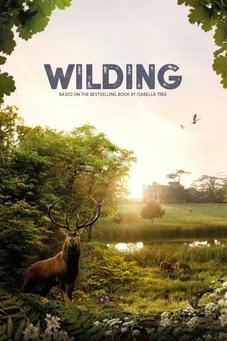
"Wilding" tells the story of a couple who bet on nature for the future of their English estate.











Support for PBS provided by:
Wild And Wonderful Denmark is a local public television program presented by CET and KSPS PBS
Distributed nationally by American Public Television