Prairie Yard & Garden
The Shakespeare Garden
Season 37 Episode 6 | 28m 45sVideo has Closed Captions
How in the world did Shakespeare end up in South Dakota?
How in the world did Shakespeare end up in South Dakota? If there are flowers or gardening involved, the PY&G crew is sure to find out the answer.
Problems playing video? | Closed Captioning Feedback
Problems playing video? | Closed Captioning Feedback
Prairie Yard & Garden is a local public television program presented by Pioneer PBS
Production sponsorship is provided by Shalom Hill Farm, Heartland Motor Company, North Dakota State University, Friends of Prairie Yard & Garden, and viewers like you.
Support provided by:


Prairie Yard & Garden
The Shakespeare Garden
Season 37 Episode 6 | 28m 45sVideo has Closed Captions
How in the world did Shakespeare end up in South Dakota? If there are flowers or gardening involved, the PY&G crew is sure to find out the answer.
Problems playing video? | Closed Captioning Feedback
How to Watch Prairie Yard & Garden
Prairie Yard & Garden is available to stream on pbs.org and the free PBS App, available on iPhone, Apple TV, Android TV, Android smartphones, Amazon Fire TV, Amazon Fire Tablet, Roku, Samsung Smart TV, and Vizio.
Buy Now

Visit the Prairie Yard & Garden Website
Do you love gardening? Consider becoming a friend of Prairie Yard & Garden to support this show and receive gifts with your contribution. Visit the link below to do so or visit pioneer.org/donate.Providing Support for PBS.org
Learn Moreabout PBS online sponsorship(gentle music) - O Romeo, Romeo, wherefore art thou Romeo?
I think most of us had to read "Romeo and Juliet" or some other Shakespeare story as we went through school.
But did you know that William Shakespeare was my kind of guy in that he liked plants and gardens?
There are many Shakespeare Gardens around the world, including one in South Dakota.
I'm Mary Holm, host to "Prairie Yard and Garden" and let's go see if we can find Romeo and William Shakespeare in Wessington Springs, South Dakota.
- [Narrator] Funding for "Prairie Yard and Garden" is provided by Heartland Motor Company, providing service to Minnesota and the Dakotas for over 30 years in the heart of truck country.
Heartland Motor Company, we have your best interest at heart.
Farmers Mutual Telephone Company and Federated Telephone Cooperative proud to be powering Acira, pioneers in bringing state-of-the-art technology to our rural communities.
(soft music) Mark and Margaret Yackel-Julene in honor of Shalom Hill Farm, a non-profit rural education retreat center in a beautiful prairie setting near Wyndham, Minnesota, and by friends of Prairie Yard and Garden, a community of supporters like you who engage in the long-term growth of the series.
To become a friend of "Prairie Yard and Garden" visit pioneer.org/pyg.
(bright music) - Last year I got a phone call from Loree Gaikowski, the executive director of the Wessington Springs, South Dakota Chamber of Commerce.
Her mother loves to watch "Prairie Yard and Garden" and encouraged her to call and let me know about the Shakespeare Garden in Wessington Springs.
While I am so grateful to both Loree and her mom, as we have a chance to see and find out all about the Shakespeare Garden.
First we visit with Susan Arnott, who will tell us the history.
Thanks Susan.
- Welcome to Shakespeare Garden.
We are thrilled to have you come here and visit us.
- Now, tell us about your background.
- This garden is an old garden, it started in 1927.
It was part of Wessington Springs College, which was here for about 80 years before it closed in 1964.
It stayed open as a high school for another four years, so it really closed in 1968.
But this garden started in 1927.
The idea in 1926 when one of the English professors here, Emma Shay, went to English, she wanted to see the homes of the British authors and she went by herself.
She was in her sixties and was in England for the summer of 1926.
And when she came home, she wanted to start a Shakespeare Garden here in Wessington Springs.
And the powers that be at the college gave her this hillside.
Emma and Clark Shay were people whose- Her parents were part of the founding of Wessington Springs College.
She was a professor here in her young years, and so was Clark Shay.
Her name was Emma Freeland at that time.
And in the 1890s they were here then they left, went to Seattle, met there again, and married in Seattle.
And in their later years after teaching in colleges through the US, they came back here and worked at Wessington Springs College, which was Wessington Springs Seminary until about the 1920s.
She was an English professor, he was a science professor, and she was really interested in English literature.
- So how did they actually start the gardens?
- In 1927 on Shakespeare's birthday, that was the sort of the founding day we call it, of this Shakespeare Garden.
The college students, the seminary students at that time, they helped start and do all the work of getting this garden started.
The garden actually started on the other side.
This is the newer part of the garden.
All of it was during her lifetime, but they started with the north side of the garden.
As years went on, they added this south part.
- About how many students came to school here?
- You know, that is a good question and I would say there were different numbers of students through the years, but maybe the heyday might've been the thirties and the forties, but then again, there were a lot of kids here, probably maybe 40 high school kids or 50 during the '60s, the last years of the school and college students, maybe 20 to 30.
- Why was it discontinued?
- The reason I think is the cost of things.
There were three big buildings and other buildings too that had to be maintained and they were old buildings and there wasn't a lot of money for any of it.
I think a lot of the faculty were almost missionaries here for a long time coming here because Wessington Springs was founded in 1882 and the college started in 1887.
The seminary as it were, and it was the only high school place you would go after grade school in this town until the high school started around 1910.
So if anybody was gonna go to high school, here's where they came.
And I think these people came from the east coast.
They were really wonderful people, really well educated people who were teaching at this school, including the Shays.
- So was there kind of a specialty that the college was known for?
- Teaching was one of them.
There was, in fact, early on a model school.
It was called a model school and it was an elementary school for children that the teachers would be able to teach the teaching students and back, like say in the '40s, you could become a teacher without much school.
You didn't have to go to two years of school.
I believe there was even a several month course that you could take here.
That was one thing.
A lot of pastors, a lot of free Methodist pastors came through here and several missionaries started out here and Mrs. Shay had herself, wanted to be a missionary, but she did this instead.
And I would say she was successful in her wish to be a missionary.
Yeah.
- Are any of the buildings from the college left here?
- No.
All of the buildings were demolished in the early 1970s.
This place closed in '68 and the buildings were just kind of here and needed to be torn down really.
And so they're all gone.
All the buildings, all the buildings stood right where all that yellow housing is right there and they all faced College Avenue.
There was a gymnasium, there was a girls' dorm, a women's dorm, there was a boys' dorm, there was an administration building and there was a chapel and there was even a barn because they even had a little... did milking and did horsemanship classes and so on for some years of this existence.
This was a junior college and there was another junior college sponsored by the Free Methodist Church in McPherson, Kansas.
And that school was sort of a sister school and the records went to that school so they are still in existence.
There are quite a few, there have been a lot of alumni through the years.
Now all the alumni are in their seventies and so there have been reunions here.
So we've had about three or four really wonderful reunions here for the college students.
Yeah.
- Do you ever get people stopping in town that went to school here?
- Yes.
Yes.
A lot of them, a lot of people make a pilgrimage.
I think that's how they feel.
They really loved it here.
This has really been a wonderful place at the foot of these hills, you know, and people, they would, a lot of them could go back into the hills for hiking and things and so yeah, they loved it.
People who went here loved this place.
- [Mary] The grounds look beautiful.
Can I find out more about the plants?
- Yes, I think Brenda will be glad to show you.
(bright music) - [Mary] Nothing beats delicious pure maple syrup on a stack of pancakes, waffles, or french toast for breakfast in the morning.
It's the perfect topper to start your day.
Pure maple syrup can also be used as a marinade and glazes for meats, mixed with butter to cook vegetables or as a luscious topping over a dish of ice cream.
Pure maple syrup is one of nature's sweetest gifts.
Pure maple syrup is a natural food that contains nothing artificial, no additives, no colorings or preservatives.
It's nearly perfect.
That's why I'm visiting Camp Aquila Maple Syrup on the Star Lake Peninsula in Otter Tail County, near Dent, Minnesota, where Stu and Corinne Peterson have been tapping trees and processing maple syrup for years.
- Our trees are sugar maples and we think that's the premium tree for tapping for flavor and for sugar content.
I think the climate and our soil conditions make for healthy trees and flavorful syrup.
- [Mary] Maple syrup is among the oldest agricultural products in the United States.
Sap is collected from species of sugar maple trees in late winter, just before spring and processed by boiling the sap and through the evaporation process condenses into pure maple syrup that is filtered and bottled.
- A big part of it is clean equipment, sanitary collection.
The condition of the sap is paramount.
Sap needs to be cooked as soon after collection as possible.
There's an old saying that "if it ain't boiling, it's spoiling."
- But it's not just for breakfast anymore.
People today are finding creative ways to expand the use of pure maple syrup that is beyond the breakfast table.
Pure maple syrup is now introduced in products ranging from sauces and coffees to candy and even beer.
- That has been one of our really fun projects to work with a couple local craft breweries.
They have used our sap to brew the beer and they have used our finished syrup for flavorings.
I don't know how they make it, but I like to help them taste it.
- So the next time you are looking for a sweet all natural sweetener, make sure you pick up pure Minnesota maple syrup and to find pure maple syrup in your area, visit minnesotagrown.com.
(bright music) - I'm Brenda Deines and I am on the Shakespeare Garden Board and I'm a historian, so I get to keep all of the pictures for the scrapbook and the photo albums.
- So tell me, how did the gardens originally get started?
- They started with Mrs. Shay.
She decided she wanted a Shakespeare Garden, so the administrator of the college gave her the land right behind the administration building and it was an alfalfa field, so the students had to come up in the spring and dig out the alfalfa before it could be planted for flowers.
All of the beds are original beds.
They all have the same rocks that were, when it started, the students had to go up into the hills and bring them back down.
It was a hard job.
- Are any of the original plants still growing here?
- Yes.
Right behind us we have the resurrection lilies.
They come up in the spring just as leaves and die off and then in the end of July and August they send up a stem and they usually have four or five lily blossoms on them.
They are in their original place right where they're coming up now.
- [Mary] So have the gardens changed over the years?
- [Brenda] Yes, we tend to plant different assortments of flowers in different beds and we try to take pictures so we know what we had the year before and if we liked it we can do it again maybe in another bed.
- [Mary] Then do you have annuals or perennials or both?
- [Brenda] We have both here, annuals and perennials.
- [Mary] Who decides what you're gonna plant?
- [Brenda] The board members, individual people.
We have what we call a planting festival in May and we encourage anybody and everybody to come and we usually do that the week before Memorial Day.
A lot of them are Susan's relatives, so we give them free reign, they can choose the flowers and if there's someone that hasn't been here before and wants help, us board members will give them ideas.
- [Mary] Then do you start the plants yourselves or do you buy them in?
- [Brenda] We buy them in.
We do not plant them except the zinnias.
Our one lady saves the seed in the fall.
She lays them out in her shed and dries them and then packages them up by color and brings them back in the spring and she and another lady plant them again.
They plant them by seed and the zinnia seeds aren't planted deep.
They rake up the ground, sprinkle the seeds out, cover it with a little bit of ground and water it.
- [Mary] Then who all helps with the planting?
- [Brenda] We have a board of directors, which most of us work with the garden and some don't care for the garden, so they do the teas in the cottage.
So we all have our positions that we like to do.
And then this year we have several ladies that come up and take care of certain beds because it's too much for just us four or five board members that do it.
- [Mary] Who does all the mowing and the weeding?
- [Brenda] We have a greenhouse here and the owner has two sons and they do the mowing and the weed eating and trim the hedge.
- [Mary] And then do you get any other young people or groups to help you too?
- [Brenda] Yes, we have the FFA boys and girls from the high school come up in the spring, they turn over the beds for us and take out all the rubbish and the tree branches and whatever.
And then in the fall they come back when the gardens are dried up and clean them off for the next spring.
- [Mary] Do you try to have plants that are in color throughout the season?
- [Brenda] We do.
Sometimes it's kind of difficult with the perennials, but then we try to plant the annals in with the perennials so there's color.
Well, we've got the peonies for the spring.
We've tried daffodils and tulips, but the squirrels always get the bulbs and the deer love our garden.
We used to have a rose garden but they ate the roses and they've done a pretty good job on our hedge here too so we have to spray the rabbit and deer for that.
- [Mary] Do you have to divide some of the perennials every so often?
- [Brenda] We have, we've divided the peonies, a lot of the irises.
We like to give away extras because we can't use them all.
So there's people that will take them and use them at their home.
- [Mary] Are there some special features here in the garden also besides just the plants?
- [Brenda] Yes, we have a shed back here that the FFA club built for us one year and then we have a wishing well up at the top of the hill that one of the college classes built.
I think that was in 1932.
And there's also a gazebo up there that was built in honor of someone's anniversary.
And then in the other garden there, we have an arbor, which is covered with grapevines that has been remade when we started the garden again in 1989.
And then there's another little gazebo over there that was built in honor of someone.
Some other features in our garden is a fish pond, which an English class made and we had to refurbish that because it leaked and we now have a a rubber lining in it instead of a cement.
And then there was also a larger fish pond up here that was very deep and we were afraid with kids coming up here, we didn't want any liability so we turned it into a flowered, we filled it with dirt and it's a flower bed now .
There's also a bird bath that Mr. Shay or Professor Shay made in the one garden over there.
And he was kind of advanced for his time there because he had put in a sprinkler system through the bird bath and that's how he watered that bed there.
- Tell me a little bit more about how you redid the garden in 1989.
- In 1989, South Dakota Centennial was giving out $5,000 grants.
So we applied and we got a grant for 5,000 and we started the garden again.
The first weekend we worked at it, we had 4-H kids, school kids, Sunday school classes, anybody that wanted to help.
And we took out 25 pickup loads of garbage and tree branches.
And when we came back and looked, you wouldn't have known that we had even been here.
So it was a work in progress.
- [Mary] I would really like to find out more about this cottage and the events that are held here.
- [Brenda] We would like to share that information with you.
(soft ambient music) - I have a question.
I'm interested in growing some drought tolerant plants that don't require a lot of inputs.
What would you recommend?
- Yeah, so we are in our third year of drought, so it's really important if you're thinking about putting in a garden at your home to consider drought resistant plants to survive those really dry periods we get in the middle of summer in Minnesota.
If you're thinking about some easy to grow drought tolerant plants, three that I would recommend as a starting point are purple coneflower, butterfly milkweed, and little bluestem.
So with purple coneflower, some of the reasons I like this one are it's a native tall-grass prairie plant, but there are a lot of different cultivars that have been produced from this native plant.
There are some cultivars that are very tall, so if you're looking for something to go in the back of your garden that's gonna be tall, you can do that.
There are some that are shorter, more like two feet instead of five feet.
So depending on what size you want, there's a cultivar out there for you.
Another one that I would recommend is butterfly milkweed.
Butterfly milkweed grows in a low bunching growth habit.
So it usually just grows in your garden about two feet tall max.
If it were out in nature in a prairie, it would grow taller to compete with the other plants.
But if it is in your garden and it doesn't have a lot of competition, it's gonna grow shorter.
A third plant that I like for a beginner pollinator garden that's drought resistant is actually some ornamental grasses or some native grasses.
And so these just help create some more cooling habitat for our critters during those really hot dry periods.
And some of these grasses are extremely drought resistant, like little bluestem.
So little bluestem is something that's native to tall-grass prairies, which a lot of Minnesota used to be tall-grass prairie.
And you could just plant the native species of little bluestem.
It's available in a lot of garden centers throughout Minnesota.
Or you could also look for cultivated varieties or improved varieties of little bluestem.
These are going to grow in a clumping or bunching growth habit as well.
And so they're not going to escape and spread all over your garden.
So it's nice to interplant these with your flowers to add interest and green color.
There are a lot of drought resistant plants for your Minnesota garden, but if you're just getting started, those are three that I would recommend starting with and then you can explore from there.
- [Narrator] Ask the arboretum experts has been brought to you by the Minnesota Landscape Arboretum in Chaska dedicated to welcoming, informing and inspiring all through outstanding displays, protected natural areas, horticultural research and education.
- What is this beautiful cottage that's behind us?
- Well, this was built to be the retirement home for the Shays, Mrs. Shay, Emma Shay who started the garden and her husband Clark Shay lived here from 1932 until she died in 1945 and he died in the early 1950s.
This was their home and it was built in 1932.
And as we understand it, it was copied from a replica, a picture postcard that Mrs. Shay had of the Anne Hathaway cottage in England, Anne Hathaway being the wife of William Shakespeare.
And that's where Shakespeare Garden in England is that this is supposed to be sort of a picture of one, about one half of the cottage that's in England.
And of course it's really a very old primitive house inside so this is nothing like that inside.
But on the outside it does look very much like the Anne Hathaway cottage in England.
- [Mary] What is the roof made out of?
- The roof is water reeds and we got our first batch from Manitoba Canada and we had a master thatcher here, Cecil White from Centralia Washington.
And when he came, we had volunteers tear off all the old asphalt shingles.
Mrs. Shea wanted it to have reed like the one in England, but at that time it wasn't possible to do that.
So when we needed to redo the roof, we thought we would try this out and he just did the front side the first summer he was here, the next year we could not find reeds.
So it went one or two years before we were able to do the backside and we found those reeds in Rhode Island and we had local truckers go to Canada and to Rhode Island and bring the reeds back.
- [Mary] So how long does a roof like this last?
- [Susan] He told us 50 years, so we're going on 32 now, so I don't know.
- [Mary] So is there a layer underneath to keep it from leaking?
- [Susan] Yes, he laid, I'm not sure what it was, but he laid down some tar paper or something and then made a grid with laps.
Cecil brought his own materials and tools and he forged the nails that he used to put the reed on the cottage.
We would like you to know that this is the only reed roof in the state of South Dakota.
- [Mary] It is so unique, but what is the cottage used for?
- [Susan] We have more or less restored the cottage and it is now used for teas.
We've given teas all through the years since we've been in existence, since we restored the whole garden and cottage.
People can come and have teas here for a donation to us and so we've had a lot of teas here.
We've had on the lawn, we've had concerts, music in the garden every Thursday evening through the months of July for several years now.
Local talent and from the surrounding area, there have been some weddings in the garden, quite a few weddings in the garden.
And so it's been used for receptions and things and people just a couple weeks ago there was a bride and groom up here having pictures taken after their wedding across town.
But a lot of seniors come and have their senior pictures taken here, yes.
- [Mary] Does this stay open throughout the winter?
- [Susan] We will show it to people who come here during the winter to, you know...
If people call us and wanna see the inside of the cottage, we would show it.
We have had winter teas even to have something to do here during the winter and this cold winter months for teas.
And we've had people come and do interesting programs for those teas.
We serve two sandwiches, a chicken salad and cucumber sandwiches.
We serve scones, we serve fruit and hot cider and stuff, so.
- [Mary] Who administers the cottage and the grounds?
- [Susan] We have a board of directors of seven people.
Right now it's seven women.
We have split up the jobs of the board, but all of us really take care of this place.
We do all the housekeeping and we do all the gardening.
I will say most of the gardening, we do have some people volunteers from town who are helping take a flower bed and weed it and take care of it.
But basically the board of directors, we are the ones who take care of the garden and the cottage.
- [Mary] About how many visitors do you get each year here?
- [Susan] We get a lot of visitors.
We get visitors from all over the country and all over the world actually.
We've had visitors from all over the world.
I would say at least two or three groups each day in the summer.
- How do you get the word out about this beautiful place?
- I think a lot of it is through our Facebook page and you can Google it, if anybody can Google Shakespeare Garden in Wessington Springs and it'll come right up.
And we have signs on the interstate and we have brochures in some of the visitor centers throughout the state and call our chamber, Wessington Springs Chamber and our area development corporation.
And that's a good way to find out about us.
Another way is through the alumni.
Both of our high school, public high school, and the college that was here, they're still...
Most of the alumni are pretty old now if they're left, but their children and grandchildren like to come here.
So we get a lot of visitors through the alumni of the school.
Anybody can come to the garden anytime they want.
The cottage is open by appointment.
We have numbers on the windows or in the Facebook page and so people can call and get an appointment to have a tour.
- [Mary] Thank you so much to both of you for sharing this beautiful spot and for telling us all about it.
This has been great.
- [Susan] We appreciate you coming.
- [Brenda] Thank you.
(gentle music) - [Narrator] Funding for "Prairie Yard and Garden" is provided by Heartland Motor Company, providing service to Minnesota and the Dakotas for over 30 years in the heart of Truck country, Heartland Motor Company, we have your best interest at heart.
Farmers Mutual Telephone Company and Federated Telephone Cooperative proud to be powering Acira pioneers in bringing state-of-the-art technology to our rural communities.
Mark and Margaret Yackel-Julene in honor of Shalom Hill Farm, a nonprofit rural education retreat center in a beautiful prairie setting near Windham, Minnesota.
And by friends of "Prairie Yard and Garden" a community of supporters like you who engage in the long-term growth of the series.
To become a friend of "Prairie Yard and Garden" visit pioneer.org/pyg.
(bright music)
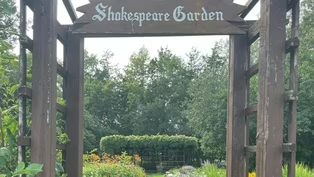
Preview: S37 Ep6 | 30s | How in the world did Shakespeare end up in South Dakota? (30s)
Providing Support for PBS.org
Learn Moreabout PBS online sponsorship

- Home and How To

Hit the road in a classic car for a tour through Great Britain with two antiques experts.












Support for PBS provided by:
Prairie Yard & Garden is a local public television program presented by Pioneer PBS
Production sponsorship is provided by Shalom Hill Farm, Heartland Motor Company, North Dakota State University, Friends of Prairie Yard & Garden, and viewers like you.