Smart Start: A KET Special Report
The Status of Kentucky's Early Childhood Education Workforce
Clip: Episode 1 | 4m 47sVideo has Closed Captions
A panel of experts discuss the status of Kentucky's early childhood education workforce.
A panel of experts discuss the status of Kentucky's early childhood education workforce.
Problems playing video? | Closed Captioning Feedback
Problems playing video? | Closed Captioning Feedback
Smart Start: A KET Special Report is a local public television program presented by KET
Smart Start: A KET Special Report
The Status of Kentucky's Early Childhood Education Workforce
Clip: Episode 1 | 4m 47sVideo has Closed Captions
A panel of experts discuss the status of Kentucky's early childhood education workforce.
Problems playing video? | Closed Captioning Feedback
How to Watch Smart Start: A KET Special Report
Smart Start: A KET Special Report is available to stream on pbs.org and the free PBS App, available on iPhone, Apple TV, Android TV, Android smartphones, Amazon Fire TV, Amazon Fire Tablet, Roku, Samsung Smart TV, and Vizio.
Providing Support for PBS.org
Learn Moreabout PBS online sponsorshipWe have a great panel assembled to talk about child care, workforce issues.
And joining us in our Lexington studios are Mike Hammonds, vice president of Advocacy and Learning Grove and Northern Kentucky.
Sarah Vanover policy and research director at the Kentucky Youth Advocates.
And Kate Shanks, senior vice president of public affairs with the Kentucky Chamber.
Good to have you all.
Thank you for being here.
So when we talk about early childhood education and the settings and the affordability, accessibility, it always seems to bend towards Dr. Vanover the the quality of the workforce and even having an adequate workforce.
Can you talk to us about where Kentucky stands when it comes to early childhood education workforce?
Well, we're in a significant shortage in the early childhood workforce, and that is not just the Kentucky thing.
It's a nationwide issue in Kentucky.
Since we are lower cost of living state.
We see that the average wage for child care providers is $12.39 an hour.
And we also know that 98% of other professions make more than child care providers, and that includes dog walkers.
So when you think about the amount of work that goes into watching a room full of children and the low wage that accompanies it, it is very hard to keep a talented workforce in that situation.
Many people grow up thinking, I want to work with kids and they they find a school, a career, a program they don't want to work in, and they realize that they can't provide for their own family once they get there.
Nobody grows up thinking, I want to stock shelves in retail.
I want to, you know, be a server my whole life in a restaurant.
But those are the jobs that are paying slightly higher than the child care field.
And we lose a lot of people to those because they're able to take care of their families and obtain health insurance and benefits for many of our child care providers can't.
All right.
So is that the main crucial issue when it comes to building up the child care workforce is pay?
I would say that compensation is probably the biggest issue, not because our child care providers walk into it thinking, I'm going to get rich doing this and they get disappointed afterwards just because of supporting their families.
The other issue that accompanies that is, is a level of respect.
Many of our K-through-12 teachers receive a higher level of respect due to the education they've got and the experience that they have or the age of the children that they're working with as a child's age decreases.
There is a respect that's associated with that.
And our preschool teachers do not receive the same respect as our kindergarten teachers and our infant and toddler teachers often receive even less respect.
They're viewed as a babysitter and not somebody that is educated on child development or has the experience associated with that field.
And so when you're making low wages and your work is not valued, then that can be a driving force to leave your career field.
What is the compensation differentiation between a preschool early childhood educator and one that send the primary education system?
Do we know that?
So we know that a kindergarten teacher on average makes around the 50 to 55000 a year field where our private childcare sector is making around the 28 to 30000 a year.
And so you can be working with a four year old and and make that 28 to 30000 a year.
And then once that child ages one more year of the kindergarten teacher is making approximately 20 to $25000 more per year.
Plus they have a retirement package, they have sick days, benefits and much more vacation time throughout the year.
There is a perception, Dr. Vanover, that perhaps the early childhood educators are not as perhaps qualified or as educated as those who were in the K through 12 system.
Is that true or false?
Well, I would say every field has entry level staff that have come out of high school or may be new to the field.
And we see that in the K through 12 system with peer educators or new staff that are entering.
But I would say both fields have trained professionals in them as well.
When I was a professor at Eastern Kentucky University, I was training students to get their bachelor's in child development.
Many of them were going into the private childcare sector.
They had a four year degree in child development, were making $10 an hour and were defaulting on their student loans because they weren't making enough to pay them back.
So we we have professionals in both fields.
We have entry level staff in both fields.
But overall, the perception is that the K through 12 field is more professional than the birth of high field.

Biggest Factors for Kindergarten Readiness
Video has Closed Captions
Clip: Ep1 | 7m 32s | A panel of experts discuss the biggest factors in kindergarten readiness. (7m 32s)

The Challenges of Universal Pre-K
Video has Closed Captions
Clip: Ep1 | 9m 29s | A panel of experts discuss the challenges involved with universal pre-K. (9m 29s)

Child Care Industry's Impact on Kentucky Economy
Video has Closed Captions
Clip: Ep1 | 10m 34s | A panel of experts discuss the child care industry's impact on the Kentucky economy. (10m 34s)
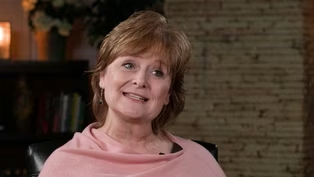
Donna Grigsby, M.D. (Full Interview)
Video has Closed Captions
Clip: Ep1 | 33m 32s | Full Interview with Chief of Division of General Academic Pediatrics. (33m 32s)

Video has Closed Captions
Clip: Ep1 | 6m 54s | A panel of experts discuss the impact of early learning. (6m 54s)

The Importance of Child Care Funding
Video has Closed Captions
Clip: Ep1 | 5m 54s | A panel of experts discuss the importance of child care funding. (5m 54s)
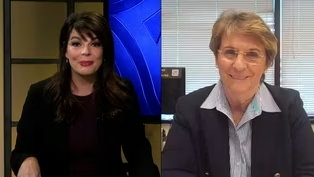
Video has Closed Captions
Clip: Ep1 | 27m 48s | Full Interview with Director of Early Childhood Initiative, Bipartisan Policy Center. (27m 48s)

The Need for Child Care Funding
Video has Closed Captions
Clip: Ep1 | 6m 47s | A panel of experts discuss the need for child care funding. (6m 47s)

Setting a Foundation for Learning
Video has Closed Captions
Clip: Ep1 | 8m 47s | A panel of experts discuss how early education sets a foundation for learning. (8m 47s)
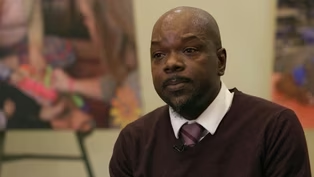
Vaughn Nebbitt (Full Interview)
Video has Closed Captions
Clip: Ep1 | 8m 27s | Full Interview with Vice President of Early Childhood Services Family & Children's Place. (8m 27s)
Providing Support for PBS.org
Learn Moreabout PBS online sponsorship















Support for PBS provided by:
Smart Start: A KET Special Report is a local public television program presented by KET