
The Storyteller’s Mark and More
Season 16 Episode 6 | 27m 17sVideo has Closed Captions
Preserving the work of Mari Sandoz, a couple that builds LEGOs together stays together and more.
Preserving the work of Mari Sandoz, a couple that builds LEGOs together stays together, exploring the rich past and promising future of North Omaha, & the fresh bounty of the Norfolk Farmers Market. Mari Sandoz's powerful storytelling and in-depth research brought the history and spirit of the West to life. A fun-loving couple from Arnold has found the perfect pastime-building LEGO sets together
Problems playing video? | Closed Captioning Feedback
Problems playing video? | Closed Captioning Feedback
Nebraska Stories is a local public television program presented by Nebraska Public Media
The Storyteller’s Mark and More
Season 16 Episode 6 | 27m 17sVideo has Closed Captions
Preserving the work of Mari Sandoz, a couple that builds LEGOs together stays together, exploring the rich past and promising future of North Omaha, & the fresh bounty of the Norfolk Farmers Market. Mari Sandoz's powerful storytelling and in-depth research brought the history and spirit of the West to life. A fun-loving couple from Arnold has found the perfect pastime-building LEGO sets together
Problems playing video? | Closed Captioning Feedback
How to Watch Nebraska Stories
Nebraska Stories is available to stream on pbs.org and the free PBS App, available on iPhone, Apple TV, Android TV, Android smartphones, Amazon Fire TV, Amazon Fire Tablet, Roku, Samsung Smart TV, and Vizio.
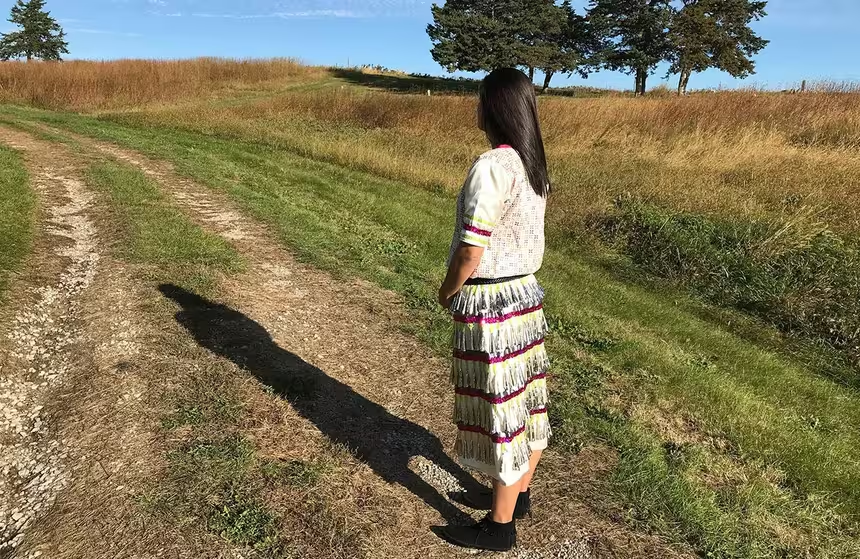
Do you have a Nebraska Story?
Do you have a story that you think should be told on Nebraska Stories? Send an email with your story idea, your name, your city and an email address and/or phone number to nebraskastories@nebraskapublicmedia.org. Or, click the link below and submit your information on nebraskastories.org.Providing Support for PBS.org
Learn Moreabout PBS online sponsorship(upbeat music) - [Narrator] Coming up on "Nebraska Stories," the pen that captured the Great Plains, (upbeat music) a house built just for LEGOs, (upbeat music) exploring the rich past and promising future of North Omaha, (upbeat music) and the fresh bounty at the Norfolk Farmer's Market.
(upbeat music) (upbeat music) (upbeat music) (upbeat music) (upbeat music) (birds chirping) (birds chirping) (birds chirping) (birds chirping) - [Dick] I am talking to Ron Hull who had the good fortune to get to know Mari Sandoz.
What was she like to meet?
- [Ron] I think if you remembered anything that anyone would ever tell you about Mari Sandoz, you'd have to remember that this was a woman who worked harder than I think anybody I ever knew.
She always worked.
You know, she never claimed to be a Willa Cather or a great stream of consciousness kind of creative writer.
That wasn't her goal to be.
What her goal was to be a significant research person who carefully did research as the historian does, and then combine that with creative writing and some talent, which she certainly had.
She's the best storyteller ever.
She could talk for hours about stories in an animated way that just brought back everything.
The images that she conjured up in your mind were just magical.
- [Rita] I like to think that the beginning was this little girl who sat on the gatepost, and she'd rather read than eat.
Isn't this how your writing all began?
- Oh yes, I'd rather read than eat.
I'd rather read than eat now.
But that gatepost was a nice big old heavy one.
It was broad on top and flat and people went by.
The world went by.
Cowboys, Indians, and the wind and the birds and the dishes were behind me in the house.
(bright music) I didn't decide to become a writer.
I just got bored without having any stories through reading and the storytellers So I started telling myself stories.
(bright music) (bright music) (bright music) (bright music) (bright music) (bright music) - [Rita] You gave up a couple of times, didn't you though?
- [Mari] Yes.
- [Rita] Before Old Jules was published and didn't you go back to the Sandhills?
- [Mari] Yes, to get a little meat on my bones, yes.
The doctor found some spots on my lungs.
I'm down to 90 pounds and nobody wanted to read "Old Jules."
- [Rita] I think of this patience of you sending this over and over and over again.
- Doesn't a matter of patience you had to bear by the tail.
Everybody knew I was writing this book.
Was I going to admit that it wouldn't sell?
Not unless I had to.
- Do you ever envy her having gotten out and gotten away and lived another life, known two worlds?
- No, because she worked.
If I think I worked, she worked 10 times as hard.
- [Dick] At being a writer.
- At being a writer.
She really worked.
- [Dick] I don't know what kept her going in the same sense of your mother, but in another way.
She was rejected so long, and her manuscripts were considered worthless by so many.
- That's right.
- Publishers for so many years.
Now it seems strange.
(birds chirping) Why was that?
Were they looking for other kinds of material in those days?
- They didn't believe this country.
They just couldn't believe it.
(bright music) -[Shannon] This is a child who was beaten and grew up in a dugout and to emerge from that, into being a person who had enormous influence on what we know about the history of this region and Native American history and culture, I think the idea that she fought so hard to become a writer and very few people realize how old she was as all this was happening.
She didn't publish "Old Jules" until she was almost 40, and she really only had 20 solid years as a famous, well-known, respected author.
And the fact that she did that and came through with such powerful works and legacy is a remarkable thing.
(bright music) (bright music) (bright music) The Mari Sandoz society was founded in the 1970s by a group of people who were really passionate about sharing the history and legacy of Mari Sandoz.
They began to develop people's interests in Mari as a person, beyond just the books that she wrote.
So this organization really took shape in that decade or so after Mari died.
And then it became just much bigger over time, based out of Chadron and eventually raising enough money to build the Mari Sandoz High Plains Heritage Center that we're sitting in here today.
(bright music) - [Lauri] We have a lot of tourists through here that 'cause they love the museum, we'll have people, you know, from Canada or whatnot.
We get a lot of guests from, you know, back East, not just back East, but Massachusetts the other day, you know, New York.
They hear about it, they read about it, but they wanna see the real spot.
(bright music) On the south side, it's the dynamic slash permanent side of the Mari Sandoz High Plain Heritage Center.
And if you notice, we are super fortunate.
We actually have what I call the 3D effects, her hats, her clothing, her desk, her furniture from Greenwich Village in New York.
(bright music) There's one awesome display of her real jewelry, her scarves and whatnot, because when she was in New York, she was very fashion conscious.
(bright music) And what we have is the archives, which is a locked place where they have original manuscripts and her original clothing.
Really fancy, fun shoes.
And you can tell that she utilized them.
It wasn't just, you know, once in a while.
They're very well worn.
(bright music) -[Shannon] Really, right now we're at this next step, which we're gonna call Mari Sandoz Society 3.0.
And the main feature of that is going to be digitizing her collection of materials that she willed when she passed away in 1966.
She decided less than three months before she died that her materials would go to the University of Nebraska at Lincoln.
There was over a hundred linear feet of papers that were gifted.
So we're really excited to do this project that will join the Neihardt collection and the Cather collection as being three of the major authors and collections that are being held by the University of Nebraska at Lincoln.
(bright music) (bright music) -[Mary Ellen] I'm really excited about the Mari Sandoz archives and what she has there because well, there's so many aspects of it.
It's like, what do I start with?
So for correspondence, it's really exciting, and there's many different ways.
The amount, the personality of Mari Sandoz that comes through.
The way she was very clear about her opinion.
She was a generous and lovely woman, but she was not afraid to share her opinion.
I love that.
I love that she was such a strong advocate for her work and for a variety of communities.
And that's just correspondence.
Then you've got, over 350,000 is the number we have on her index cards, which she would keep all of her research that she would do, but she would gather a lot of articles and documents and stuff and keep that research.
So her research files are really large.
(bright music) And then we go into the manuscripts, which are really exciting because you can see the habit of writing in long hand in the beginning I understand.
And then she would slowly get her stuff typed and then edited and typed and edited again.
So you can see all those variations of a manuscript.
(bright music) The whole sum total of the collection, if you follow a thread of a person or a book or a theme, you can just see how much energy and time and research and thoughtfulness that she put into all of her work from the beginning to the end.
(bright music) - [Shannon] We are certain that once this is fully digitized and people can go in and do a Google search of this digital content, that they're gonna draw connections between events and people and research that she has done that's gonna be new.
And we think this will bring an entire renaissance of historical research about Mari Sandoz and the West.
(bright music) -[Mary Ellen] I'm excited about this, even though the digitization process will take a long time.
I'm excited because I think more people need to see who Mari is, like her advocacy for indigenous people, her really strong viewpoints on the strength of women in these environments.
I will say that's also exciting about the digitalization project is we've hired students to come in and start doing the indexing and listing all the different letters, and then they'll start doing some of the scanning now.
But they were so excited and so well versed in some of the topics that she talked about and some of the things that she said and some of the stories that were already coming out of her letters.
And so that level of enthusiasm that you just see in students as they're doing the work, is indicative of what people who could read more will learn and get excited about.
(bright music) -[Milena] So this is a letter in 1943 from a man named Roy Handley to Mari Sandoz.
And I think it just really strikes at the heart of like her significance and like who she was as a writer and a person.
The stories of Mari Sandoz shall live forever in the hearts of those who love the prairies and in years to come when the untamed country is but a memory, when the generations come and go and the living have gone to join the folks of yesterday.
And these books shall be a living testimony of the settling of the West, written by one who knows the West and in the plain language of the West, as spoken in the pioneer spirit that all can understand.
(bright music) (birds chirping) (upbeat music) (upbeat music) (upbeat music) - [Harvey] It is a hobby for free time.
I don't golf, I don't fish.
I gotta have a vice, I guess.
In my retirement ages (upbeat music) - [Narrator] For many, collecting evokes pride in the pieces that they have in their possession.
For others, it's the assembling of that collection that drives them.
(upbeat music) For a couple in Arnold, Nebraska, constructing a Lego collection has been a years long effort, one that continues to expand each year.
For me it's just, for lack of a better term, the excitement or whatever, to have a pile of like nothing and just see it come together as you build the sense of accomplishment, I guess.
(upbeat music) - [Barb] Well, it's better than sitting in front of the TV watching nothing.
(upbeat music) You feel like you've accomplished something when you get done.
(upbeat music) If we're building big, one of us will start out building the other one sort and after a while we switch.
So we're back and forth building or sorting and it keeps your fingers.
'Cause after a while they start stiffening up and we just do that.
- [Narrator] Harvey and his wife Barb share time together piecing these intricate creations together.
It's a small part of their long and successful marriage.
(upbeat music) The couple has put together over 500 kits and continues to assemble more.
It became apparent as their passion grew that they would need more space for these creations.
- [Harvey] Early on when I built Legos, I was just putting them in like a cardboard box and setting them in my basement of the house.
Well then a few years later, we bought a lot next door and I was running outta room to store my toys.
I put this building up in 2018.
So I like the fact that I can come and go 'cause it's right next door to our living house.
(upbeat music) - [Barb] Yeah, I can't send him over here when he's naughty, 'cause that's not going to, you know, teach him anything.
A lot of people always, they'll tease him about being sent to the Lego house.
- [Narrator] Their Lego house has a multitude of themes inside that include Disney, pirates, (upbeat music) Western, and an amusement park among many others.
(upbeat music) - [Harvey] I've got a Harry Potter Hogwarts castle that was 6,000 pieces, but I've got sets that there's only 20 or 30 pieces in it and some 200, some three, they come in all sizes and I've had people ask me about buying or trading or whatever, but I'm married to 'em (upbeat music) and no, I'm not gonna let 'em go.
(upbeat music) - [Narrator] With the size of the collection and their passion far from waning, Harvey and Barb opened up their museum to the public.
(upbeat music) In doing so, they've seen many reconnect with their childhoods as they pass through.
-[Harvey] And they will come in here and reminisce about when they were kids and what they built, the different sets that they like and, I can come over here and sit down and start working and think I've been here for 20 minutes and you look at your clock and you've been there two hours.
So, but it's very relaxing and soothing.
(upbeat music) (upbeat music) (light jazz music) (light jazz music) (light jazz music) (light jazz music) [Preston] Well, the truth of the matter is I'm passionate about my beloved community, North Omaha, and that passion has taken on the form of me wanting everyone who comes in contact or who does not to learn more about our community, its history and its culture.
(mellow jazz music) [Narrator] Writer, activist and native Nebraskan Preston Love Jr., is on a mission to change people's perspectives on the North Omaha community and he's found an innovative way to do it by bringing them to the historically African American neighborhood.
it's[Preston] That's why I'm doing the tour for the purpose of educating and hopefully waking up people and making them more aware of this wonderful, my beloved, but wonderful, glorious community.
[Narrator] Called the North Omaha Legacy Tour it focuses on the rich heritage, legacy and historical contributions of the community.
It begins with a short orientation to provide context for the tour, followed by a drive through areas that are culturally significant.
(light jazz music) [Preston] The Omaha Star is historic in so many ways but it tells a story about a community, like communities all over this nation who grew their own things because of racism and discrimination and bigotry.
The Omaha Star was founded in 1938 by a very eccentric woman by the name of Mildred Brown.
Mildred Brown was a unique lady in her day because she was an African American business woman in a day where there weren't a lot and she was a go-getter, she started that business.
It is still going, but The Star has quite a history.
It was started with the idea that it would only write the good news about the residents of North Omaha and it has stayed with that all along.
You have the most current edition in your pack that I gave you.
(light jazz music) [Preston] The Great Plains Black History Museum is a chronicle in itself.
It's a tour within four walls, if you will.
And so, it has great, great value for people to learn about the past and how it connects with the future.
Many things I'm going to turn you over to the executive director of the Great Plains Museum, Eric Ewing.
[Eric] As you look around the exhibit that you'll find in this space is the history of historically Black colleges and universities.
This is a year long exhibit, so actually, even what you see right now by the end of this week, it will be 10 to eight new institutions because there's so many schools we couldn't feature 'em all at once, so what we decided to do was make it a year long exhibit and each month we change out the institutions that are on display.
[Narrator] But this tour isn't just about North Omaha's past, it's about revitalizing this once thriving community.
[Preston] We visit some of our community gardens which are propping up.
We visit and comment on the amount of vacant lots that are unutilized property in the community.
We visit the many wonderful new and exciting murals in the community and then we visit the significant residuals of this long-term community disinvestment, the community's economic devastation.
All of that is caught up and is mentioned and part of the tour as well.
[Narrator] It also includes a stop at the site that was once home to the first Black honoree in the Nebraska Hall of Fame.
[Preston] The Malcolm X Center speaks for itself in my mind because people are interested and some are just learning that the iconic Malcolm X was born in this community and so we go to his birth site.
It's a natural and it is significant.
[Schmeeka] Thank you everyone for being on this great tour for stopping to visit us here at the Malcolm X Memorial Foundation.
We want everyone to come and learn the truth of who he was as a man, as a child, as a husband, as a father, and learn and help support our mission in uplifting this community.
[Narrator] Opening minds and changing opinions is what Preston Love Jr. hopes to achieve through the tour, and it seems to be working.
Well, the things with the Malcolm X thing at the end of the tour was interesting to me.
I mean, the things that we heard about Malcolm X years ago were not very nice to say the least, and so to see what's happened and how the people here have taken an interest in showing what he really did and things that have happened and are trying to make changes in this whole area based on his foundation here.
So, I think that's fantastic.
Probably one of the most exciting things that I can mention about the tour, which was expected, but underestimated was the economic impact that we're having on this poverty stricken community.
Since we've started, our estimate is that we have impacted financially over $50,000 of money that has come into the community that would not have come if it weren't for the tour.
That's the tours, buying from our retail since they're here, having meals here since they're here returning after the tour.
(upbeat jazz music) [Gladys] What being a part of the Legacy tour has done for Big Mama's is, you know, continue my mom's vision of bringing people together over great food.
The tours bring folks from all over the state, from all walks of life and in these crazy times that we live in, we need things to bring people together and my mother always felt that you could change the world if you prepared somebody a great meal.
(upbeat jazz music) [Preston] I think the tour is serving a great purpose.
I want people to come and take this tour because they will learn about a community when they come from outside the community that they don't know.
Several times I said, I didn't know that.
The red line delineating white neighborhoods from black neighborhoods, I found very interesting.
It never occurred to me that there was an exact dividing line between neighborhoods.
I didn't know that.
You know, one of the things I'm really proud of, somewhat unexpected but it is that we really are really making a difference as it relates to bridging the gap between communities and culture within the city.
We are really making the difference and I'm proud that as people learn about our community then they have a tendency to wanna learn more, number one and reach out and develop new relationship.
(upbeat jazz music) (upbeat jazz music) (upbeat jazz music) (guitar playing) (guitar playing) [Narrator] River Point Square is lined with vendors each summer for the Norfolk Farmer's Market.
[Sandy] Hi!
Last radish.
Dollar 50.
(guitar playing) Out of 2 [Narrator] There you'll find sisters Stacy and Sandy Dieckman who got their start at the market.
Growing up we always wanted to live out in the country.
We did a lot of gardening at my grandfather's house.
When we graduated from college, we actually bought a house in town together.
Kind of a fixer-upper.
Fixed that up and then sold it and used the down payment money to buy the farm.
The place that we ended up buying had produce grown on it at one time, and so we decided that this was something that we wanted to try.
[Stacy] The farmer's market was in the parking lot where I used to work, and so stopped at the parking lot and talked to the vendors there and just got started.
[Customer] You got any more of the sourdough left or?
Sourdough, I think we do.
We do, yes.
I'll take one of those.
A sourdough.
Okay.
[Narrator] North Fork Bread Company, another local favorite, also got their start at the Norfolk Farmer's Market.
I started baking bread as a hobby probably about six or seven years ago.
When I was in grad school, actually, and I would make it just for my just my friends and, and my wife.
I had started selling at the Norfolk Farmer's Market four years ago the summer of 2018, and that was the original plan at at first was just to do the farmer's market and and just kind of take, take the winters off or sell individually here and there.
(upbeat music) (upbeat music) [Sandy] I think that the, the most fun thing to grow is the pumpkins and the gourds because like, especially like the gourds when you start picking 'em you never know what you're gonna find.
They always come in, in the different oddest shapes.
We like to do green beans.
There's just nothing better than fresh green beans.
(upbeat music) (upbeat music) They're morning buns.
They're very popular.
That combination of that croissant dough with the with the orange peel plus the the brown sugar and all that, makes for and cinnamon, makes for a really good combination.
[Narrator] Caleb, Stacy and Sandy started selling to just a few customers, but quickly expanded.
The city invited us a year ago to come down here and start selling here at, at the River Point and so that's been a really good move for us.
When the farmer's market moved downtown that really exploded our business for us.
I wanted to keep that momentum going.
This bakery came up for sale and I said, well, it's a good opportunity.
I feel like it's, it's been presented to me and so I feel like I need to go ahead and and take the plunge and, and go for it full-time.
[Narrator] As these vendors continue to grow they will always find a sense of home at River Point Square.
[Caleb] The farmer's market was such a great way to just get to know the community.
I mean, it was my first introduction to to the city of Norfolk.
Really connecting with people one-on-one.
[Stacy] You get the same customers come back to you all the time, talk to you they tell you about their kids, they tell you their stories.
[Sandy] I love being around the people here at market.
I enjoy planting things and seeing things grow and I don't think I would ever quit for a long time.
The best part of Farmer's Market is you're kinda like a family.
Perfect.
Thank you.
What do you say Paolo?
Say thank you.
(kid mumbling) Thank you.
Thank you.
Yeah.
Good job.
(laughter) (upbeat music) (upbeat music) - [Narrator] Watch more Nebraska stories on our website, Facebook and YouTube.
Nebraska Stories is funded in part by the Margaret and Martha Thomas Foundation, and the Bill Harris and Mary Sue Hormel Harris Fund for the presentation of cultural programming.
(upbeat music) (upbeat music) (upbeat music) (upbeat music)
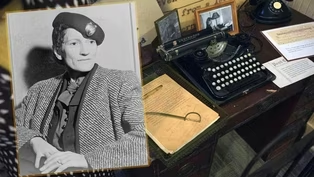
Sandoz, the Storyteller’s Mark
Video has Closed Captions
Clip: S16 Ep6 | 10m 19s | Learn the history ofMari Sandoz, a celebrated writer of the American West. (10m 19s)
Providing Support for PBS.org
Learn Moreabout PBS online sponsorship















Support for PBS provided by:
Nebraska Stories is a local public television program presented by Nebraska Public Media