
This Iowa Nonprofit is the Largest Nongovernmental Seed Bank in the Country
Clip: Season 3 Episode 310 | 7m 12sVideo has Closed Captions
Learn about the history of Seed Savers Exchange in Decorah and see how it operates.
Every seed has a story. Learn about the 50-year history of Seed Savers Exchange in Decorah, and get a behind-the-scenes look at how the nonprofit operates.
Problems playing video? | Closed Captioning Feedback
Problems playing video? | Closed Captioning Feedback
Iowa Life is a local public television program presented by Iowa PBS
This Iowa Nonprofit is the Largest Nongovernmental Seed Bank in the Country
Clip: Season 3 Episode 310 | 7m 12sVideo has Closed Captions
Every seed has a story. Learn about the 50-year history of Seed Savers Exchange in Decorah, and get a behind-the-scenes look at how the nonprofit operates.
Problems playing video? | Closed Captioning Feedback
Where to Watch Iowa Life
Iowa Life is available to stream on pbs.org and the PBS app.
Providing Support for PBS.org
Learn Moreabout PBS online sponsorship[Charity Nebbe] Every seed has a They connect us to the past and help guide us into the future.
They are the reason we get to enjoy fresh fruits and vegetables.
Walk through a field of sunflowers and grow gigantic pumpkins.
Perhaps most importantly, they provide a living link to our food history, which is where the story of a humble nonprofit with a worldwide reach begins.
This is the Seed Savers Exchange Heritage Farm, a 900 acre plot of land in northeast Iowa that's home to thousands of seeds.
Two herds of ancient White Park cattle, historic apple orchards, a trout stream, and lush display gardens.
The organization operates with a simple mission to grow, preserve, and share heirloom seeds in order to help protect America's diverse garden heritage.
Seed Savers Exchange is the largest non-governmental seed bank in the country.
It safeguards more than 20,000 varieties of fruits, vegetables, herbs and flowers.
But it all started with the simple idea of saving just two seeds.
More than 50 years ago.
[Diane Ott Whealy] I grew up on farm about ten miles from here, and part of my childhood memory was sitting on the porch visiting my grandparents after touring their garden.
And he had morning glories trained along side of the porch.
So I just sat in this little cozy morning glory room.
Not really knowing anything about where the morning glories came from, but I just knew it felt really wonderful.
[Nebbe] When Diane and her former husband, Kent, started their first garden, she asked her grandfather for the seeds.
He also gave Diane a small envelope of German pink tomato seeds, and said they were both brought to Iowa when his parents immigrated to the state from Germany in the late 1800s.
[Ott Whealy] You know, all of a sudden I realized that I was connected to a family that I really didnt think about or knew about but I had a living connection to them.
So after my grandfather passed away and we realized that we were losing a lot of these seeds, and unless there was some systematic way of collecting them, they would be lost forever.
So we thought, well, let's see if there are other people out there interested in saving these older varieties.
We put a small ad in the Mother Earth News.
Hey, is anybody else out there saving heirloom seeds?
So we got this response from.
Yes.
Yes, we save heirloom seeds.
Thank you for recognizing that they're important.
Soon, our house was full of letters and seeds, and we thought, well, now what do we do with this people who entrusted us with their family heirlooms?
So then we started thinking about having a place like we have today.
[worker] Can you guys do two extra rows?
[Mike Bollinger] Seeds are where everything starts.
The uniqueness of the Seed Savers Exchange collection is that these are varieties that have come from home gardeners, mostly.
From all over the country.
They are being grown for a meal in mind and for their family and mind, and for their community in mind.
[Nebbe ] Of course, for any seed to remain viable and healthy, they need to be grown out.
But from a practicality perspective, Seed S avers can't plant each seed in its collection every year.
[Bollinger] We can't grow 20,000 varieties out every year.
We have to have curated crop plans to really be able to say, here's how much we can can regrow this year.
So, you know, this year, for us, that's about 560 different varieties that we're going to be growing here on site in Decorah.
[Nebbe] Plants grown for seed at Heritage Farm fall into three categories distribution, evaluation or to simply maintain viability.
[Corbin Scholz] So we are getting our tomatoes and squash planted for lot checks, evaluations just kind of trialing the plants.
When people pull into Seed Savers Exchange, they want to see like a prime example of a beautiful garden.
And so we try to give them that experience.
And also, maybe there's a catalog variety they're interested in getting, but they want to see it being grown.
And so we grow out some of the varieties that are offered in our catalog already, so that people can kind of see what they look like, how big they get, what the fruit looks like.
[Nebbe] There are eight gardens spread throughout the property in order to maintain proper isolation distances to avoid cross pollination.
Unlike other gardens, most vegetables at the Seed Savers Exchange Heritage Farm aren't actually grown for consumption.
Their purpose is to provide for more seeds so others can enjoy them.
In the fall, the fruits are harvested and the process of collecting the seeds begins.
After being threshed, winnowed and sorted, they'll dry out before being put back into storage, where they'll sit for months or years waiting to be grown out again.
It's a simple life cycle that Seed Savers Exchange has stewarded for more than 50 years, and one that gardeners have been doing since the beginning of time.
Saving and planting seeds is an act of hope and optimism and guides us into the future, while maintaining ties to our history.
[Scholz] Being a farmer or someone who grows food you can like, everything is a tangible thing.
You know.
You can see all the progress you're making throughout the day.
You can watch the plants grow.
It like really grounds you and it makes you feel like a part of nature.
[Bollinger] For me, it just feels like a breath of fresh air when you come here.
And I feel like that is something that Kent and Diane really envisioned when they started.
It was a place for people to come and experience and kind of, you know, understand what biodiversity looks like and feels like and tastes like.
[Ott Whealy] We are a seed bank, but we're more than a seed bank because we we are living linked to so many histories and so many families and so much food that we bring it all to life here at Seed Savers Exchange Heritage Farm.
It's like a living museum.
[music]
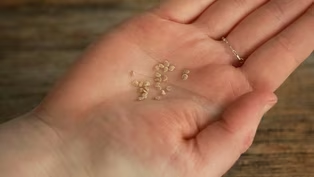
How Does a Seed Grown in Decorah Get To Your Own Garden?
Video has Closed Captions
Clip: S3 Ep310 | 2m 53s | From being planted to arriving at your doorstep, follow a seed's journey at Seed Savers Exchange. (2m 53s)
Michael Egel and the Rise of Des Moines Metro Opera
Video has Closed Captions
Clip: S3 Ep310 | 6m 40s | Michael Egel's journey from small-town Iowa to Des Moines Metro Opera leader. (6m 40s)
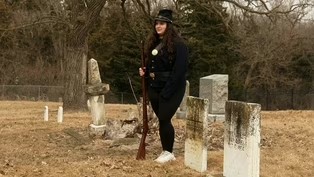
Schoolboy Soldiers of Rippey: Iowa Students Preserve a Civil War Legacy
Video has Closed Captions
Clip: S3 Ep310 | 6m 57s | A forgotten Civil War story is brought back to life by Iowa students. (6m 57s)
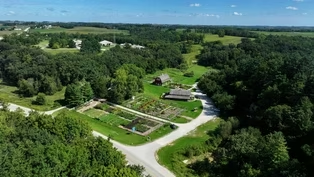
Take a Virtual Visit of Seed Savers Exchange Heritage Farm
Video has Closed Captions
Clip: S3 Ep310 | 1m 33s | Visit Seed Savers Exchange Heritage Farm in Decorah. (1m 33s)
Colfax, Iowa in 1976: A Bicentennial Time Capsule
Video has Closed Captions
Clip: S3 Ep310 | 4m 31s | A 1976 film captures life in Colfax during America's bicentennial celebration. (4m 31s)
Providing Support for PBS.org
Learn Moreabout PBS online sponsorship












Support for PBS provided by:
Iowa Life is a local public television program presented by Iowa PBS