
This Is Where the First Alphabet Was Born
Clip: Season 52 Episode 16 | 3m 5sVideo has Closed Captions
It became the basis for most written languages, beginning 4,000 years ago in the Sinai desert.
From the depths of ancient mines came a revolutionary idea: a simple set of symbols that anyone could learn — the birth of the alphabet, and the democratization of knowledge.
Problems playing video? | Closed Captioning Feedback
Problems playing video? | Closed Captioning Feedback
National Corporate funding for NOVA is provided by Carlisle Companies and Viking Cruises. Major funding for NOVA is provided by the NOVA Science Trust and PBS viewers.
Support provided by:


This Is Where the First Alphabet Was Born
Clip: Season 52 Episode 16 | 3m 5sVideo has Closed Captions
From the depths of ancient mines came a revolutionary idea: a simple set of symbols that anyone could learn — the birth of the alphabet, and the democratization of knowledge.
Problems playing video? | Closed Captioning Feedback
How to Watch NOVA
NOVA is available to stream on pbs.org and the free PBS App, available on iPhone, Apple TV, Android TV, Android smartphones, Amazon Fire TV, Amazon Fire Tablet, Roku, Samsung Smart TV, and Vizio.
Buy Now
NOVA Labs
NOVA Labs is a free digital platform that engages teens and lifelong learners in games and interactives that foster authentic scientific exploration. Participants take part in real-world investigations by visualizing, analyzing, and playing with the same data that scientists use.Providing Support for PBS.org
Learn Moreabout PBS online sponsorship- This is one of the turquoise mines, and if you look all over the walls, there are these scratches from where the workers' pickaxes have been, but here, something else is going on.
There are about 30 or 40 of them all over this place.
Some of these have been copied from hieroglyphics, but some are completely new, and here's how the system works.
You take the symbol and you say the name, but you only take the first sound, and you discard the rest, so for example, this here, this is an ox.
You can see the horns and the head here.
To the miners, this would be aleph.
Now, aleph, just take the first sound, ah, discard the rest.
This is another symbol.
This is a symbol for house.
To them, it would be bet, so you just take the beh sound at the beginning, and if you put these two together, you start understanding what you're actually looking at here.
This is the birthplace of the alphabet.
(dramatic orchestral music) This new script was simpler to learn than hieroglyphics, because the alphabet did not represent complete words, but spoken sounds.
It was able to convey any thought with only 20 to 30 symbols.
(dramatic orchestral music continues) These miners are the ones who gave birth to this, and their legacy is still with us today, and is so important.
(dramatic orchestral music continues) In the centuries and millennia that followed, nearly all the early written languages fell into obscurity as those civilizations waned.
but this alphabet would only grow, spreading across the planet, reshaping and branching into many different forms.
(dramatic orchestral music continues) It now forms the basis of most known written languages, (dramatic orchestral music continues) allowing millions and then billions of ordinary humans to access knowledge, to communicate, and to document their thoughts and their existence in every corner of the globe.
For me, this is one of the most powerful moments in the human story, because unbeknownst to the underdog, they had changed the world.
One of civilization's most profound and revolutionary ideas didn't come from an educated elite, it came from inside these dark and miserable mines through the copying and innovating of lowly migrant workers.
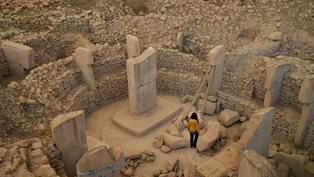
Göbekli Tepe: The 11,500-Year-Old Mystery That Rewrote History
Video has Closed Captions
Clip: S52 Ep16 | 2m 47s | What archaeologists found here reveals one of the biggest turning points in human history. (2m 47s)
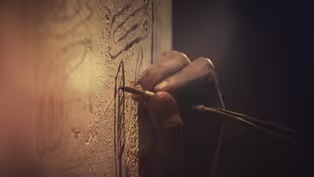
Human: Building Empires Preview
Video has Closed Captions
Preview: S52 Ep16 | 30s | Discover how two revolutionary ancient inventions changed the course of humanity forever. (30s)
Providing Support for PBS.org
Learn Moreabout PBS online sponsorship
- Science and Nature

"Our New World" reveals Nature's astonishing adaptation abilities and how humans can help it thrive.

- Science and Nature

Capturing the splendor of the natural world, from the African plains to the Antarctic ice.










Support for PBS provided by:
National Corporate funding for NOVA is provided by Carlisle Companies and Viking Cruises. Major funding for NOVA is provided by the NOVA Science Trust and PBS viewers.