
Thomas Naegele and More
Season 15 Episode 1 | 27m 13sVideo has Closed Captions
Learn about a pioneering artist painting scenes at an internment camp and more.
A pioneering artist painting scenes at an internment camp, a mother and daughter equestrian duo with Olympic aspirations, and a filmmaker discovers rare archival footage of his hometown are the featured segments on this episode of Nebraska Stories,
Problems playing video? | Closed Captioning Feedback
Problems playing video? | Closed Captioning Feedback
Nebraska Stories is a local public television program presented by Nebraska Public Media
Thomas Naegele and More
Season 15 Episode 1 | 27m 13sVideo has Closed Captions
A pioneering artist painting scenes at an internment camp, a mother and daughter equestrian duo with Olympic aspirations, and a filmmaker discovers rare archival footage of his hometown are the featured segments on this episode of Nebraska Stories,
Problems playing video? | Closed Captioning Feedback
How to Watch Nebraska Stories
Nebraska Stories is available to stream on pbs.org and the free PBS App, available on iPhone, Apple TV, Android TV, Android smartphones, Amazon Fire TV, Amazon Fire Tablet, Roku, Samsung Smart TV, and Vizio.
Do you have a Nebraska Story?
Do you have a story that you think should be told on Nebraska Stories? Send an email with your story idea, your name, your city and an email address and/or phone number to nebraskastories@nebraskapublicmedia.org. Or, click the link below and submit your information on nebraskastories.org.Providing Support for PBS.org
Learn Moreabout PBS online sponsorship(light music) (upbeat music) -[Narrator] Coming up on "Nebraska Stories," scenes of life behind barbed wire in a Nebraska POW camp, (upbeat music) dancing in the dirt with Olympic dreams, (upbeat music) and the rich past and promising future of North Omaha.
(rock music) (rock music) (rock music) (rock music) (rock music) (gentle music) (gentle music) - [Narrator] In southwestern Nebraska in a tall grass meadow lie the scattered ruins of a prisoner of war camp constructed in World War II.
(gentle music) (gentle music) Broken concrete pads are all that remain of a place that once held German soldiers captured in North Africa.
(gentle music) (gentle music) (gentle music) The Nebraska Prairie Museum in Holdrege hosts an exhibit that preserves this remarkable period in Nebraska history.
-[Micah] I think majority of our guests say, "I never heard about this," and so I think it's a very unique moment in history that only lasted a couple years, but I think that most, the majority of people had zero idea that that event happened.
- [Narrator] During World War II more than 400,000 prisoners of war were confined in detention centers across America.
Nebraska hosted four base POW camps, each accommodating around 3000 prisoners.
The first arrived in 1943.
They were German and members of the Afrika Korps.
But, it's in the adjacent gallery where visitors can explore the everyday experiences of German POWs and their captors through paintings by Thomas Naegele.
(gentle music) (gentle music) -[Micah] So much of the photos that we have from the era are all black and white.
And so what he provided was atmosphere, color, perspective to the events of the camp.
(gentle music) (gentle music) (gentle music) (gentle music) - [Narrator] His mother a doctor, his father an artist, Thomas Naegele was born in Stuttgart, Germany in 1924.
- My mother was Jewish, she came from a Jewish family.
My father came from a protestant one.
- [Narrator] His childhood was a happy one until the Nazi Party rose to power.
In 1937, when he was 13, Thomas became a war refugee when he and his two brothers were shipped off to attend school in England.
-[Thomas] Well I said, I'm not goin', I'm staying in Germany.
My mother looked at me and said, "If you turn this down "there are lots of boys and girls "who will jump into your place instantly "and you'll go down in this country "and get lost and they will survive."
(gentle music) - [Narrator] His parents escaped Germany mere days before the war began.
The family reunited in England and then pushed on to North America, eventually settling in New York City where Thomas was able to finish high school before he was drafted into the United States Army.
(gentle music) - [Thomas] Officer at Fort Dix asked me a direct question.
He says, "How would you feel about firing on a German?"
I said, "I don't like the idea of firing on anybody, "but if I'm really confronted and it was "a question of survival, I would like to be the one "who pulls the trigger first."
(gentle music) So he rubbed his chin and says, "How about if we "put you in the medics?"
(gentle music) - [Narrator] As a German war refugee the Army struggled to find an occupation for Thomas.
He was reassigned to the Signal Corp to train as a lineman at Camp Crowder, Missouri.
It's where he had his first encounter with his former countrymen.
-[Thomas] Well one morning a question was asked at assembly, "Does anybody speak German?"
And I raised my hand, in spite of the advice that you should never volunteer for anything.
But, I was curious, and sure enough I was assigned to help relocate a building and the German crew arrived on a truck, under guard, and it was a very motley crew of different types whom I depicted there.
They were all from the Afrika Korps.
That was the first German Army unit to be incarcerated in America.
- [Narrator] Thomas underwent another duty change, but this one he kept for the duration of the war.
He was now an interpreter.
But, it was a role that caused other GIs to question his loyalty.
-[Thomas] This guy says, "What the hell is going on here?
"Are you a Nazi yourself?"
You know, they thought that I was with them.
(train horn) - [Narrator] Not long after the German POWs arrived in Nebraska, Thomas was stationed at Internment Camp Indianola, located about 10 miles east of McCook.
(train track sounds) - Believe it or not, I had my paint box from Germany and my school bag from Germany all the way through the Army.
(tires on gravel sounds) - [Narrator] On scraps of wood salvaged from junk piles Thomas began painting in his free time, recording a distinctive one-of-a-kind record of life behind barbed wire.
(static sounds) (indistinct chatter) -[Thomas] This is a sort of a catalog of the type of people as they arrived.
We had Navy personnel.
We had SS personnel.
We had elderly people.
(indistinct chatter) But, the tower was the obvious fundamental necessity for operating that camp.
And you could see that tower for miles around.
And of all things, it sprang a leak in the wintertime and ended up with a huge icicle cascade hanging overboard.
(hammering sounds) (horse and wagon sounds) They didn't like the bread that they had in the Mess Halls.
There were bakers among the PWs, so they actually were provided with flour that made decent bread.
(people bustling around) The Germans had discontinued the military salute and replaced it in their desperation with the Hitler salute.
And yet we Americans respected this order anyway.
I remember that McCook was crawling with officers from the nearby air base and it was customary to salute these people.
And they in turn, saluted back.
(city street sounds) - [Narrator] Thomas also captured a moment where he had to deal with angry prisoners rebelling over work detail.
(prisoners chatting) - I was supposed to take away the milk from their Mess Hall as a reprisal from us.
I unlocked the gate, which they were pressing on from behind.
The leader of that group was an S and S man.
His name was Post, and he sidled up to me in the Mess Hall and he says to me, "Naegele, do you know what we could do to you?"
(gentle music) I was the only American in that chorus of guys (gentle music) and I said to him, "Let me remind you, "you're in America and you're not gonna "get away with anything.
"And I advise you to control yourself and stand back."
And he did.
(gentle music) - [Narrator] Not all of the art on exhibit was created during Thomas's time in the service.
Several were painted five decades later to commemorate the 50th anniversary of World War II.
-[Thomas] I wanted to be part of that record.
I painted the pictures fairly quickly, one after another.
- [Narrator] The full set of paintings were exhibited on the east coast and then shown in Germany near Thomas's hometown.
It was while he was in Stuttgart that Thomas met Nebraskan, Glenn Thompson.
Thompson was writing a book on POW camps in America.
The men became friends and that is how the paintings found a permanent home in Holdrege.
-[Micah] Glenn had approached Naegele on the idea of having a POW exhibit space.
And so they somehow brokered a deal and they had built this prisoners of war interpretive center where we are in today.
(car door opening and closing) - [Narrator] In many respects Nebraska still retains the essence of the days when Thomas was stationed at Camp Indianola.
The relaxed, unpretentious way of life on the Great Plains left a lasting impression on him and he believes on the men who were once imprisoned here.
(gentle music) (horse neighing) (gentle music) - [Thomas] And rural America was in a sense, a cure.
(gentle music) You can't put it any other way.
But, the peacefulness of the middle west had a casual attitude towards life that made for an environment in which these prisoners got a whole different view of life (indistinct chatter) without realizing it.
(indistinct chatter) It wasn't organized.
It wasn't deliberately administered or anything.
It just co-existed.
(soft bustling sound) Overwhelmed all the trivia and the pettiness and selfishness and the racist attitudes, and the arrogance from which most of us, all of us, suffered to a certain extent.
(gentle music) Nature prevailed.
(birds chirping) (upbeat music) (upbeat music) (gentle music) (gentle music) - [Narrator] As the sun rises across Eastern Nebraska, Jami Kment and her daughter Lexi carry out their daily chores on the farm.
(gentle music) (gentle music) - [Jami] No matter if you're sick, if it's a blizzard, if it's raining outside, it's hot, you're tired, you have to take care of them.
(gentle music) They depend on you and so it helps you get grounded, especially as a teenager, being more excited to go see your horse then to go see boys and friends was always a good thing.
- I'd say my relationship with the horses is friends for sure, best friends.
They're the ones that when I have a really hard day at school.
I can just come down here and hang out and just kind of tell them my life problems and they're just like, "Okay, treats now."
They're always willing to listen.
(upbeat music) - [Jami] They have the look in their eye, how they twitch their skin, how they move their ears, and yeah, but it takes time to get to know a horse and to know their personality and what they think about things, but it's a really neat connection to have with them.
(upbeat music) - [Narrator] This mother and daughter share a mutual love for horses and a passion for the sport of dressage.
It all started years ago when Jami was a little girl and her father would drive by a pony club on their way to a local lake.
- [Jami] My dad actually knew the guy that owned the place.
His name was Lowell Boomer and he's actually the founder of dressage in the US and so from that day on the boat never went back into the water and for $5 every Sunday we could come out and rent a horse.
(upbeat music) - [Narrator] G Lowell Boomer also had a deep love for horses.
As a young man, he witnessed a military dressage competition held in Lincoln, which ignited his interest in the sport.
Later he founded the Nebraska Dressage Association and played a pivotal role in establishing the US Dressage Foundation.
(military band music) Dressage is the art of training horses where the horse and the rider perform a series of precise and predetermined movements from memory, but the origins of the sport are rooted in military combat on the battlefield.
- [Jami] The horse could give the illusion of stampeding towards you when really it was in place.
Or if you had your sword, you could go quickly to the side to be able to get your enemy or you could be able to turn it quickly to get someone behind you.
(upbeat music) (upbeat music) - [Narrator] As athletes advance in dressage, the difficulty of movements increases.
- [Jami] You will have a half pass and that's when a horse goes sideways and crosses its legs as it's going apart, (upbeat music) or you'll have flying changes where a horse is skipping in the air and going, it's at the canter where you go from one lead to the next lead and you can do it even every stride and that's where it looks like a horse is skipping.
Then there's the passage, which looks like a slow motion trot that's very elevated in the piaffe where the horse trots in place.
(upbeat music) Horses are really good about yielding to pressure.
If you weight your left seat bone, they want to move to the left seat bone, so if you do a half pass to the right, you weight your right seat bone and then you use your left leg to show them where to go, and then they'll start crossing their legs to go that way.
- [Narrator] Dressage has both national and international championships, but the level of competition at international events is much higher.
- [Jami] You have to have a passport for your horse and there's a lot of more stringent drug rules.
- [Narrator] Jami has won many international competitions, but when she's not competing, she guides others in the sport.
- [Jami] I have 12 full-time clients that work with me four to five days a week, 52 weeks of the year, and then I have other clients that are outta state that I teach virtually.
(upbeat music) - [Lexi] I won my first national championship when I was 13, (upbeat music) so that was at Festival Champions.
- [Jami] Probably one of my funnest accomplishments as a coach is having my daughters there, and Lexi was a triple gold medalist, meaning she won every gold medal there was at the North American Youth Championships.
- Sometimes I get emotional, my first national anthem play.
There's a picture of me on the podium and I look like I'm really mad, but I'm just trying not to ball my eyes out.
- [Narrator] Injuries are also a part of the sport.
Lexi had to put a halt to training when her horse Monty was hurt.
She worried they wouldn't be able to defend their titles in the coming year, but after a grueling off-season, Lexi stood atop the podium again.
- The first time was more of a surprise and more of like a, "Oh my gosh, I can't believe we did that," a not quite real feeling.
The second time was a more of a, "Okay, I can do this.
I can come back from hard things and we can still be good.
We don't have to just have one time that we're great and have it be over.
- [Narrator] Jami and Lexi's journey in the world of dressage showcases a deep bond between horse and rider and between mother and daughter.
(upbeat music) - [Jami] I feel like a very proud mom and a proud coach, and it's fun to be able to wear both of those hats at the same time, but at a competition, I'm definitely more of a coach than I am a mom, and then we get to go home and I get to be the mom.
(soft music ) (upbeat music) (film clicking) NARRATOR: Grand Island, Nebraska, 1926, captured on flammable nitrate film.
And here's the same view shot with a video camera 90 years later, the past meets the present.
(popcorn popping) LADY: Thank you for coming!
NARRATOR: We're at the Grand Theater for the premiere of Hometown Movies.
This is filmmaker, John Sorensen's gift to his hometown.
JOHN SORENSEN: The earliest footage in the film is from 1926 and there's like a high school class graduation.
NARRATOR: In his tribute to a man generations of children will never forget.
WALLY KEMP: Hi folks, I'm Wally Kemp, Grand Island drive-in theater.
Been out to Hollywood, very en thusiastic about the pictures that's coming forth, I want you to take a peek at a few of them, thank you.
NARRATOR: Wally Kemp, longtime manager of The Grand, had Hollywood connections.
But his real gift was getting kids excited about movies.
JOHN: For the summer shows, he would come on stage and I was one of those kids, my parents were some of those kids before me and he would come out and he would say, "I'm so glad to have you all here, I wanna do a few special things I do every year to start the shows.
First of all we're gonna sing God Bless America."
AUDIENCE: ♪ God bless America my home sweet home.
♪ JOHN: Everybody turn to the booth and now ...
AUDIENCE: On with the show!
(applause) (soft music) NARRATOR: This is one of the hometown movies Wally Kemp collected over the years and screened in this very theater.
Only one copy of this film was ever made and after Wally Kemp's death, no one could find it.
Until John Sorensen got in touch with a film curator at the Stuhr Museum in Grand Island in the 1980's.
JOHN: And we spent a day searching all over the grounds trying to find something.
He finally went, "There's a room I hardly go into, there's a desk in it with a drawer, I think I may have seen some film."
We got in there, he opened the desk drawer, cigarette in mouth, there's all that film and I said, "Tom put out the cigarette."
Because some of that, the 1926 was they call silver nitrate, highly flammable stock and it could've blown up the whole museum.
NARRATOR: John took the nitrate film to an expert, Paul Eisloeffel, of the Nebraska State Historical Society.
PAUL EISLOEFFEL: We wanted to make sure that it hadn't degraded in any way.
We were very careful about unrolling it and watching, looking at frame-by-frame.
One thing that I found when I was researching the film is that it was made with the intention of actually documenting the town.
So they took great pains to show businesses, to show community leaders, to show pioneers, to show the school kids, a whole spectra of what the city was like at the time.
NARRATOR: Another surprise from Wally Kemp's collection, Hollywood comes to town in living color.
In 1939, Paramount Pictures rented a train to transport celebrities to the Omaha premiere of a new film called Union Pacific, with a stop in Grand Island along the way.
The whole town came out to see Barbara Stanwyck and director Cecil B. DeMille.
PAUL: It had this national, regional, local aspect all kind of colliding into this one event, and I think it really documented that event very well.
(light music) (energetic band music) PAUL: I think the moving image is probably the most important document of the 20th century.
If we didn't have the footage of the moon landing, the Rodney King footage, if we didn't have the Zapruder film of the Kennedy assassination, how would our lives be different?
(playful music) NARRATOR: And sometimes the moving image simply captures everyday life.
These are rare scenes from downtown Grand Island in December, 1945 at the end of World War II.
JOHN: It's like Frank Capra came to town and found It's A Wonderful Life actually happening and took it down as a reality show, it's very powerful.
PAUL: Just point the camera at what's happening, capture that and that's what home movies are all about.
Downtown is where things were happening, that's where you wanted to be.
NARRATOR: From shadows of the past, into the full light of the present.
MAN: Great, wonderful.
WOMAN: Oh I liked it all.
LADY: It was wonderful.
FEMALE: Educates me a little bit.
MALE: My grandparents lived here so I was looking for them real hard in the film.
NARRATOR: And surprise, Buzz Dauphit recognized his father from the long lost footage of 1945.
BUZZ DAUPHIT: I couldn't believe it!
My dad was a tremendous skater.
He grew up in Fullerton area on the Loup River and they had an old guy from Norway taught him how to ice skate.
(flute music) BUZZ: And he could do figure eight's, backwards and frontwards, terrific skater.
I think that picture was probably taken at Shimmers Lake.
And they had an ice skating club, I could believe, so anxious to call my sisters and tell them I saw dad out there skating.
(cheery music) NARRATOR: So here it is preserved for all time, lost and found film, the past waving at the present.
Nothing more, nothing less than shadows on the screen.
(cheery music) (upbeat music) (upbeat music) - [Narrator] Watch more Nebraska stories on our website, Facebook and YouTube.
(upbeat music) Nebraska Stories is funded in part by the Margaret and Martha Thomas Foundation.
(upbeat music) (upbeat music) (upbeat music) (upbeat music) (upbeat music)
Video has Closed Captions
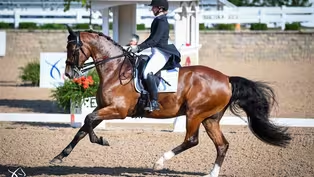
Clip: S15 Ep1 | 6m 26s | A mother and daughter compete together on the national stage in the sport of dressage. (6m 26s)
Thomas Naegle, Behind Barbed Wire
Video has Closed Captions
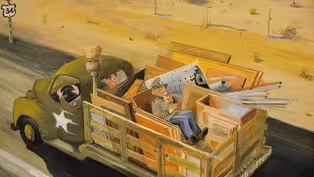
Clip: S15 Ep1 | 11m 38s | German-born Artist Thomas Naegele paints images of life in a POW camp in Indianola, NE. (11m 38s)
Providing Support for PBS.org
Learn Moreabout PBS online sponsorship

- News and Public Affairs

Top journalists deliver compelling original analysis of the hour's headlines.












Support for PBS provided by:
Nebraska Stories is a local public television program presented by Nebraska Public Media