In the Arena
Tim Killeen and Marie Lynn Miranda: Opening Doors for the Next Generation
Special | 23m 30sVideo has Closed Captions
Tim Killeen and Marie Lynn Miranda explore education, service, and finding your path.
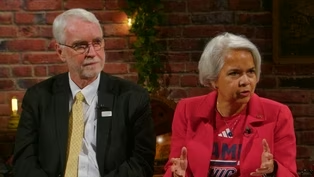
University of Illinois System President Tim Killeen and UIC Chancellor Marie Lynn Miranda join Doug Cruitt to share their paths from science and mathematics to higher education leadership. They discuss opportunity, service, helping Illinois communities thrive, and encouraging young people to follow their curiosity and find their purpose.
Problems playing video? | Closed Captioning Feedback
Problems playing video? | Closed Captioning Feedback
In the Arena is a local public television program presented by WTVP
In the Arena
Tim Killeen and Marie Lynn Miranda: Opening Doors for the Next Generation
Special | 23m 30sVideo has Closed Captions
University of Illinois System President Tim Killeen and UIC Chancellor Marie Lynn Miranda join Doug Cruitt to share their paths from science and mathematics to higher education leadership. They discuss opportunity, service, helping Illinois communities thrive, and encouraging young people to follow their curiosity and find their purpose.
Problems playing video? | Closed Captioning Feedback
Where to Watch In the Arena
In the Arena is available to stream on pbs.org and the PBS app.
Providing Support for PBS.org
Learn Moreabout PBS online sponsorship(rhythmic music) (upbeat music) (upbeat music continues) - Theodore Roosevelt reminded us that the credit belongs to those willing to step into the arena, to strive, to stumble, to rise, and to dare greatly.
Today's guests step into that arena every single day.
Together, they lead institutions responsible for educating and inspiring more than 100,000 students, the next generation of thinkers and doers, researchers, and entrepreneurs.
And like most founders we've met on the show, their own journeys haven't followed a straight line.
Today, we're going to explore those journeys and what it means to lead institutions charged not simply with preparing people for the world, but empowering them to build the world that comes next.
I'm Doug Cruitt, and today we're stepping into the arena with the University of Illinois System President Tim Killeen and UIC Chancellor Marie Lynn Miranda.
(energetic music) (energetic music continues) And I'd like to welcome our guests today.
We have two guests, a special episode with President Tim Killeen and Chancellor Marie Lynn Miranda.
Welcome to "In the Arena".
- Thanks for having us.
- It's a pleasure to have you both here.
So, this show is meant to inspire, to educate, to motivate, to connect people with ideas and other people that have stepped into the arena, who sometimes become marred by dust and sweat and blood, as President Roosevelt (Tim laughing) once said.
And we like to take our listeners and our viewers through a journey of time, to go back in time.
And so, the question we ask our guests are, who were you before the role that you're in now, before you started this company or before you became president?
So, Tim, I'm gonna start with you if that's okay.
And I'd like to go back to perhaps your childhood to talk about some things that maybe helped to get you to where you are now, that looking back in hindsight, can say, maybe that person or that event, or that TV show, or whatever it was might have inspired you.
- So, I grew up in Wales, which is a small country on the edge of Europe, in a beautiful country and in a tight community.
It was an Irish Roman Catholic kind of community.
And I was a hardworking student, I think.
I was probably terminally shy as a young person.
- Okay.
- I wasn't as outgoing as now I've become in this job, but I wanted to do things with my life that were meaningful.
And I think that was because I was in a big family and lots of cousins, and so forth, and they were all singing and doing things in different professions.
So, I was definitely motivated to the extent I could excel.
- Mm.
- I didn't feel like I could excel, but I knew I was good at certain things.
And some things I was good at, I didn't really like that much, but I was good enough at it.
I thought I would go down that because if I could master that, then I could do other things.
- Mm.
- So, I went into physics because I thought it was the most difficult thing I could do.
And if I could do that and get through it, I'd probably be able to do anything else I wanted to do.
And that set me on a journey of, I would say, science and nature, and understanding, and the beauty of mathematics, illuminated somehow in a strange way, - Mm-hmm.
- not the really esoteric mathematics, but things that can describe and so you can understand things.
And then, working with your hands on projects, building gadgets, I really like that.
Gadgets that work.
I've got a gadget in space as we speak, that's working as we speak.
So, I became that kind of, perhaps a little obsessive about doing things that mattered to me that were difficult somehow.
- Mm-hmm.
- And because they were difficult, I failed a lot, as you do.
(Doug laughing) But you get better as things.
You don't get to mastery, but you get better.
And then, you can see contributions flowing from that, as your previous speaker said.
- Mm-hmm.
- And then, the big thing for me was coming to the United States because the shyness had to disappear.
I came to the United States as a young postdoc and the sky is open, the panorama was suddenly vast and huge - Mm-hmm.
- and I was expected to do things that I thought were interesting and I wasn't constrained.
And that was just such a joy and an opportunity.
And again, struggles to, you have blind alleys and you have failures, but then I got involved in NASA space science projects, which I thought were the most exciting things I could ever imagine doing, - Yeah.
- launching satellites to planets and to earth observation things.
That was so exciting.
And then, I branched out from there into administration.
And so, every step has been, I would say pretty unplanned, - Mm-hmm.
- but every step has opened up for the panoramas.
And now, I have the honor of being a president of a major university system, 102,000 students, which was never a plan.
So, my life has been like a pinball machine.
You pull the stopper back, the ball goes, and it bounces around and you keep the flippers moving and good things can happen.
- Yup.
- So, that's me.
- I appreciate that.
I'm a visual guy, so in my head, you're tinkering, you're building things.
What's something you built whenever you were young that you were really proud of?
It doesn't matter the age, but I mean you could have been in your garage.
- Well, I built a short wave radio and became a ham radio operator.
I took apart car and did all the things that you do to redo that.
So, gadgets were really important.
And then, a little older, I worked on a sounding rocket that got launched from Northern Norway into the aurora lights.
That was really exciting.
- Wow.
- So, with a countdown, (Doug laughing) nine, seven, you know, - Nine seven?
- I get my numbers wrong.
(Doug and Marie Lynn laughing) It was very exciting.
So, the thrill of doing something electric and meaningful with gadgetry somehow was very appealing to me.
And then, connecting it to the human experience is also a major part of what motivates me.
- Mm-hmm.
- So, it's not doing physics for physics' sake, it's doing geophysics because it's a relationship of the planet that nurtures life and humankind - Mm-hmm.
- that's on that life.
And of course, education then becomes a natural extension of that.
So, that's been a little bit of my journey and I've been on every five continents.
I've been to the South Pole, I've done snow angels on the South Pole.
So, I've had a blessed career (Doug laughing) that I'm kind of proud of, but certainly enjoyable.
But working as a professor with young people is the top.
- Mm.
- That's the most joyous thing you can do for somebody like me.
- That's amazing.
Thank you for sharing that.
Marie Lynn.
- Yep.
- Let's go back into your youth.
So, tell me about your journey in your early years.
- Sure.
So, I am the child of immigrant parents.
I grew up in the city, in Detroit.
When I sat down at the dinner table every evening, it was my mother and my father, my three brothers, my grandmother, her two sisters, my cousin, his wife, and their three kids.
- Wow.
- So, my mom had to figure out on pretty limited resources how to make things work for that huge crowd of people, - Yeah.
- that, to me, that was just sort of every day what life should be like.
So, as a consequence, I can work anywhere, no matter how noisy it is.
(Doug laughing) But we didn't have a lot of resources available to us.
We had very strong sense of family and we had a very strong sense of this message that my family communicate, my parents communicated to us, my grandmother communicated to us, our school communicated this, our church communicated this, that for what gifts you've been given, you have an obligation to give back.
- Mm.
I love that.
- And I just really loved math.
I can think about math for a really long time, - Mm-hmm.
- particularly geometric and linear algebra concepts.
And I just kept trying to figure out how do I combine my deep love of math and this deep sense of... It wasn't obligation as much as it was a true sense of you were put on the planet - Mm.
- with whatever gifts you have to give back.
So, how do I figure out bringing those two things together?
And the way that I figured it out eventually, it took me going through undergrad and then graduate school, and then getting into my first job was to figure out that these kind of spatial analytic approaches that kept my brain so happy that I got to work on them, that I could apply those approaches to health disparities.
And if I applied them in creative and innovative ways to health disparities, I could not just describe and illuminate for people what the health disparities were, but you could actually come up with interventions that would close disparities.
And it really came together for me when I started having children because then I could do the same thing both at home and at work, - Mm-hmm.
- which was at home, I wanted to create an environment where my children could prosper.
And if I took this spatial and analytical approach, applied to health disparities, and focused on children, then at work, I could work to create environments where all children could prosper, not just my own children.
- Wow.
- So, being able to bring together that just deep love of math with this deep desire to be of service in the world, to be a good person in the world, - Mm-hmm.
- and to live up to the promise that this country gave our family by welcoming us into the country and providing us with incredible educational opportunities.
- Mm-hmm.
Amazing.
Tim, you've been using a term recently, thrivability.
- Mm-hmm.
I have.
- First, I think we should make T-shirts, #thrivability.
- I think so.
I think so.
- So, we'll spin that business up later today.
- Okay, very good.
I'll join you.
- But tell me more.
(Doug and Tim chuckle) Tell me more about what that means for our state and also for maybe the Central Illinois region.
- Yeah.
Yeah.
Well, when you're an educator and you're looking at the formation of human capital, young people learning and growing and experiencing, and being social and so forth, it's such a journey, a set of journeys that you recognize that you're here, yes, for a span of time, but really, we are a community that should prosper - Mm.
- into the future and it should be nurtured in order to prosper and flourish in ways.
I find that is really important.
And there's a little dismay in the air right now with anxieties for all kinds of things that young people are experiencing and looking at.
And the word sustainability is used more frequently.
- Mm-hmm.
- And you know, in my simple mind, that could be like a low quality but sustained future.
- Yeah.
- Thrivability kind of connotes a future in which you grow, you can experience, you can participate, you can live, you can enjoy assets, the green spaces, and you know, all kinds of things to live out a life of joy.
And I think that's what we need to do.
As educators, we're investing in it every day - Right.
- to create that kind of capability.
So, it does not roll off the tongue quite as easily as some other words, (Doug chuckles) but I think if we focus on thriving and flourishing as, you know, in authentic ways with human welfare and healthcare delivery, access to amenities, and to cultural issues, that's what we need to strive towards.
Leaving no communities out or behind and avoiding conflicts because they're not, they're negative.
- Mm-hmm.
- So, that it encompasses all of that.
And I think we're on the time we have - Mm-hmm.
- with the assets we have and the opportunities we have to convene and to create, and to deploy gadgets which work, right?
- Right.
Mm-hmm.
- I think we owe it to the next generations and as a relatively new grandparent, I feel it's even more keenly these days - Mm-hmm.
- Mm.
- that we need to work together.
And I would say both of us, I know my colleague Marie Lynn so well that we share the passion for really creating that kind of aspirational setting in the youth of our country and the world.
And we need to do that for a purpose and the purpose is to support each other through service to one another.
And I think that's the most joyous thing we can do.
And that's the essence of education, I think.
- Mm-hmm.
- Yes, it's seeking the truth and developing research pathways, and so forth, making sure that people can do their arithmetic, which obviously I can't, (Tim and Marie Lynn laughing) and so forth.
But I think that drives me.
It certainly motivates me and it shows up through pretty much daily activities on whatever front we're talking to.
I say coming to Peoria is always inspiring for this - Yup.
- because this is a community that works together.
Everybody knows everybody else.
They like everybody else.
It's very much a healthy community that has aspirations.
And if we, at the University of Illinois System, can help Peoria manifest itself into the future - Mm-hmm.
- with that kind of, in Central Illinois, - Mm-hmm.
- which is a magnificent place to live and grow up and work, and be.
- Tim, you've been in the arena at Uni of I System for 11 years?
11?
- 11 and a half.
- 11 and a half.
- Not that I'm counting.
(Marie Lynn and Tim laughing) - Not that you're counting.
What are you most proud of is question one.
So, we'll start that.
Question one, what are you most proud of?
- I'm most proud that over my entire tenure, our enrollment has grown and we've kept our costs down.
And the world-class educational attainment is solid.
- Mm.
- And everything's going up, reputation, not just enrollment, but everything's going up.
Our research volume is.
So, every objective metric is positive.
- [Doug] Mm-hmm.
- And that, I think, is not easy to pull off in this day and age with all of the issues that you read about.
So, it's 102,267 students is a lot of students.
They're mostly from Illinois and they mostly live and work and stay in Illinois.
I'm very proud of those fundamentals now.
- Mm.
- There are all kinds of other things I'm proud of too that we've initiated, and so forth.
But it's been a wonderful run, I would say.
- Mm-hmm.
- And you know, it'll be 12 years when I step down and that is way past the due by date for university presidents (Tim and Marie Lynn laughing) these days.
So, I think that's been a contribution, and of course, recruiting colleagues such as Marie Lynn - Yes.
- has been a thrill.
- To do your arithmetic for you.
- Yeah.
- That does my arithmetic for me.
And she's a consummate data scientist.
So, I am proud of a lot of things.
But it's an honorable, good place.
- Mm.
- And we can talk to, as we did this morning, talk to students in a high school and say, look, if you come to us, you will never regret it - Mm-hmm.
- and you will be able to flourish.
And you'll be able to sort of demonstrate your skills and sets, and connect in societal ways that are very joyous and beneficial.
So, that's, it's, you know, there are lots of jobs you could have that don't give you that kind of feedback.
- Mm-hmm.
- So, I'm proud of what we've accomplished, but it's all been a we, not I.
- Right.
- It's been the whole team has pulled together, and.
But I think visually as well, I think what we've done is we've scaffolded a platform over those years.
And it takes a while - Mm-hmm.
- to get public trust and confidence up.
You need to show up and return.
- Mm.
- But that platform that we have now at our university system, I think is unique, - Mm-hmm.
- unprecedented.
And it's a launchpad.
See, I'm talking about the space scientist that I am.
- Here we go.
- It's a launchpad for great things to happen, truly great things to happen in ways that can benefit society.
Like we all know the technological economy is growing, the green economy is growing too.
- Mm-hmm.
- Those are two fastest-growing world economies.
We can interlace those two things here like nowhere else.
- In a big way, yes.
- And we want to lead that.
And it's gonna have to be through partnerships with public, private, and governmental partners, and authentic external partners, other countries, and so forth.
And so, that openness to the world and that the talent is really important.
But the future is, it's a brave future.
So, I'm like jazzed that... - Mm-hmm.
- I'm jealous of my successor already, which is a strange thing to say, but I think using that platform to get to the next level is a very exciting prospect.
- Very good.
So, one final question for you both.
We'll start with you, Marie Lynn.
- [Marie Lynn] Mm.
- What advice would you give our viewers out there that, and we'll just, let's focus on our younger viewers, ones that are maybe pondering of a career path of, "Where do I want to go?
What do I want to do?"
Any sort of inspirational words or bits of advice?
- Yeah.
And it may be a little counterintuitive.
I think we've gotten - Yeah.
- into the habit of telling young people all the time, "Find your passion.
If you find your passion, you'll never work a day in your life."
- Mm-hmm.
- And then, passion is just a huge word for young people.
Like, "I like this thing.
I'm enjoying it, but is it my passion?"
- Mm.
- So, it sets such a high bar.
And I oftentimes want to say to young people, find work, something to study, a job to go to, whatever it might be, that you find interesting, that you find yourself surrounded by interesting people and curious people.
- Mm-hmm.
- And find a setting where your own curiosity, the things that really get you thinking, you get to explore that, you get to bring that part of you out.
And then, eventually, the big thing or the bigger thing you're gonna do in your life will become apparent to you.
There's actually this great math... Here, I'm gonna talk about math.
(Tim and Marie Lynn laughing) There's this great, Dantzig came up with this great simplex algorithm, and I won't go into all of the linear algebra, but the basic concept is, the world is full of uncertainty.
You're a young person, you're not quite sure what you wanna do, where you're going, but you can, in the face of all of that uncertainty, you can make a good first step that feels good to you.
- Mm-hmm.
- And then, when you get to that place, you can make a good second step, that's called simplex stepping in this algorithm.
And eventually, that bigger thing that you're doing, you are making your way through this complicated, uncertain world, and you arrive in this really beautiful place.
So, be generous with yourself.
- Mm-hmm.
- Find something interesting and find people who are interesting, and spend your time there and your purpose in the world will reveal itself to you.
- That's great.
I know I'm not good at math, nor do I fully trust it, but I understand that.
- Mm.
- And so, I like that a lot.
(Marie Lynn laughing) - You just needed a good math teacher.
- I did, I did.
I love that.
(Marie Lynn laughing) Same question to you.
- Well, I agree with everything Marie Lynn said.
I think I would tell young people to believe in themselves, - Yup.
Awesome.
- that they belong, that they're there for their purposes and those purposes may be mysterious to begin with, but they will unfold - Yes.
- over time.
Trust the future.
Be optimistic.
Don't just pull yourself down continuously.
Be bubbly optimistic.
Enjoy your friendships.
- [Doug] Mm-hmm.
- Be healthy if you can and be outbound, and enjoy smelling the roses and enjoying the green spaces.
Take care of yourself, take care of your mental health.
- Mm-hmm.
- Don't over turn yourself into a crisp because of anxieties or something like that.
But just kind of realize that life can be joyous and service to others is particularly joyous.
- Yes.
- You may not know that when you begin.
- Mm-hmm.
- It's maybe about me and what can I do and where do I fit and who's gonna give me credit, and so forth.
Can I make money?
Can I get a job?
All of those things are anxieties, but life unfolds in ways that are sometimes, they were mysterious to me.
- [Doug] Mm-hmm.
- Maybe some people have a game plan and just follow it and that's fine.
But I think trust in yourself.
And if you can through service, generate some joy through interacting with others, that is like, I think, the essence of living in society.
- Mm-hmm.
- So, I'd give them that, and I did that this morning to the students that we were interacting with - Yup.
- Mm-hmm.
- at a high school, and there were a lot of nodding heads as well.
So, there are lots of reasons you can pull yourself back or you can get down and dismayed, - Mm-hmm.
- but don't... And that's okay once in a while, but don't let that define you.
(upbeat music) - That's wonderful.
Well, Tim, Marie Lynn, thank you so much for stepping into the arena with us today.
- Absolutely.
- And thanks for all that you do for the next generation and beyond.
And we'll keep in touch.
- All right.
Thank you for having us.
- All right.
Thank you.
- Thank you very much.
(gentle music) - More than 100,000 students.
It's an extraordinary number, but behind that number are 100,000 individual stories still being written.
President Killeen and Chancellor Miranda have traveled their own winding roads to leadership.
And now, part of their work is helping thousands of others begin theirs.
Roosevelt reminded us that the credit belongs to those willing to enter the arena.
Perhaps great leadership is making sure the next generation knows the door to that arena is open.
So, find your door, step through it and dare greatly.
I'm Doug Cruitt.
We'll see you next time "In the Arena".
(inspiring music) (bright music)
 New
NewPreview: Tim Killeen and Marie Lynn Miranda
Preview: Special | 30s | Preview: Tim Killeen and Marie Lynn Miranda (30s)
Providing Support for PBS.org
Learn Moreabout PBS online sponsorship New Episode
- Science and Nature

Explore scientific discoveries on television's most acclaimed science documentary series.




 New Season

 New Season

Support for PBS provided by:
In the Arena is a local public television program presented by WTVP