
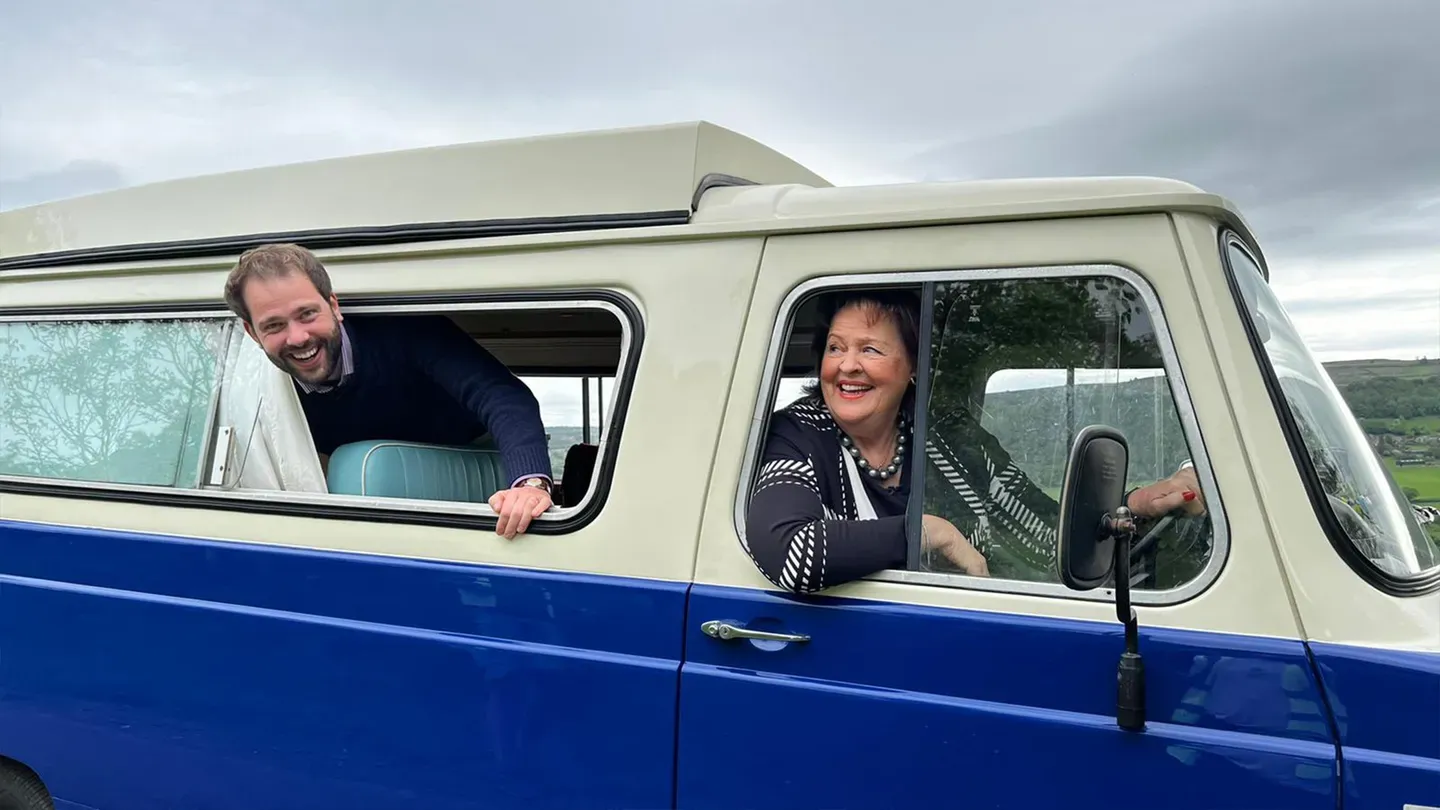
Tim Medhurst and Margie Cooper, Day 2
Season 25 Episode 12 | 43m 26sVideo has Closed Captions
Tim Medhurst and Margie Coopers’s travel to the Lakes where they find carp and diamonds.
In the Lake District, Margie buys a French carriage clock, a Chinese pepperette and a candlestick from Derbyshire. Tim falls for the image of a Victorian woman, though his Victorian horse toy might make for a bumpy ride at auction.
Problems playing video? | Closed Captioning Feedback
Problems playing video? | Closed Captioning Feedback
Tim Medhurst and Margie Cooper, Day 2
Season 25 Episode 12 | 43m 26sVideo has Closed Captions
In the Lake District, Margie buys a French carriage clock, a Chinese pepperette and a candlestick from Derbyshire. Tim falls for the image of a Victorian woman, though his Victorian horse toy might make for a bumpy ride at auction.
Problems playing video? | Closed Captioning Feedback
Where to Watch Antiques Road Trip
Antiques Road Trip is available to stream on pbs.org and the PBS app.
Providing Support for PBS.org
Learn Moreabout PBS online sponsorshipVOICEOVER (VO): It's the nation's favorite antiques experts...
Perfect.
Sold.
VO: ..behind the wheel of a classic car... Lovely day for it.
VO: ..and a goal - to scour Britain for antiques.
Every home should have one of these.
VO: The aim?
To make the biggest profit at auction.
But it's no mean feat.
Yes!
VO: There'll be worthy winners... 950... You're gonna make £1,000!
VO: ..and valiant losers.
No!
VO: Will it be the high road to glory... Make me a big profit.
VO: ..or the slow road to disaster?
Are we stuck?
IRITA & RAJ: Yay!
VO: This is the Antiques Road Trip.
VO: Ha-ha!
What fun.
Today, we'll be far out in England's largest national park.
Isn't the Lake District absolutely beautiful?
MARGIE: It is.
TIM: How many lakes are there?
Well, there's the obvious one - Windermere.
VO: Of course, but you'd hardly expect antiques experts to be able to name all 16.
MARGIE: There's Bassenthwaite.
TIM: Yep.
(IMITATES SCOTTISH ACCENT) Loch Lomond - oh, that's not a lake.
VO: Not actually in England either.
Ha-ha!
That's Margie Cooper behind the wheel, with wingman Tim Medhurst by her side.
Those doors keep flapping open.
Do they?
VO: Their transport this week is a 1970's Leyland Sherpa camper van.
Very low mileage.
Nice owners.
Right.
We can make up this hill, Margie.
VO: At least.
Wait a minute, wait a minute.
Let's get her into third.
(GEARS CRUNCH) TIM: Whoa.
MARGIE: Oh!
Sorry about that.
VO: Wannabe rally driver.
Margie is from Cheshire.
She's a dealer who specializes in silver but is happy to buy just about anything.
MARGIE: It's good, isn't it?
Be out of your comfort zone.
VO: Whilst Dorset's own Tim - great name - an auctioneer and a dealer is equally fond of heading off-piste.
(IN A HIGH VOICE) "Hello.
My name's Timmy."
VO: Although his prehensile purchase... AUCTIONEER: Five bid.
TIM: Oh, no!
VO: ..didn't exactly pay off at their first auction... At five... (GAVEL) VO: ..which could result in a less zoological approach moving forwards.
TIM: So, forgetting hand puppets... MARGIE: Yes... ..what would you love to find on this leg?
You know, I like a nice bit of furniture, personally.
Don't you?
We could get it in the back.
MARGIE: Yeah.
VO: Yeah.
Make sure those doors are firmly closed, though, eh?
Margie started out with £200 and has thus far made a bit of an improvement.
That is, £218.60.
While Tim, who began with the same sum, has a little more - £248.50.
Oh, look, there's some lambies.
Are they the first lambs we've seen this year?
Oh, look.
They're so cute.
VO: Ye-s. (SHEEP BLEATS) Our little lambs kicked off in Cumbria, and then headed over the border.
Today, they'll be let loose in the Lakes before crossing over to the Isle of Man.
Can be rough, that crossing.
Hope they're not sick.
Then it's back to the mainland, and a finale in Rochdale.
We're going over a cattle grid.
Ready?
TIM: Ahh-a-a-a-a-a-a... VO: Strictly Lake District, shop till you drop starts out in Maryport, just outside the national park.
VO: Famous for its blues festival... ..where Howlin' Tim Medhurst... Ha-ha... ..has been dropped off for his first gig of the day at Maryport Collectables and Antiques.
And there's proprietor Ben, shuffling his 45s.
What will our expert decide is a hit in here, we wonder?
TIM: Now, that is an eye-catching clock, isn't it?
And that screams to me the 1930s.
I'm imagining a big '30s boardroom with a big table, lots of chairs and people sitting around with cigars.
And look at that - it's kind of in the shape of one of the old radios as well, isn't it?
But it's really stylish, and I do like clocks.
If we turn it over, it's quite interesting, actually, because, one, you can use it as a mantel clock, which I think is probably its primary purpose, but then, also, it's got a hanger here so you could have it as a wall clock.
So it's sort of like it's got dual purpose.
VO: Yeah, clock that - ha!
No price on it, though.
TIM: Has got some wear and tear.
It needs a bit of TLC, but I think it's very, very stylish.
The straight lines, the timeless - pardon the pun - period of the 1930s, the art deco.
So, one to think about, but I haven't got much time, so I'd better crack on.
VO: Fair enough.
Now, whither our guy's road trip buddy?
And does she have the Tim's-already-in-a-shop-getting- all-the-good-stuff blues?
I reckon Tim's up to no good.
Knowing him, he'll sniff something out.
(CHUCKLES) But I hope he's having a nice day.
Quite miss my little friend.
VO: Margie's about to get her first buying opportunity in the nearby town of Cockermouth, on the edge of the park, birthplace of William Wordsworth, at Castle Antiques and Curios.
Hi, there.
Hello!
(CHUCKLES) Right.
VO: Anything going for a sonnet?
Looks like a box... ..with nothing in it.
(CHUCKLES) VO: Bad luck.
£218.60 to spend, remember?
That's proprietor Mat, who'll be happy to help.
MARGIE: Oh, my goodness!
That's an old telephonist machine.
I always wanted to be a telephonist.
I remember having a toy one.
I always wanted the ones that pulled out and went into a hole, but this is quite a sophisticated one.
Mat, is this a telephonist...machine?
MAT: Yeah, it is, yeah.
MARGIE: It is, isn't it?
MAT: It's...for an exchange out of a... ..probably a large office, or...apartments.
MARGIE: So, how much is that?
MAT: 70 we've got on it.
MARGIE: Oh, is it?
MAT: Yeah.
MARGIE: Never seen one like it, really.
Well, you've got so many interesting things in the shop, I'm going to wander around.
VO: A no-sale in Cockermouth.
How about Maryport, where Tim seems to have decided against the clock - get it?
But where is he?
Ah, there he goes.
TIM: I like this little object for several different reasons.
Firstly and foremost, it's a little box, and I do love little boxes, but also it's quite eye-catching because in the lid of this box is contained an original little 19th-century engraving of a couple, but they've been painted, as well, with watercolors to pick them out.
I would say it was maybe French, and it's made of brass on the outside, and then it's completely paper-lined, and normally with these boxes, they're usually quite tatty, because, of course, this paper, over what is about 150 years, would deteriorate.
And the best thing of all - turn it over and on the bottom it's got a little inscription and it's dated 14th of July 1856.
So not only do we know around the period that this was made, which is quite unusual with antiques, but to have an inscription, that's been personally written, in the 1850s by a Victorian, I find that quite amazing.
Now, opening the box up and looking in here, 'Victorian box - £20.'
I think that's pretty reasonable for something that is 150-odd years old and it's in that condition.
I really like that, so I'm going to take it with me, pop it in my pocket - I will pay for it.
I will pay for it.
VO: We'll be sure to remind you.
Ha-ha!
Anything else take your fancy?
TIM: Now, that's quite interesting.
I love early photography, and this one's caught my eye because it seems like this is the lifespan of a lady here, Mary Stuart - 1807 to 1889.
And there's three photographs in here - 1830, 1873 and 1887.
But the thing I love about this the most is the first photograph.
It's dated 1830, when the lady appears to have been 23 years old, but, of course, photography wasn't developed then, so instead of actually photographing the person seated, they've photographed a portrait miniature that was painted in 1830.
And I think that's utterly charming.
VO: 1839 is generally accepted as the year when photography was invented.
TIM: She was born in 1807, and it looks like she passed away in 1889, and I just think it makes it quite a charming, sort of, snapshot of history - pardon the pun.
VO: Oh, alright.
TIM: Now, price-wise, look at that.
Six whole pounds, so I think I'm going to buy that.
I've got my little box in my pocket.
I've got my photographs.
I'm happy.
VO: In that case, we're all happy.
TIM: Ah, Ben, hi.
BEN: Oh, hi, Tim.
I've had a really good look round, and I've found two rather nice things.
This little snuff box at £20, and the framed photograph's priced at £6.
Fantastic.
TIM: Now, I know they're not expensive things, but is there any wiggle room if I took the two?
Well, I could take a pound off.
TIM: Yeah, that's fine.
Do you know what?
Any pound helps at this stage.
VO: Reduction duly negotiated... TIM: Thanks very much, Ben.
BEN: No problem.
Thanks so much.
BEN: Bye.
VO: ..with 223 unspent, and while he says, "So long, Maryport," we'll find out if Margie's any closer to a purchase.
I've seen a little pendant, a drop pendant in the window.
I think it's peridot.
I think they're green stones.
Hopefully it's gold, but I can't see until I get it out the window.
Actually, I think I can get to it.
VO: Go on, then.
MARGIE: It's a bit small.
It's a bit light.
Those are peridots, green stones, and a smidgen of a diamond, hopefully.
It's alright.
It's not bad.
If it's cheap.
If it's the right price.
VO: Time to talk to Mat.
MARGIE: Mat, I've seen this in the window.
MAT: Mm-hmm.
Yep.
MARGIE: It's marked gold, isn't it, nine carat?
MAT: Nine carat, yep.
MARGIE: Yeah, yeah... MARGIE: So, how much is that?
MAT: 28.
MARGIE: So 25 buy it?
MAT: 25 will buy it.
OK.
I'll have that.
Thank you.
Lovely.
That's one in the bag.
Yeah.
VO: Thanks, Mat.
MARGIE: Right, so I am going to carry on looking... ..because, you know, the thing is, you've just got to look.
Ooh, look at that!
You see?
You've got to look.
Look up - ooh, what's that?
MAT: Yeah, there's stuff everywhere!
..and you've got to look down.
What is this?
MAT: That's an old fishing... ..a 1930's fishing bag.
It's a seat, as well.
MAT: And you can sit on it.
MARGIE: Oh, right!
MAT: You put all your tackle inside.
So it's a fishing tackle seat?
MAT: Yeah.
VO: Out of her comfort zone, but there may be a profit.
MARGIE: So what sort of money are things like this?
MAT: That one's 35.
MARGIE: (LAUGHS) MARGIE: Oh, my goodness!
It's just nice to buy things that are a bit different.
VO: I think she may be fishing for a deal.
I'm a bit concerned about that.
If I said...25 and 25, £50 for the pair, how does that sound?
MARGIE: That's a deal.
MARGIE: Thanks very much.
MAT: That's alright.
VO: Very convivial, but while Margie heads off with £168 left to spend... ..Tim's taking a bit of a break from treasure-seeking, at a former Benedictine priory... ..close to the Cumbrian coast, in the village of St Bees, where he's come to find out about a unique discovery made here over 40 years ago, from local historian, Chris Robson.
TIM: Chris, hello.
CHRIS: Hello, Tim!
TIM: Lovely to meet you.
CHRIS: Welcome to St Bees Priory.
VO: Since the dissolution of the monasteries in the 1530s, the building has become the local parish church, and it was in 1981, in a forgotten corner, that what's become known as St Bees' Man was unearthed.
So what we're standing on now was once inside?
Yes, but now it's just a parking place... ..and this is where students were practicing archeology... ..and then when they came under here, they found the skeleton of a lady, but on the other side, something very different.
It was a body wrapped in lead.
What was expected was, sort of, green goo and a few bones.
And the crowd came round and then somebody got an electric saw and went round and then opened it like this.
VO: Although the identity of the two people was unknown, what was truly astonishing was the condition of the one wrapped in lead, incredibly well-preserved, despite its age.
TIM: How old did they think the body was?
CHRIS: Well, this building actually fell down in 1500... ..so whatever is found here has to be pre-1500.
Therefore, you then have a situation where you can open up and see inside somebody pre-1500, where there's liquid blood.
TIM: Wow.
CHRIS: As strange as that.
VO: A postmortem was able to determine the man's age - about 40 - the cause of death, even what he'd had for breakfast.
But for many years, the true identity of the St Bees Man and Woman remained elusive.
TIM: So the body was buried in a specific way, in lead, which might be because he was high-status.
So do all of the other artifacts point towards who he actually was?
Yes, they all add up to a particular pattern... ..and the key question - can we get a name for the man and the lady?
So the original suggestion was, in fact, that the lady was aged 35, but the original dating was wrong.
She was much nearer 55 or 65, so there's actually...
There were various clues in this priory, which point to the fact that the lady was actually Maud de Lucy, so it becomes fairly clear we're now talking about Anthony as the man, Maud as the sister.
VO: Anthony de Lucy, Lord of Cockermouth and Egremont, traveled to Prussia in 1367 to join the violent colonization of the neighboring lands.
But when he died almost a year later, his body was enclosed in lead for protection on the long journey home.
CHRIS: They went off to Lithuania, where they were attacking the stockade.
Three of our men died on the walls, and we've got those three - Anthony de Lucy, John De Moulton, Roger Felbrigg - and it would seem, therefore, that something went badly wrong.
TIM: I notice alongside all of the other artifacts you've got here, there's some letters.
What do they say?
CHRIS: It's written by John De Moulton - one of Anthony's party - from London.
"I leave tomorrow to go to Prussia with my friend Anthony de Lucy."
Suddenly, in fact, we know exactly from that letter not only the date, but the place.
Sometimes history throws up all sorts of answers which you didn't expect.
TIM: What do you think is the most important part of the discovery of the St Bees Man?
CHRIS: I think the story of the... Of the man himself.
And, also, a bit like a chemical fluke, has in fact preserved him over all these years, and the understanding of how that can happen is of great interest.
VO: Meanwhile, the body is now at rest again, in the St Bees churchyard.
VO: Now, let's get bang up-to-date.
Well, closer, anyway.
MARGIE: You know, I really like this car.
Well, you can't really call it a car.
It's a van, isn't it?
I love being high up in any vehicle, and I think lots of people are noticing it and getting a wry smile.
VO: Margie and her Sherpa... Ha... ..are steaming off to their next retail opportunity, in the market town of Keswick... ..once described by the great Victorian critic John Ruskin as almost too beautiful to live in.
MARGIE: There it is.
Yeah... VO: Sounds like it might be very suitable for shopping in.
MARGIE: Keswick Collectables.
VO: Margie still has £168 left, remember?
With Mark, the man to do business with.
Gosh, that's interesting.
Never seen one of those before.
Look at this.
It's a penknife... or a little fruit knife... ..with a watch.
All that beautiful enamel.
Cartier, 1920's.
My word!
So that must be belonging to a lady, mustn't it?
But most unusual.
It's out of my price bracket, because it is £295.
But what a lovely thing, and you know what's really nice about it?
The enamel isn't damaged in any way.
In fact, why would you want a clock in the middle of a penknife?
VO: To cut time?
Ahem.
MARGIE: Very nice thing.
That is amazing.
£295.
Right, this is really sweet.
This is a... Chinese silver pepper pot.
(CHUCKLES) You put your pepper in there, like that.
And it is in the style of a pagoda.
It's got some age to it.
It's probably 60, 70 years old.
VO: No price, though.
I really like these.
(SOFTLY) I'm going to put it in my pocket.
I'm very trustworthy.
VO: Margie!
I'm going to have a word with him.
Right... Well, isn't that a cute little clock?
That's a little French... carriage clock.
Isn't it sweet?
It's actually...
It's ticking away... ..and it's got its key.
I'm not sure how old it is.
Maybe mid-20th-century, maybe a bit earlier.
But isn't that nice?
I always think miniature things are far more difficult to make than the normal size.
So maybe I can do... a deal with Mark.
Mark, have you got a minute?
MARK: Certainly have.
Can you tell me about this sweet little clock?
What sort of price is it?
(CHUCKLES) Be looking about 100 for the clock.
Well, I've seen something else.
Go on.
That... Could I have the two for 100?
Or is that pushing it?
No, no, no, that's fine.
VO: 35 for the pepper pot and 65 for the clock... MARGIE: 100.
VO: ..with £68 left over.
So I'm going to take them... ..and I'm going to go.
Thank you.
Smashing.
Thank you very much.
MARGIE: Bye bye.
MARK: See you, now.
Bye.
VO: And now Margie just has to go and pick up her chum.
TIM: I am still thinking we should, um... TIM: ..camp up in this.
MARGIE: Do you think so?
In this Sherpa, yeah.
Egg-and-cress sandwiches.
Yeah.
Not much room in the back.
TIM: There isn't much!
Be a little bit of a squeeze, but... VO: Nighty night.
VO: The next day, it's surprising there isn't ice on the lakes.
What about this weather?
TIM: It's wonderful.
Is that snow?
It is snow.
TIM: I can't believe that we're in a Leyland Sherpa, in the snow, in the Lake District.
VO: Oh, but you are, Tim.
And, what's more, you have an awful lot to buy today, having so far only acquired a trinket box, and some Victorian photographs.
TIM: A charming snapshot of history.
VO: Leaving him with £223 to spend today... ..while Margie plumped for quite a bit more.
A gold pendant, a fishing tackle box, a pagoda pepperette, and a little carriage clock.
Miniature things are far more difficult to make than the normal size.
VO: All of which means she has just 68 left in her wallet.
TIM: Oh, it's really snowing now.
We're in, uh, Switzerland.
Yodel-lay-ee-hee.
TIM: That was really good.
Yodel-lay-ee... You've got to get that "ee".
(LAUGHS) VO: Would you Geneve it?
Part two of our lake-or-break tour of the District starts out in Broughton-in-Furness... ..where Tim gets first dibs... Ooh!
VO: ..having deposited his companion elsewhere.
Bring it on.
Still got plenty of cash, of course.
So will he play it safe or take a bit of a...whisk?
Ha-ha!
TIM: Well, that's a cute little pooch, isn't it?
And I think this is probably a Derby one.
And this one, I would say, probably dates to the early 19th century, around the 1830s.
And what a survivor.
I mean, it has got some damage.
There is a chip here.
The poor dog's ears are missing.
But look at that.
That is 200 years old, roughly.
And look - the brightly-colored decoration as fresh as the day it was painted.
VO: Only £20, as well.
TIM: I do absolutely love it.
It's a 200-year-old piece of porcelain... ..and quite a rare model, as well, but I'll put it back.
I'll keep it in my mind... and I might come back for that little doggy.
VO: Down, boy!
Now, what else?
TIM: Now, if you were a Victorian in the second half of the 19th century and you were a sporty type, you would want one of these.
This is quite a rare Victorian... ..lawn tennis press.
Because if you're thinking back to the Victorian period, you'd have a wooden tennis racquet, and it would be made of bent wood, and you wouldn't want to lean it up somewhere where it'll get damp, and then the moisture will affect the shape of the racquet, and it will dry wonky, and then it'll affect your game.
So you would undo all of these bolts, these ginormous bolts, all the way.
You'd then open it up... like this... ..and then you'd put your racquets in here, and I'd say you'd probably get two or three racquets comfortably in there, and you would do the press back up as tightly as possible, and then you could put them away and forget about them until your next match.
I think they're probably quite a rare survivor, really.
VO: Ticket price, £75.
TIM: I wonder if Margie likes a game of tennis.
I feel like maybe if I buy this, and made some money in the auction, it'd be game, set and match to me.
VO: Fighting talk!
Umpire Helen will be the person to appeal to...eventually.
TIM: Now, he's a handsome workhorse, isn't he?
Look at him, proudly standing there, walking along.
It's a late 19th-century, early 20th-century child's toy.
And, look, it's on its original base, with its original little wheels where it would have been pulled along the ground.
It is actually made of spelter, which is a sort of cheap metal used in the late 19th century to, sort of, mass-produce objects.
VO: Spelter is an alloy of zinc and lead.
And that's when toys became a little bit more mass-produced as well.
I do know that the carved wood horses on wheels do sell very well.
Not sure about a metal one, but it's priced at...£70.
Now, I think if we could get it down a little bit, do a bit of negotiating and take that to the auction, I think it'll probably melt some hearts, and somebody might want to take it home.
Come on, let's see what we can do.
VO: Giddy up, then.
TIM: Oh, hello, Helen.
HELEN: Hello, Tim.
(CHUCKLES) TIM: I've brought my little friend here.
I can see.
TIM: So I've got this press, which is priced at 75, and the horse, which is priced at 70.
Do you think there's any possibility we could get to £100 for two, if I took the two?
HELEN: As it's the two, yes.
Thank you very much.
Thank you.
Right, it's a deal.
I'll get my money out.
VO: £50 each, then.
TIM: Helen, it's been a pleasure.
Me and my little workhorse... HELEN: Are off to work.
TIM: Yes.
TIM: Thank you very much.
HELEN: Thank you.
TIM: Bye, Helen.
Toodle-oo.
HELEN: Bye!
VO: Leaving him with 123 for next time.
TIM: Right.
Here we go.
Wahey - beep, beep!
VO: Bye bye.
VO: Now let's catch up with Margie beside the largest natural lake in England.
Yes, she's come to the shores of Lake Windermere, close to Ambleside... ..to find out from fisherman, Harvey Lord about a fascinating local delicacy.
MARGIE: Ah... (LAUGHS) Harvey.
HARVEY: Hello, Margie.
MARGIE: Nice to meet you.
HARVEY: Nice to meet you.
And that is a char?
This is an Arctic char, yes, from Windermere.
They're slightly different to other char you might catch.
They're normally a migratory fish, and in Windermere, they've been landlocked... ..and have evolved differently.
It looks a bit like a trout.
HARVEY: Yeah, similar family, but you'll find that these are a much superior fish to a trout, Margie.
MARGIE: So has the char always been a popular fish?
HARVEY: Well, yes.
MARGIE: Mm.
I mean, in the 17th, 18th centuries, they used to ship them around the country down to London... MARGIE: Yeah... HARVEY: ..and they used to preserve them in butter.
They even made special little pots for the char.
It's a bit like potted shrimp, if you've ever had... MARGIE: Oh, gosh, I love 'em.
Love 'em!
VO: The huge demand took the Windermere char population to the brink, thanks to the practice of net fishing, which was eventually banned in 1921, to save the fish from extinction.
And Harvey is one of a handful of people now using much more traditional methods.
MARGIE: So how do you fish for char?
Well, they're a deep-water fish, so we need to be out in the depths of the lake.
MARGIE: Yeah.
Those poles look very long.
HARVEY: Yes.
So the reason we have the poles so long is that off each pole there's a very long line, 80, 90 feet... ..and then you may see on the pole, we've got a little bell, which is a Victoriana horse bell... MARGIE: (LAUGHS) HARVEY: ..so the idea is, we get a fish and the bell will ring, you see?
So it's a whole different way of fishing.
HARVEY: It is, yes.
The tradition of char fishing goes back... ..maybe 900, maybe 1,000 years, maybe longer.
VO: It looks like Windermere char numbers have now recovered, but the fish's future is still far from secure.
HARVEY: The problem that faces the char now... ..is the pollution.
MARGIE: As deep as they go?
HARVEY: Yeah.
Towards the bottom, I suppose, the water is probably quite pure, but the lake generally is in danger of eutrophication with the runoff from all the sewerage and farmers' fields and things like this, chemicals that are coming in.
MARGIE: ..into the lake.
HARVEY: And this is what's going to finish the char off, rather than us fishing for them, and maybe taking one or two char away.
Mmh.
And they used to be in here in tens of thousands, you know?
Whether they're in quite those numbers these days, we're not sure.
VO: Time now to take Harvey's catch to nearby Ambleside and discover why the Windermere fish was once so very popular, at the restaurant of chef, Ryan Blackburn.
RYAN: The potted char is an old Cumbrian specialty that we still do here, and we're still doing it in the same method they'd have done it 100 years ago.
So, basically, all we're going to do with it is we're going to bake it first, with the butter, and it's the butter which is what's going to pot it and seal it in, cuz I always like to cook the fish on the bone, cuz I feel you get the best flavor out of it done that way.
Ryan, do you serve it here in your restaurant?
RYAN: Yes, we do.
Yeah.
So now we just want to check that that's cooked.
The best way to do that is to just try and peel the skin away, and if the skin peels away nicely... MARGIE: Yeah.
..then we know that the fish is ready.
So for the spices, we're going to use a little bit of the most traditional one, which is mace or nutmeg.
We put a little bit of smoked paprika in there, as well.
And then just the little pinch of cayenne in, just as a little bit of fire.
And so we just get this char and break it into pieces and put it into a pot.
So what we want to do is get as much of this in as we can, and then so it keeps, what we want to do is pour the butter over the top so it sets and seals it in.
What we do with this is we're just going to pop that into the fridge and let it set and then we'll... RYAN: We'll try some.
MARGIE: Ooh, lovely.
Ah!
The table is set.
Hmm.
I can't wait.
(CHUCKLES) VO: So, will she go potty for it?
Ha-ha!
Mm!
Delicious.
So what's going on there?
RYAN: So, this is our version that we serve in the restaurant, so this is, like, the modern interpretation of it.
Right, so what else have I got on top of this?
RYAN: A little bit of mayonnaise... MARGIE: Mm!
..that's got watercress in it, horseradish, a fennel flower... Oh, that is lovely.
..and a little bit of trout roe.
I mean, that was nice, but this is delicious.
MARGIE: Well done, chef!
RYAN: Thank you very much.
MARGIE: (LAUGHS) RYAN: Thank you.
VO: But while Margie's gone fishing, Tim has been getting on with the bread and butter.
TIM: Cattle grid.
Ahh-a-a-a-a-a-a-a... VO: You know?
The shopping.
TIM: What amazing views.
There's so many sheep everywhere.
Do you know what?
Actually, if antiques don't work out for me, I might just become a shepherd.
I'm not sure I've got the stature for it, though.
I think you need to be quite hardy to be a shepherd.
I'm a bit more of a weed in tweed.
(SHEEP BLEAT) VO: Quite.
Shops - not sheep - in the splendid town of Bowness, further along Lake Windermere.
(BRAKES SQUEAK) VO: Squeaky brakes, farmer Tim.
That's the place.
Our man has £123 available to spend in Antiques On High.
Lovely.
Oh, wow.
Look at that!
That is not what I expected when I opened what looks like rather a plain pine coffer or chest.
Look at that interior.
It's absolutely amazing - look.
It's rosewood and satinwood lined, and you can take all these bits out.
There's compartments, and it's all beautifully made.
This would have been owned by somebody that knew what they were doing with wood.
I think that's charming.
Look at that.
And it's got the man's name up here on a little plaque - George Henry Pole.
A whole Victorian man's livelihood... ..in one box.
What's the price?
Gulp.
You ready?
Hold your breath.
£600.
VO: Step away from the chest!
And look who's here.
He-he!
They're in this one together.
Margie's not quite so well-off, though.
Just £68 available.
MARGIE: This is a nice cabinet.
It's a bit dear, though.
That's sweet, isn't it?
VO: A pincushion.
MARGIE: The rarer the animal, the more expensive it is.
You get a lot of pigs, and they're, like, under £100.
But they're very collectable.
It's silver.
It's 1920's.
I'd love to buy that, but it's 220 quid.
VO: (MIMICS WRONG BUZZER) MARGIE: Loads of pigs.
VO: Who needs 'em?
MARGIE: Nice cabinet, but... (SIGHS) (WHISPERS) ..bit out of my price.
VO: Oi, oi.
What's he up to?
(WHISPERS) Margie's so gullible.
MARGIE: Tim?
Oh, very funny.
Oh, he's having a little doze!
Oh!
(LAUGHS) Where is he?!
TIM: Boo!
MARGIE: Oh!
(LAUGHS) You silly boy.
TIM: (CLAPS) I got ya!
MARGIE: You're a bit of a joker.
TIM: Did I get you?
MARGIE: Course you got me.
I thought you were lying in the bed.
TIM: Stop messing about, Margie.
MARGIE: (LAUGHS) MARGIE: I thought you looked like three cushions.
TIM: I look like two.
How dare you!
MARGIE: (LAUGHS) VO: Come on, you two!
Vince is the man to speak to - when you find anything to buy that is!
TIM: That's quite an impressive vase.
Almost paper thin.
Listen.
(VASE RINGS) That's known as vaseline glass, and it has that sort of appearance of petroleum jelly.
But it's a lovely blue color, isn't it?
Very fresh and actually quite modern.
It almost looks like a bit of modern art glass, doesn't it?
VO: Yeah, but what I love is that great trumpet shape!
Super.
TIM: This dates to around 1880, 1900.
That's lasted well over 100 years - in perfect condition.
And, to be honest, with a little bit of a clean, it would almost look brand-spanking-new.
Price-wise here, we're looking at £45 on the ticket, which for something that's survived that long, and is of that quality...
..I think is an actual bargain, isn't it?
But will it make more than that in an auction?
I've got a sneaky feeling it might well do, because it is a particularly nice piece of vaseline glass.
So, I think I'm going to take it with me and see if we can do some negotiation on that one.
VO: At last!
TIM: Vincent, hi... Hello, Tim.
How are you?
VINCENT: Nice to see you.
TIM: Very well.
Thank you.
I have found this rather lovely and fine...glass vase.
VINCENT: Yes.
TIM: You've got £45 on it.
VINCENT: Yeah.
TIM: Can I make you an offer?
VINCENT: Go on, then.
TIM: Do you think £35?
Would that be alright?
TIM: Is that alright?
VINCENT: That's pretty fair.
VO: All done with 88 left over.
TIM: Thank you, Vincent.
VINCENT: Alright.
Take care, Tim.
VINCENT: Cheers.
Bye bye.
TIM: Cheers.
Thank you.
VO: Now, can Margie make her move?
Oh, I like this.
Isn't this lovely?
This is a technique called pietra dura, which means hard stone.
And it's the sort of thing that you would bring back when you're on the grand tour, from Italy.
VO: Very popular in Florence during the Renaissance.
MARGIE: But I think this is Derbyshire hard stone, and it's a wonderful technique, look.
The hardstone is inlaid.
How clever is that?
And how attractive, with the black...background.
It's £49.
And I've found... (SOFTLY) ..a little chip.
I'll get Vince.
Vince, have you got a minute?
Yeah, certainly, Margie.
MARGIE: Or maybe two.
VINCENT: Yeah.
BOTH: (CHUCKLE) I quite like this.
VINCENT: Right.
OK, lovely.
But I've found a chip and a big chunk out of it.
VINCENT: Oh... A big chunk?!
MARGIE: (CHUCKLES) So, it is...49.
VINCENT: 25.
MARGIE: That's fair.
MARGIE: Thanks, Vince.
VINCENT: Is that alright?
MARGIE: I can't say no to that.
VINCENT: OK, terrific.
VO: Thanks, Vince!
£43 left over.
And they're off!
TIM: Right, come on, Margie.
I've parked up the hill.
MARGIE: You would, wouldn't you?
I'll give you a race.
Come on!
Come on, Margie!
Come on!
I'm not running up the...!
TIM: Come on!
VO: Don't blame you!
Shut eye, please.
VO: It's auction viewing day down on St George's Quay at the Lancaster Maritime Museum.
And here come our campers!
MARGIE: We're here.
TIM: Right.
May the battle commence, Margie.
Round two.
Ding, ding, ding!
VO: After shopping all around the Lake District, our pair have now headed south towards the county town of Lancashire, while their purchases have been dispatched to Stroud Auctions in Gloucestershire, where, in the room, on the net and on the phone, auctioneer Stuart Maule will be selling it all.
VO: Tim parted with £160 for his five auction lots.
STUART: The Victorian pull-along horse.
Great decorative item.
No doubt it's never going to be used as a toy again - I can't see anyone pulling it around nowadays.
But the collector's market for Victorian toys is always really good, so hopefully it should sell very well.
VO: Margie spent a bit more - £175 - also for five lots.
STUART: The Chinese silver pagoda, a brilliant item.
The Asian art market is strong.
Combine those two together, and we're sure to have some great results with that kind of item.
VO: Yo-ho-ho, now, shipmates.
TIM: Right, let's sit on our treasure chests.
MARGIE: Yeah, treasure chests!
TIM: Hopefully we can leave with these full of cash.
..a treasure chest!
Right, off we go.
VO: Using tablets, of course, and starting with Tim's reasonable Victorian photograph collection, bought cheap.
MARGIE: Well, there's not much risk here, is there?
MARGIE: (LAUGHS) TIM: Playing it safe, Margie.
And £10 opens the bidding.
STUART: £10, the bid's with me.
TIM: Yes!
STUART: Do I see 12 anywhere?
At £10, then.
The bid's on commission.
Looking for 12.
TIM: Come along.
MARGIE: Doubled your money.
At £10.
If we're all done, at 10... (GAVEL) VO: He's doubled his money!
I spent a fiver, made a fiver.
MARGIE: (LAUGHS) TIM: Job's a good 'un.
VO: Margie's turn.
Her tiny French carriage clock.
I could see this flying away.
MARGIE: Do you think so?
TIM: Right, here we go.
TIM: It's time.
MARGIE: Is it?
Ah, very... Time's up!
£40 starts the bidding.
42, 45.
Well, he's got Internet bidding all over the place, hasn't he?
STUART: 60.
MARGIE: Come on.
65.
And 70... Oh, good.
At £70, then.
It's on commission with me.
At £70.
At £70... (GAVEL) VO: Margie's also made a fiver, after a slightly bigger outlay.
TIM: Its time was up, Margie.
MARGIE: Never mind.
VO: Tim's trinket box, precisely dated to 1856.
TIM: I really like this little box.
I think, to be honest, this is probably my favorite thing that I bought.
Very sweet.
Oh, you're a little romantic, aren't you?
BOTH: (CHUCKLE) STUART: I can open the bidding straight up at £14.
£14 to start the bidding... TIM: I thought he said 40 then.
MARGIE: I did.
STUART: At 14, 16 is bid on the net.
16.
Do I see 18 anywhere?
Oh, no.
STUART: At £16, the bid's on the net.
Do I see 18?
At £16, then.
We're selling to the net, at £16... (GAVEL) VO: Oh, dear.
I would have thought it would have done better.
I'm taking a hammering today, aren't I?
Margie.
VO: Now for Margie's pietra dura candlestick, as found.
I would snap your hand off for £25.
There's a teeny, teeny, tiny chip.
We won't talk about that.
STUART: I can open the bidding up at £42.
MARGIE: Ah... STUART: £42 starts the bidding.
STUART: 45.
48.
MARGIE: Oh, my goodness!
50, five.
You're giving me a hammering here.
STUART: My bid's out at 60.
MARGIE: Oh, that's good.
Oh, that's perfect.
At £60 then, the bids on the net.
Do I see five?
We're selling to the net, then, at £60.
(GAVEL) VO: Well played, Margie!
Doubled up and more.
MARGIE: I couldn't expect better than that.
That was really good.
Yeah.
So, I'm really pleased.
Very good.
Well done.
Thank you!
VO: Tim again.
His tennis racquet press.
TIM: I paid £50.
MARGIE: Yeah.
Do you think that was a bit punchy?
It's a nice bit of mahogany.
Hopefully it causes a racket.
(SNAPS FINGERS) £25 opens the bidding on commission.
Do I see eight anywhere?
At £25, then.
The bid is on commission with me.
Looking for eight.
At £25.
If we're all done, at 25... (GAVEL) VO: Lordy!
I hope he's not feeling too highly strung.
TIM: I took a punt.
MARGIE: You did.
TIM: I lost the game.
MARGIE: Oh... MARGIE: Game, set and... TIM: Match to you.
VO: Not quite, Tim.
Although the auctioneer was very keen on Margie's pagoda pepperette.
Isn't it lovely?
Really, well made, and all of the little tiles... ..all engraved on it.
STUART: And I can open the bidding straight up at £30.
STUART: £30... TIM: Not a bad start, is it?
38.
And 40.
42.
45.
48.
And 50.
55.
And 60.
65.
And 70.
Oh, my goodness!
75.
My commission bid is out.
The bid's on the net at 75...
It's exceeded its expectations.
STUART: At £75, then, the bid's on the net.
At £75.
If we're all done.
At £75... (GAVEL) VO: A profit that's not to be sneezed at.
MARGIE: That's good, isn't it?
TIM: Very good.
VO: Now, can Tim turn things around with his little toy shire horse?
MARGIE: How big is it?
TIM: Um... Not full size.
MARGIE: Yeah.
TIM: Sort of this size.
(LAUGHS) I didn't think it was full size!
STUART: I can open the bidding at £35.
35.
38.
And 40 is with me.
At 42.
45's with me.
48.
And 50.
MARGIE: Well done.
Yeah!
STUART: 55.
And 60.
MARGIE: Yes.
STUART: 65.
70 now.
Ah!
STUART: My bid's are all out at £70.
The bid's on the net at £70.
Do I see five anywhere?
Come on, keep going a bit more.
STUART: £70, the bid's on the net.
At £70.
If we're all done.
At 70... (GAVEL) VO: Tim's back!
A much needed return to form.
TIM: I'm happy with that.
It got across the line, didn't it?
VO: Margie's turn now.
Her fishing tackle comfort zone departure.
STUART: At £30, then.
Two bids with me.
32, 35.
What's going on here?!
STUART: ..on commission.
Do I see 38 anyway?
At £35, then, we're selling.
MARGIE: Oh, good!
TIM: Well done, you!
STUART: If we're all done.
At 35... (GAVEL) VO: Margie can do no wrong today.
It's profits all the way.
MARGIE: What a lucky lady!
I thought that was the fishiest buy you've ever made.
VO: Ooh!
Tim's last chance now - his turn-of-the-century art glass.
MARGIE: You're going to do OK with this.
MARGIE: Double your money.
TIM: I'm glad you're confident.
MARGIE: I am confident.
TIM: Good.
£30 opens the bidding.
At £30.
£60 takes... MARGIE: Wahey!
TIM: Yes!
£60 on the net, 65.
MARGIE: Yeah!
STUART: 65.
At £65, then, the bid's on the net... TIM: That's a relief.
STUART: 70 anywhere?
We're selling to the net bidder at £65.
If we're all done, at 65... (GAVEL) VO: Another nice profit, but will it be enough?
Uh, I'm pleased with that.
TIM: £30 profit.
MARGIE: Well done.
Thank you very much.
We're being really nice to each other.
You are.
You're being so nice today.
(LAUGHS) ..to each other.
VO: She might be even nicer if the last lot does well.
A gold and diamond pendant.
TIM: I could see it making £100, you know?
TIM: I could!
MARGIE: Well...
I'll jump in that boat if I do.
TIM: I'll hold you to it.
MARGIE: No, I won't!
(CHUCKLES) I can open the bidding up at £55.
£55 starts the bidding.
STUART: 60.
Five.
TIM: (CHUCKLES) Oh, man!
70.
Five.
80.
Well, it was a dead cert.
Do I see five?
85.
At £85, then.
If we're all done at 85... (GAVEL) VO: What a fabulous way to end it!
Great work!
TIM: Well, Margie, I think...we can safely say...you won that battle.
Well, thank you very much.
VO: Tim began with £248.50, and after auction costs, made a tiny loss, And so he now has £241 and tuppence.
While Margie, who started out with £218.60, made, also after costs, a very nice profit, which means now she's shot into the lead with £310.10.
TIM: You bought some wonderful things.
MARGIE: Oh, thank you.
I'm looking forward to seeing what we can buy next.
MARGIE: Early days!
TIM: ..hunting for antiques?
MARGIE: Definitely.
TIM: Come on, then.
subtitling@stv.tv
















Support for PBS provided by: