Make48
Time is Running Out!
Season 5 Episode 506 | 26m 46sVideo has Closed Captions
The teams shift their focus their presentations.
The teams continue to build their products, but now they shift their focus their presentations, pitch videos, and sales sheets!
Problems playing video? | Closed Captioning Feedback
Problems playing video? | Closed Captioning Feedback
Make48 is a local public television program presented by KTWU
Distributed nationally by American Public Television
Make48
Time is Running Out!
Season 5 Episode 506 | 26m 46sVideo has Closed Captions
The teams continue to build their products, but now they shift their focus their presentations, pitch videos, and sales sheets!
Problems playing video? | Closed Captioning Feedback
How to Watch Make48
Make48 is available to stream on pbs.org and the free PBS App, available on iPhone, Apple TV, Android TV, Android smartphones, Amazon Fire TV, Amazon Fire Tablet, Roku, Samsung Smart TV, LG TV, and Vizio.
Providing Support for PBS.org
Learn Moreabout PBS online sponsorship- [First Narrator] Make48 is funded by - [Second Narrator] Stanley Black & Decker provides tools and services around the globe to help turn great ideas into reality, and to help us shape the world we live in.
We proudly support programming that inspires invention, innovation and hard work.
Together with Make48, we're providing men and women the tools and resources to build a better world.
Stanley Black & Decker, for those who make the world.
- [Show Host] Previously on Make48, the real building began.
- How does this work?
This goes around the outside?
- I think that's just showcases what we could build.
Right?
- I would just build around this.
- [Show Host] And the teens leaned heavily on the tool techs.
- I just tried my pitch on someone who asked what we were up to, and the pitch works, sort of, because there's no video.
So.
(upbeat music) - [Show Host] This is Make48.
Everyone's got a big idea.
(cheerful music) - [Tom Gray] I think with a category like this, toys, there's just a happiness around the category.
When you have a fun challenge, the atmosphere in the room throughout the 48 hours, it's a whole different level.
- [Jay Flores] Play is a great way for people to grow, but also, it's a place of inspiration.
When you're playing with your toys, you think of concepts that may not exist now.
Cartoons and movies are really good examples of future innovations that students could be inspired by.
And so the toys that we're creating here could be something that's gonna inspire that next generation of innovators.
- [Dougal Grimes] Fun has to come first.
Otherwise, it's not a toy or a game.
I mean the biggest challenge here is they've got 48 hours to do it.
- Right.
- I mean, we spend years sometimes developing something, like 18 months, two years.
And these folk have to create something from scratch.
Like, "Hey, here's a toy.
Make a toy in 48 hours."
So there's a lot of pressure on them in that sense.
- [Travis Putman] It was pretty unique in that those teams had already been experienced a full Make48 and you really don't know what's gonna happen unless you've been through one.
And these teams actually were pretty good at finalizing their idea and getting started on the development of the idea.
Most teams settled on an idea pretty quickly and were able to move on and get started in the next process.
- [Tom Gray] On day three, you should be, in the morning, you should have your prototype built.
The reason for that is you have to make your one minute pitch video and your sales sheet.
It's really hard to do that if you don't have a prototype built.
Because your subject matter is the prototype.
You've got to explain it in that video.
- Going pretty well.
Now we're just dialing in the pitch and working on the movie or the video.
- The movie.
- The hour long movie.
- The movie.
- Feature film.
- We've got about a hundred hours of B roll, so it's gonna take us a while.
- Yeah.
And zero experience with video.
So.
- I'm learning how to edit video on the job.
It's gonna be cheesy.
- We're having a lot of fun.
It's different than the last time we were here.
I think that it took, at least me and maybe Ben, I think, a little bit of time to fully understand one of, our main idea that we were coming to.
But I think once we kind of understood what we were coming for, I think it's been awesome to go in a completely different direction.
- I'll say this, the challenge was way harder.
We were a lot more sure of ourselves, or sure of what we had come up with, in the last challenge.
And this one kind of took a little bit to grow on us, but after the focus group and seeing the prototype, I think.
- Yeah.
- We feeling pretty excited about it.
You said it's a little over what?
- It's a minute and a half.
- Too long, man.
- I know, but if we can speed up the part where she's placing the tiles, like that's the longest chunk of the whole thing by a lot.
- Okay.
- Otherwise there's like.
- We'll have to ask Buddy how to do that.
- 15 seconds of her sitting where we can do the voiceover, then a sped up time lapse of her putting it together and then just me snapping it on and the light turning on and that kind of is the end.
- Yeah, we're doing okay.
We've got our prototype all set up.
So working, Alex is working on the pitch outline, finishing up pricing.
Phoebe is doing the video and my mom's pulling together some extra things.
- We're taking it a step at a time and trying to figure out how to get everything all wrapped up and done.
- Took us a little while to come up with our idea that we really like now it feels awesome that the prototypes coming together, we've got a couple hours and we'll be able to really see the visual.
- I'm having a good time.
I think that in the last couple of hours, my role as a mother is coming out stronger, feeling like we're so close, you know, let's do this.
Let's not get, you know, overwhelmed.
Just sort of the coaching.
- Yeah.
It's all.
It's hard.
It's hard to kind of have a moment to breathe because 48 hours is kind of tight.
- We're doing pretty good.
I got some good sleep about how many hours?
Like five hours or so.
- We're outta here about one o'clock got back this morning around seven.
Went to bed about 2, 2:30.
We're having fun here.
- Yeah.
I'm having a good time.
I'm tired.
I'm okay.
- Last time we came up with our concept, came together a little bit quicker and a little, a little easier.
We were all fully on board and didn't have much to dial in this one, took a little bit more prototyping, getting it in front of the patent attorneys than having to pivot.
I think luckily we avoided having any kind of legal issues or, you know, midway, pivots and redesigns.
So this one's been a little bit more challenging with, with steam toys being such a broad category.
It's hard not to think "Should we go in a different direction?
Should we stick with the one we have?"
Because there's so many options and seeing the other competitors, it makes you think, okay, how are we stacking up?
What kind of, you know, concepts are they looking at?
What markets are they going after?
And how can we compare and stay ahead of them.
Making some final tweaks to the prototype.
Things are looking good, gotta dial up some of the painting.
Some of the nicks that we took out of the product, dialing that in and then jumping into video and presentation.
- Pitch, I think is gonna be good.
Video is coming together.
- Well, we didn't sleep last night.
So a little bit tired and, but optimistic and a little bit overwhelmed because we have about three hours now to finish video, finish sales shift and prepare to pitch.
- So how you've got a, a stack of cards, or?
- So this is just like our tryouts.
Those are the challenge card.
So you start the game by picking one and then you read your challenge.
This one is saying, you're arrived late today, now you only have three minutes to build the bridge.
So you have a timer here and you're gonna put three minutes instead of five.
That is the standard of the game.
And then once that you put that game on, because whenever it gets to zero, you're gonna release the car.
You're gonna go through whatever you have.
- Develop your, your bridge there.
- Exactly.
- Okay.
- And your goal remember is to get to the pitch line.
- So you're seeing you could play individually, or you could play in partners or three or four or.
- Yeah.
So we were planning to have different packages.
So this is maybe one package and then we have a medium size package and then we have extreme size.
- Okay so they'd each have more and more, - So the idea in the mood player game is to get the finish line first.
You don't have the pressure anymore of the time, but you do have the pressure of getting there before your opponent.
- Right.
- So you're gonna be building your bridge here.
The challenge is the same on both sides.
For example, the challenge where it says, oh, now you are level three on the red.
So it's the highest here.
So both gonna be level three.
And then they start, whoever gets the car here first, wins.
- The higher angle is gonna be greater speed.
- Exactly.
So you may try, okay.
I will try the simplest one because I want to win.
And then you fail, you restart.
But the other person, if they decide to go through the harder path, but it's the one that will withhold the load, they may win.
- So the cards get shuffled before.
Exactly.
So you don't know what's, - No.
And each player gonna pull, like draw one.
So you have one challenge for both sides.
And then you have this, that is, we call the random factor.
It's just to always, will never be the same.
Even if you play several times because you have different wild cars, different combinations.
- The most awarding part of all days, it's getting the prototype done.
We're having fun.
We are having a lot of connections too.
We're talking to a lot of mentors talking a lot of techs, learning a lot of stuff too.
So yeah, we are having fun.
I mean we're tired, we are tired.
- We are the last to leave, and the first to arrive.
Trying to, to compensate with the small team, but we are having fun.
So that's what matters and learning a lot.
So yes, I will do, hands down, this competition as many times as I can because I love that.
- Cool, Awesome.
I look forward to seeing it in the competition.
I want, I will see it played out.
The fact that you have sound, different rhythms and everything That, I mean, they could feel it.
You know, it's a playful thing.
- Yeah.
The kid could build, like could be going for, I want it to sound like this and work to get that sound or the kid could build structure and then go, "What does my structure sound like?"
- I feel like we're maybe an hour or two ahead of where we were last.
The last time we did this.
- Yeah.
The funny thing is, I feel like we're ahead, but we're still kind of behind, but.
- We've also learned how to delegate to each other.
You're better at this.
You can go ahead and get started on this.
We know that you, we can produce other things while you are starting this.
And so we're all kind of working on everything at once as opposed to doing it this than this, than this than this.
And it's really worked out better.
I think.
- So you look at it either way.
- This really comes in to the stem part - Very much.
- Because you're teaching.
I mean, in a way you're teaching rhythm you're, it's kind of math, but you're doing math through the various rhythms.
- Absolutely.
- You know, whether it's the, the snare or the drum or whatever.
- It's bringing together math and the arts.
- Well, we're adding a physical component to music, you know, a physical.. - Exactly.
- You know like, like another way to look at it, another way to conceptualize it.
But.
- Instead of taking the lines, you know, the five lines you got triple class base class, whatever, and you've got your various rhythms, 1, 4, 4, whatever, they're creating their rhythms right here.
- Yeah, exactly.
- You know, in the physical they're doing what somebody would do just with their pen and pencil.
- (all saying "Right.")
- The good thing is for young kids, young kids wanna stack things.
- Yeah.
- And they can do that and still get some kind of a lesson out of it.
And that's very introductory elementary level of thinking.
And as the kid matures and starts to really grasp some of these concepts, it can be a lot more complicated.
It can be as complicated as you want to make it.
- Sure.
- We were trying to think through some of these rhythms last night and it was like, oh.
- It's actually kind of challenging.
You know.
- Us as musicians, we were talking about something like this, how even for us, brilliant to build a beat, have strings and be able to play along with it and see what that full breath of song sounds like.
- Like garage band.
- Exactly right.
- Only all you have to do is sit at your keyboard and go, okay, build this.
Let's try it.
- You can just build a loopy beat and play your guitar or whatever.
- And then you could change it, you know, part, way down.
You could be recording it.
I mean, you could, you could lay down your own.
That nice part is really very reasonable.
- That's have a range of 29, 79.
- So, but we you're looking at a $30 cost of manufacture, by the time you injection bolt this you pay pennies for the micro processors inside each of these.
- Yeah.
- You know, LEDs are cheap, magnets are cheap.
- There's no quantities of scale.
- I'm having a better time now than I was earlier.
- Yeah?
- Yeah.
I'm having a more relaxed time than I did the last time I did this.
- Yeah.
- Because we're familiar with the space.
- I think we ended up being ahead of most people after being behind it.
- Sure seems that way.
- It seems, I don't know where we're at now.
- We don't know what the rest of the people are doing for sure.
So.
- You start, I explain the product and then you show it.
- How about (unintelligible) Ready?
- Okay.
3, 2, 1 go.
- When we heard that the theme for this Make48 event was toys, we were ecstatic.
We're youthful and we're young, and we were excited to see what creative ideas we could bring to the table.
- The grindr.org, you know, we've got the dynamic of, of mentors and students.
- They went through a bunch of different phases of what they were gonna develop.
And early on, they, they actually did have quite a bit of exploration around multiple different ideas.
And they were focusing on the element that was stem toys for kids in hospitals.
Obviously it's a lot harder.
So I think they picked something that was gonna do a lot of heavy lifting.
- They wanted to do something that wasn't just stem, but they felt really helped.
So they wanted that message conveyed.
- Their idea is just so wholesome, and I love the Panda content.
- Make sure that we mention that, for security, maybe we'll ask your dad to touch on that.
Cause he said that as a parent, like they'll help the pitch out.
Cause he said, as you know, as a parent it's encrypted so that other people can't use it and that it's just on it's own.
Right?
- I like the fact of watching these two young ones get flustered, come back, come with a great idea, change something or disagree with something from watching their growth.
And when we come up with a end product being, you know, showing that they're proud of what we do.
- I think we have all the major points.
Box is finished.
We're gonna set up the logo on that crate that's down there.
We have the wooden logo.
- Where's that gonna go?
- This?
Oh, we can lean on the table up against the box.
I mean, it's really not that big of deal.
It's just a cute panda.
- It's not a cute panda, - (together) It's a positive panda!
- It's coming along.
We're getting there.
We need our, we're working on our presentation now.
And sales, we have our sales sheet pretty close.
We have the other part of the team working on the video.
So it's a divide and conquer at this point.
Just try to tie up all the loose ends that we need with our judging and criteria sheet.
We're trying to get a new logo printed on vinyl that we put on the product.
The logo's complete, we just need to just some finishing touches if we can get to everything.
We left here around one.
Yeah.
About one o'clock and we got here about 6 30, 7 o'clock so not bad, we got a few hours.
Since it's the second time we've done this, it's not as stressful as the first time, but I wouldn't say it's not stressful.
- The concept that My Three Sons have come up with is so much fun.
I saw some of the kids testing it out.
I just really wanted to start playing too, but they were having so much fun that I didn't wanna take that time away from them.
- So we'll do a quick introduction.
This is My Three Sons.
Our product is space set and it's to help kids learn the trajectory of rockets and trajectory of - That's fantastic.
- And then we'll go from the video and everything else.
And then talking about, you know, this product falls within the steam category because it has to do with trajectories, rockets.
What makes our product unique compared to any other ones is basically the target balloon design, I guess the clip design, right?
So we haven't seen any other systems or targets on, on the market that have actually allowed you to blow up a balloon, twist it and insert it into a device and actually hit it and blow away.
- I worked a lot with the, My Three Sons team.
They were basically taking an existing product and modifying it to make it just a little more challenging and a little more fun.
I helped them to develop a bracket to hold a balloon.
They blow the balloon up, you twist it and then wedge in this little bracket that we designed and 3d printed that would hold the balloon, but when a rocket hit it, it would let the balloon go and start flying all over.
- That setup.
You just want it to be really about the, how the functionality is.
- Okay.
- And the educational benefits of like those kids are gonna learn trajectory.
They're gonna learn how to hit a target.
We're gonna reuse the product.
All of those things, just pull those out as little sound bites, because those are the things that differentiate you.
And then how it's constructed.
I have a feeling they'll ask about the manufacturing.
- Our goal is trying to get, get all the information out there.
So there's no questions.
- You're gonna do it.
Right?
You're gonna demo it right there.
- So while I'm talking about the, the products they're gonna be actually demoing it.
- Okay.
- So one thing you wanted remember is that I can only focus on one thing at time.
So you might, when he's talking about those components, point to those components so that you're like Vanna White their with him.
That's just a tip.
And then when they blast, when they do the blast off, I think you, you know, you can definitely step back, okay, step back.
Now we're gonna do it.
Boom!
- Good at that.
- Right.
And then, and then it will be fun for the audience to see.
- We are, we're doing good.
We're running through some pitch parts, seeing how it sounds.
Seeing if it's going to convey, you know, to a user.
What we think we've got, we're really proud of the product.
We just want to get it across that finish line.
- The base currently folds up for easy transport, but we could also see the finish product where the base of the box is made out of this water-resistant material.
This would allow for even more game configurations between the top and the bottom of the box.
It's been really nice getting to see people that we, you know, got to know when we were at the Indianapolis event, it's been nice meeting new people and just been fun.
And finally, the kit would include a collection of stickers to decorate your pipes.
We see things like sewer rats, drips, or even bandaids over the pipes to fix those imaginary leaks.
- I like that part a lot.
- We think that Make48 is special because it's the ecosystem and the teaching that comes out of it.
And when you leave, Make48, you've got 120 new friends, right?
That are all very powerful.
Those people came together for that competition because of a reason, they got a skill, they're a network.
They could be a potential company looking for talent.
And what we want to see, is to make sure that these people do not lose contact after the fact.
We're seeing great relationships, we're seeing employment happen from our competitions, but it's just getting together, make some magic happen.
And some fun happen, teach them what you can about new innovations and collaboration.
And then out, they go to the real world and, and, and hope they, they take it to the next level to their career.
- [Stan Fernald] We took months worth of work and condensed it into 48 hours.
They have to conceive an idea.
They gotta be passionate about that idea.
They have to build that idea.
They have gotta convey to a tool tech, how to make their things, like draw it up usually Then they gotta present this idea, which means that they have to make a little video.
They gotta do a sales sheet.
They have to meet with a patent attorney to find out if it's there's no prior art out there, they have a lot on their plate.
This is a lot of work condensed into 48 hours.
- These teams have experienced Make48 before.
So when they were coming into the competition, they had already tried to pre-plan as much as they could.
So I did see a lot more elevated excitement and confidence.
There was no nerves.
Like there were, when you're doing Make48 for the first time, because they'd been through it.
You know.
- They had at least an expectation of what to do and when, and that really, that improved the overall product altogether.
- [Whitney Manney] The environment was like definitely a bit more.
I mean, as calm as Make48 can be, because I think everybody kind of expects like, okay, the clock is gonna start and this is what the process is gonna be like.
I think those city events are a great kind of like boot camp to get you ready for the nationals.
I mean really at that point, all they're waiting for is to hear like, what is the theme specifically and what are the rules?
Like what are they looking for and then to go from there.
And so it was kind of interesting.
The teams did seem pretty cool, calm and collected.
And honestly, even in the prototyping phase, like people were really direct and they really knew what they wanted, which I think is so great because time is of the essence.
- Make48 Madison was my first event.
I had a little bit of an idea of what to expect, but I did not expect the high quality of prototypes that these teams would come up with in the end.
I been to different types of startup weekends and, and maker competitions that did not have the same amount of support around the teams.
They may have had access some to some tools, but not access to the same level of support and experts.
And it really showed me the world changing impact that this event has not just in kind of the cliche, that all these ideas are, are new, but also that some of these could be in market in a couple months or years.
And that that 48 hours is what sparked that being able to be possible.
- One thing we're really proud of at Make48, that every competition we've done, the teams have finished the 48 hours with a physical prototype to pitch to the judges.
And that's pretty unique.
You've got a time clock that's way shorter than normal innovation timelines, but you've got, you've got the teams, you've got the tool techs helping build for the teams.
You've got the Makerspace with the equipment and because of all that collaboration and all those different parts put together, that's the reason why these prototypes are getting built.
- [Show Host] With the clock getting closer to zero, the teams have completed their prototypes, their videos and their pitches.
Now it's time to celebrate their accomplishments.
Take a deep breath and prepare to meet the judges.
- Excited for the presentation.
But definitely tired.
- Collective deep breath.
- I mean a little nervous, but I'm feeling good.
- We are really proud of our game.
- It'd be a hard win.
Really.
There's just so much out there.
- Definitely nervous.
- I'm excited.
I don't feel as nervous.
- Well, we've always found the pitch, especially in our other one, to be the most important part.
- I think that we feel really good about the final design.
- We're gonna try to be as, as original and fluid as we can.
I hope I don't stumble.
Like I just did.
- (altogether) 10 9 8 7 6 5 4 3 2 1.
(air horn sounds and cheering) (upbeat music) - [Show Host] On the next episode of Make48, the teams finally meet the judges.
- The president of Mackall design and event.
We have Kevin Mackall, leader of the Deb Bruce foundation.
We have Dr.
Lean Taylor Knight and CEO of Trident Systems, we have Rupal Thanawala.
- [Show Host] And they present their products in front of a live audience.
- Make48 is funded by - Stanley black and Decker provides tools and services around the globe to help turn great ideas into reality and to help us shape the world we live in.
We proudly support programming that inspires invention innovation and hard work.
Together, with Make48, We're providing men and women the tools and resources to build a better world.
Stanley Black and Decker, for those who make the world.
- To learn more about the invention process and to get to know the teams visit make48.com (soft instrumental music) (soft instrumental music) (soft instrumental music)

- Science and Nature

Explore scientific discoveries on television's most acclaimed science documentary series.
- Science and Nature

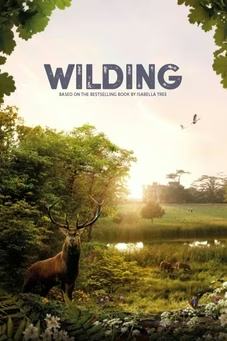
"Wilding" tells the story of a couple who bet on nature for the future of their English estate.











Support for PBS provided by:
Make48 is a local public television program presented by KTWU
Distributed nationally by American Public Television