Oregon Field Guide
Toads of the High Cascades, Earthquake Liquefaction Solution, Model Rockets Club in Central Oregon
Season 37 Episode 9 | 29m 12sVideo has Closed Captions
The wonder of Western toads. A fix for a earthquake problem. Families that launch rockets together.
The super-charismatic Western toad of the high Cascades is an integral part of the alpine ecosystem. Can soil microbes stop the Cascadia earthquake from liquefying the ground? Enthusiasts and families launch model rockets in Oregon’s high desert in an explosion of imagination.
Problems playing video? | Closed Captioning Feedback
Problems playing video? | Closed Captioning Feedback
Oregon Field Guide is a local public television program presented by OPB
Oregon Field Guide
Toads of the High Cascades, Earthquake Liquefaction Solution, Model Rockets Club in Central Oregon
Season 37 Episode 9 | 29m 12sVideo has Closed Captions
The super-charismatic Western toad of the high Cascades is an integral part of the alpine ecosystem. Can soil microbes stop the Cascadia earthquake from liquefying the ground? Enthusiasts and families launch model rockets in Oregon’s high desert in an explosion of imagination.
Problems playing video? | Closed Captioning Feedback
Where to Watch Oregon Field Guide
Oregon Field Guide is available to stream on pbs.org and the PBS app.
Providing Support for PBS.org
Learn Moreabout PBS online sponsorshipMajor support for Oregon Field Guide is provided by... [ ♪♪♪ ] WOMAN: Come on!
There he is, there he is, there he is.
[ exclaims ] Get him out of there, buddy!
Good boy!
[ laughing ] WOMAN: Whoo, high five!
Yeah!
AARON: Tonight on Oregon Field Guide: A marching band causes an earthquake at OPB so we can learn about scientists trying to fix a big problem.
MAN: This method, if it works-- but a big if-- but if it does work, then it would have a real impact.
Then, a family of rocketeers reaches for the stars.
I like hanging out with him and building rockets in the garage.
[ electronic beep ] But first, the surprisingly wondrous life cycle of high Cascade toads.
[ birds chirping ] WOMAN: We're in the central Oregon Cascades, between 4,000 and 6,500-feet elevation.
There are lots of lakes in this area, and the animals that I work with breed in the lakes.
This is a male Western toad.
He’s coming in for breeding.
Breeding happens as soon as the snow melts.
Toads and frogs are related organisms, and in many ways you could call a toad a type of frog.
In general, toads are more terrestrial.
They need to go to water for their breeding activity.
But after that, they do not require that water.
You're probably a grandson of somebody that I have seen before.
I’ve been coming here since 1982.
Initially I was studying their breeding, you know, like are females attracted to certain males?
Is there a male mating advantage by size or by their call?
And my PhD thesis sort of un-wove those threads.
[ ♪♪♪ ] The males usually are the first ones that you see.
They go into the lakeside and hang out, trying to grab any toad they see, hoping it’s a female.
[ high-pitched calling ] That’s a release call.
If they clasp another male, that receiving male puts out a release call and the other male releases it.
And so you have this ongoing "pip, pip, pip, pip, pip, pip" as the males are clasping each other and then releasing.
Guy, you're probably... I think you’re 3 years old.
Well, maybe there'll be a first-year female here and you’ll get lucky.
The females are larger.
And they come to the mating area for breeding.
A male, or many males, will come over and try to clasp her.
She avoids it, though.
And if that male is small, he falls off.
Once the male has clasped, then the female is in charge of navigation at this point.
She is in the driver’s seat.
[ ♪♪♪ ] She’ll dive.
And the male will kick to make them go faster, and they orient towards the egg-laying area.
In this species, all the pairs lay their eggs in the same place.
There could be a couple hundred pairs breeding in the same place at the same time.
The female extrudes the eggs out of her cloaca.
And they come out of the female as strings.
The male is on her back, holding on, and he lets his sperm go on top of the eggs.
So you have these long strings of eggs that are intertwining among all the pairs that are laying their eggs over just a couple-day period.
At the end of that breeding period, you can have over 1 million eggs in this communal egg mass.
It is astounding.
The female has just vanished at that point.
They come in, lay their eggs, and are gone.
They just disappear.
[ ♪♪♪ ] The eggs are black.
And they'll hatch within probably another week and a half.
And then they’re tiny little tadpoles.
The tadpoles are omnivorous at this point.
They'll eat plant matter and animal matter, anything dead or alive that it finds.
And as the hatchlings start to grow, the tadpoles start becoming mobile... but they don't just go swim off into the lake.
They stay together.
So they develop schools.
And the entire communal egg nest can result in being a school of tadpoles.
If there were a million eggs laid, that’s a million tadpoles that are now hanging out together.
Oftentimes they're in a school that snakes along the lake shore for hundreds of yards.
The tadpoles grow and grow through the summer, and then they start developing legs.
[ ♪♪♪ ] It absorbs its gills and develops lungs.
It’s really a different type of life.
And it only takes them about two and a half months to complete that larval growth and metamorphose into tiny little toadlets.
[ ♪♪♪ ] I think they’re cute.
They have these giant eyes and almost this smiley face as toadlets.
They need to metamorphose and get out onto the land before it snows.
So it’s a race, I think, for them.
So usually by the first of September, the toadlets are coming out of the lake.
They come out as hoards, you know, just gazillions, it seems like, almost simultaneously.
And they start a terrestrial lifestyle.
And then you have a million metamorphs or toadlets, baby toads, [ laughs ] along the lake shore.
It is a massive sight to see, and you are worried you're gonna step on the animals because there's so many.
And once they're a toadlet, they are not omnivorous anymore.
They are carnivorous, and they'll eat anything that they can get in their mouth.
It becomes a predator.
[ ♪♪♪ ] They venture into uplands.
People have found these toads miles from water.
They go to hidey holes, which may be rodent burrows or under logs.
And then they are hibernating over the cold part of the year.
And so they really require terrestrial habitats, riparian, and aquatic habitats.
They connect the food web.
They’re sort of the central engine.
They transfer the energy from the little critters up to the big critters.
That energy wouldn't get up to those top predators if you didn't have that intermediate cog in the engine of a food web.
And that’s where these guys are really important.
I really love working with these toads... Another male!
...and becoming one with the location and the animals and the activities that are occurring there.
You were here.
I feel like they're part of my family-- I’ve been working with them for so long.
And I’d like to see these animals persist through time.
So we need to be good stewards of the land and keep this place as pristine as it can be into the future.
When the big one hits, a lot of land in the Northwest is going to liquefy, possibly including this area beneath the OPB office.
Which is why I'm so excited to share this story with you from our show "All Science.
No Fiction."
about a group of scientists who are looking for a solution.
[ bass drum beating slowly ] Something is coming.
Something big.
Here in the Pacific Northwest, we’re due for the Cascadia megathrust earthquake.
And with an earthquake this massive, even areas hundreds of miles away will feel its devastating effects.
But what if we could reduce the amount of devastation the earthquake causes, actually make areas of the ground immune to the worst effects of the shaking?
It could save buildings, infrastructure, and even lives.
Whew!
And that’s "All Science.
No Fiction."
[ ♪♪♪ ] It's not easy to know what's going on in the ground beneath your feet.
But that's what it takes to understand what’ll happen during an earthquake.
Portland State University researcher Fadzai Zivanai is testing out a new soil treatment that could reduce the damage caused by earthquakes.
It takes a high-tech hammer... It is so finicky.
...and some very low-tech pipes to measure how quickly sound waves travel through the soil.
There's waves.
The speed will show how saturated the ground is with water, which is a sign of how likely this soil is to turn into a soupy, sloppy, liquid mess during a major earthquake.
Oh, my goodness, I think about Cascadia and earthquake shaking or the earthquake risk here quite often.
Here in Portland, we have a lot of structures that were built before we had a real understanding of the seismic risk in the area.
Cascadia, the big one... predicted magnitude 9.
It’s not if it will happen, it’s when.
Cascadia will send massive shock waves through the earth, like the sound waves on these drums.
The resulting damage will be widespread, like it was in Alaska in 1964.
REPORTER: This is what happened in downtown Anchorage.
JES: And one of the most devastating side effects of a large earthquake is soil liquefaction.
REPORTER: The geologists found that earthquake vibrations themselves caused less heavy damage than the vibration-induced sliding and settling of weak deposits beneath the city.
Liquefaction happens when vibrations from an earthquake hit soil that’s fully saturated with water.
Normally, when shaken, the particles of soil wanna settle... like these beans do when you tap the side.
[ tapping lightly ] But saturated soil can't compress because there’s water in the way.
The intense downward pressure causes the water to squeeze in and fully surround the particles, which makes the previously solid ground flow like a liquid.
Buildings sink or tilt.
Pipelines pop to the surface.
Unsecured bridges destabilize.
The longer and stronger an earthquake is, the more likely liquefaction will happen.
MAN: The idea is that for the soils to liquefy, you need to have 100% saturation.
Not 99%, but it has to be 100% saturation.
This method works by reducing that saturation ratio from 100% down to whatever level required for it not to be liquefiable.
Khosravifar and his team are trying to desaturate the ground using some unlikely allies: the hungry microbes that naturally live in the soil.
So this is the garden soil.
So this is called calcium acetate.
Then you also mix-- This is called calcium nitrate.
The two ingredients together are a microbial smorgasbord.
When you pump the nutrients down into the ground, the microbes in the soil feast.
[ microbes exclaim ] Basically, these microbes are eating the nutrients and producing nitrogen, and this is what you want to do-- To happen underground.
Exactly.
Okay.
The microbes which already exist in the soil will be stimulated by that nitrate solution.
So when they get stimulated, they'll produce nitrogen gas.
That nitrogen pushes some of the water out from between the grains of soil, effectively desaturating the ground.
So when you think about those microbes and what they're doing, are they burping or are they farting?
[ laughs ] I think they're doing both.
Burping and farting, yeah.
Whatever the microbes are doing, Zivanai hopes to simulate it in the controlled conditions of the lab.
So this is what I call the magic tent, where all the chemistry and all the reactions are happening.
She'll run her microbe and nutrient solution, dyed a brilliant blue, through this tank to see how it spreads through different soil types and how long the nitrogen hangs around.
This is the sand layer, and this brown one is a silt layer.
And this silt layer is the one which is most common here in Oregon, Portland.
And these all soils are liquefiable.
[ ♪♪♪ ] Liquefiable sand and silt soils are most often found along rivers and waterways, where the water table is high.
Problem is, this also happens to be where most of our towns and cities are built.
In Oregon, there's spots of high risk on the coast, in river valleys, in the mountains, and beyond.
The areas with significant liquefaction are areas of reclaimed land or areas where there's fill.
This is exactly what the ground is under Portland's Critical Energy Infrastructure Hub-- the tank farms.
The hub is where 90% of Oregon's total fuel supply is stored and handled.
Much of this industrial area where the tank farms are used to be a lake before it was filled in.
The liquefaction risk here is very high.
These are fuel tanks that were largely built before we had this understanding of the seismic hazard in the area.
The state is taking steps to bring the tanks up to seismic standards, but if an earthquake hits before that's done, emergency officials are expecting chemical leaks, fires, and a devastating disruption of fuel supplies when we need it most.
Out at the lab's field site near the Portland airport, the team tested their liquefaction fix under real conditions.
So this is a PVC pipe.
It's slotted from 5 feet down to 20 feet.
The nutrient solution gets pumped down through the pipe.
[ ♪♪♪ ] To make it work underneath a building, you could install a nutrient well on one side and then sink an extraction well on the other.
Drawing water out of the extraction well creates an underground flow that pulls the nutrients in that direction.
The microbes living in the ground chow down on the nutrients and produce tiny nitrogen bubbles that push out the water.
In other words, it desaturates the soil.
The field tests, which began in 2019, have shown real promise.
All those burping microbes reduced the soil saturation considerably-- below 95%.
That should be enough to stop liquefaction.
They dropped down and they stayed down for like five years.
They successfully re-treated the site in 2025.
How far is this technology out from being real-world appliable?
Um... I don't have the answer to that.
That's because there are still many research questions to answer and regulatory hurdles as well.
The Pacific Northwest hasn't had a major earthquake in more than 300 years, and we're not prepared for the next one.
This method, if it works-- but a big if-- but if it does work, then it would have a real impact.
So when it comes to safeguarding our communities from Cascadia, innovative solutions are going to be needed.
You can watch more stories from "All Science.
No Fiction."
at opb.org or on OPB’s YouTube channel.
Next up, we head to the high desert to launch some rockets.
[ electronic beep ] I can’t quite describe the feeling.
It's a rush.
That is a really great feeling.
WOMAN: Yes!
It survived!
[ people exclaiming ] AARON: There's a spot in the Oregon desert where, if you show up on the right weekend, you'll find a bunch of people with their eyes on the sky.
Three, two, one!
[ button clicks ] [ wind whistling, man speaking indistinctly over speaker ] It's the juxtaposition of, like, the mountains and the lava fields, and I like the desert environment.
I would call it dry, dusty.
It's pretty.
For the Leibowitz family, what started as a backyard hobby has turned into a full-blown passion for rocketry.
It's easy to remember.
MARGALIT: So I would’ve been about 11 when I started.
It seemed fun when he did it, playing with, like, fire and explosives and power tools.
MICHAEL: You got me into it.
[ ♪♪♪ ] What?
Playing the blame game.
[ Michael chuckles ] I like hanging out with him and building rockets in the garage.
She’s my sanding buddy.
[ both chuckle ] We do a lot of sanding.
[ laughs ] MAN: All right, we’re gonna fly some rockets here.
Margalit Leibowitz flying the Chocket.
We’re going in five, four, three, two, one.
[ rocket whooshes ] Shoot, honey.
That happened last time.
Launching is only half the adventure.
Now comes the recovery mission, tracking down the rocket in a vast sea of sagebrush.
MICHAEL: Hey, hey!
Found it.
Take a picture.
Margalit is a developing rocketeer, but what's been really fun about... about seeing her development is seeing her sense of humor.
Her rockets are hilarious.
[ laughs ] I can count, okay.
I built it mostly with my dad.
That’s who I do most of my rockets with.
I built Chester the Chocket out of Cheeto cans.
[ giggles ] We have fiberglassed the inside.
We've got the parachute, and the blanket protects it from the motor, so that it doesn’t, like, burn or melt the parachute.
Naming a rocket, a lot of it is what will make people laugh.
Um, like, with mine, it's like, oh, it's the Procket, Pringles rocket, and just combine the two.
And Chester the Chocket.
Oh, it’s Orphan Destroyer.
This is Tempest Fugit, which is Latin for "time flies."
Annabel Kane.
Ah.
This rocket is Don't Bring Me Down.
I name all of my rockets after songs.
This is Colibri the Hummingbird, ’cause with any hope, it zooms off into the distance.
Yet Another Subliminal Thought.
This is a big deal with his rocket at this point.
Last time he tried to fly it, they had rejected it both for structural concerns and for the weather conditions.
It's-- It’s okay.
Is it gonna work?
MICHAEL: Perfect.
Just wanna make sure my igniter doesn’t, like, slip out.
It's heavy.
It is.
This is going to be a heads-up flight, so everybody please come out from under your tent, put eyes on this rocket.
Rocket’s name: Yet Another Subliminal Thought.
[ laughter ] Okay, Michael, we are going in five, four, three, two, one, launch.
Oh, no.
[ electronic beep ] [ people exclaiming, laughing ] I feel like, for my rockets, I have just, like, overwhelming nerves when it goes up.
WOMAN: It’s way up there.
MAN: Oh, 16,000!
We can still see it.
We got 16,000 feet, still going.
Oh, wow.
Oh, my God.
I saw some tracking smoke, 20K.
[ overlapping chatter ] MICHAEL: You know, I like that we're trying to do something, we’re trying to accomplish something.
I like that there's a technical challenge and seeing how different people have solved similar problems and the creativity of all the different people.
What did you fly it on last time, do you remember?
E247C, yeah.
E24?
Okay, so... E24, yeah.
And we bring a whole crew, right?
Yeah.
It's not just our family, but, you know, several families together, rocketing.
Forget those little rockets that you played with as a kid.
These rockets can tower up to 12 feet tall and weigh up to a hundred pounds.
And they can fly up to 40,000 feet high.
ELECTRONIC VOICE: 11,755 feet.
AARON: Riding high on her recent success, Margalit prepares for her most ambitious launch yet.
I’m doing a night flight tonight.
Awesome.
I'm supposed to tell you.
Awesome, thank you.
Thank you.
All right, looking forward to it.
Her scratch-built rocket, aptly named Glow Stick, is her bold step into night launching.
So it's a fiberglass body tube, and it's designed to look like a glow stick as much as it can.
And on the inside, I have LED strips wrapped around an inner tube so that it can light up.
Ooh!
Here we go.
MAX: It should not be stuttering.
Okay, we're just gonna unplug it and plug it back in, because that solves everything, right?
Okay, yeah, this one is misaligned.
MICHAEL: Okay.
She's going.
That’s a hell of a nose cone.
[ thunks ] MICHAEL: Oh, my God.
REBECCA: Oh, [ bleep ].
All right, never mind.
[ Rebecca laughing ] MICHAEL: Oh, my God, I... REBECCA: Oh, my God.
Never mind.
REBECCA: Oh, babe.
It’s fine.
REBECCA: When we tried to slide it on the rail, the cap on the top obstructed it from going far enough down.
So it can’t go on the rail, so no night flight.
[ Michael groans, chuckles ] Disappointed.
MICHAEL: I’m sorry, honey.
Margalit, can I give you a hug?
Sure.
I’m sorry, honey.
It's fine.
I was really disappointed, but I still wanna be the first night flight in our club.
It’s something.
And those feelings are there, but... We will conquer the nighttime barrier.
Yeah, and maybe we’ll finally camp out.
Maybe.
I got you, fam.
Alrighty.
I love her so much and I really enjoy spending time with her.
And I really enjoy building and flying rockets with her.
And she is a lot of fun to be around and I really value this time.
I like it too.
[ chuckles ] [ rocket whooshes ] [ people cheering, exclaiming ] [ birds chirping ] [ wind whistling ] Major support for Oregon Field Guide is provided by... Additional support provided by... and the following... and contributing members of OPB and viewers like you.
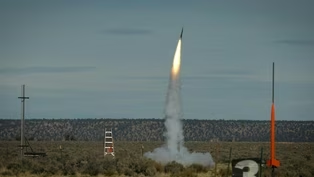
Desert Rockets: Big Dreams, Bigger Model Rockets
Video has Closed Captions
Clip: S37 Ep9 | 8m 14s | Enthusiasts launch model rockets in Oregon’s high desert in an explosion of imagination. (8m 14s)
Video has Closed Captions
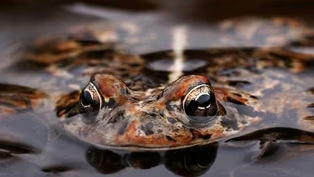
Clip: S37 Ep9 | 9m 29s | The life cycle of the Western toad is both dramatic and highly entertaining. (9m 29s)
Providing Support for PBS.org
Learn Moreabout PBS online sponsorship New Episode
 New Episode
- Drama

Lesley Manville and Tim McMullan return in the final installment of the Susan Ryeland mysteries.






 New Episode
 Recently Added




Support for PBS provided by:
Oregon Field Guide is a local public television program presented by OPB