Special Programs
Total Eclipse Exploration
Episode 20 | 29mVideo has Closed Captions
Join WCMU as we look to the sky and to explore eclipses.
Eclipses have long fascinated and intrigued people worldwide, captivating imaginations across generations. Join WCMU for Total Eclipse Exploration as we delve into the intriguing history of eclipses, unravel the fascinating science behind them, uncover the intriguing folklore that surrounds these cosmic events, and explore both high-tech and traditional viewing methods.
Problems playing video? | Closed Captioning Feedback
Problems playing video? | Closed Captioning Feedback
Special Programs is a local public television program presented by WCMU
Special Programs
Total Eclipse Exploration
Episode 20 | 29mVideo has Closed Captions
Eclipses have long fascinated and intrigued people worldwide, captivating imaginations across generations. Join WCMU for Total Eclipse Exploration as we delve into the intriguing history of eclipses, unravel the fascinating science behind them, uncover the intriguing folklore that surrounds these cosmic events, and explore both high-tech and traditional viewing methods.
Problems playing video? | Closed Captioning Feedback
How to Watch Special Programs
Special Programs is available to stream on pbs.org and the free PBS App, available on iPhone, Apple TV, Android TV, Android smartphones, Amazon Fire TV, Amazon Fire Tablet, Roku, Samsung Smart TV, and Vizio.
Providing Support for PBS.org
Learn Moreabout PBS online sponsorship(instrumental music) - Eclipses have long fascinated and intrigued people worldwide captivating imaginations across generations.
Today, the allure of these celestial events remains as strong as ever.
Join us on this journey as we delve into the history of eclipses, unravel the science behind them, uncover the folklore that surrounds these cosmic events and explore both high tech and traditional viewing methods.
Take a look.
(transition whooshes) - [Narrator] The oldest surviving record of an eclipse comes from Yin, an ancient capital city in China.
It was carved on a tortoise shell.
Three flames ate the sun, and big stars were seen.
A lot of ancient stories from the Americas to Scandinavia to India refer to the sun being eaten.
People thought some deity was angry, or these were omens that meant a king would die.
And some of those kings were nervous enough, they appointed people to study the sky and take lots of notes.
What started out as fearful fascination turned into something more scientific.
Freaking out about eclipses kick-started astronomy.
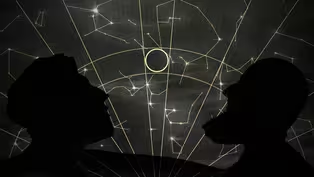
One of these early astronomers, Hipparchus used an eclipse to calculate the distance to the moon.
There was a total eclipse in his hometown, but he heard that 600 miles due south, only four fifths of the sun was obscured.
That was all he needed.
See, Hipparchus was all about this new kind of math involving lots of angles and triangles.
He calculated that the moon was between this far away and this far away.
This was hundreds of years before telescopes, and we'd already started to measure the solar system.
By the 17th century, the moon's size and distance were well known, but no one knew why the moon orbited earth.
Then a real oddball named Isaac Newton figured out the law of gravity.
But some people needed convincing.
Newton's hype man, Edmund Halley, that guy they named a come after said, "okay, Newton's law of gravity determines the moon's orbit so I should be able to use that law to predict exactly when the moon will go in front of the sun."
He calculated that an eclipse would hit Britain at 9:05 AM on May 3rd, 1715.
And he printed up these handy posters that reassured everyone, no, the king isn't going to die.
Halley got impressively close.
The sun went dark at nine sharp, and that eclipse proved Newton wasn't crazy.
He was a genius.
People went on to use Newton's ideas to accurately predict the orbits of most of the known planets.
But two planets had unexpected wobbles, Uranus and Mercury.
In France, tireless mathematician Urbain Le Verrier used lots of equations to show that it must be the gravity of unknown planets pulling Uranus and Mercury off track.
He calculated exactly where the planet pulling on Uranus would have to be.
And when astronomers went to look, there it was, they named it Neptune.
Le Verrier was psyched, and he was so sure they'd find a planet pulling on Mercury too.
He preemptively named it Vulcan.
But here's the problem, Vulcan was supposed to be right here just hidden by the sun's glare.
Vulcan hunters would need an eclipse.
Every time one rolled around, scientists including Thomas Edison scoured the sky.
But those eclipses never revealed Vulcan.
It just wasn't there.
Mercury's wobbly orbit remained a mystery until Albert Einstein came along.
Einstein had this radical new theory, the general theory of relativity, and indeed Vulcan unnecessary.
According to the theory, Mercury was thrown off course because the sun's bulk was warping the very fabric of space time.
Einstein's equations predicted the wobbly orbit perfectly, but as always, some people demanded more proof.
And once again, an eclipse came in useful.
In 1919, the darkened skies allowed scientists to see stars near the sun.
And just as Einstein predicted, the sun's huge mass nudged the starlight off course.
Those results made him an instant celebrity.
(camera shutter clicks) (soft music) During the solar eclipse, you can see the sun's fiery atmosphere.
Here's the reddish chromosphere.
In 1868, scientists studying the light of the chromosphere found evidence of an unknown element.
They named it Helium after the Greek sun God, Helios.
It took another 27 years before someone discovered Helium on earth.
Where the chromosphere ends, the feathery Corona begins, it sends blasts of charged particles into the solar system, and these space storms can take out electronics on Earth.
They could even potentially kill interplanetary astronauts.
So how does the Corona work?
Well, there's a lot we still don't know, partly because we can really only investigate it when something blocks the overpowering brilliance of the sun's disc.
We've built advanced instruments to try and do that, but the moon still does the job much, much better.
That's why even after all these years, scientists still flock to eclipses, point their gadgets at the sky and make the most of that brief moment in the moon shadow to shed new light on the sun.
(soft music) - Today, researchers are still pursuing secrets of the universe one eclipse at a time, and you bet they'll have a close eye on this one.
Now, according to NPR, an estimated 31 million people in the US are in the path of totality, making this an even more remarkable experience.
Now, a total solar eclipse is when the moon crosses directly in front of the daytime sun.
Here in Michigan, a very, very tiny corner of the southeast portion of our state is actually in the path of totality.
While most of us will experience about 98, 99% of totality, that might sound significant, but one CMU astronomer we talked with says it's not the same as seeing it and feeling it in person at 100%.
Dr. Aaron LaCluyze shed some light on this phenomenon.
- You kind of have to get 'em at just the right time, just the right moment.
So in truth, there's only a couple of times of year that are conducive to having eclipses at all.
So that's why we don't have an eclipse every month.
Like you would have a lunar eclipse and a solar eclipse every month, that doesn't work out that way.
It's kind of just two times a year that it's a chance for an eclipse but that doesn't guarantee that you have the eclipse, and it also doesn't guarantee you're in the right part of the globe to have that eclipse.
So what's exciting about this one is it just so happens that the sweet spot is here in the US.
- [Interviewer] Yeah, absolutely.
So talk about the path.
Where is it supposed to go?
- Right, so the path that we're gonna see, and it's not everybody in the US is gonna get to see it.
Like I said, it is a relatively small path.
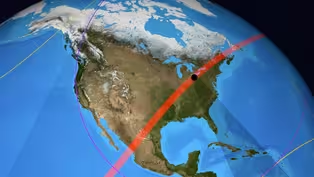
There's gonna be a stripe that kind of stretches from down in Mexico up through Texas, but it cuts up through kind of southern Indiana, Northern Ohio, and then heads out to the east coast or so.
So here in Michigan, unfortunately, we will not see totality.
Totality is just south of us and as much as it pains me to say such things, my best advice for my fellow Michiganders is go to Ohio.
Here in mid Michigan, we will see a partial solar eclipse.
So part of the sun will be blocked out by the moon, but not all of it.
So totality, it's really just kind of a narrow stripe.
And even in totality, you get kind of a small window for that.
So from start to finish for a solar eclipse.
So the moment the moon starts to just barely get in the way of the sun until it goes fully away from the sun on the other side, that kind of path takes about two or three hours from start to finish.
But totality itself, like the moment, like the cool stuff that we're gonna talk about, that only lasts a couple of minutes, like the maximum it can possibly last, I think is about seven and a half minutes.
So it is a very, very brief window, but it's an astonishing window when you see it.
Now, what's interesting about a total solar eclipse, prior to totality, as the moon is starting to block out the sun and you've only got 80 or 90% covered, it's dangerous to look at the sun.
You've gotta wear like eclipse glasses, which we had those, you know, back in 2017 when that solar eclipse happened.
Everybody talked about getting eclipse glasses.
Or you can get special solar filters for a camera, or there's special kinds of welding glass that you can use, but make sure you have the right stuff.
But you need that to look at the sun safely.
But once totality occurs, the moment you actually cover up the central disc of the sun, you can actually look at it with the naked eye, but only, and I stress, only during totality.
So a couple of seconds before or a couple of seconds after is not good enough.
You've gotta nail it, right?
And that experience is, it's really an odd experience.
I'm gonna try and describe it.
It's hard to describe unless you actually experienced it.
- Right because you actually went to see the last total eclipse.
So yeah, share with us your experience.
- You know, I've been an astronomer for over 20 years.
I'm in my mid forties, and I had never seen a total solar eclipse with my own eyes.
I'd seen pictures and textbooks, I'd seen pictures online, and I'm like, "oh, that's kind of neat.
I'm sure they're using some kind of special camera technique to show what that looks like."
That's what I thought.
Even as a professional astronomer, that's what I thought.
But in 2017, I had the opportunity to see the total solar eclipse.
Now, it didn't come near Michigan, that one either.
And I have family down in South Carolina.
So I went down to visit them, and I got to see totality.
It is like words are inadequate, wholly inadequate to describe what it's like.
When totality occurs, it kind of feels like you're wearing like a special pair of sunglasses that has a little dial on the side and somebody's cranking it up and making it darker and darker and darker as time goes on.
But everything else looks normal.
Like shadows are nice and sharp and distinct.
Unlike at sunset, when the sun goes down, shadows get really diffuse and long and then go away.
And it's a very gentle passage into nighttime.
With the eclipse, that's not what happens.
It gets really weird.
You actually start to feel, or at least I personally started to feel a little bit anxious, a little bit uneasy, because the light's not right, for lack of a better word.
And so it gets darker and darker and darker.
And then the wildlife starts to react as if it's twilight 'cause it's getting darker and darker.
And so all of the insects that come out at twilight, like I think at the time we had some like crickets and cicadas, you know, those sorts of things, the insects that make noises at night at twilight, and then all the birds that feed on those insects came out.
And then in the modern era, we have all these streetlights that aren't on a timer.
They're on a sensor.
And that sensor saw everything getting darker and darker and darker.
And so all the street lights turned on, and then in every direction you looked, it looked like twilight.
You know, when the sun sets, you get that kind of red or orange haze kind of in the direction of where the sunset is, but the sun's up there and every direction looks like that because you're now in the shadow of the moon as it comes.
And so it was really, really strange.
And at the time, I'm an amateur photographer in my spare time, and I promised myself, I'm not going to experience the eclipse just staring through a camera.
I can't do that to myself.
So I set a timer on my watch and I said, "I've got 30 seconds to take pictures, and then I will not touch the camera."
And so totality happens, and everybody around me is just freaking out.
I take my pictures for 30 seconds and my watch beeps and I stop and I look up, and it's hard to describe what you see.
So the sun, we tend to think of the sun as just that disc on the sky.
But it's not, there's more to the sun than that.
On kind of outside of that disc that we see, which that disc is called the photosphere, just in astronomy parlance, it's literally the sphere that the photons come from.
So photosphere, so that's what our eyes normally see is just that photosphere and it's very, very bright.
But once you cover it up, you can see the outer edges of the sun, a thing called the solar corona, which in this case is a word that means crown.
It has nothing to do with the past few years of insanity.
But the solar corona, it's this crown, it's this weird like hazy thing around the edges of the sun.
You can think of it as the atmosphere of the sun.
That's not quite right, but it's a good way to think about it.
It's a very diffuse layer on the outside of the sun that you normally don't see with the naked eye because it's too faint.
But once you block out that disc of the main sun, you can finally see it with your own eyes.
We actually discovered the corona scientifically through an eclipse.
They were observing an eclipse and they were like, "Hey, what's that weird shimmery thing around the sun?"
Now that corona changes over time.
Sometimes it's a little brighter, a little more dynamic than others.
And so with the naked eye in an eclipse, you can actually see it, and it shimmers, it stretches out well away from the sun.
And it looks like some sort of like science fiction movie effect, but it's happening in front of you with your own eyes.
With the moon blocking out the sun, it's so dark compared to everything else around it, compared to that corona, it almost looks like someone took like an ice cream scoop and just made a perfect scoop out of the sky and just cut a hole, a perfectly round hole in the sky.
And so that lasts for a few minutes, and your mind is just reeling from what you're seeing, and then suddenly it's gone and it just moves on and you wait for the next one is what you do.
You know, there are people who, once they experience their first eclipse, they spend the rest of their lives kind of chasing that feeling of seeing another eclipse with their own eyes.
It's like, it's just this whole... it's a thing that you can only experience personally.
Like I can't quite tell it to you.
I can just tell you to go do it.
Like you have to go do this.
So it is well worth anyone's time if you get a chance to travel to it.
I've encouraged my students to go ahead and skip.
Well, don't tell my fellow professors this.
I've encouraged them to go ahead and skip classes that day.
Like if there's not an exam, there's no reason to be in class.
Like, go, go to Ohio, go to Indiana, go to wherever you to go to see it.
- [Interviewer] Okay.
All right, well, maybe I have to pack up my kids and go.
You're selling me pretty good on this.
- [Aaron] Excellent, excellent.
(transition whooshes) - A big thanks again to Dr. Aaron LaCluyze for sharing his experience and knowledge and of course, his enthusiasm with us.
Now, one more thing he stressed, if you're going to see totality, make a plan, getting there is going to be easy, but once it's over, it's going to be a lot harder to get back home.
So make sure you plan accordingly.
Studying an eclipse involves a community of scientists and researchers, each putting it under a microscope of their own area of expertise.
We learn now from two more CMU professors about how eclipses influence their passions of astrophotography and folklore.
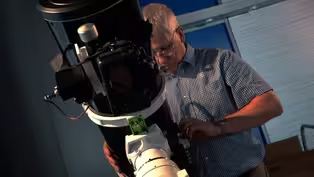
(transition whooshes) - I got my first telescope at the age of 12, and since then I've been hooked on astronomy and astrophotography.
Astrophotography is the photography of anything that you see in the sky.
So that could be the sun, the moon, planets, stars, nebulas, galaxies.
And of course, depending on what you photograph, you need very different equipment.
Essentially, the telescope becomes the lens.
So the telescope has that almost eight inch prime mirror at the back that captures the light, reflects it back, and then there's a small secondary mirror at a 45 degree angle that sends out the light out to that port on the side of the telescope where the camera is.
When I pick an object, I shoot it for several nights.
My astro camera is a monochrome, black and white camera, so I have to shoot with different color filters, and I shoot multiple exposures, typically about two to four minutes in length, and then I shoot 10, sometimes even 100, 200 individual exposures.
Multiply that by three for three colors.
So that often takes several nights.
One of the things I learned from previous eclipses is that mobility is the key.
In 2017, I met with some friends and people from the local astronomy clubs in Carney, Nebraska, and we looked at the forecast the night before the eclipse, and it was kind of iffy.
So my family and I decided we'll do a six hour night drive into Wyoming, and it paid off.
We enjoyed the eclipse under perfectly clear skies.
So totality lasts only for a few minutes.
Back in 2017, it was a little over two minutes.
This year's eclipse has four minutes of totality.
That's still not a lot of time, and you really want to spend that time enjoying the moment, looking around, maybe spotting some planets in the dark sky, and you don't want to mess around with the camera.
So really the key thing is to have your camera run on a fully automatic mode.
That means I connected to a computer, I have a program that I set up to program a sequence of shots, and I press go, and then ideally, I don't have to touch it until the eclipse is over.
If you're a first time eclipse watcher, don't spend too much time on photography, especially if you don't have experience with eclipse photography or solar photography in general, because you will just miss so much.
It's better just to enjoy the scenery.
- My expertise lies in the stories that people tell and have always told about their culture and the worlds around them.
The way that any culture or tribe or group of people tells stories about their environment, it provides enormous insight into really what it is to be human.
Obviously, there's a lot of similarities that cultures share, but the differences I think, are really crucial.
Every culture has their own particular responses to events like the eclipse.
Everyone is watching the skies and deriving meaning from that.
Right now in our contemporary world, we have primarily a scientific language that allows us to understand what's happening in these events that we're viewing.
Well, people of the past were no different.
They looked up to the heavens, they had questions about what was happening, and they came up with their own culturally relevant answers.
So I think when we look at those beliefs of the past or of contemporary indigenous people about things like eclipses, whether they're solar or lunar, again, they tell us a lot about what it means to be human and to have questions about the natural world around us.
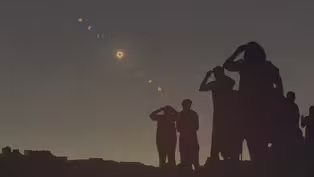
Lots of cultures viewed a solar eclipse with a fair amount of trepidation.
The Maya, for example, of Central America, viewed it as the moon has become angry and takes a bite out of the sun.
In fact, their word for it is Chi'bal K'iin, which means the sun gets bitten.
There are in Benin and Togo in West Africa, there's a fascinating, and I think really relevant belief about eclipses.
It's not a psych, a scientific viewpoint, but it's a psychological interpretation.
The idea is that people argue with each other.
Men, women, children, everyone.
We get into things, we argue, but sometimes those arguments become too much.
And at that time, the people of Togo and Benin believed that the sun and the moon, hearing all of this argumentation constantly from people over the Earth would begin to argue themselves.
So when there was a solar eclipse, it was believed to have been brought about by these arguments between the sun and the moon.
And the moon would then move in a certain way and the sun would darken.
But then, this is, I think the most fascinating part and what makes these beliefs really relevant.
It was then in incumbent upon people here on the Earth to settle their disputes.
So among these people in West Africa at the time of a solar eclipse, they would begin to open up dialogues of conversation, of peacemaking, of settling old debts, settling old arguments.
So again, it's not so much a scientific explanation, but it's one that provides an important function in that society.
I suspect that even ancient people understood that there was a metaphorical power in this also, that it was a moment when darkness had the ascendancy for a moment.
That the sun, which is the source of life for every human being in the world, is being overtaken by a shadow for a moment.
Now that is what's happening.
And that's also, I think what these kind of, the monsters, the wolves, the dragons are seen to be doing.
But more than that, it's about telling a story that people can participate in.
A dragon, a celestial dragon is eating the sun.
Now, you as a human being, it is your job to frighten that dragon away.
So get out there, you get the drums out, the pots and pans, the sticks, the flutes, the rattles.
And it's your job to participate in that event.
So it's an event that not only confirms a culture's understanding of their cosmos, their view of the cosmos, but also confirms their place in it.
We are connected to that.
And then when we have events like eclipses, those relationships become very important for a small moment in time.
Remind us of those connections with those beings.
Even if you can't get out, if you can't see it or experience it in totality, you can still experience it by knowing that it's happened.
And by knowing that for thousands and thousands of years, your ancestors and the ancestors of your neighbors and your fellow human beings have stopped for a moment and had a real human experience.
Whether it was based in fear or hope, it doesn't really matter at the end of the day, they have paused to say something wondrous is happening, and it then becomes your own individual personal job to determine what kind of meaning that's gonna have for you.
So if I could, if I were king of the universe, I would say, take a moment and think about it.
What does the eclipse mean for you?
What has it meant for others?
Where's your place in the long standing tradition of looking up to the sky at the time of an eclipse or another celestial event and wondering what is happening and why is this wonderful to me?
(transition whooshes) - And thanks again to Axel Mellinger and Ari Berk for helping us better understand an eclipse from their perspectives.
In Saginaw, troop 366 G includes a group of enthusiastic scouts who are especially fascinated with space exploration.
They're taking on the task of safely viewing the eclipse with a different kind of method, proving their readiness for any challenge.
(transition whooshes) - So today I'm going to be teaching Troop 366 about the history of eclipses, and I'm also going to be teaching safety for viewing the eclipse.
And we're going to be building an eclipse viewer so that they can take it home and possibly view the eclipse themselves.
They are a girls troop.
They joined the first day that girls could actually join the BSA.
- [Voiceover] With a passion for science, technology, engineering, and mathematics, Angie is eager to guide Troop 366 G through their plan to view the eclipse.
- I have been teaching STEM to this troop since their inception.
So they're gonna take a box and you cut a hole in the box and you put aluminum foil over the end and you poke a hole in it and then you cut another hole on the side of the box and you put white paper inside the box.
So the sun comes through, you stand with your back to the sun, and you put the viewer kind of over your shoulder and the sun comes through the hole, the pinhole, and you look through the viewing hole on the side, and it actually shows just a picture of the sun through the pin hole for you to see the eclipse.
Okay, now...
I'm hoping that they use the boxes at least for a little while, and then view it with the eclipse viewers.
I hope that they use both ways to see which one works better.
Scouting is an amazing program.
I am a boy mom.
I don't have any girls.
So I was super excited when the girls were allowed to join, because if it would've been something that was offered when I was a kid, I would've joined in a heartbeat.
That is probably what I'm most passionate about, is teaching science and technology, engineering and math to girls, because when I was younger, it wasn't encouraged, right?
You went to school and you were going to become a teacher, or you were going to become, and those, I would love to be a teacher.
I'm not a teacher by profession.
I am a data analyst, so not the same.
But girls weren't really encouraged to be scientists or astronauts.
I was in an engineering program and I was one of the only girls in an engineering program.
So I think that it's important that they get the exposure to do those things, that it's okay, girls can do it too.
Just like the boys can.
I hope that it gives them a little bit of excitement for this.
I hope that it encourages them to look into it a little bit more, you know, delve into it a little bit deeper.
Some of the history that I'm going to tell them about, I didn't even know.
In preparing for this, I learned something.
So I'm hoping that they learn something and it ignites a spark in them to want to learn more.
- [Voiceover] Eagle Scout McKayla is inspired to acquire all the eclipse knowledge she possibly can.
- The fact that it's such an uncommon thing to see, from what I've heard at the level it'll be this year, I wanna understand how that works and why it is so rare and what makes it special.
Our troop has actually worked a lot with the people who are here today doing STEM related things.
So I feel like we've kind of fostered that environment in our troop.
And I feel like with the science merit badges that I've taught, I've tried to bring some of that into our troop as well.
We do a lot of things in the outdoors, a lot of service for the outdoors.
And so I'd really hope that their love for STEM is thriving right now.
- I love everything that there has to do about space.
When I was a kid, I wanted to be an astronaut.
I mean, I'm the girl that on a clear night is looking in the sky, right?
I wanna see the stars.
I wanna teach the kids how to pick out constellations in the night sky.
And so I'm hoping that maybe this is something that they will want to do.
Good night scouts.
Dismissed.
(transition whooshes) To commemorate the upcoming eclipse, scouts can earn a special glow in the dark patch.
Now, this achievement includes not only mastering the proper technique for safely viewing the eclipse, but also encourages scouts to reflect on and share their experience with their groups.
This concludes our total eclipse exploration.
And remember, if you're going to see it, make sure you have a plan.
Wear protective eyewear.
Keep your fingers crossed for clear blue skies.
Thanks for watching.
(transition whooshes) (uplifting music)
Video has Closed Captions
Clip: Ep20 | 5m 23s | Scientists use eclipses for discovery and to prove their theories. (5m 23s)
Video has Closed Captions
Clip: Ep20 | 5m 1s | CMU Professor, Dr. Ari Berk, describes how different cultures interpret eclipses. (5m 1s)
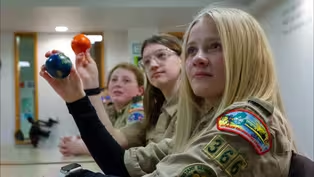
Eclipse Preparation with Scout Troop 366G
Video has Closed Captions
Clip: Ep20 | 3m 59s | In Saginaw, Scout Troop 366G prepares to view the eclipse. (3m 59s)
Video has Closed Captions
Clip: Ep20 | 3m 3s | CMU Professor, Dr. Axel Mellinger, shares his passion for astrophotography. (3m 3s)
Video has Closed Captions
Clip: Ep20 | 7m 58s | CMU Professor, Dr. Aaron LaCluyze, describes viewing a total eclipse. (7m 58s)
Providing Support for PBS.org
Learn Moreabout PBS online sponsorship

- News and Public Affairs

Top journalists deliver compelling original analysis of the hour's headlines.













Support for PBS provided by:
Special Programs is a local public television program presented by WCMU