Oregon Art Beat
Travis Pond, Esther Godoy, Glitterfox
Season 26 Episode 6 | 26m 2sVideo has Closed Captions
Meet metal sculptor Travis Pond, photographer Esther Godoy, hear Portland band Glitterfox.
Travis Pond is a Portland metalsmith artist who takes pieces of salvaged metal and gives them new life in the form of intricate sculptures. Through storytelling and photography, Esther Godoy intimately documents, celebrates, and uplifts Butch voices. Portland indie rock band Glitterfox performs “Passenger,” a single released in 2024, at Green Anchors.
Problems playing video? | Closed Captioning Feedback
Problems playing video? | Closed Captioning Feedback
Oregon Art Beat is a local public television program presented by OPB
Oregon Art Beat
Travis Pond, Esther Godoy, Glitterfox
Season 26 Episode 6 | 26m 2sVideo has Closed Captions
Travis Pond is a Portland metalsmith artist who takes pieces of salvaged metal and gives them new life in the form of intricate sculptures. Through storytelling and photography, Esther Godoy intimately documents, celebrates, and uplifts Butch voices. Portland indie rock band Glitterfox performs “Passenger,” a single released in 2024, at Green Anchors.
Problems playing video? | Closed Captioning Feedback
How to Watch Oregon Art Beat
Oregon Art Beat is available to stream on pbs.org and the free PBS App, available on iPhone, Apple TV, Android TV, Android smartphones, Amazon Fire TV, Amazon Fire Tablet, Roku, Samsung Smart TV, and Vizio.
Providing Support for PBS.org
Learn Moreabout PBS online sponsorshipSupport for Oregon Art Beat is provided by Jordan Schnitzer and the Harold & Arlene Schnitzer Care Foundation Endowed Fund for Excellence... and OPB members and viewers like you.
Funding for arts and culture coverage is provided by... [ ♪♪♪ ] [ ♪♪♪ ] POND: There's a story with all the materials that I'm using.
There's a history there, and I think those stories are important.
What attracts me to working with metal was that it was accessible.
Your appliances all have pieces that I've taken apart and put into the sculpture.
I don't know if there's magnets in my eyes or if it's just something I've been doing for so long that, like, it's basically all I see.
Finding a wrench, you see it as a wrench.
I see a talon there, I see the stamping on the metal that could be cut up, could be rearranged, could be integrated into the piece.
And I think that that gives it some kind of connection to its past life.
Otherwise, why don't we melt it down, make a form, and pour a mold?
But then you lose all of what this material is and where it came from.
We are a throwing away a lot.
It has that-- references to our society and what we do with things.
And I hope having a new purpose will give some kind of hope and inspiration to a direction that we can go.
When I was around 19, I took a sculptural welding course, and that's how I found metal.
I loved the immediacy of how the steel was put together and you got structure right away.
I went to the San Francisco Art Institute, and I double majored in painting and in sculpture.
I sold my second piece that I ever made and then I sold the fourth piece, and then I kept selling, so, you know, that's kind of when I thought this could be a career.
The creative part, I'd say, is about 10 percent.
The rest is somewhat craft and a lot of labor.
But the most rewarding aspect of that is watching the audience or a viewer really engage and be inspired by the work.
How you guys doing?
Welcome to my studio.
We're in awe.
This is impressive.
This is absolutely amazing.
Thank you.
This one over here has tons of my grandmother's things.
She had a whole collection of antique things, and this was her old silverware.
WOMAN: Aw.
This is how I thought my whole life, you know, and being dyslexic and not that great with words, like, I spoke in a different language basically.
It was like-- visual language.
I love this too.
WOMAN: Oh, wow.
POND: Currently, I am making a public piece for the North Williams District in North Portland.
I'm making a nine-foot saxophone to honor the history of the neighborhood, which is an old jazz neighborhood.
And then also in that neighborhood there is a thing called the Wishing Tree, where people write their wishes on a price tag and they'll hang those wishes on a tree.
So what I have done to commemorate that piece is to make that price tag as the base.
And then atop that price-tag base will be an owl.
The owl represents the one that's going to take the wishes to be granted.
At this point in the project, we are finalizing the owl's position on the base, so we are trying to get it balanced in the right position, picking it up with its center of gravity where we need it to be.
And I think we are on target as far as balance front to left, reading good in the front to back.
I think I'm going to start to weld that on there.
And we have... solid structure.
Whoo!
So, as you can see, it's, uh, completely a part of the piece.
And now it's never coming apart.
Not in our lifetime, anyway.
[ ♪♪♪ ] [ people chattering, applauding ] I'm good!
You too.
WOMAN: Amazing.
WOMAN: Can't believe it's happening!
POND: Today's the installation day for the two sculptures that I made for the Williams District, for the Festival of Light specifically, but also on a permanent collection here.
WOMAN: I've been here on this street for 17 years.
I've seen some of his artwork around town.
Oh, that!
Felt really perfect for our space.
He came up from our feedback with the owl and the wish.
We were looking at possible ways to rebrand the district and bring in light elements.
The reason that this is a saxophone is that this was originally one of the most important jazz districts in the country, which I think he's encapsulated really beautifully in his sculpture, and it's really one of the things that I think that's going to end up making our district really special, where art is really part of the community.
All of these things that I make are very personal.
I'm going through very personal experiences and very personal thoughts while I'm making them.
That's how I get through my day.
That's how I cope with the world.
And hopefully I'm making something that will be an inspiration and make the day better, because that's what we all need.
[ ♪♪♪ ] GODOY: What is it about this word that makes people hate us?
Why are queer people so afraid of this word?
Where did this start?
[ chuckles ] How did it happen?
And how can we change that?
And so "Butch Is Not a Dirty Word" is literally what I was trying to say.
I'm like, why do we all think this word is so horrendous?
So today we're photographing somebody called Silver.
They're like a-- I think they might be Gen Z, so they're, like, younger than the people I usually photograph, which I love, because they tend to have, like, um, just, like, less rigid ideas about gender and sexuality.
And Silver is like a little bit of an Instagram celeb, and they do-- like, they're a performance artist.
They're, like, a singer.
The second shoot later in the day, Silver and one of their best friends, Marisa, they just have very good energy together, and then I thought I'd bring in a third person who's like an older butch person.
I think it just helps round out the shoot and to see just, like, different generations interacting with each other.
So, yeah, Murph is on their way, and they're going to meet us here and we'll all go off together.
Um, how do you feel about being photographed today?
[ both laugh ] Um, I don't know.
I'm like-- I'm nervous, for sure.
But, um...
Nervous how?
Uh, well, I don't like-- Yeah, I don't want to be small or, like, hide pieces of who I am, so... Mm-hmm.
That's part of why I was like, "Yeah, dude, let's do it."
Mm-hmm.
[ both laugh ] When you asked.
So I've always called myself a creator, because so much of what I've done is creative production.
I've always had this drive to just create spaces for people that are underrepresented to, like, come together.
And I've always had this drive to make it look cool.
Like, I grew up with skateboarding, and so I just picked up, like, how to brand something and how to, like, present something so people want to be a part of it.
I love your outfit now, actually.
Keep that on.
You want it just, like, casual?
Yeah, just casual for now.
We'll just do some warming up.
One of the number one complaints that I hear from other butch people is people project this kind of masculinity onto them that's actually not all that accurate for them.
So a lot of the project is about breaking down those stereotypes.
People refer to the word "butch" as a noun, as an adjective, as a gender identity all in itself.
Nobody can really say what is or what isn't butch.
There's so few other terms that do that.
It feels like a safe space for me.
All right, pick up where you left off, please.
You are not-- Yeah.
You are not grabbing my cheeks.
[ laughs ] [ camera beeps ] Big smile from everyone.
Open your eyes, Silver.
[ all laugh ] [ shutter clicking ] Cute.
Yeah, I got you.
SILVER: I started doing music stuff when I was like 16.
I had moved to L.A. by myself, I-- Oh, you moved to L.A. by yourself?
Yeah, it was like... really, like, popping off.
It was cool.
Yeah.
And then, like, things just took a really sharp turn.
As soon as I came back, I, like, hardcore humbled myself in the sense of, like, I was 20 at that point, and I was like, "Fudge, what am I going to do if I'm not going to do music?"
because that was really scary for me.
And so, like, I had to go back to high school as a 20-year-old.
And I didn't think I was going to do it, one, because I was like, "I'm 20.
Like, what high school is going to let a 20-year-old in?"
Did they let you into--?
They did.
An alternative high school let me in.
What we got going on down here?
A lot of everything.
Put your chin down a little bit, yeah.
And then eyes up at me.
Love it, okay.
Halt.
What got you into photography?
Um, honestly, this project.
I, like-- I was so anti being a creative when I was young.
Okay, wait, so this time...
I wasn't the demographic of people in Australia that would necessarily be thought of as creative or as artistic.
When I heard "art," I just saw a bunch of people who, um, would kind of shut the door on people that didn't look like them.
And so that, like-- I kind of grew a sense of resentment towards, like, art and artists in general, and I really moved so far away from that terminology.
Yeah, okay, I want to get some of the camo, but I also want to get some with the getup-- No, sorry, okay.
First, leave that other shirt on for first.
And then we'll get a full outfit change.
Okay.
[ shutter clicking ] Look at the hat now.
Okay.
[ ♪♪♪ ] You know, when it comes to, like, queer beauty, like, I feel like you don't see it represented as much.
It's, like, super hard to find.
And we're finally getting captured for it, you know?
And there's like-- It's like a buffet.
Different flavors of us.
So it's nice.
I don't know if I would use the word "buffet," but I do really love that, like, Esther's project feels like it really, like, I don't know, highlights different forms of butchness in a way, where it's like not every butch is the same.
And that's something I've really taken away from that page.
MURPHY: Growing up in, you know, an Irish Catholic family in Philadelphia, I didn't see representation of who I am now, and I always wonder, like, "What-- Who could I have been if I had come into my identity and my self and my self-confidence in my gender expression earlier?"
And that's what I love about this project and Esther and the way that they go about representing butchness in this expansive way.
So in the early days, I had this vision of...
I didn't want the portraits to just be portraits.
I wanted to capture people in their environment.
So it was almost like I was looking for this... this mixture between portrait photography and kind of photojournalism.
I was always using different photographers and using many different people, and I just couldn't quite get my vision back.
And so at some point, I was like, "I'm just going to pick up the camera and start trying to capture it myself."
Good.
[ shutter clicking ] Now look at each other in the eyes.
And smile.
[ all laughing ] Trying not to, like, breathe on you.
I know, it's... [ all laughing ] Just take a deep breath.
[ inhales deeply ] Okay, I'm ready when y'all are.
Wait, we both blow?
Yeah.
[ all laughing ] You should be like, "Yeah!"
I didn't mean to blow that hard.
I grew up in Melbourne, and it had such a contrasting... um, it was such a contrasting experience to what it's like on the West Coast of the USA for butch people and for masculine of center people.
I kind of just honestly didn't even think it was an option.
I found it very difficult to date.
I just, like, kind of resigned to the fact that I wasn't attractive and sex and love and romance weren't going to be for me.
I made my way to the States, to Portland, when I was about 23, in my early 20s.
I saw this, um-- this butch lesbian who was, like, just a little bit older than me.
Like, I had no idea I could be like that, and she was so confident and she was so in herself and she really didn't have any visible shame that I could see.
I saw the way that they navigated the world in Portland.
I saw how people responded to them, and it was so positively, like that's just nothing I'd ever seen in my life.
It blew my mind.
I remember the-- like, the start of the project, I was like, "What I want to do is I want to show people in Melbourne how people think about butch lesbians or butches, like, in the States.
And Portland specifically just had, like, this kind of "anything goes" energy.
There was this sense that the city truly was run by lesbians.
Like... [ laughs ] Originally, like, it was just supposed to be one little, like, zine.
I thought we'd launch it at the local queer bookstore.
We used Facebook back then, and I put a Facebook event up for it, and I was so scared, because I was-- I was really, really scared to put it out publicly, and I was almost preemptively embarrassed that, like, no one was going to show up.
I think we had, like, maybe 50 seats available.
And as soon as I put the Facebook event up, like, literally I think like 600 people responded as RSVP.
They wanted to come.
I adored photographing this person.
The light was just so beautiful in that workshop, and they were so in themself, like in their creative space.
It really comes through in kind of their posturing.
And when I look at this, I just see a softness in-- Like, such a toughness in the masculinity, but also this softness that comes through in how the gaze is held and how the body posturing is held.
Like, you always see people's hands and you can kind of see, that's really where a lot of their, like, softer attributes come out.
Um, this photo here, I think, is pretty beautiful as well.
And you see this person's got this, like, army-style haircut.
And I know that this person spoke about in their interview, like, how differently people respond to them when they're out in the world with their feminine partner and their children-- people are a lot more open to them and kinder to them.
Versus when they're in the world on their own, people are a little more reserved towards them.
And I think that's a really common experience that a lot of butch people talk about.
[ ♪♪♪ ] The first time I saw my photos outside of a digital space and printed and enlarged and framed, I think that's the moment I was like, "Oh, my God.
I had no idea, but I think I'm actually a photographer."
Or, like, "That's art."
Like, I remember what it felt like to be seen for the first time, and to see other people having that experience through this project is, yeah, incredibly humbling and, um, it's emotional.
Um, it's really, really emotional, yeah.
[ ♪♪♪ ] Because-- because the experience of being gender nonconforming when you're young is-- you're constantly told to shut yourself down.
Anything you feel that's true to yourself, shut it down.
It's not right, people don't respond to it well.
So it's like you learn this pathway in your brain that's like, "Anything that feels real and true to you is not correct and you should be something else."
So really it's like I've only come into these identities through being, um, seen as those things by other people.
Somebody else called me a butch, and it was-- they called me a butch in a really good way, and I was like, "Am I?
All right.
I guess I'm butch, then," you know?
And somebody else called me an artist, and I was like, "Am I?"
And I'm like, "I guess I am."
I know-- like, I know the incredible value that these people occupy in the world, and I have only learned that through people teaching me that about myself.
And what I always try to do through these photographs and through this work is just give that gift to other people, the gift that was given to me.
[ guitar strums ] Check.
Check.
Mm-hmm.
Check, check.
[ instruments warming up ] [ drumsticks clicking rhythmically ] [ playing "Passenger" ] ♪ Street's dim I don't mind the dark ♪ ♪ Waitin' on this boulevard ♪ ♪ Doors open And I take my ticket ♪ ♪ Night ride To the city limits ♪ ♪ Take me there ♪ ♪ Past the empty storefronts And houses ♪ ♪ Sirens blare ♪ ♪ Street's empty But my head is crowded ♪ ♪ I'm just a passenger ♪ ♪ Lost in the city lights ♪ ♪ Face on the number four ♪ ♪ Ridin' at midnight ♪ ♪ Oh-oh-oh, oh ♪ ♪ Doors open And I take my ticket ♪ ♪ Night ride To the city limits ♪ ♪ Take me there ♪ ♪ Past the empty rail yards And fountains ♪ ♪ Stars so pale ♪ ♪ How am I going to know When I've found it?
♪ ♪ I'm just a passenger ♪ ♪ Lost in the city lights ♪ ♪ Face on the number four ♪ ♪ Ridin' at midnight ♪ ♪ Hey, hey ♪ ♪ Hey, hey ♪ ♪ I'm just a passenger ♪ ♪ Lost in the city lights ♪ ♪ Face on the number four ♪ ♪ Ridin' at midnight ♪ ♪ I'm just a passenger ♪ ♪ Lost in the city lights ♪ ♪ Face on the number four ♪ ♪ Ridin' at midnight ♪ ♪ Street's dim But I don't mind the dark ♪ ♪ On this boulevard ♪ ♪ Doors open and I ♪ ♪ I don't mind the dark ♪ ♪ On this boulevard ♪ ♪ Doors open and I ♪ ♪ I don't mind the dark ♪ ♪ Night ride tonight ♪ ♪ Boulevard ♪ ♪ Doors open and I ♪ ♪ Street's dim ♪ ♪ But I don't mind the dark ♪ ♪ Whoa-oh-oh ♪ ♪ Whoa-oh-oh ♪ ♪ Whoa-oh-oh ♪ [ song ends ] Whoo-whoo!
To see more stories about Oregon artists, visit our website... And for a look at the stories we're working on right now, follow us on Facebook and Instagram.
[ ♪♪♪ ] Marisa, closer in.
There it is, there it is.
Ah, we don't want to use that one!
Do you have another one?
[ all laughing ] [ playing "TV" ] ♪ Take me higher ♪ ♪ To that holy fire ♪ ♪ I can't find the spirit Anymore ♪ ♪ The sun is setting ♪ ♪ And these days Are getting harder ♪ ♪ Just to make it out the door ♪ ♪ And I'm ♪ ♪ Staring at the TV ♪ ♪ Like something's Gonna reach me ♪ ♪ Like someone's gonna Turn and call my name ♪ ♪ Drowning in my own bed ♪ ♪ Locked up in my own head ♪ ♪ Waiting on a color Besides this gray ♪ ♪ Ooh-ooh-ooh... ♪ Support for Oregon Art Beat is provided by Jordan Schnitzer and the Harold & Arlene Schnitzer Care Foundation Endowed Fund for Excellence... and OPB members and viewers like you.
Funding for arts and culture coverage is provided by...
Video has Closed Captions
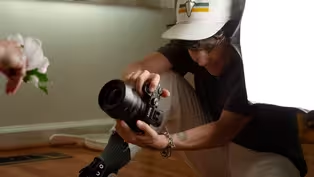
Clip: S26 Ep6 | 12m 12s | Through storytelling and photography, Esther Godoy documents, celebrates and uplifts Butch identity. (12m 12s)
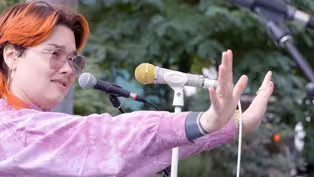
Glitterfox Performs "Passenger"
Video has Closed Captions
Clip: S26 Ep6 | 4m 20s | Portland indie rock band Glitterfox performs “Passenger” at Green Anchors. (4m 20s)
Video has Closed Captions
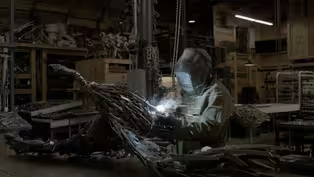
Clip: S26 Ep6 | 6m 59s | Travis Pond is a Portland metalsmith artist. (6m 59s)
Providing Support for PBS.org
Learn Moreabout PBS online sponsorship















Support for PBS provided by:
Oregon Art Beat is a local public television program presented by OPB