Oregon Field Guide
Tree Rings and Earthquakes; Avalanche Dogs; Wood River
Season 33 Episode 1 | 25m 29sVideo has Closed Captions
Ancient trees uncover seismic history; Avalanche Dogs on Mt. Bachelor; Wood River.
Northwest scientists are using ancient trees to uncover the seismic history of the region. Anyone who's been to a ski resort, knows that the folks in red jackets are looking out for your safety. At Mount Bachelor, there's a special unit dedicated just to avalanche rescue--and the training starts young! Wood River Photo Essay.
Problems playing video? | Closed Captioning Feedback
Problems playing video? | Closed Captioning Feedback
Oregon Field Guide is a local public television program presented by OPB
Oregon Field Guide
Tree Rings and Earthquakes; Avalanche Dogs; Wood River
Season 33 Episode 1 | 25m 29sVideo has Closed Captions
Northwest scientists are using ancient trees to uncover the seismic history of the region. Anyone who's been to a ski resort, knows that the folks in red jackets are looking out for your safety. At Mount Bachelor, there's a special unit dedicated just to avalanche rescue--and the training starts young! Wood River Photo Essay.
Problems playing video? | Closed Captioning Feedback
How to Watch Oregon Field Guide
Oregon Field Guide is available to stream on pbs.org and the free PBS App, available on iPhone, Apple TV, Android TV, Android smartphones, Amazon Fire TV, Amazon Fire Tablet, Roku, Samsung Smart TV, and Vizio.
Providing Support for PBS.org
Learn Moreabout PBS online sponsorshipMajor support for Oregon Field Guide is provided by... [ ♪♪♪ ] MAN: My rappel!
MAN: Oh, my gosh, it's beautiful.
MAN: Good morning, everybody.
Woo!
Let's do it again!
MAN: Nicely done!
MAN: Oh, yeah!
Fourteen and a half.
Yes, that was awesome!
[ people cheering ] There you go, up, up... ED JAHN: Tonight on Oregon Field Guide: [ man whooping ] Avalanches can happen, even in ski areas.
[ explosion booms ] But at Mount Bachelor, these dogs are trained to jump into action if the worst were to happen.
Then, it's a rest for the eyes along the peaceful Wood River.
But first, we head to Washington for a scientific adventure.
Over the years, Oregon Field Guide has joined scientists all over the Northwest as they study the threat that earthquakes pose to our region.
Now, understanding the risks and using science to get answers is obviously important work.
But as you'll see in this next story by Jes Burns, that work can also be grueling, messy, and taking you to some really interesting places.
JES BURNS: A chainsaw is not an ordinary obsession for a scientist, but Jessie Pearl loves them.
JESSIE: This poor little saw.
Normal wear and tear on a chainsaw is not cutting through barnacles or mussels, but for us, that is kind of our everyday.
When I first started my PhD, my advisor said, "Yeah, you know, I'm looking for someone who's willing to throw a chainsaw in the back of the truck and just drive up every time there's a storm."
And I was like, "That's me, heh!
Science is great!"
And it's a lot of this.
[ chainsaw rumbling ] You just start to get a really deep love for a tool that's going to get you your sample quick.
That's our signal to clean it.
[ chuckles ] We got some bark.
That's what we wanted.
This muddy, waterlogged wedge of Douglas fir is a key Jessie will use to help unlock the seismic history of the south Puget Sound.
We're looking for evidence of past earthquake events, and we're looking for evidence that is preserved in the landscape.
Earthquakes may seem like random events, but they happen at relatively regular intervals.
Depending on where you are, it could be tens, hundreds, or even thousands of years in between.
Whoo!
Piecing together the locations and timelines of past earthquakes can reveal those patterns, giving emergency planners a better idea of what to expect when the next earthquake hits the region.
I'm always game for more samples.
You know, there's so much we can do with wood.
The trees Jessie and geologist Wes Johns are interested in are near these marsh islands, where the mud and sediment are being eaten away by the tides.
These aren't just any dead trees, though.
These root-ball spider webs didn't wash down a stream or float in on the tide.
Instead, Jessie believes they died here 900 years ago.
So the evidence that I'm gathering specifically is old trees.
So trees that were an ancient forest that was submerged very quickly because of the earthquake, so the land level actually dropped.
And now it's what I like to call a ghost forest.
If Jessie can figure out when these trees died and can confirm that they all died at the same time, She'll know what year the earthquake hit.
I would love to be able to sample-- See how those guys, they're, like, still standing up?
The answers are in the tree rings.
Cannonball.
Let me see if I can find something hard to stand on.
Whoo!
[ chainsaw rumbling ] The problem with chainsawing is, really, it works you into the mud.
[ revving ] [ screams, then laughs ] [ saw shuts off ] Uh-oh, did it fall?
There it is.
There we go.
Huzzah!
Nice!
Trees are incredible windows into the past.
Dendrochronology is the science of using their growth rings to date things.
They're really wonderful in the sense that they stay in one place their entire life, and they record, within the chemical and physical composition of their wood, everything that happens to them, whether it's a big storm, whether it's a decade of drought, whether it's a big, severe fire that came through.
And so tree-ring scientists like myself can use all these different clues that are within the trees to tell a story about what has happened to this landscape in the past.
Tree rings don't grow uniformly from year to year.
When the weather's good and there's lots of water, trees grow fast, putting on wide rings.
When things are bad, they grow slowly.
Because climate conditions are regional, every tree of the same species in the same area puts on common patterns of growth.
If you know what year your first tree died, you can count back in time on its rings.
Find a slightly older piece of wood, and you can lock in where the pattern overlaps and go even further back in time.
Find more old trees, you can go back and back and back.
Scientists can use the tree-ring timeline, or chronology, to understand changes in climate, wildfire frequency, and even to date earthquakes.
In western Washington, the reliable Douglas fir chronology goes back less than a thousand years.
But what do you do if the earthquake you're trying to date is even older than that?
You head to a lake at the edge of the Olympic Mountains.
MAN: These trees at this site are a critical piece of the puzzle, where we're trying to piece together the timing and extent of a major earthquake that happened about 1,100 years ago.
And here at Price Lake, we have a fault that then pounded a stream and flooded the forest and killed the trees.
JESSIE: Most of these trees are very much still underwater.
It is an underwater forest.
Collecting samples from an underwater forest requires underwater gear.
Awesome!
Like a beastly hydraulic motor... Nice!
All right.
[ turning over, rumbling ] ...that will power an underwater chainsaw.
Whoo!
Out on the water, USGS divers Pete Dal Ferro and Jenny White McKee are scouting for trees that still have bark on them.
Bark is key for accurately dating when a tree died because it guarantees the outermost rings haven't just rotted away during its thousand-year slumber.
JESSIE: Actually, it might be bark right here on top.
Look at this.
MAN: I think that is bark.
Yeah.
I think it's orange-ish, right?
WOMAN: Yeah!
[ laughing ] Do the jig!
[ chuckles ] The bark dance.
You ready for the main event?
Yep.
[ motor rumbling ] [ saw whirring ] WOMAN: You're really having to push on it, huh?
PETE: Yeah, it's pretty hard.
[ motor shuts off ] I've gotta sort of lever way harder than you do in real life.
I'm also swimming, so that part's hard.
I'll -- You know, I'll try to get all the rings.
[ saw whirring ] [ woman whoops and man laughs ] Woo-hoo!
MAN: That's enormous.
JESSIE: Holy crap!
WOMAN: You worked really hard.
Are you okay?
That thing is so beautiful!
WOMAN: Yeah, I feel a little bit bad for this tree.
PETE: I do too.
Jessie and Bryan believe this tree is so old, they won't be able to rely on the known Douglas fir chronology for the region.
Instead, they'll have to use a far newer trick of the dendrochronology trade.
Back in the year 774 A.D., there was a massive solar storm that hit the earth's atmosphere and created a huge pulse of radioactive particles.
Scientists call it radiocarbon, or Carbon-14.
BRYAN: And so all the trees around the world, we've noticed, have this big pulse in radiocarbon that's specific to the year 774 through 775.
So instead of counting tree rings backwards from modern days, the researchers will look at the ring with the radiocarbon spike, and they'll count forward until they hit the bark.
Using this technique for multiple samples, they'll be able to figure out the exact six-month period more than 1,000 years ago that this submerged forest died.
But there's a problem with the first slice of tree.
No bark.
Rotten wood.
There isn't actually any bark remaining.
So the divers go to another tree nearby to try their luck there.
PETE: We followed the tree down, and there was a ledge of what felt like another outer layer.
Could be more tree, but could've been bark.
But that layer's this far into the mud.
WOMAN: I think the bark is only surviving sub-surface.
JESSIE: Yeah, that makes sense.
The mud and sediment make this cut far more difficult.
Visibility is zero.
The thick mud coats Pete's mask and clogs his regulator, making it harder to breathe.
PETE: Oh, it's [ bleep ] terrible.
The next time you're chainsawing, close your eyes and try to put the saw back in the cut.
[ saw whirring ] And bits of wood and debris repeatedly bind up the saw.
Finally, after hours of work, the wedge surfaces.
WOMAN: Wow.
MAN: Yeah!
Well, this is plenty to deal with.
This'll lock in.
I think that's gonna be plenty of rings.
That was a fighter.
During the cut, the bark separated from the wood, but there's evidence the final ring was preserved.
See that thin red?
That's-- for Doug fir, that's cambium, yep.
Yep.
For sure.
And it's still thin and red after a thousand years.
Thin and red.
This last ring right here is the year the tree died, and that's gonna tell us the year of the earthquake.
Unbelievable.
This lake was holding the secrets, but this is the piece that'll help crack it.
And while uncovering the Pacific Northwest's seismic past is the immediate aim of Jessie's research, she's also working towards a far grander goal: finding the trees to fill in the gaps in the Douglas fir tree-ring chronology.
JESSIE: If, at the end of this project, we come up with a 2,000-year-long tree-ring record which you could utilize for any other trees you might find at other ghost forest sites to figure out when they died, I mean, that will be something that will be used for generations of scientists to come.
[ ♪♪♪ ] Get him out of there!
Anyone who's been to a ski resort knows that the folks in red jackets are looking out for your safety.
Here at Mount Bachelor, there's a special unit dedicated just to avalanche rescue.
And the training starts young.
WOMAN: It's pretty interesting, because, you know, when you're traveling around the mountain with the avalanche dogs, people are always really excited and they're yelling, like, "Oh, the avalanche dogs!"
and trying to get their attention.
But the reality is, they're here to do a job, and when they're on the mountain, they're working.
They are here to rescue you if you were caught in an avalanche.
[ man whooping ] IAN MCCLUSKEY: While most avalanches happen in the backcountry, they can happen on any mountain, including here, at Mount Bachelor.
And if that worst-case scenario was to happen, the avalanche dogs are the first responders.
MAN: They're like just a member of our patrol.
They show up with us in the morning, they get their uniform on just like us, and they ride the chairlift up with us, and they're here all day.
It's a rough life.
[ chuckles ] Even with daily efforts to mitigate potential avalanches... [ explosion booms ] ...around three percent of avalanche fatalities in the US have involved guests skiing or snowboarding inside the boundaries of ski resorts.
Today, many of the major ski resorts in the US have avalanche dog programs.
Mount Bachelor started their program in the 1990s.
We've got three aging dogs and kind of one new young pup, so we're definitely at a transition point.
WOMAN: We've brought Shasta on, she's a new pup.
Riggins is almost 10.
The two Goldens, Banyan and Mango, they're 8 and a half.
So we're going to be rebuilding the team over the next few years.
Get this next chair.
Come on, Shasta.
Go up.
Go up.
Good girl!
Wow!
BETSY: It takes about two years to fully train an avalanche dog.
Good load up!
Wow, was a that a little scary?
The first year, the focus is a lot on just basic obedience, learning to travel around the mountain... Good girl, Shasta.
...riding chairlifts, riding snowmobiles.
Getting used to the guests calling for them and teaching them not to, you know, run towards the guests and maybe get hit by their skis.
The second year, we really focus on the game of finding someone buried in the snow, and it really is hide-and-seek for them.
It's a game.
Search!
It could take ski patrollers hours to locate someone buried in a field of avalanche debris.
It can take a dog only seconds to pick up the scent.
BETSY: We're training them to find with their nose what they can't see on the surface.
The speed at which a dog can locate a person buried in the snow and help to dig them out is a matter of life and death.
Get him out of there!
If someone buried in an avalanche is found within 15 minutes, they have a 90 percent chance of survival.
But if the rescue takes more than 35 minutes, their chances of survival drop to 30 percent.
DREW: Super important for things to happen quick, right?
So you've got someone trapped in the snow, they've got just minutes of maybe available oxygen.
Dogs are an important tool for us to be able to find someone quick.
That's a good boy!
Good job!
Who's in there?
But for the dogs in training today, this is just a fun game.
BETSY: And when they do find that person, they get to do their favorite thing, which is play tug.
Good boy!
Good boy!
Oh, good boy, Banyan!
Oh, good boy!
Good boy!
Good boy!
You know, if you don't sound like a crazy idiot, you're not doing it right.
That's like super high-pitched, praising the dog.
Get him out of there, buddy!
Get him out of there!
Yeah, good job, Banyan!
Buddy!
BETSY: One thing that's funny is people always are like, "Oh, I would've thought it would be a Saint Bernard," you know, and it's just that-- that image of the Saint Bernard with the cask of brandy or whatever coming to rescue you.
Using dogs for alpine rescue has a long and fascinating history, dating all the way back to the 1600s.
High in the Alps between Switzerland and Italy is the St. Bernard Pass.
It was here that monks raised dogs to help locate and save stranded travelers.
Legends tell of the many alpine rescues these dogs performed.
When skiing first came to the United States, so, too, did mountain rescue dogs.
This rare film shows Saint Bernards training on Mount Hood in the 1930s.
But it's not just Saint Bernards that make great avalanche dogs.
Generally, avalanche dogs, you want the dog to be a retriever that's really playful.
That's why Golden Retrievers, black Labs, yellow Labs work well.
Shasta's the 16th dog to join Mount Bachelor's Avalanche Dog Rescue Program.
And today is a big day: her first training drill.
She'll start by watching the older dog, Banyan.
[ indistinct chatter over radios ] What do you got there, Banyan?
Get him out of there!
Get him out!
Go on, buddy!
Go on, get him out of there!
What do you got?
Get him out of there!
Get him out of there!
What do you got?
Get him out of there!
Oh, Banyan!
Oh, good boy!
Did you find me?
Good boy, Banyan!
Good boy!
Good boy!
Oh, good boy!
Good job, Banyan!
Whoo, buddy!
What do you got there, pal?
Now it's Shasta's turn.
Shasta, what's this?
You gonna come find me, Shasta?
What's this, huh?
What's this?
What's this?
The first step is to get Shasta used to the idea of running into a snow cave to play without the digging part.
That'll come later in her training.
Good girl, Shasta!
She's in a snow cave sniffing around, and we've got a tug toy that she's holding onto and we're playing a little tug-of-war.
She's not scared at all.
This is exactly what we want to see.
BETSY: All right, ready, Riggs?
Okay, go load up.
As the puppy Shasta starts her first season, Riggins is nearing the end of his career.
BETSY: His first day on the job, he was a 7-week-old puppy.
He rode around in my jacket on the chairlift.
Wait.
Free!
So, yeah, he's been here 11 seasons now.
You know, I have such a strong bond with Riggins.
We've spent so much time together.
I know all dog owners have a strong bond with their animals, but I don't know, it's just something different.
It's just at another level.
My husband always gets mad and says the dog gets more kisses than he does.
[ chuckles ] It's a little bittersweet, you know?
When I see the gray on his beard and know he's getting older.
And he's about to turn 10.
He's probably only going to be an avvy dog up the mountain for another year or two max, you know, and it's sort of an end of an era for me.
I remember being so young in the program and so gung-ho and wanting to train my dog and just wanting so badly to be a part of that program.
And now I'm kind of passing that on to the next generation.
Good girl, Shasta.
BECKY: You know, watching Drew step into a new role and then bring on his own avvy dog, and, you know, it's-- it's very heartwarming when you see that, you know?
You know that it's okay, it's time.
You know, it's okay to move on.
[ Riggins barks, panting ] We spend all this time training these dogs, years training them.
[ barking ] And the goal in the end is that he never has to be used to find someone buried in an avalanche.
The goal is that he just continues to do drill after drill after drill and he retires having never had to be deployed to rescue someone.
[ barking ] The whole point of the program is for that one time that we need him.
And we'll have him and we'll be able to deploy him with the goal of saving someone's life.
Did you find me?
Good boy!
Good boy, Riggins!
It's the end of another long day at Mount Bachelor.
And after the lifts close, the ski patrol and the avvy dogs have one last duty: sweep the empty runs to make sure everyone has gone home safe.
DREW: You know, at the end of a long day, getting a nice view of the mountains and being with your dog, that's a good way to end it.
[ ♪♪♪ ] What does an oasis look like?
Well, photographer Todd Sonflieth may have found one along the lush Wood River in the often parched Klamath County.
[ birds chirping ] [ ♪♪♪ ] You can now find many Oregon Field Guide stories and episodes online.
And to be part of the conversation about the outdoors and environment here in the Northwest, join us on Facebook.
[ birds trilling ] Major support for Oregon Field Guide is provided by... Additional support provided by... And the following... and the contributing members of OPB and viewers like you.
Video has Closed Captions
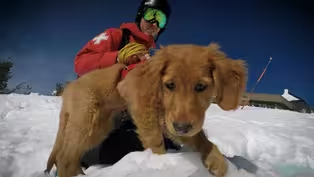
Clip: S33 Ep1 | 9m 3s | Mt Bachelor has its own avalanche dog program that trains canines to find buried skiers. (9m 3s)
Video has Closed Captions
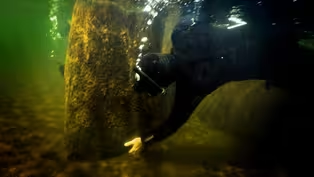
Clip: S33 Ep1 | 11m 22s | Scientists are using ancient trees to uncover the seismic history of the region. (11m 22s)

Video has Closed Captions
Clip: S33 Ep1 | 1m 32s | Wood River Photo Essay (1m 32s)
Providing Support for PBS.org
Learn Moreabout PBS online sponsorship















Support for PBS provided by:
Oregon Field Guide is a local public television program presented by OPB