Oregon Field Guide
Tribal Land Transfer, Sea Jellies, Buzz Holmstrom
Season 32 Episode 7 | 27m 47sVideo has Closed Captions
Tribal Land Transfer, Sea Jellies, Buzz Holmstrom
Native Americans on Oregon’s north coast are reunited with 18 acres of their homeland in Seaside, Oregon. Join the Field Guide team behind the scenes at the Oregon Coast Aquarium, where a ‘jelly mom’ offers an up-close look at the fascinating world of sea jellies. Author Vince Welch tells the story of Oregon River Legend Buzz Holmstrom, who died mysteriously on the Grand Ronde.
Problems playing video? | Closed Captioning Feedback
Problems playing video? | Closed Captioning Feedback
Oregon Field Guide is a local public television program presented by OPB
Oregon Field Guide
Tribal Land Transfer, Sea Jellies, Buzz Holmstrom
Season 32 Episode 7 | 27m 47sVideo has Closed Captions
Native Americans on Oregon’s north coast are reunited with 18 acres of their homeland in Seaside, Oregon. Join the Field Guide team behind the scenes at the Oregon Coast Aquarium, where a ‘jelly mom’ offers an up-close look at the fascinating world of sea jellies. Author Vince Welch tells the story of Oregon River Legend Buzz Holmstrom, who died mysteriously on the Grand Ronde.
Problems playing video? | Closed Captioning Feedback
How to Watch Oregon Field Guide
Oregon Field Guide is available to stream on pbs.org and the free PBS App, available on iPhone, Apple TV, Android TV, Android smartphones, Amazon Fire TV, Amazon Fire Tablet, Roku, Samsung Smart TV, and Vizio.
Providing Support for PBS.org
Learn Moreabout PBS online sponsorshipMajor support for Oregon Field Guide is provided by... [ ?
?? ]
MAN: My rappel!
MAN: Oh, my gosh, it's beautiful.
MAN: Good morning, everybody.
Woo!
Let's do it again!
MAN: Nicely done!
MAN: Oh, yeah!
Fourteen and a half.
Yes, that was awesome!
[ people cheering ] There you go, up, up... ED JAHN: Tonight on Oregon Field Guide: Oh, that looks great.
I never grow tired of that.
Meet Oregon's jelly mom and swim among a smack of jellyfish.
FILM NARRATOR: Rounding a bend, the water drove him straight... Then, he's not a household name, but Buzz Holmstrom pioneered whitewater river running for an entire generation of recreational boaters.
But first, a story from the coast.
Native Americans lived for thousands of years on land that the rest of us now call home.
It's just a fact.
The U.S. government, along with mostly white settlers, took almost all of it from Native people.
But here on this piece of land just outside of Seaside, Oregon, producer Cassandra Profita found that it's not too late to give some of it back.
WOMAN: Growing up, I often was told that the Clatsop people are now extinct, they don't exist anymore.
And I obviously, knowing I was Clatsop -- am a Clatsop person, knew that was wrong.
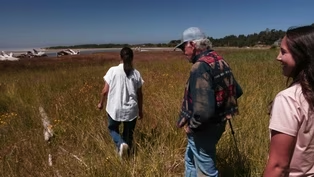
PROFITA: Charlotte Basch is walking with her parents on the land where her ancestors used to live, along the Necanicum River Estuary in the present-day town of Seaside.
The estuary is where the Neawanna, the Neacoxie, and the Necanicum Rivers all come together.
It's an incredibly beautiful spot.
This is where the Clatsop Native American people signed a treaty for the right to fish and hunt indefinitely.
And where, nevertheless, they were forced to leave.
I'm named after my great grandmother Charlotte and my great-great grandmother Celiaste, both of which lived in this community and on this land.
Charlotte and her father, Dick, are descendents of Clatsop Chief Coboway through his daughter Celiaste.
Dick learned from his grandmother Charlotte how his ancestors used this village site before white settlement pushed them out.
They didn't have a reservation to go to, so they scattered across the Northwest.
Many lost track of their family lineage.
There were pieces that were able to be threaded through the generations.
You know, of course a lot was lost, but I am lucky enough that I know something about our family and our history.
While this peaceful stretch of undeveloped land feels remote, it's actually just a couple miles from the throngs of vacationing tourists in the bustling beach town of Seaside.
On a busy street in the center of town, Dick worked with an artist to illustrate the history of his ancestors' homeland and share their story with the community.
The importance of this place was immense.
The longhouses here had family, neighbors, right across the estuary, where there was another village.
This was such an important place that after our treaty was signed, that treaty included the right to fish forever here at the mouth of the Neacoxie.
But that treaty was never honored by the U.S. government.
So the Clatsop never got what they were promised for giving up their land and they still have no federal recognition.
They put up fences and ''no trespassing'' signs, and our people weren't able to go to the place they gathered, and they were arrested for trespassing.
Can you imagine that, the horror that they had to endure?
Generations later, Roberta Basch found that problem persisted with the land trust that owned this property when she was denied access to traditional plants.
ROBERTA: They said, ''No, you can't,'' because they were preserving, conserving some of those plants.
Well, I know how to do that.
My people have been doing that since time immemorial, and it's been very difficult to be told you can't be who you are.
Because for us, we are not separate from the land.
We are not separate from the plants.
The plants keep our bodies alive, the plants keep this whole area alive.
We're not separate.
But we've been told by society that we have to learn how to separate ourselves from the land.
That's not possible.
It's just not possible to be able to do that.
Katie Voelke is the executive director of the North Coast Land Conservancy.
Her land trust protected the property from development and restored its tidal marsh ecosystem.
She says years of hearing from tribal members like Roberta led her organization to make an historic decision.
We realized that though we have a conservation mission, our connection to this land is not and could never be as deep and important and meaningful as the connection of the Clatsop people.
We realized that what we owned was one of the most important places to other people, and why would we own that when we know that those other people will care for it even more greatly than we would?
MAN: They said, ''It was never our land,'' and they deeded the land back to us.
[ chuckles ] It's remarkable.
And because of that, we sit here today and the circle has come all the way around.
And we have -- it's going to really literally allow us to be a tribe.
WOMAN: How long would it take to dry something like this?
Though they had no land to call home, the Clatsop-Nehalem people never forgot their culture.
Now they finally have a place to practice it.
Because they're typically dried out.
It's dried, and then you soak it.
And you work it that way.
One of the things that we want to do is keep that culture alive, to teach our tribal members, to teach family, to teach those in the community.
They're making plans to build a longhouse and a museum at the site.
You make it a longhouse.
Yeah, do it right.
DAVID: So here we are for the first time in a very, very long time, actually owning land in our homeland.
We're like, ''Okay, now what do we do?''
[ laughs ] We're thinking about our future and having a lot of discussions.
Like, how do you put Humpty Dumpty back together again?
And so now we have this huge hope.
And we're dreaming again.
With the title transfer, the tribes reclaimed about 18 acres of their ancestral homeland and launched a whole new chapter of their history.
CHARLOTTE: To be able to look now and know that this is actually in tribal ownership again is truly indescribable.
It gives you a sense of pride, I think, and resilience, knowing that our people, our community have been here literally since time immemorial, and despite everything that happened to us, we're still here in this place.
[ ?
?? ]
Of all the creatures of the sea, few are as strange and surreal as the sea jelly.
When they move through water, they pulse and look almost like aliens from outer space.
I've always been fascinated by them, so I came to the Oregon Coast Aquarium to get an up-close look at the secret world of sea jellies.
[ ?
?? ]
WOMAN: I think people are really drawn to jellyfish because they are so different from us.
They're fascinated because it's an animal, just like we are, but it's an incredibly different animal that is so simple and yet so complex when you start to look more closely.
[ children chattering ] Look at that baby one!
McCLUSKEY: Thousands of visitors to the Oregon Coast Aquarium marvel at the collection of sea jellies.
But few notice that above the tank, on a catwalk, is a woman working behind the scenes.
This is Evonne, keeper of the sea jellies.
I've been called a lot of things here.
[ laughs ] Jelly keeper, jelly aquarist, also jelly mom.
Sea jellies are perhaps better known as jellyfish.
Their most famous feature, of course, is their stinging tentacles.
But from there, they get even more unusual.
Jellyfish are not actually fish.
As invertebrates, they have no bones at all... or teeth or eyes or ears.
They don't even have a brain.
And they never sleep.
Sea jellies have been on this planet a long, long time, more than 500 million years, making them the oldest multi-organ animal on Earth.
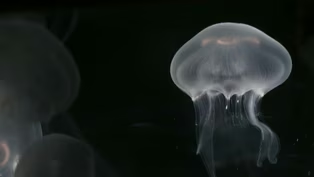
They have a network of nerves, a large stomach in the center, and the glowing shapes are their gonads for reproduction.
They are called jellies because their bodies are gelatinous, but as much as 95 percent of their body is actually water.
We are not trained specifically for jellies when we go through marine biology degrees in college, so it was a whole new world to me.
And they are beautiful, and at the same time, they can be frustrating from an animal-care standpoint.
Jelly care is a lot of chemistry and physics.
Evonne has earned the name jelly mom not just because she's the caregiver of these jellies but actually for something more literal.
One of the things that we do here at the aquarium is breed jellyfish.
All jellies are going to look the same as adults unless they are reproducing.
When we see that a large moon jelly is holding lavender clusters under the bell, we know that that is a mature female.
There are thousands of planula, or jellyfish larvae.
That is fantastic.
So when the adults have reproduced and the larvae have settled out, they form little polyps.
And eventually, when conditions are just right, these little polyps will produce many, many young.
And we have a number of tanks in the back that range from small to medium to large, so we have graduation day periodically as the little ones are able to move into larger and larger tanks, ultimately coming out to the exhibit, sometimes to rejoin the parents.
A team from the Oregon Coast Aquarium sets out from Newport Bay into the open ocean.
They make the special mission every couple years to gather jellies from the wild.
This helps the health and the genetic diversity of Evonne's breeding population.
Today we're looking for some moon jellies and some sea nettles.
So we've come to a site where we've collected them before, and we're looking closely on the surface to see their silhouettes to see if we can find a spot where they've aggregated with the currents.
Oh, there's one!
Ah, a sea nettle!
Back there.
Sea jellies are drifters, carried by the ocean's currents.
Where the currents converge, you'll find large groups of jellies.
A group of sea jellies is called a smack.
EVONNE: When they want to feed, they go higher in the water column.
However, if you are a fragile animal with not much pigment, it's not good to be on the water surface on a bright, sunny day.
So as the sun rises and becomes brighter, these animals will migrate deeper into the water column.
Early morning hours, we might find them all at the surface, and by high noon, they could be 60, 70, or 100 feet deep.
The divers are using special nets that can scoop up the jellies without hurting them.
It can also collect some of the seawater.
Coming in with three.
The seawater's not just to transport the jellies.
Floating in it are unseen gametes.
These are the sperm and eggs of the jellies, which Evonne can use back in her lab.
Is that okay?
Okay, perfect.
The crew returns with 18 Pacific sea nettles.
There we go.
But before they can be put on display, they must first be inspected for small creatures that came with them.
EVONNE: You are gonna love the size of this crab.
[ both laugh ] Yeah, so that's a little crab that just cruises around on the tentacles of the jelly, and it's feasting on the things that are captured on those tentacles, but it's not necessarily eating the jelly or causing any harm.
Just a hitchhiker.
Also found on the jellies are tiny creatures with large, dark eyes.
These aren't just hitchhikers like the crabs, but are parasites.
WOMAN: Yeah, this one's got a lot.
And they will feed on the jellies' tissue.
EVONNE: All right, I believe this animal is free and clear, but if anybody's hiding in there, we'll see it within the next week or two.
[ Evonne chuckles ] Oh, that looks great.
I never grow tired of that.
They will sit in this tank now for 30 days just for a quarantine period, and now we will just continue good nutrition and monitoring and take them forward to exhibit in a month, and then the public will be able to walk into our gallery and also be in awe of these animals.
[ ?
?? ]
I really enjoy the work.
And I don't know how to describe it, but whether I'm cleaning a tank or feeding the jellies or simply watching them to see what the flows are doing in the tank, I simply can't take my eyes off of them.
I've been doing this for over 13 years, and I would love to keep doing this through the rest of my career.
And chances are, after I retire, I will probably set up a small jellyfish tank at home.
[ chuckling ] And take care of them then.
[ insects chirping ] The name Buzz Holmstrom probably doesn't ring any bells for you.
In the 1930s, he was an Oregon native who pioneered recreational river running, and this was well before the age of rubber rafts.
Buzz's story, though little known, is an amazing one.
It's also shrouded in mystery.
FILM NARRATOR: Rounding a bend, the water drove him straight for the big stone.
Pull, Buzz!
A few inches less and the world would have added Buzz Holmstrom to the long list of the river's victims.
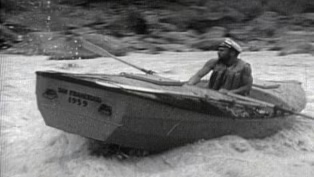
ED JAHN: In the late 1930s, audiences thrilled at this Academy Award-nominated film about Buzz Holmstrom, a boatman from Coquille, Oregon, who became the first person to boat 1,100 miles down the Green and Colorado Rivers and through the Grand Canyon, alone and in a handmade wooden boat.
FILM NARRATOR: The speed becomes terrific.
The boat is almost unmanageable.
Rocks rear up from nowhere.
And yet today, few Oregonians have heard of Buzz Holmstrom.
MAN: People like Buzz represent the love of nature and the love of the outdoors.
Vince Welch is a longtime commercial river guide.
Among professional river runners, the legend of Buzz is well-known.
WELCH: Hang on!
[ rafters exclaiming ] But here on the Grande Ronde River in northeast Oregon, guests are just getting introduced to a man who helped shape river running in the West.
Buzz Holmstrom was a unique individual, and he is part of this river.
I first heard about Holmstrom when I was in the Grand Canyon.
And as a boatman, when I learned that he had run the Grand Canyon alone in a handmade wooden boat, that had a great appeal to me.
And then I realized he was from Coquille, Oregon, and being from Oregon, I thought, ''Oh, this is my guy.''
Vince and some friends were surprised to learn that Buzz's story had never been captured in a book, so they wrote one, and they rediscovered a man whose story once filled the pages of the national press and who died mysteriously in 1946, here on the lonely banks of the Grande Ronde River.
This is Rondowa.
The Grande Ronde River comes in and meets the Wallowa.
A simple memorial near the junction of the Grande Ronde and Wallowa Rivers marks where Buzz died under a shroud of mystery.
He died of a gunshot wound, apparent suicide, according to the coroner, but no one -- no one in Coquille or his family believed it, because it just didn't fit the Buzz they knew.
How are you, June?
Nice to see you.
It's good to see you.
While researching his book, Vince set out to find what really happened.
WELCH: Boy, this is just a treasure chest.
This is the photograph that I think is so good.
Vince tracked down Buzz's niece, June Jennings, in Coquille.
She said Uncle Buzz was the lone adventurer in a family of traditional loggers and farmers.
WELCH: He kind of didn't worry too much about his clothes, did he?
JENNINGS: No, I don't think he ever did.
He was more interested in the doing of the thing.
WELCH: Yeah, there you go.
June remembers Uncle Buzz as a happy guy.
WELCH: So he just had that wanderlust?
JENNINGS: Yeah.
You always have one in the family, don't you?
[ laughs ] I didn't get any of it.
I've been in this house for 53 years.
Buzz started life as a typical Coast Range kid.
He worked the fields, he played football.
So why did he think that he could be the first one to ever boat the Grand Canyon solo?
This was a lot of land for a small family.
June says Buzz and his brother may have earned their confidence as kids, by basically managing the family farm themselves while their dad coped with illness.
JENNINGS: I look at all these fields, and I think of those two boys farming this, planting and hoeing the corn.
It's amazing that they could take care of this much.
[ dog barks ] But when Buzz and his brother weren't working, they had what we might call a free-range childhood, with unlimited access to forests and mountains and fields.
I don't think this bridge was here for them.
Middle Creek was a favorite childhood haunt for the boys.
So this would have been roaring?
In the wintertime, it'd probably be as high as the bridge.
Buzz and his brother were fearless, riding logs and careening down the flooded creek for miles.
WELCH: We can't imagine it anymore.
We look after our kids and we want them to be safe, and so we stay within our comfort zone.
But when you come out here in the middle of the Coast Range, I think what it does, it expands your idea of what's possible.
So this was as good as it was going to get for a couple of country boys.
This became their world, their universe, and somehow, Buzz took it to another level.
Other local boys from Coquille would eventually take up jobs in farming and logging, but not Buzz.
He started designing boats modeled in part on the popular Rogue River and McKenzie River drift boats of the time.
At the age of 25, Buzz left Coquille to test his boat design on the rising waters of the Rogue River, alone.
He left in -- I think it was November.
On the Coast Range?
You know, he's not really well-equipped.
There was no Patagonia with this guy.
And he hit a rock, the boat tipped and floated away, and he was stuck there in his long johns and his cork vest.
But Buzz not only survived, he grew more confident.
And at age 28, he turned his sights on the Grand Canyon.
The thing to remember here is that in the 1930s, the Grand was almost exclusively run by massive, organized expeditions, often full of surveyors and workmen.
Buzz set out to run it for fun with just a few friends, but then his friends bailed on him.
He didn't intend to go by himself, and he wasn't promoting himself.
He didn't have an agent.
He just went and did it.
The boat Buzz built was a heavy wooden dory, almost exactly like this one, built by Vince's co-author, Brad Dimock.
The design is strong but breakable, and one mistake could have destroyed Buzz's boat and quite probably killed him.
Was he stubborn or was he just going, ''Okay, what the hell?
I can't turn back now, I built a boat.''
We don't know.
When you think about it, I mean, I wouldn't do that.
That sounds scary to me.
But Buzz succeeded in doing something that no one else had.
FILM NARRATOR: Buzz was now a superman with superhuman strength.
He defied the river to do its worst.
He was master.
He was stronger than the river.
Yet after all the national fame, the fan letters, the press, Buzz returned to quiet Coquille to work at a gas station.
Well, this is the old Standard station here in the center of Coquille.
This is where Buzz worked from high school throughout his life.
After the Grand, returning to small-town life was a jarring change of pace.
I mean, he was the hero.
It was a big, big deal.
But what triggered Buzz's apparent suicide?
Was Buzz bored by life back in Coquille?
Was he hurt by a woman he'd dated?
Did he fear failure when he was hired to navigate the flooded Grande Ronde and struggled to pull it off?
Or was Buzz, whose real name was Haldane, murdered, as some have suggested?
But even after years of research, Vince never got much closer to an answer.
It doesn't really matter, but it lends something to the story, a tragic kind of element to it, that this guy who did this incredible thing would do that, take his life.
FILM NARRATOR: Water filled the cockpit.
Waves tried to tear him out of his boat, but on and on... Vince says Buzz left a legacy that reminds river lovers of what real adventure can be.
Buzz's dangerous solo journey down the Grand Canyon is nothing like the safely packaged commercial experiences that most people experience on rivers today.
What happened there on the banks of the Grande Ronde at Rondowa... Buzz took risks, fended for himself, and found pure adventure in the way of a true Oregon pioneer.
We felt it was a great story about Grand Canyon and about what boating's really about.
He had his beans and his bacon and his coffee and his grubby clothes, and to us he was the real thing.
[ ?
?? ]
You can now find many Oregon Field Guide stories and episodes online.
And to be part of the conversation about the outdoors and environment here in the Northwest, join us on Facebook.
[ birds chirping ] Major support for Oregon Field Guide is provided by... Additional support provided by... And the following... and the contributing members of OPB and viewers like you.
Video has Closed Captions
Clip: S32 Ep7 | 8m 17s | Profile on Oregon river legend, Buzz Holmstrom. (8m 17s)
Video has Closed Captions
Clip: S32 Ep7 | 8m 37s | Evonne, the "Jelly Mom" offers an upclose look at the fasinating world of sea jellies. (8m 37s)
Video has Closed Captions
Clip: S32 Ep7 | 7m 10s | Clatsop-Nehalem Tribal Land Transfer. (7m 10s)
Providing Support for PBS.org
Learn Moreabout PBS online sponsorship















Support for PBS provided by:
Oregon Field Guide is a local public television program presented by OPB