Oregon Field Guide
Tugboat Races, Vineyard Robots, Teacup Lake Photo Essay
Season 35 Episode 9 | 23m 18sVideo has Closed Captions
Tugboat Races, Vineyard Robots and Teacup Lake Blizzard
Tugboat Races, Vineyard Robots and Teacup Lake Blizzard
Problems playing video? | Closed Captioning Feedback
Problems playing video? | Closed Captioning Feedback
Oregon Field Guide is a local public television program presented by OPB
Oregon Field Guide
Tugboat Races, Vineyard Robots, Teacup Lake Photo Essay
Season 35 Episode 9 | 23m 18sVideo has Closed Captions
Tugboat Races, Vineyard Robots and Teacup Lake Blizzard
Problems playing video? | Closed Captioning Feedback
How to Watch Oregon Field Guide
Oregon Field Guide is available to stream on pbs.org and the free PBS App, available on iPhone, Apple TV, Android TV, Android smartphones, Amazon Fire TV, Amazon Fire Tablet, Roku, Samsung Smart TV, and Vizio.
Providing Support for PBS.org
Learn Moreabout PBS online sponsorshipMajor support for Oregon Field Guide is provided by... [ music playing ] WOMAN: Come on!
There he is, there he is, there he is.
[ exclaims ] Come over here, buddy!
Good boy!
[ laughing ] WOMAN: Whoo, high five!
Yeah!
JAHN: Next, on Oregon Field Guide: This one right here.
These robots mimic the vibrations of agricultural pests.
[ warbling ] Could this technology be an alternative to pesticides?
Then, grab some hot chocolate and embrace the chill of a Cascades blizzard... from the comfort of home.
But first, they're not fast, but these tugboats are racing to win.
Tugboats like these are a huge part of Northwest maritime history.
They're powerful, small, and generally pretty slow workhorses of the water.
So when we heard about a tugboat race, we were more than a little intrigued, and producer Ian McCluskey set out to see what it was all about.
[ gulls cawing ] McCLUSKEY: Down at the docks in Olympia, Washington, a handful of skippers have gathered from across the Pacific Northwest.
MAN: You know, you've got boaters in general, and then you've got wood boaters, and then you've got us knuckleheads that are the classic wooden workboat guys.
[ boat horns blowing ] It's time once again for the annual Olympia Harbor Days, which hosts the only remaining tugboat race in the Northwest.
[ engine starts ] The hallmark of what we do with Harbor Days is we have a tug race.
You know, I'd love to say that no one takes it very seriously, but everyone does take it seriously.
Even though tugs are very, very slow boats.
MAN: I tell people when I hit the throttle, I say, "Hang on, 'cause we're gonna go from zero to 12 miles an hour in maybe a minute."
[ horn blowing ] The Chippewa has fired up its engine and heads to the starting line.
At the wheel is John Bainter.
It's like riding a bike.
His family once owned the Chippewa in the 1970s and '80s.
He's now been invited by the new owner, Jeff, to take the wheel once again and, they hope, steer the Chippewa to victory.
The tugs motor out to the open water of Budd Inlet...
I gotta go over here and get in position.
...and line up at the starting buoy.
Because the race happens on the open waters of the inlet, there are no grandstands.
Spectators have to be on boats.
Friends, family, and supporters watch the race from the tugs themselves.
And on the R.W.
Confer, skipper Jeff gets some starting-line advice from his mom.
You can cut in front of Creosote.
He's got to back off, because you've got rights.
No, you don't.
Mom, this isn't sailing.
No, you don't.
MAN [ over radio ]: Nine, eight, seven, six, five, four, three, two, one... Fire in the hole!
[ people cheer ] And they're off.
Some tugs seem to gracefully roll the water behind them, like the Creosote.
And some seem to plow through it, like the burly R.W.
Confer.
Here we go!
[ all cheer ] JEFF: You know, instead of having a big, sleek boat that goes fast... Whoa!
...I want something slow and steady and that's got the power when you need it but also something that has some history to it and some stories to tell.
[ music playing ] If you look around, there's still dents and dings and ripped steel, and, you know, each dent and each ripped piece of steel has a story to it.
That's part of the personality and the charm of this boat.
The Confer was built in Portland's Albina shipyards in 1930, a time when America had fallen into the Great Depression.
And it turns out that one visitor to Harbor Days has a special connection to this tug.
This boat was named after my grandfather.
That's my mother, Roma Maxine Confer.
She was 18 at the time in 1930 when it was built.
The oldest boat at Harbor Days is the Lillian S. It was built in Astoria, Oregon, in 1912, which was also the same year that the Titanic sank.
It had a long career, especially in Alaska, as a salmon tender and was even part of the cleanup efforts for the Exxon Valdez oil spill in 1989.
It now belongs to Dave, who has taken on its restoration as a life project.
DAVE: What I don't know about boat building, I've got to learn, because I can't go out and hire everybody every time that, you know, something needs to be done on it, because unless you've got unlimited funds, these boats will bleed you dry.
So, I'm going to, uh, just keep plugging away on her as best I can and, you know, broke the rest of my life and happy as a clam, so... [ laughs ] Olympia is still a working port, and modern tugs are still performing some of the same duties that the vintage tugs did a century ago.
In comparison, the vintage tugs look like little bathtub toys.
[ horn toots ] But for as iconic and cute as they are, the old wooden tugs were the muscle that built these ports.
[ music playing ] Back in the day when a lot of these boats were brand-new, there was so much logging going on, there was so much fishing going on, there was so much of everything going on-- All of the businesses were framed around the ports.
These boats helped build this area.
When a large ship would come into port, they would need the assistance of a tug to maneuver it to the dock.
The tug crews would race to be the first to the ship, thus winning the work.
And just as rodeos sprung up from ranch work, tug skippers started this friendly competition.
Tug races sprung up in many of the larger port towns of the Pacific Northwest, like Seattle, Tacoma, and Olympia.
But today, Olympia Harbor Days is the last of its kind.
Out on the racecourse, the tugs have hit their full throttle, slowly building and building power, working up to about 14 knots.
That's faster than someone can jog but slower than riding a bike.
MAN: All right, here we go.
In order for the tugs to remain healthy, they have to move.
They have to flex the old timbers and turn the engines, just as we would have to move our legs and get our hearts pumping and blood flowing.
SAM: They're not happy sitting.
They're actually far happier being used than they are being parked.
The chance for these retired tugs to move in the water is rare.
And few people are willing to commit to a lifetime of boat maintenance.
And when it becomes too late to save a historic tug, there's no turning back.
Like for this one, docked near Seattle.
DAVE: We're losing boats at least one a year, if not more.
And pretty soon, unless something is done, we're not going to have any of these old boats left.
It's a conundrum.
A lot of these boats, when they run out of the energy of the owner right now, they very likely are dead.
There's not a lot of young people with both the energy and the monetary expenditure it takes to keep those boats up.
But this year at Harbor Days, there was a fresh face at the skippers' meeting.
[ engine starts ] Nick had owned a historic tug just a couple weeks.
We were always down at the dock working on her boat.
A couple weeks ago, the old owner came to me and was asking if I wanted to become the steward of it.
I've always just had kind of an attraction to old boats just 'cause classic boats have beautiful lines and look cool.
And the idea that it's been working really hard for a hundred years and I can keep making it do that... COSIMA: Perfect.
And it's really an icon in the community of, like, a working boat.
She's not this antique that stays perfect on the dock.
This is a boat we call when we need help, and this boat always shows up.
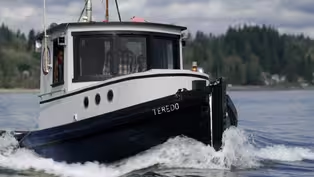
And when I was a kid, like, if we had engine problems, like, you call Teredo, you know?
Yeah, this boat's pulled her boat off a beach a few times.
Yeah.
[ laughs, sighs ] Over the years.
[ laughs ] COSIMA: We're not gonna do some huge restoration that's going to be written up in magazines.
Oh, yeah.
We're just taking these old boats and trying to do the best we can and share it with people.
We just want to use them.
We want to be on the water.
Yeah.
After racing for about nine minutes, the tugs are now nearing the finish-line buoy.
Go, go, go!
[ laughs ] Creosote has been in the lead, but now the Chippewa pulls up side by side.
A nail-bitingly close race... [ phone rings ] ...at least by tugboat standards.
Right in the middle of the race, hon.
Okay.
Bye.
That's the finish line right there.
Below deck, the Chippewa's engineer, Andrew, makes some final adjustments, eking out all the horsepower the old engine can give.
With the exhaust temperature nearing 1,000 degrees, the Chippewa chugs into the lead... Chippewa wins!
[ horn blows ] ...with the Creosote and Confer close behind.
All right!
Nice job, John!
[ all cheering ] [ horn blowing ] That's the race.
[ chuckles ] There's no real prize or glory.
WOMAN: So in first place, the Chippewa!
[ all cheer ] Just some victory cake and a commemorative mug.
Here's to local tugs.
[ all cheering ] There's little fanfare as Harbor Days wraps up for another year.
The tugs putter back to their respective ports.
But the skippers leave with one shared accomplishment: the legacy of historic tugs lives on for now.
And next year, another chance to race.
[ music playing ] In the world of agriculture, insect pests are a huge and expensive problem.
But Oregon State University scientists have created a singing robot that they think can battle pests without the use of pesticides.
Now, this story comes to us from OPB's Jes Burns, who created a new video series called "All Science.
No Fiction."
Hope you'll check it out.
Okay, so we've got two units here.
We'll place these two units out.
BURNS: Vaughn Walton is an entomologist with a new toy.
Do you want to see it?
BURNS: Yeah!
[ all laughing ] Yeah, yeah.
So let's connect it.
This is the test run here.
It's a device designed to communicate with insects through vibrations.
[ low warbling sound ] You can feel it with your hand.
That's the signal.
If the conversation goes well, the device, nicknamed the Pied Piper, could eventually save one of the Pacific Northwest's most important crops from a sneaky little bug called a treehopper and the potentially devastating disease it spreads in vineyards.
With Pied Piper, we're trying to find an alternative that is clean, that is environmentally safe, to try and get rid of these bugs without using any toxic pesticides.
The Pied Piper works by taking advantage of how some insects communicate, through vibrations.
[ warbling ] It's all about saving energy.
The females must use as little energy as they can so that they can produce as many eggs and many offspring as they can.
Saving energy means being as efficient as possible in finding a mate.
The treehoppers do this by playing an elaborate game of telephone.
[ low warbling ] They vibrate their abdomens, and the sound travels through whatever they happen to be standing on.
The mates will find that signal, they will zone in on them, and they will be able to mate.
The Pied Piper robot does something very similar.
[ warbling ] It plays the treehopper's call... to lure the insects in.
Walton is testing the device over the summer at Mark Huff's vineyard in northwest Oregon.
This one right here.
Why this one?
It's doing well.
[ laughs ] Therefore, it might attract the insects.
For Huff, dealing with pest problems is constant work.
From the moment that the grapes unfurl from their buds, you are thinking about it all the time.
And if you're in the organic business, like we are here, you have a very limited amount of tools in the tool chest.
Walton attaches the device's microphone and speaker to the grape vine.
Got the high-tech rubber band here.
[ Vaughn laughs ] There you go.
Pied Piper will listen for treehoppers.
And when it hears one...
The computer will send a mating signal through this wire back onto the stem.
When the treehopper feels the signal, it'll come running.
Luring treehoppers out into the open is a bigger deal than it may seem.
They're experts at staying hidden... and annoying the scientists looking for them.
As you get closer to them, they'll be sitting on one side of the stem, and they'll just move around to the back of it, and you just won't see them.
The treehoppers themselves only do minor damage to grape vines.
But they're carriers of a much more sinister plant virus called red blotch.
With red blotch, we're seeing reduction in photosynthesis in the plant itself.
What that translates towards winemaking is that you have less of these volatiles that we as humans love in wines.
The perception is that the quality of those wines are not as good.
[ person spits ] The Pied Piper has already shown it can lure treehoppers in.
But does it then kill them?
No.
The hope is to use the device's communication with the treehoppers to keep them from making babies.
It's a technique called mating disruption.
[ high-pitched voice ] Oh, no!
Mating disruption is kind of like birth control.
The idea is to confuse and distract.
Keep the bugs from finding each other.
You have an adult female that most likely is able to mate and should lay eggs within three or four days.
If you can delay that, you can cut the capacity of this insect being able to reproduce, sometimes in all, sometimes 90%.
It could be a revolutionary solution for organic vineyards.
Yet treehoppers aren't the only buggy pests farmers are dealing with.
And they're also not the only insects that communicate through vibration.
[ "Blue Danube" playing ] That worked okay.
There is a bunch of low-frequency stuff still.
It's been Oregon State undergrad Vincent Vaughn-Uding's job to train the Pied Piper to recognize treehopper calls.
Now he's expanding its repertoire.
We're working on getting the devices to work for brown marmorated stink bugs, which are another pretty major agricultural pest.
The stink bugs are recent invaders in the Pacific Northwest, and they're starting to cause damage to hazelnut crops.
In general, bugs are annoying.
They're very finicky.
But to speak to stink bugs, Pied Piper has to know the language.
And that starts with recording their communication with a vibration-sensing laser.
Vibrometer.
It can measure with very high accuracy just vibrations in a thing you point it at.
I'm going to try to get a stem.
We can get recordings that the traps can play back later in order to lure the insects towards them, and it's also how we can figure out how we need to tune our detection algorithm, like what dominant frequencies and harmonics we need to look at.
Once the insects are on the test plant, the recording and waiting begins.
They usually take a little while to, like, get acclimated before they start doing stuff.
Yet almost immediately, the male and female stink bugs strike up a conversation.
Yeah, yeah, yeah, yeah.
I think we already got a chirp.
If you look in here, you see these little streaks.
The main thing that we were looking for is just some signal that had very sharp, well-defined frequencies in it.
It's kind of like the difference between white noise and a human voice.
The frequencies of the stink bugs' call fall within human hearing range.
And all it takes is a little processing and encouragement from Walton... You got a signal?
Yeah, we were getting-- Are you serious?
...for the glorious mating call of the brown marmorated stink bug to ring out.
Play it.
Can you play it?
Yeah, there's a lot of noise.
That's okay.
Don't apologize.
Just play it.
[ low, slow warble plays on recording under static ] Ah!
I can hear it.
Yeah.
You can hear it.
So, yeah, it's in there.
Can you hear it?
Yeah!
[ "Blue Danube" playing ] [ low warbles play in musical rhythm ] If the Pied Piper can stop treehoppers and other insects, it will achieve something pesticides are incapable of.
VAUGHN: I think the key thing here is that it only affects the target insect.
It's cleaner for everyone that lives here, it's better for our salmon and our rivers.
You can't see these bugs, you can't hear them, but now we have a method of detecting them, which we never were able to do in the past.
And the more songs the Pied Piper learns to play, the more pests it can mesmerize and lead astray.
The story you just saw comes to us from OPB's new series, "All Science.
No Fiction," which uses whimsy and curiosity to showcase the coolest science happening across the Pacific Northwest.
You can catch the entire series along with all your favorite Oregon Field Guide stories on YouTube or the PBS app.
Now we close the show by celebrating the work of Dan Evans, who suffered more than a little bit to capture the beauty of a blizzard.
[ wind blowing ] [ ski pole tapping ] [ music playing ] You can now find many Oregon Field Guide stories and episodes online.
And to be part of the conversation about the outdoors and environment here in the Northwest, join us on Facebook.
[ birds cawing ] Major support for Oregon Field Guide is provided by... Additional support provided by... and the following... and contributing members of OPB and viewers like you.

Video has Closed Captions
Clip: S35 Ep9 | 2m 18s | A blizzard creates a winter wonderland at Teacup Lake, Oregon. (2m 18s)
Video has Closed Captions
Clip: S35 Ep9 | 9m 55s | Tugboat races at Olympia Harbor Days celebrate Pacific Northwest maritime history. (9m 55s)
Providing Support for PBS.org
Learn Moreabout PBS online sponsorship















Support for PBS provided by:
Oregon Field Guide is a local public television program presented by OPB