
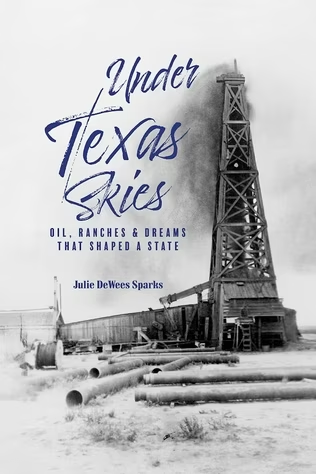
"Under Texas Skies: Oil, Ranches, and Dreams That Shaped a State" by Julie DeWees Sparks
Season 2026 Episode 8 | 27m 39sVideo has Closed Captions
Julie DeWees Sparks joins to discuss her book, "Under Texas Skies".
Julie DeWees Sparks, author of "Under Texas Skies: Oil, Ranches, and Dreams That Shaped a State", discusses her new book that covers the history of the oil business in Texas: from the explosive birth of the industry at Spindletop to the fracking boom and beyond and all the interesting characters and larger-than-life figures that made it happen.
Problems playing video? | Closed Captioning Feedback
Problems playing video? | Closed Captioning Feedback
The Bookmark is a local public television program presented by KAMU
"Under Texas Skies: Oil, Ranches, and Dreams That Shaped a State" by Julie DeWees Sparks
Season 2026 Episode 8 | 27m 39sVideo has Closed Captions
Julie DeWees Sparks, author of "Under Texas Skies: Oil, Ranches, and Dreams That Shaped a State", discusses her new book that covers the history of the oil business in Texas: from the explosive birth of the industry at Spindletop to the fracking boom and beyond and all the interesting characters and larger-than-life figures that made it happen.
Problems playing video? | Closed Captioning Feedback
Where to Watch The Bookmark
The Bookmark is available to stream on pbs.org and the PBS app.
Related to This Episode
Providing Support for PBS.org
Learn Moreabout PBS online sponsorshipHello and welcome to The Bookmark.
I'm Christine Brown, your host.
Today my guest is Julie DeWees Sparks, author of "Under Texas Skies: Ranches and Dreams That Shaped a State".
Julie, thank you so much for being here today.
Thank you.
It's nice to be here.
Thank you.
This is such an interesting book because it's like history.
It's business.
It's kind of a bunch of biographies.
It's a lot of things all at once, but done in a really interesting way.
Can I ask you to introduce it to us?
Okay, great.
I started out the book was actually a paper.
First, I am a docent at Bayou Ben, which is a house museum in Houston that was given to the Museum of Fine Arts, Houston by Miss I'm a hog.
She was the only daughter of James Hauger, former governor.
And when I became a docent there, they asked me because I'd come from the oil business, would I write a paper to present on the oil's influence on the city of Houston?
And I wrote the paper, and it was just it was interesting to me.
I learned a lot because so many places all around Houston with the names Cullen and, you know, just big names all over SP and it made it it explained it to me where these all came from.
Well, in the course of after I wrote the paper, my husband shared it with quite a few people and one of our good friends read the paper and he came to me and he said, I want you to write a book.
And I said, I'm not an author.
I don't know.
But he said, I want you to write it about the whole state of Texas.
What did you bring to the state of Texas?
And I took up the challenge, and I'm so glad I did because I learned a lot, a lot.
So I it it shows because this is this is like the kind of book that I think it wants to teach you something.
It wants to give you information, but not in a in A to stuffy or too difficult for the the layperson to understand.
Right?
It's not technical.
I am not a technical person.
I have a finance background, and I just wanted people to learn what I had learned, and I learned a lot more while writing the book.
But like I said, all these names that we've heard all of our least growing up in Texas, all of our lives, H.L.
Hunt and Murchison and said, Richardson and Eamonn Carter, all these people.
Those are some of the bigger ones.
But there's also a lot of people that I learned about that I'd never heard of before, that came to Texas from all across the United States, just because they wanted to make money and get rich.
It's definitely a who's who and if.
If you didn't know who was who now after you read the book, that's where that comes from.
Oh, I've been to that museum, and I remember that hotel, you know, it's all the connections are there.
We just don't think to make them necessarily.
Well, as we were driving up.
My husband said, didn't you write about the man that Kyle Field is named for?
And he was hired by Edgar B Davis to help him start his agricultural community in Luling, Texas.
And B Davis is probably a name a lot of people haven't heard, so.
But yes, I did want to make sure we mentioned since we are currently on the A campus, there are several buildings on this campus named for gentlemen who are featured in this book.
More recently, George Mitchell.
And then going back, you know, further bright, there's another one I'm forgetting.
But, you know, there's a lot of A&M connections.
Of course.
Yes.
With our with our programs here.
Not surprising.
So you were in the oil business for for many years.
That's right.
So you have a background in this.
I find it interesting that you maybe you weren't tired of it.
You still had more to learn or wanted to dig into that even more.
It's a fascinating industry.
And I graduated from LSU and I went to Houston to to look for a job.
I had no idea that I would end up in the all business.
The first job I interviewed for was with Getty Oil Company and they offered me the job.
So I took it and I had some fabulous mentors at Getty.
In fact, we used to come to College Station quite a bit because we in office here, and one of my mentors was a huge Aggie, and he wanted to make sure that I got out in the field and I saw wells being drilled and learned the business.
And and I'm so thankful to him because without that inspiration, I might have just moved on.
But he brought the whole business alive for me, so I have him thank for that.
I imagine getting out there and seeing how every, every aspect of the job is done, that that probably does go a long way for sparking passion, sparking interest, understanding.
And then once you're writing this kind of, you're able to put yourself in their shoes a little more of like, wow, they were.
I did it when it was much more established, and now they're going out there in nothing and doing all this.
I had lunch with some friends of mine a couple of weeks ago, and they were commenting on the book, and they said, it's shocking to me how many of these guys had third grade educations, grade school educations, and yet they came to Texas.
They had an idea, they had a dream, and they made fortunes.
They just you have to have an instinct.
I think that's what makes a wild or made a wildcat or is you have a dream, you have a belief, and you just go out and keep trying.
And they they were a lot of them were successful.
More of them weren't successful.
I really liked that you included that last bit of the title shaped estate, because I think it physically did like these places they went.
They built up towns, they built up industry around them.
But I also feel like it really shaped the culture in that, that sense of Texans are a people who we want to we want to try.
We want to build something.
We want to.
You know, I don't know that you see that everything you just described kind of has permeated into our culture because of this, this industry and the kind of people who came here to, to build themselves up.
Texas in the 1890s was a net exporter of natural resources.
We had timber, we had cotton people, cattle, of course, and we were very much an agricultural state.
And we imported finished goods.
We didn't have factories, we didn't have steel mills like they had in Pittsburgh and things like that.
They had the Gilded Age going on in most parts of the country.
And here we were.
We barely even had railroads that could take us places.
And then in 1901, when Spindletop came in, the entire world was changed with that.
Well, because the internal combustion engine had already been invented, but it was kind of a toy that rich people played with.
They didn't have the fuel to run cars.
And when Spindletop came in, all of a sudden the world opened up.
And Texas was the nexus of at the beginning.
Another theme I noticed so many of these, these people, these young men, mostly they you say they had little to no education, but a lot of them, they came from really nothing.
They became millionaires in some cases billionaires, after having grown up in one that I remember because it's so close to us.
I grew up by living with a single mom in Navasota and then became multi-millionaires.
It's the American dream in microcosm.
I mean, it's so it's so fascinating to read all their stories.
That is true.
Both Glenn McCarthy and Hal butI both were from meager backgrounds in Beaumont.
They were water boys out in the Spindletop field.
And then how butI was just really sucked into it.
He really wanted to learn as much as he could, and he was the first one to get a dual degree in geology and petroleum engineering.
And he was self-taught for a lot of it, too.
And Jim McCarthy, you know, he he was a football player and he was recruited to play football.
But he did go to college.
But yes, they both started from very meager backgrounds.
And a lot of them did.
Sid Richardson and Clint Murchison were buddies together back in Athens, Texas.
And well, Clint's father owned a bank, so he wasn't exactly poor.
But, you know, they started out with, you know, becoming good friends and learning.
They started out selling cattle, buying and selling cattle.
And Sid made the comment that when you buy a cow for a certain price and you have to sell it for this much more, but you really it's not worth that much more.
You have to do a lot of talking and telling to get people to believe in you, and that's what a lot of them did.
I do want to talk to you about your research process, because this is just as we're talking about names, all these different stories, all these different people.
I know you must have had to do a lot of research to put this book together.
Can you talk about your research process?
Yes, and I actually enjoyed it.
I loved the research part of it when I wrote the paper at first for the Houston side, my husband has a library at home that started out with books that he got from his father, but then he's added to it quite a bit over the years, and his foundation of books are all on ranching history, Texas history, and all history.
So I had a whole plethora of information right there.
And so I could pick a topic or pick a person and go in and just start reading and making notes and studying up on it.
And then it's so amazing, the archives that museums and universities have, so many of them are available online.
Newspaper archives were available online, and so it was easy to do a lot of research when you finally figured out.
Sometimes it's not easy to search their archives.
You have to figure them out.
But and then going places to some of the museums, people were very helpful in helping me find things.
They wanted to make it profitable for me to be able to find their information because they wanted to share, and that was helpful to.
So when you got started writing, having not done this, not written a book before, was it difficult?
Was it daunting?
Did you did it come easier than you thought?
Well, I'll tell I'll say it this way.
It took me four years to write the book.
In about a year to get it all published, that I had no idea that publishing side of it was going to be.
I didn't know what I was doing, but about two years into it, I thought I had a book, and I had met two gentlemen on a trip that I had gone to over in Europe, and both of them said, why don't you let me read what you've done?
One of them is an author.
And so I sent my books, my manuscript to them, and about a month later they each came back and they were both very kind and very polite, but they very softly told me that this is you got to start over.
And I was so thankful that they did because it made me just take the whole thing apart, start over again.
It was in a sort of format that I wanted it to to be in, but that's when I got back.
Instead of being talking about generalities, I got into the down side of it and actually talked about more people and picked out more stories of the background of some of the areas that helped me, because one of the gentlemen that read my book was from Borger, Texas, up in the Panhandle, and he said, honey, you barely touched the Panhandle.
You need to go back.
There's a lot.
And he was right.
Lots of good stories there.
So two years later, then I had what I thought was a good book.
I hoped I can say you did, but, reader, yeah, getting someone to read your manuscript.
If you're out there wanting to write a book, let people read it.
Don't don't be precious about it because that feedback can be vital.
I have a very good friend that I let read one chapter.
She and I have been friends for over 40 years and she came back and she said, it's good.
She said, but why don't you write it like you talk?
She said, I would rather it be like you and I are sitting here having a conversation, and you start talking about, you know, Pattillo Higgins or any of these people don't make it sound like you're talking to a classroom.
So that helped me to to find your voice.
And if that's.
Yeah, to make a lot of people have said it sounds like very conversational.
Well, and I think that's its benefit, you know, if you want because this is, this is as much close to everything as we can get in a book.
This is meant to be kind of an overall view at the history of it.
You have a robust references section at the back.
So if people if there's a name or there's a topic or there's a city or something they want to dig in on, well, you can find the book that you referenced and you can dig into that.
But if you if you want a primer on the oil business in Texas.
This is exactly what you want.
Yes.
And introduced us to you to a lot of the people.
Like I said, so many of them I had never heard of before.
One of our good friends is from Ranger, Texas, and I'd always my sister and brother in law live in Fort Worth.
So I'd been passed Ranger many, many times.
And but I didn't really know the story about the Ranger oil field.
And so when I got into that, that was so interesting because it was one of the big ones and it was right discovered right in 1917, right before World War one.
And the wars, the most recent wars have been won by people who have the the energy, the resources.
And so when we went into World War One and World War Two, both wars, we brought in will and most of it came from Texas.
And so it helped the allies to win both times.
But to hear how important Ranger was to that effort in World War One, it brought it more to life to me than just driving through.
Because sadly, Ranger is not the robust city it was back in the day because the fields pretty much played out.
I do want to make sure we mentioned this covers.
You know, we start in Spindletop and we get to Beaumont and we get to.
But it covers the panhandle, Permian Basin.
We go we get the oil industry all over and how it affected the all over, and it kind of spiderwebs out.
You know, we started here and then people started saying, why not me?
Why not my backyard?
And we see how it how it flowed out from there, to use a pun.
Definitely.
And that's another thing that led me down a trail that I didn't expect to go down was the ranching side of it.
I was writing about all, but you can't write about Texas oil unless you go into the ranching.
And I'm not just talking about King Ranch or Pierce or O'Connor.
Those are, you know, the big ones.
But there are smaller ranches that I learned about and the families behind them.
And like I've said to several people, not everybody's ranch had all on it.
But when it did have on it, they were able to do so much more with their ranchers ranches, and the ranching personalities had just as much grit and determination as the wildcatters did, because it's not an easy business.
And also to there was sometimes some friction.
Some of the ranchers didn't want this business on their land and some were welcoming.
Please fight.
So I never thought about maybe that conflict, but you certainly covered in the book.
Yeah.
Henrietta King was determined they were not going to bring all the equipment in and mess with her cows.
She didn't want her cows to be upset.
And the Koran ranch when they were, because there are a lot of the ranchers were, of course, drilling for water, and they were drilling for water.
And sometimes the discover, and they'd get so angry because they didn't want they wanted water for their cattle, and sometimes the oil would spill over their pastures and it would make them angry.
But eventually they began to realize there was some good uses for it, too.
Yeah, it's a little tempting when those dollar signs start, you start going off.
So you talked about we talked about how comprehensive it is.
How did you decide to organize it?
I mean, this is a lot of history in a lot of you've got a lot of different people, a lot of different time periods, a lot of different locations.
I imagine that was one of the hardest things to do.
I started out going in chronological order, and I had a list of the Texas oil fields.
It's in the back of the book of the Texas oil fields, and they were in the order that they were discovered, of course, Spindletop being the first well, of course, a cannon and Spindletop.
But so I went in order from that, and it spread out geologically.
And then the ranchers kind of fit in in different places.
But then at the end, there were so many different men that I wanted to write about.
And so I kind of put them in categories of by big cities, like I had Dallas and Fort Worth and San Antonio and areas like that to make sure that I included as many of them as I could.
But I've already had one person write to me and say, yes, you've got all my friends in there.
I recognize the names of just about everybody, but you left out so and so.
I knew I was going to get that, but you can't put them all in.
No, there's only so many pages that a book can be.
I picked out the ones that I felt that were most colorful characters.
And there's a lot of them.
I yes, that that was my my favorite thing is I reading these these interesting people with these interesting stories or they're colorful or they're a little bit shady sometimes.
I mean, it's it's if you're not if you don't think you're interested in the oil business, read it for the people, read it for the people stories.
Because this this is interesting.
Yeah, there's so many characters in there.
And I just want to briefly mention that J.P.
Bryan wrote the foreword to my book, and when I asked him to write it, he was so kind.
He said I'd be honored to write it, but he even commented in the foreword, he goes, she's touched on so many of these characters and given them their moment in the limelight, even though it might not be somebody that you recognize the name from way back when, he said she gave everybody their little bit of moment in a mini biography.
If not, some guys have a couple chapters, sometimes have a paragraph, sure, but they're there.
A lot of them.
Sure.
I feel like we are not allowed to talk about the history of the oil business and characters without mentioning the hunt family.
Yes, because I feel like even if you don't know who they are, you know who they are and kind of how they influenced Texas culture.
Well, I grew up in Dallas.
We moved there when I was six years old, and whenever people came to visit us, that was one of the things that we did was drive around white Rock Lake and show people the hunt, hunt mansion there on white Rock Lake.
And I used to ride my bike around and I always stopped to look at the big house.
It looks like Mount Vernon.
So yeah, the hunt families in every aspect of Dallas, you know, you grew up there, you knew the hunts in some way.
Certainly there covered there are many generations of of of what they did, how their business affected us all that we've touched on a few namesakes.
I did one of the family, if you're not even at A&M, I know there was a building at my school it didn't named after the the you know, these these names, these are people that you don't know.
You know exactly until you until you read the book.
Did you learn anything surprising?
Was there anything that was interesting or shocking to learn?
There were a lot of surprises that I learned, and when I think about it, a lot of it was on the ranching side of it because I had not considered how hard it was for those people to get their ranches in South Texas and in the area.
One thing that I learned was that when the Texas one, that's independence from Mexico.
I always thought that the Rio Grande was the border, but the Mexicans didn't consider it the border.
And so they thought it was the Natchez River.
And so they fought another war to get that no man's land settled.
And so I'm telling you how bad I am in my Texas history.
But still, that was news to me.
I hadn't really they didn't think Santa Ana had the right to make that treaty.
So that was interesting for me.
And then just I was my father was a landman, but he's been retired for so long.
I was reading some things about differences in the eastern side of the state, in the western side of the state.
And I asked a friend of mine who's a landman, and he said, yes, the eastern side of the state has a different kind of legal system and land system than the western side.
It's more Spanish than the East.
So they even have different rules of how how the leases were handled.
So even we are a huge state and there's a lot of diversity across the state, micro cultures.
And the history of this was more Spanish or this was more English or this was and there was even a French.
You cover the kind of a French settlement that was in there.
I mean, it it all weaves together.
That's what I like about Texas history, is maybe you don't always think about how it mattered, but it does matter where you are, what history you have, what part of history you see.
Yeah, definitely.
Because East Texas is so completely different from South Texas.
They're all different.
And one thing I learned to is, you know, people have different definitions.
What is the Panhandle?
And then when I was researching the Luling field, when it was discovered they were all the research that I was doing, they kept calling it South Texas.
And I was like, that's to me, Central Texas.
So even people in the way the vernacular is used across the state, it's not the same everywhere.
No, I've run into that to watch Coastal Bend, what's south, what's west, what's the handle?
Yeah.
You know, ask ten Texans.
You'll get ten different answers.
I'm sure you mentioned them.
This is kind of maybe a nerdy thing to be excited about, but I wanted to highlight.
Your appendixes are so lovely in this book because there's family trees, there's the chronological lists.
There's even some poetry back there.
I mean, there's there's a lot of bonus material that I would hope people would look at because there's, there's some good there's some good gems in the back.
Yes.
When I was doing Ranger Field, I found out about.
The poet that wrote a lot of the poems about the oil industry and Will Ferrell.
And when you try to find Will Ferrell, you try to Google him.
You're not coming up with the Will Ferrell that you're thinking of.
But I loved what he wrote about when they weren't trying.
The oil men wanted to drill in the graveyard of the Baptist church outside of Ranger and the church, even though they were offered a lot of money.
They said, you can't, you just can't do that.
And so he wrote this very famous poem about it and how, you know, sure, everybody wanted all in their backyard, but that they were very determined not to let that happen.
So that was very reassuring to read that somebody did stand up to the oil man, at least.
And one more reminder that this business touched everyone.
It touched poets, it touched churches, it touched ranchers.
I mean, this really did change.
I mean, change the state.
But as you said, it changed the world.
It changed everything.
It changed the world because there are over 6000 products that we use on a daily basis that are made from crude oil as their basis.
And I list some of it in there.
But, I mean, obviously the list is exhaustive, but it's interesting to realize how how people have been so innovative in this state.
Not only do they have to teach themselves how to drill for oil, how to transport the product, and how to make it safe for people.
One of the things that I wrote about was the explosion at the New London School, and before that, gas didn't have any smell to it, and so they didn't realize they had a gas leak.
And so after that, the railroad commission dictated that they put in to give it that smell that we know when we when we smell it now from a gas fireplace or whatever.
So there were things that happened that were tragic, that brought brought in good to us, but also just people being so innovative and researching and questioning.
I think we've we've really come so far with what we're able to do with the crude oil and make our lives easier, make everybody's lives easier.
And it's worldwide.
It didn't just happen in the United States.
Well, we are unfortunately running short on time.
So in our final two minutes, what would you hope people take away from your book?
One of the things that I really liked is, like I said, there's so many people that came to the state to try to get their little piece of the pie and to try to make a difference for their families.
And then a lot of them, when they did become wealthy, they sat back and said, now what?
And we have the Texas Medical Center, which almost every building there has a name on it from somebody that was in the oil business, our universities, the permanent university fund that that has established Texas A&M as well as UT, and that was found on land in the Permian.
That's the well that discovered the Permian Basin on the cover of the book.
So they were able to turn their fortune into philanthropy and help the United States and the state of Texas.
And the state of Texas does not have a state income tax, which makes it very attractive to a lot of people that want to come here.
Well, it's a fascinating book.
It's a it's a fascinating look at our history, maybe told through a lens that you wouldn't think of if you're not in the business or you don't you don't think about it that way.
It's one that I have to say.
I really enjoyed digging in and learning some new things, some interesting trivia.
I'm going to I'm going to bust out some of this trivia, impress people next time I drive by one of these buildings for sure.
Yeah.
Well, good.
Well, thank you so much for being here, for writing this book and for talking with us.
Thank you for having me, I enjoyed it.
The book again is Under Texas Skies.
Thank you so much for joining us and I will see you again soon.

 New Episode
- News and Public Affairs

Top journalists deliver compelling original analysis of the hour's headlines.







 New Episode


Support for PBS provided by:
The Bookmark is a local public television program presented by KAMU