Articulate
Unremitting
Season 9 Episode 2 | 26m 46sVideo has Closed Captions
Writer Kate DiCamillo and theater artist Ping Chong have navigated winding paths.
Writer Kate DiCamillo and theater artist Ping Chong have navigated winding paths.
Problems playing video? | Closed Captioning Feedback
Problems playing video? | Closed Captioning Feedback
Articulate is a local public television program presented by PBS39
Articulate
Unremitting
Season 9 Episode 2 | 26m 46sVideo has Closed Captions
Writer Kate DiCamillo and theater artist Ping Chong have navigated winding paths.
Problems playing video? | Closed Captioning Feedback
How to Watch Articulate
Articulate is available to stream on pbs.org and the free PBS App, available on iPhone, Apple TV, Android TV, Android smartphones, Amazon Fire TV, Amazon Fire Tablet, Roku, Samsung Smart TV, and Vizio.
Providing Support for PBS.org
Learn Moreabout PBS online sponsorship- [Narrator] Articulate with Jim Cotter is made possible with generous funding from the Neubauer Family Foundation.
(upbeat music) - Welcome to Articulate, the show that explores the useful truths that art explains so well.
And on this episode, "Unremitting."
Kate DiCamillo's transformation from docile to dogged came with a sudden moment of self-realization.
- I couldn't make myself talented, I couldn't make myself lucky, but I could make myself relentless.
I knew how to make myself relentless and so it's on me.
- [Jim] And the innovative theater artist Ping Chong has approached his life's work with unrelenting intensity.
- Going full tilt for almost 50 years and I would be producing three or four works a year.
I'm not afraid to push the boundaries.
If you're gonna look at something for the truth, you can't go halfway, you have to go all the way.
- [Jim] That's all ahead on Articulate.
(upbeat music) (gentle music) Growing up, Kate DiCamillo was often sick.
She was hospitalized several times with pneumonia and spent a lot of time on the bathroom floor.
- I was like up in the middle of the night with whatever was wrong, I would go in there and it would be cool.
And Nanette, the standard poodle that I grew up with, we always said she must've been a nurse in a previous life.
So the dog would hear me up and the dog would get up, push open the bathroom door, come and sit with me and keep me company in the wee hours of the night.
I feel like that dog partly raised me.
- [Jim] That dog was a source of comfort for DiCamillo in the midst not only of sickness, but also a tumultuous childhood.
When she was sick, her family moved from Philadelphia to Florida to treat her pneumonia.
Her mother and her brother Kurt went ahead, but her father an orthodontist, never arrived.
- He never moved down there and that was the plan.
But he would show up.
He stayed in Philadelphia.
We didn't know when he was gonna show up.
Sometimes when he said he was gonna be there he wasn't there, and so then we got to the point where, okay, "I'll take the kids for the summer."
And so he would drive down and drive us back up.
And that's when we found out that he was living with somebody else, although my parents never got divorced.
And so we did that three summers.
- And was that stressful?
Like, would you rather not have gone to the trouble?
- It was terrifying.
It was very clear that my mother was reluctant to release us and also very clear that she didn't have the power to stop it.
- [Jim] DiCamillo's mother, Betty, raised her and her brother.
Through the uncertainty of her childhood, DiCamillo says her mother saw a strength in her, she didn't know she had, and she pushed her to use it.
Early on, little Kate was eager to learn how to read, but she had trouble with the phonics method her school was using.
- What my mother did when I came home hysterical about this, because she was very matter of fact, "For the love of Pete calm down," and then gave me something that not only charted the rest of my life, but gave me really, when I think about it psychologically like something that I needed saying, "You're smart," she said that to me.
"You're good at memorizing," she knew me.
And then she said, "We'll find a way around it," which is the most beautiful of all of those things.
We'll find a way around it, i.e, there's really nothing wrong with you, we'll just do it in a different way.
And so she made me flash cards with a word on each flashcard and every day I'd come home and we'd go through that pile of words and I'd just memorize them.
- [Jim] With that extra help.
DiCamillo's mother didn't just teach her how to read, she also gave her the tools to come to terms with the impact her father and his absence had had on her.
As a children's author DiCamillo has written over 25 books and has twice won the Newbery Medal for children's literature.
Many of her books feature someone with one or no parents.
Her characters run the gamut: a courageous mouse, an organ grinder and his monkey who experiences homelessness, even a squirrel with a penchant for poetry.
But DiCamillo doesn't write to say what she feels so much as to discover it.
- Part of the mystery that I'm always trying to unravel within my soul is how do you do it?
How do you deal with a missing parent?
I have a word, a phrase, a name sometimes, an image sometimes and I don't know, it just always feels to me like a divining rod.
It's just like, oh, this, you hold it over this word and it moves.
It's like, okay, dig here.
And I'm digging, but it's in a different spot, but I'm still getting to the same thing every time, which is this missing parent.
I'm so much happier if I can take the chaos of here and make it into the pattern of a story.
- [Jim] But it took time for DiCamillo to find that happiness in her writing.
For much of her twenties, she bounced around working in a theme park and a camp ground.
She thought a lot about writing, but wasn't actually putting words on paper.
One conversation that sticks with her from that time was with a friend named Oscar.
The two were talking while manning a ranger station.
- And of course, if you sat with me for longer than 15 minutes at that point, that's what you would hear about is me wanting to write.
And I remember him saying to me, one night, "That's on you."
And I'm like, what an unfeeling response.
And that, when you keep on going, it's just like, I have Oscar's words in my head.
I couldn't make myself talented, I couldn't make myself lucky, but I could make myself relentless.
I knew how to make myself relentless.
And so it's on me.
- [Jim] And relentless she was, even in the midst of daunting odds.
Over the next several years, DiCamillo received almost 500 rejection letters from publishers.
In her thirties, she followed a friend to Minneapolis and took a job at a book distribution center.
It was there that she started reading children's books.
- I mean, I just remember thinking, this is what I'm supposed to be doing.
This is where I'm supposed to be.
- [Jim] Writing her first children's novel "Because of Winn-Dixie" became a way for DiCamillo to cope with a bout of homesickness, missing her family in the midst of a harsh Minnesota winter.
The book follows ten-year-old Opal who rescues a dog shortly after moving to a new town in Florida and the connections she makes thanks to her new canine friend.
"Winn-Dixie" was a smash hit that exceeded DiCamillo's highest expectations.
About 11 million copies are in print in over two dozen languages.
And in 2005, the book was beautifully adapted for the big screen.
With "Winn-Dixie" the flood gates opened and since then DiCamillo has come out with 27 more books.
But over the same period, she also grew more distant from her father.
- I went a couple of times as an adult to see him, it became increasingly difficult.
You could only be his way in the world.
There was no way to be yourself.
It was crushing.
I was in Minneapolis by this time, my father was going to go to Saudi Arabia and work as an orthodontist for X amount of time and come back.
Then, as far as we knew, he went to Saudi Arabia and we didn't hear anything from him for a year.
No one knew where he was and it turns out that he'd never gone.
And that was the point at which I thought, I can't, it's just not safe.
- Emotionally safe?
- Yeah.
- Kate DiCamillo never fully reconnected with her father before his death in 2019, but she did find a moment of closure.
Listening to a podcast one day she heard a guest say that there are four things to say to somebody who's dying.
- Thank you.
I love you.
I forgive you.
Do you forgive me?
And I carried that around for a while, and this is when my father was still alive.
And then I wrote him a letter and I said, "Thank you.
I love you.
I forgive you."
And because that was kind of like the child, I didn't ask that question of, can you forgive me?
Because I thought the important things to say were, that I loved him and it was a miraculous thing to just write it out in my handwriting and send it.
And I sent it and it might as well have gone by magical owl because like four days later I got a letter back that said, "Forgive me for what?"
And then that was when I knew that I had done...
It's like the, okay, there you are.
You're still the person that you were.
And I see you in all your complexity and I see the huge gifts that you gave to me and I'm grateful.
- [Jim] After many explorations of what it means to have a missing parent, DiCamillo's latest book is dedicated to the one who stayed, her mother Betty, who died over a decade ago.
DiCamillo started the book shortly after her death.
But then she put it aside only to rediscover the pages a few years ago while cleaning out a closet.
- And it has been so long since I've read them that I can read them without seeing it as something that has anything to do with me-- - Almost with an editor's eye.
- I can see, oh, okay, it's clear that there's something here.
- [Jim] That story would become, "The Beatryce Prophecy".
The book tells the tale of a girl who can read and write in a land where girls are forbidden to do either and her quest to unseat the king.
The book is a paean to the power of words and the essential role that stories play in our lives, especially those of young people.
When DiCamillo thinks about that power, she turns to another classic children's novel, "Charlotte's Web," and a childhood friend who read the book over and over.
- I asked her as an adult, "What do you think that you were looking for as a kid?"
And she said, "It wasn't that I thought it was gonna end differently.
It was more like it was all so beautiful and I didn't think that I could bear it and then I would read it and find that I could bear it."
Kids need that so much.
It's just like, okay, somebody's telling me the truth and is trusting me with the truth and that makes me feel like I can bear it.
- [Jim] For over 20 years, Kate DiCamillo has been creating stories to help young people around the world learn to bear the challenging truths of life.
But in the process, she's also learned to listen to the lessons children have for grownups.
- That kind of feeling that if you look out of the corner of your eye, you can see this like whole world going on that no one's talking about.
And that's very deeply connected to childhood for me.
And it's something that most of us get rid of as we age, that door slams shut.
There's no room for that peripheral magic.
But that small door has stayed open for me, for whatever reason.
Getting to write these books gives me back that access, that view of the world.
And so I love what writing for kids has done to me as a human being.
It's made me more hopeful and more aware of that peripheral magic.
- [Jim] Kate DiCamillo understands you can never be too old or too young to learn from a good story.
The tales we tell ourselves help us make it through our own tangled journeys to find the magic we pass on to the next generation of story listeners and storytellers.
(gentle music) Most of Ping Chong's early life in the 1950s took place in one stretch of New York City: two blocks on Bayard Street in Chinatown.
- My public school was there, my parent's business, a cafe, a little cafe was there and across the street was where we lived.
So that was my life.
- [Jim] He eventually moved away from this small world, but when he would return as a grownup, he was often surprised by his own reaction to how the place had changed.
- Between '65 and the eighties, Chinatown started to change.
And in the eighties, I went into a store and I asked for something and they didn't speak Cantonese and I was shocked.
You have this sense of territory I guess.
This is the Chinatown I grew up with forever and ever and ever.
And now it's going, going, going.
It's not gone yet, but it's going.
It was just shocking but then you put two and two together and say, well, the world doesn't ever stay the same now does it?
It's a hard thing to deal with.
I'm not a person who adjusts to change immediately.
It's hard.
I find change hard.
- [Jim] But difficulty has never really deterred Ping Chong from pushing through the inevitable changes of life.
Born in Canada, his family immigrated to the United States when he was just four months old.
- On my entry document, under profession was written the word "infant."
- [Jim] And the living conditions in Chong's childhood home were, at best, cramped.
- We lived in an apartment which had one bedroom where my parents were, a closet almost where my two sisters had a bunk bed.
My brothers, sister, and not myself, we slept in the living room.
I had one corner about the size of this table on top of the air conditioner, which was my space.
- [Jim] The responsibilities of family extended beyond that tiny dark apartment.
Chong's father also had to support his first wife and kids in China, as well as his brother's family.
So young Ping and his siblings worked in the family's Chinatown cafe.
But Chong wanted out.
He had dreams of a bigger life.
And these visions often presented themselves cinematically.
- I needed to create worlds for myself to escape other things, and I'm not sure why I needed to escape, but it was important to escape.
And film, obviously, to escape into film takes you out of your immediate situation.
What I love about film is that it's about light.
For me, light is mystical.
I mean, if the light's streaming into the room in some way, it's almost a mystical experience for me.
- [Jim] And so Chong began studying film and graphic design at the School of Visual Arts and the Pratt Institute in New York City.
But it wasn't a storybook escape.
He was the only Chinese student and he still worked in the family cafe, commuting back and forth between home and school.
He didn't connect with the other students and felt alienated.
It wasn't until after he graduated, that he met the teacher who would change his life.
An old schoolmate was taking a class with the celebrated composer and theater director Meredith Monk, and invited Chong to come along.
- I took the class with her for a semester and at the end of the semester, Meredith said, "You're a good mover."
And I didn't know what she was talking about.
I had never done dance or anything before in my life.
That's why I took the class.
And she said, "Come to my workshop."
And I went, "Oh, okay."
And didn't go.
But I happened to live three blocks from her loft where she taught her classes.
And one day I ran into her on Houston at the corner of Houston and Broadway and she said, "Oh, hi.
How come you didn't come to my class?"
And I went (Ping mumbles) And she said, "Come, I have class tonight."
So when it was time, I walked around the block four times before I could get the courage to go up to the class and then that's why I'm here today.
It's one of those fateful moments.
And so when people say, "Do you believe in fate?"
I say, "Yes, I do," because that changed my life.
- [Jim] So Chong jumped from film to theater and began using live performance to explore the sense of isolation he had felt in his early life.
One of his first original productions follows the biblical character Lazarus famously raised from the dead to 1970s, New York.
A few years later, Chong created, "Fear and Loathing in Gotham" which follows a white detective pursuing an Asian serial killer.
The piece has no dialogue and many scenes are acted out through shadow play.
- The first part of my career all had to do with resolving the sense of alienation, the sense of being an outsider, the sense of disconnection.
So at the beginning, otherness meant resolving how I was gonna deal with this sense of alienation.
But over time I realized otherness was a very vast theme that wasn't just about me, but had much more universal application.
- [Jim] Exploring a more universal sense of alienation would mean growing his personal palette of expression.
So in his late twenties, he put together a theater group, Ping Chong and Company to begin expanding the scope and reach of his work.
Since then, the company has created more than 100 original productions that have constantly sought to expand theater beyond the playhouse.
- Our partnerships were unorthodox often.
They weren't with theaters necessarily.
We had partnerships with a multicultural therapy center, trauma center.
I don't think that many companies can say we've played a 2000 seat opera house and a beauty parlor.
- [Jim] One of Chong's longest running collaborations is "Undesirable Elements".
Company members travel to different communities and interview people who live there asking questions such as, where is home for you?
What is your earliest memory?
And what are some assumptions that people make about you?
The production is then based in part on the answers to these questions and the interviewees form part of the cast.
- When I started doing "Undesirable Elements", I didn't realize how emotional it could be for people.
And after a while, I always had a box of Kleenex on the table 'cause I knew that people were just gonna, without even realizing they were gonna start crying, talking about stuff.
- And was it that you were asking them questions that a, nobody else had ever asked or maybe they'd never asked themselves?
- Both.
Sometimes both.
Sometimes no one's ever asked them these questions and sometimes they were... And the thing about me is that I'm not afraid to go in.
I'm not afraid to push the boundaries because I always go, if people don't wanna tell me they'll tell me to back off.
And also if I feel that they're fragile, I will pull back.
I feel today, there's a lot of touchy feely stuff about, oh, you can't do that, you can't talk about that.
It might upset somebody.
And I go, well, then that's not art.
- [Jim] In 2014, Chong received the National Medal of Arts.
In his remarks at the award ceremony, President Barack Obama cited Chong's innovative performances, exploring race, history, technology, and art to challenge our understanding of humanity in the modern world.
But Chong also sees the limits of how far he can stretch that understanding in a world evolving faster than he can.
- I've said often that I'm a 20th century man and not a 21st century man.
And I'm more and more inept dealing with the 21st century.
It is a very different world and it's changing rapidly on the technological level, on a social level and so on and so forth that I just don't want to negotiate that anymore.
There was a scholar at Kent State wrote a book about my work and she wrote in the intro or preface or whatever it was, she said that I had done more work than any other Asian American artist.
I had produced more work and that made me tired.
That was the first time it occurred to me that in fact, I had been going full tilt for almost 50 years.
And I would be producing three or four works a year, which I didn't think was anything strange, but it is strange because it is a lot of work and it's exhausting.
- [Jim] For the last decade, Chong has been cutting back on his workload and preparing for retirement.
Slowing down has opened new avenues for connection.
Throughout the pandemic for instance, he says, he's been able to get closer to his family through weekly video calls.
He's also been reflecting on his early life and that fateful moment at the corner of Houston and Broadway.
- I often wondered what would have happened if I hadn't gone up there that day.
And so now in retirement, I go, now I'm gonna pick up where I left off before I met Meredith.
That's sort of the feeling I have.
What's gonna happen at this point?
Obviously I can't start a new career, but it is a question of what is this next part of my life?
That's an interesting question to me.
What is this next part?
- [Jim] As for many, change can be hard for Ping Chong, but he also accepts that it's inevitable.
Whether it's a family crossing a border, a young man escaping the confines of his neighborhood or a chance encounter on the street, he's learned that navigating change often means pushing forward into uncertainty, always ready to embrace the unknown.
For more "Articulate", find us on social media or on our website, articulateshow.org.
(upbeat music) On the next Articulate, writer Michael Cunningham, overcame failure and success to find the freedom to be his true self.
- I picked myself up and dusted myself off and told myself, "How about this?
What if this meant you could just write whatever you want?"
'Cause it can be oppressive.
It can also be liberating.
- [Jim] And poet Joan Naviyuk Kane, writes to reconcile the experiences of her Inupiaq Community with the narratives of a society that would define them from outside.
- I can be gone in the blink of an eye and it would be symptomatic of the indigenous experience that has been going on in this country for hundreds of years.
How can you talk about economic development and success and achievement when we have these unresolved wounds and realities of complete dispossession.
- [Jim] I'm Jim Cotter, join us for the next Articulate.
(upbeat music) - [Narrator] Articulate, with Jim Cotter is made possible with generous funding from the Neubauer Family Foundation.
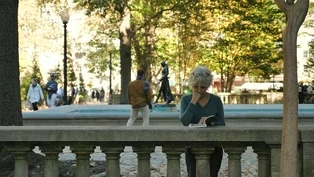
Kate DiCamillo: The Persistence of Reverie
Video has Closed Captions
Clip: S9 Ep2 | 13m 8s | Kate DiCamillo’s change from docile to dogged came with a moment of self-realization. (13m 8s)
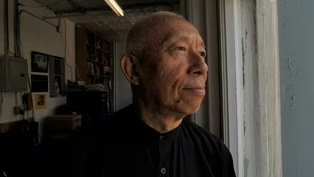
Ping Chong: Intents and Purposes
Video has Closed Captions
Clip: S9 Ep2 | 11m 51s | Theater artist Ping Chong has approached his life’s work with unrelenting intensity. (11m 51s)
Providing Support for PBS.org
Learn Moreabout PBS online sponsorship















Support for PBS provided by:
Articulate is a local public television program presented by PBS39