Prairie Yard & Garden
Valley Tissue Culture Spuds
Season 36 Episode 11 | 28m 45sVideo has Closed Captions
Sandi Aarestad provides high quality seed potato stock.
The average person consumes 120-pounds of potatoes each year. Sandi Aarestad started Valley Tissue Culture, Inc. to advantage of this much demand from the ground up in the heart of the Red River Valley near Halstad, Minnesota, where she provides the highest quality seed potato stock in the nation.
Problems playing video? | Closed Captioning Feedback
Problems playing video? | Closed Captioning Feedback
Prairie Yard & Garden is a local public television program presented by Pioneer PBS
Production sponsorship is provided by Shalom Hill Farm, Heartland Motor Company, North Dakota State University, Friends of Prairie Yard & Garden, and viewers like you.
Support provided by:


Prairie Yard & Garden
Valley Tissue Culture Spuds
Season 36 Episode 11 | 28m 45sVideo has Closed Captions
The average person consumes 120-pounds of potatoes each year. Sandi Aarestad started Valley Tissue Culture, Inc. to advantage of this much demand from the ground up in the heart of the Red River Valley near Halstad, Minnesota, where she provides the highest quality seed potato stock in the nation.
Problems playing video? | Closed Captioning Feedback
How to Watch Prairie Yard & Garden
Prairie Yard & Garden is available to stream on pbs.org and the free PBS App, available on iPhone, Apple TV, Android TV, Android smartphones, Amazon Fire TV, Amazon Fire Tablet, Roku, Samsung Smart TV, and Vizio.
Buy Now

Visit the Prairie Yard & Garden Website
Do you love gardening? Consider becoming a friend of Prairie Yard & Garden to support this show and receive gifts with your contribution. Visit the link below to do so or visit pioneer.org/donate.Providing Support for PBS.org
Learn Moreabout PBS online sponsorship<b>(gentle music)</b> <b>- Humans have been growing</b> <b>potatoes for thousands of years.</b> <b>Growing up, they were</b> <b>a very important part</b> <b>of feeding our family.</b> <b>We always had a great</b> <b>big potato patch</b> <b>that I helped plant,</b> <b>weed and harvest.</b> <b>We'd usually get</b> <b>about 200 pounds,</b> <b>which we stored in</b> <b>our underground cellar</b> <b>and used all winter long.</b> <b>We always kept some</b> <b>of the potatoes</b> <b>to use for seed as</b> <b>the next year's crop.</b> <b>I'm Mary Holm, and</b> <b>let's go meet a lady</b> <b>that produces seed potatoes,</b> <b>but at a whole new level.</b> <b>- [Promoter] Funding for</b> <b>Prairie Yard & Garden</b> <b>is provided by</b> <b>Heartland Motor Company,</b> <b>providing service to Minnesota</b> <b>and the Dakotas</b> <b>for over 30 years,</b> <b>in the heart of truck country.</b> <b>Heartland Motor Company we have</b> <b>your best interest at heart.</b> <b>Farmer's Mutual</b> <b>Telephone Company</b> <b>and Federated</b> <b>Telephone Cooperative</b> <b>proud to be powering Acira,</b> <b>pioneers in bringing</b> <b>state-of-the-art technology</b> <b>to our rural communities.</b> <b>Mark and Margaret Yackel-Juleen</b> <b>in honor of Shalom Hill Farm</b> <b>a nonprofit rural</b> <b>education retreat center</b> <b>in a beautiful prairie setting</b> <b>near Wyndham, Minnesota.</b> <b>And by friends of</b> <b>Prairie Yard & Garden</b> <b>a community of</b> <b>supporters like you</b> <b>who engage in the long-term</b> <b>growth of the series.</b> <b>To become a friend of</b> <b>Prairie Yard & Garden,</b> <b>visit pioneer.org/pyg.</b> <b>(upbeat music)</b> <b>(upbeat music continues)</b> <b>(upbeat music continues)</b> <b>- This past winter I was invited</b> <b>to have coffee with</b> <b>a group of ladies.</b> <b>One of them was telling</b> <b>me about her daughter</b> <b>that grows potatoes</b> <b>in greenhouses.</b> <b>Hmm, I wanted to learn more.</b> <b>Then it just so happens that</b> <b>our Prairie Yard</b> <b>& Garden Executive</b> <b>Producer, Mike Seahawk,</b> <b>is from Barnesville, home</b> <b>of the famous potato days.</b> <b>When he mentioned we should</b> <b>do a show on potatoes,</b> <b>I knew just where to go.</b> <b>I called Sandi Aarstad</b> <b>of Valley Tissue Culture</b> <b>and she agreed to let us</b> <b>come to visit and learn.</b> <b>Welcome.</b> <b>- Thank you, Mary</b> <b>- Tell us about yourself</b> <b>and your background.</b> <b>- Okay, I grew up in</b> <b>Hancock, Minnesota.</b> <b>I went to NDSU, and</b> <b>got a bachelor's degree</b> <b>in Home Ec Ed and extension.</b> <b>I married a potato farmer in '82</b> <b>and I worked in the</b> <b>potato industry with him</b> <b>roguing in the field, picking</b> <b>up seed in the trucks,</b> <b>grain harvest, anything a</b> <b>normal farmer wife would do.</b> <b>The opportunity for this type</b> <b>of a business started in '84.</b> <b>The boys, my husband</b> <b>and his brother,</b> <b>had purchased some seed</b> <b>that had some bacteria in it</b> <b>and we ended up in a lawsuit.</b> <b>So, they knew they</b> <b>had to do something</b> <b>other than purchase seed.</b> <b>They needed to control their</b> <b>own destiny of seed source.</b> <b>So, the University of</b> <b>Minnesota never wanted</b> <b>to have this in the</b> <b>university umbrella</b> <b>or the state controlling it.</b> <b>They felt the private industry</b> <b>was where it should go.</b> <b>And the breeder,</b> <b>Dr.
Florian Lauer,</b> <b>taught me the tissue culture,</b> <b>all the little things.</b> <b>I had to figure out how</b> <b>to commercialize it.</b> <b>So, the first couple years</b> <b>it was just for our own farm.</b> <b>In '86, I had four</b> <b>Minnesota growers</b> <b>that came to me and</b> <b>wanted mini tubers,</b> <b>is what I actually sell.</b> <b>It just evolved from there.</b> <b>'88, we got a business deal</b> <b>with Monsanto, with the GMOs.</b> <b>And then in the late nineties,</b> <b>the kids started</b> <b>finishing college</b> <b>and we built another</b> <b>four greenhouses.</b> <b>We have 13 greenhouses</b> <b>total, but all seed potatoes.</b> <b>Each variety originating</b> <b>from a one test tube</b> <b>and they're tested for</b> <b>16 different pathogens.</b> <b>And this year we actually</b> <b>have 126 different varieties.</b> <b>- [Mary] Sandi, what is</b> <b>meant by tissue culture?</b> <b>- Tissue culture is</b> <b>actually just cloning</b> <b>seed stock or plantlets.</b> <b>So, you take a plantlet and</b> <b>you've got different nodes.</b> <b>Every node shoots another</b> <b>plant or a bud or a leaf</b> <b>or whatever like</b> <b>on a normal plant.</b> <b>So, it's the same with a potato.</b> <b>You take a plantlet</b> <b>and you cut it up into</b> <b>the little sections.</b> <b>You need one meristem</b> <b>per, a meristem is a node,</b> <b>it's that little bud between</b> <b>the leaf and the stem.</b> <b>And you put that</b> <b>on sterile media.</b> <b>And the sterile media</b> <b>it looks like jello.</b> <b>It's just vitamins and like</b> <b>an auger or thickening agent.</b> <b>And it's autoclaved.</b> <b>And we pour it hot in the</b> <b>lab at about 250 degrees</b> <b>and seal it up in</b> <b>our containers.</b> <b>And we put them in the</b> <b>cupboards for two to three days</b> <b>just to see if we have</b> <b>anything grow on it,</b> <b>because it's high in sugar.</b> <b>That's what they feed on.</b> <b>And we don't ever,</b> <b>ever see anything,</b> <b>because of the heat, the process</b> <b>of the way we're doing it</b> <b>and all the</b> <b>containers are clean.</b> <b>So, then we use those and</b> <b>put the plantlets in them.</b> <b>So, the nodes and we</b> <b>put 24 in a container.</b> <b>And if one of those</b> <b>nodes get contaminated,</b> <b>it's typically the technician</b> <b>touches the media with the</b> <b>forceps and you can see it,</b> <b>because the ring of</b> <b>the mold or the fungus</b> <b>will just be a circle</b> <b>around that plant.</b> <b>It's everybody's human,</b> <b>it's not possible.</b> <b>Back about probably eight</b> <b>years ago we tried robots,</b> <b>because technically,</b> <b>everything's sterile.</b> <b>Even if it touched the media,</b> <b>it should be, it was a disaster,</b> <b>and we had to revamp everything.</b> <b>And we went back to humans.</b> <b>The humans could</b> <b>actually cut more.</b> <b>The only thing is the robot</b> <b>could work 24 hours a day,</b> <b>but you still needed a</b> <b>person monitoring the robot</b> <b>and you still couldn't,</b> <b>you know, it's so,</b> <b>it was a good idea.</b> <b>Good to just confirm how we</b> <b>were doing it is the best,</b> <b>and the system is limited</b> <b>on the human part.</b> <b>And that's why you</b> <b>don't see a lot</b> <b>of these businesses</b> <b>like mine in business.</b> <b>It's just too much work.</b> <b>The technician puts 'em</b> <b>in, the 24, we close it up,</b> <b>we label it to whatever it is,</b> <b>and then that group</b> <b>goes on the growth shelf</b> <b>and then it's on a light system.</b> <b>It has probably about</b> <b>14 hours daylight,</b> <b>but the timing of the</b> <b>lights is every two hours,</b> <b>because the lights create heat</b> <b>and that heat creates a problem.</b> <b>And it's not so bad when</b> <b>it's really cold out,</b> <b>but when we have</b> <b>90 degrees outside</b> <b>and we are trying</b> <b>to cool everything,</b> <b>everything freezes up.</b> <b>And then especially, with</b> <b>humidity and everything like</b> <b>so we've put everything on</b> <b>a two hours of</b> <b>light two hours off</b> <b>to keep the heat</b> <b>down in the rooms.</b> <b>Plants at this stage of</b> <b>the tissue culture growing</b> <b>only need 8 to 12 hours</b> <b>of light probably.</b> <b>We maybe push it</b> <b>a little bit more</b> <b>to try to encourage</b> <b>it to grow more.</b> <b>One container makes</b> <b>three containers,</b> <b>which makes nine containers,</b> <b>pretty soon you can't keep up.</b> <b>And with that, we can control</b> <b>the temperature in the room</b> <b>and the light to try to help</b> <b>us keep in step with it.</b> <b>But when we're ready to</b> <b>plant, everybody looks at,</b> <b>oh my God, we have days</b> <b>and weeks we're behind,</b> <b>and we gotta plant too.</b> <b>And you can't just pull</b> <b>somebody off the street and say,</b> <b>oh, come and help,</b> <b>'cause the plants are so little</b> <b>it's a touchy feely thing.</b> <b>And if you break 'em off when</b> <b>you plant them, you lost it.</b> <b>And the idea is to</b> <b>have as close to 100%</b> <b>stand in the green</b> <b>house as possible,</b> <b>'cause that's where</b> <b>your production is.</b> <b>Each plant will only produce</b> <b>three to four tubers.</b> <b>You can never get</b> <b>more than that.</b> <b>And partly, it's because we</b> <b>only use four inches of soil.</b> <b>And partly, is that's what it is</b> <b>with a tissue culture plant.</b> <b>- How do the plants get</b> <b>from the plastic</b> <b>containers out to here?</b> <b>- We put 'em in a box</b> <b>and they're sealed up.</b> <b>So, we'll put 'em in</b> <b>a box, haul 'em in</b> <b>and you put about</b> <b>100 plants in a tub.</b> <b>That's two by four, and they're</b> <b>all about two inches apart.</b> <b>And we're looking for</b> <b>quantity, not size.</b> <b>The farmer wants to plant as</b> <b>whole as seed as possible.</b> <b>So, every variety has</b> <b>their own maturity.</b> <b>Some have 60 days,</b> <b>some have 70, 80, 90.</b> <b>So, we group 'em in anything</b> <b>less than 90, 90 to 100.</b> <b>And then anything over 100 days.</b> <b>You just let 'em do their thing.</b> <b>(gentle music)</b> <b>- Where does our food come from?</b> <b>You may have asked</b> <b>yourself that question</b> <b>while wandering</b> <b>the grocery aisles.</b> <b>Well, where does</b> <b>our food come from?</b> <b>It's an important question,</b> <b>because knowing the</b> <b>origins of your food</b> <b>can help you make</b> <b>better decisions</b> <b>about nutrition and</b> <b>the environment.</b> <b>That's why we see</b> <b>a rising interest</b> <b>in farm to table restaurants</b> <b>and markets in Minnesota.</b> <b>At Streblow Family Farms,</b> <b>the Streblow family</b> <b>is committed to</b> <b>sustainable farming</b> <b>and provides eggs,</b> <b>chicken and other meats</b> <b>to their farm to table business.</b> <b>And today, I'm happy to</b> <b>be with Joshua Streblow</b> <b>who along with his</b> <b>wife Randy and family</b> <b>run the farm and Carl's</b> <b>Bakery in Granite Falls</b> <b>to tell us why they think</b> <b>farm to table options</b> <b>are important for</b> <b>families and nutrition.</b> <b>- Farm to table for</b> <b>us is a way of life.</b> <b>It is a way of tending to</b> <b>what we partake of as a family</b> <b>from our land and</b> <b>then being able</b> <b>to share the excess of that</b> <b>with those whom we live among.</b> <b>- [Mary] It's also</b> <b>more than nutrition.</b> <b>Farm to table products have some</b> <b>environmental</b> <b>advantages as well.</b> <b>- [Joshua] Farm to table</b> <b>encourages small stakeholders</b> <b>or small landholders to</b> <b>carefully tend to and steward</b> <b>the resources that</b> <b>they have in order that</b> <b>they can produce the</b> <b>highest quality production.</b> <b>And because it is intimate,</b> <b>then they can respond to</b> <b>it with the kind of care</b> <b>that only a small</b> <b>stakeholder can do.</b> <b>- [Mary] Another</b> <b>advantage is farm to table</b> <b>supports the local</b> <b>economy and local farmers.</b> <b>- [Joshua] Minnesota's economy</b> <b>is not some giant entity.</b> <b>It is a collection</b> <b>of small inputs</b> <b>that come from individuals</b> <b>and communities.</b> <b>And farm and table</b> <b>as a way of life</b> <b>encourages local production,</b> <b>which means you're</b> <b>sourcing local,</b> <b>you are outputting</b> <b>that same production</b> <b>into that local sphere.</b> <b>And the strength of</b> <b>that provides a strength</b> <b>to the whole of the</b> <b>economy of Minnesota.</b> <b>- So, the next time you're</b> <b>in the Minnesota River Valley</b> <b>stop on in to Carl's</b> <b>Bakery for your selection</b> <b>of locally raised meat and eggs.</b> <b>And while you're at it,</b> <b>pick up some sweet</b> <b>treats with your order.</b> <b>And if you'd like to learn more</b> <b>about farm to table products</b> <b>and local food</b> <b>farms in your area,</b> <b>go to minnesotagrown.com</b> <b>for more information.</b> <b>How many people do you have</b> <b>to do all this planting</b> <b>and harvesting?</b> <b>- Okay, so you wanna</b> <b>big enough crew</b> <b>so you can actually move.</b> <b>If you look at these</b> <b>sections, these rows,</b> <b>we can get maybe get one</b> <b>row done with six people</b> <b>in a 10 hour day,</b> <b>if we're lucky.</b> <b>That's, if the plants are good,</b> <b>the soil is</b> <b>cooperative, everything.</b> <b>The harvest goes a lot quicker,</b> <b>it's probably twice</b> <b>as fast as planting.</b> <b>But if you don't get 'em set,</b> <b>well, you don't have</b> <b>anything to harvest.</b> <b>It looks good, but</b> <b>when we harvest,</b> <b>we'll see how good it is,</b> <b>because if you</b> <b>don't have a plant</b> <b>you aren't gonna get any tubers.</b> <b>- [Mary] Where do you find</b> <b>all the people to help?</b> <b>- We have struggled immensely,</b> <b>like a lot of farmers have</b> <b>with trying to get local help.</b> <b>The younger people</b> <b>are more educated</b> <b>they don't wanna do the</b> <b>manual labor like farming</b> <b>takes the seasonal work.</b> <b>We've switched totally</b> <b>to South African</b> <b>or H2A visa people.</b> <b>I need people that I can train</b> <b>and that'll stick with me</b> <b>through the whole season.</b> <b>I can't have this</b> <b>open door policy.</b> <b>And that's what we've</b> <b>seen with so many people.</b> <b>They'll come and the end</b> <b>of May and want a job,</b> <b>because their unemployment</b> <b>benefits for the other job</b> <b>that they had have run out and</b> <b>now they need to find a job,</b> <b>but they're not a</b> <b>stable workforce.</b> <b>I've tried over the</b> <b>years to try to help</b> <b>maybe just halftime or whatever,</b> <b>but this job is so detailed</b> <b>and meticulous and unforgiving</b> <b>and I don't have enough of me</b> <b>or my daughter to</b> <b>babysit anybody.</b> <b>They have to have the initiative</b> <b>to work and get the stuff done.</b> <b>And with the South</b> <b>Africans we hire all women,</b> <b>because in the lab they're</b> <b>very good with their fingers</b> <b>and detailed and multitasking.</b> <b>There are men out</b> <b>there that can do that.</b> <b>I haven't had the</b> <b>luxury of having any.</b> <b>I've had two in my 38</b> <b>years of doing this.</b> <b>So, generally speaking, if you</b> <b>get the right group it works.</b> <b>So, we work from pretty</b> <b>much 07:00 to 05:00.</b> <b>In the springtime,</b> <b>we'll push till 06:30.</b> <b>Sometimes I cook</b> <b>for them to try to,</b> <b>you know, everybody gets tired,</b> <b>everybody gets Sunday off.</b> <b>We might have to work</b> <b>Saturday to try to catch up.</b> <b>So, Monday isn't quite so bad,</b> <b>but everybody at least</b> <b>gets one day off.</b> <b>But we as owners, you</b> <b>never get a day off</b> <b>until it starts blizzarding</b> <b>and the South African</b> <b>women they speak English</b> <b>and they're very educated.</b> <b>I have teachers, I</b> <b>have lab technicians,</b> <b>I've had dental hygienists,</b> <b>I've had nurses like LPNs.</b> <b>I've had farm girls that have</b> <b>farmed with their father,</b> <b>but the brother's there</b> <b>and they don't see any</b> <b>opportunity for themselves.</b> <b>So they go, you know,</b> <b>they wanna just go out</b> <b>and see what else is out there.</b> <b>They are just wonderful people.</b> <b>Some of them have</b> <b>traveled China, Vietnam,</b> <b>Europe, Six Flags,</b> <b>I mean all over.</b> <b>We've had many come back and</b> <b>the ones that keep coming back,</b> <b>of course, find a spouse here.</b> <b>So, this weekend we are having</b> <b>a wedding over in Bemidji</b> <b>and she's been here</b> <b>for three years.</b> <b>And she's getting married</b> <b>and she'll be leaving,</b> <b>which is understandable,</b> <b>'cause she's gonna</b> <b>go with her husband.</b> <b>They want to go someplace else,</b> <b>but he's from Detroit Lakes.</b> <b>- Okay.</b> <b>- But if we did not have them,</b> <b>we would not be in business.</b> <b>So when COVID hit, we struggled,</b> <b>'cause we had to</b> <b>get these people in.</b> <b>I couldn't, nobody would</b> <b>come and apply for the job.</b> <b>So, I had contracts out, I</b> <b>can't put a contract out,</b> <b>if I'm not gonna be able</b> <b>to service the contract.</b> <b>So, it was hairy for</b> <b>the two, three years</b> <b>that we've had the COVID.</b> <b>Everything is gone</b> <b>quadruple in prices.</b> <b>I'm in a hospital</b> <b>mode of buying things,</b> <b>sterile this sterile that</b> <b>all that kind of stuff.</b> <b>So, I buy everything by the</b> <b>semi or by a large quantity.</b> <b>So, I should be getting a good</b> <b>break, but it's still hard.</b> <b>So, getting them over</b> <b>here was a big trial.</b> <b>But once they got over here</b> <b>then they were pretty stable.</b> <b>But then it was to</b> <b>try to get 'em back.</b> <b>They had to get tested,</b> <b>people would get COVID,</b> <b>then the rest of us</b> <b>and everybody's got their</b> <b>own little sad stories</b> <b>about how they dealt with it</b> <b>and all that kind of stuff.</b> <b>But hopefully, next year</b> <b>we won't have any of that.</b> <b>It would be nice.</b> <b>(gentle music)</b> <b>- I have a question.</b> <b>What steps do I need to take</b> <b>to safely use pesticides?</b> <b>- It makes me very nervous</b> <b>when I see people</b> <b>using pesticides.</b> <b>And I can always tell when</b> <b>they haven't read the label.</b> <b>So, the first step when</b> <b>you're buying a chemical</b> <b>at the garden center or</b> <b>at the hardware store,</b> <b>read the label in its entirety.</b> <b>And I know that</b> <b>some of the labels</b> <b>can be pages and pages long,</b> <b>but it's really there,</b> <b>it's for your safety.</b> <b>It's really important.</b> <b>The label is the law.</b> <b>And if you are obviously,</b> <b>using a chemical</b> <b>against what the label</b> <b>has prescribed it for,</b> <b>you could actually</b> <b>face some fines</b> <b>from your Department of</b> <b>Agriculture or even OSHA,</b> <b>if you're doing it on work time.</b> <b>So, it's very, very important</b> <b>that you know what you're</b> <b>supposed to be doing with it.</b> <b>You need to protect yourself.</b> <b>You still want to</b> <b>wear at a minimum,</b> <b>long sleeve shirt, long</b> <b>pants, shoes and socks</b> <b>and chemical-resistant gloves.</b> <b>And I always like to</b> <b>wear eye protection,</b> <b>because the last thing you want</b> <b>is concentrated chemical</b> <b>splashing back up</b> <b>and hitting you in the eye.</b> <b>You will need to</b> <b>flush your eyes out,</b> <b>if you're doing that</b> <b>for 10, 15 minutes.</b> <b>You will wanna call</b> <b>Poison Control Center,</b> <b>if you are exposed and</b> <b>seek advice from them.</b> <b>You may even wanna</b> <b>go to your doctor</b> <b>and seek further medical advice.</b> <b>Another thing that</b> <b>I like to use is,</b> <b>if it doesn't specify what</b> <b>kind of chemical</b> <b>resistant gloves,</b> <b>you can go for these</b> <b>single-use nitro gloves,</b> <b>they offer excellent protection.</b> <b>But sometimes the label</b> <b>will also require you</b> <b>to wear a thicker glove.</b> <b>At minimum, protect as much</b> <b>of your skin and</b> <b>your eyes as possible</b> <b>and then you can use</b> <b>your chemicals safely.</b> <b>- [Narrator] Ask the</b> <b>Arboretum Experts</b> <b>has been brought to you</b> <b>by the Minnesota Landscape</b> <b>Arboretum in Chaska</b> <b>dedicated to welcoming,</b> <b>informing and inspiring all</b> <b>through outstanding displays,</b> <b>protected natural areas,</b> <b>horticultural research</b> <b>and education.</b> <b>- [Mary] So when do you harvest?</b> <b>- [Sandi] We start harvesting,</b> <b>we'll probably start</b> <b>harvesting next week</b> <b>the first part of August.</b> <b>And in fact, Alex did</b> <b>a little 14 squares,</b> <b>maybe 100 pounds last</b> <b>week, because they died.</b> <b>And they need to get out of</b> <b>the greenhouse once they die</b> <b>otherwise their skin gets ugly.</b> <b>And they also get heated,</b> <b>which breaks the dormancy.</b> <b>And then I have a hard time</b> <b>storing 'em in the cooler.</b> <b>So, next spring you see</b> <b>long sprouts, soft potatoes,</b> <b>not something the farmer wants.</b> <b>So you need full sun to</b> <b>help you push the harvest.</b> <b>- Okay.</b> <b>Where do all of the</b> <b>baby potatoes go?</b> <b>- Okay, we have a big storage.</b> <b>It's about 25 by 25 room.</b> <b>It's high humidity</b> <b>and we control the</b> <b>temperature 38 degrees</b> <b>and we put 'em in pallet boxes,</b> <b>plastic pallet boxes,</b> <b>that are sanitized.</b> <b>So, what we do is we</b> <b>have a little mini grater</b> <b>that we run the</b> <b>potatoes through.</b> <b>Alex harvests, my daughter,</b> <b>harvests the potatoes.</b> <b>She puts 'em in 50 pound bags</b> <b>and then I run 'em</b> <b>through the grater.</b> <b>I size 'em, I look at 'em,</b> <b>I see what they look like.</b> <b>So, when I have to sell 'em</b> <b>or explain to the farmer,</b> <b>if there's issues that</b> <b>maybe the lenticels</b> <b>where the potato</b> <b>actually is breathing.</b> <b>You see when you buy</b> <b>potatoes at the grocery store</b> <b>you see these little</b> <b>dots, that's a lenticel.</b> <b>That's where the potato is</b> <b>breathing in and out the oxygen.</b> <b>So, if that's in wet soil</b> <b>that little black</b> <b>dot gets bigger</b> <b>and that's where the</b> <b>diseases can go in,</b> <b>if the potato's</b> <b>skin doesn't heal,</b> <b>and all that kind of stuff.</b> <b>So, there's little</b> <b>things I look at</b> <b>and I grade the</b> <b>seed before it goes</b> <b>into the shipping</b> <b>boxes to the guys.</b> <b>So, if they have</b> <b>problems or questions,</b> <b>I know exactly what happened.</b> <b>Nobody likes to be</b> <b>dealing with somebody.</b> <b>Oh, I gotta check with</b> <b>somebody else and somebody else</b> <b>and I mean kick the</b> <b>can down the road</b> <b>and never get an answer.</b> <b>So, that's why we wanna be small</b> <b>enough to service everybody</b> <b>and have, you know,</b> <b>some of my growers,</b> <b>I'm going on the third</b> <b>generation, which is fabulous.</b> <b>Grandpa sold, grandpas one of</b> <b>the first ones that</b> <b>bought from me.</b> <b>So, and the young</b> <b>kids could care less,</b> <b>but the sons appreciate it,</b> <b>because they know how</b> <b>hard their dad worked.</b> <b>It's a multi-generation thing</b> <b>to establish a seed farm</b> <b>and there's not enough young</b> <b>people getting into it.</b> <b>Alex, my daughter's one,</b> <b>there's another family</b> <b>up in Carlstead.</b> <b>There's couple in North Dakota</b> <b>but I don't know where</b> <b>this next generation's</b> <b>gonna come for our area for</b> <b>seed to keep the farms going.</b> <b>And like a typical farmer,</b> <b>you don't retire,</b> <b>you keep working.</b> <b>You might not have the</b> <b>heavy jobs anymore,</b> <b>but you could still</b> <b>drive around in a pickup</b> <b>with your arm out the window</b> <b>telling everybody what to do.</b> <b>My dad was great at that.</b> <b>- So, where do you</b> <b>sell your potatoes to?</b> <b>- I sell all over</b> <b>the United States</b> <b>but it's into the</b> <b>seed growing areas.</b> <b>And seed is all in the northern</b> <b>part or high elevation.</b> <b>So, Maine, New</b> <b>York, New Brunswick</b> <b>PEI in Canada, you know all</b> <b>that, Alberta, Saskatchewan.</b> <b>But in the United States,</b> <b>so it's Maine, New York,</b> <b>then you come into Michigan,</b> <b>Wisconsin, Minnesota,</b> <b>North Dakota, Nebraska.</b> <b>So, then Oregon and</b> <b>Washington and in California,</b> <b>Colorado, Utah, New Mexico.</b> <b>You get into Texas and you</b> <b>kind of, it's kind of iffy,</b> <b>because they get too much heat</b> <b>and they do it to</b> <b>play around with it,</b> <b>but they're not real</b> <b>serious seed growers.</b> <b>So, the states that I stated</b> <b>are serious seed producers.</b> <b>- So, my seeds that I</b> <b>buy at the greenhouse</b> <b>or at the grocery</b> <b>store, my for my garden,</b> <b>do they come maybe from you</b> <b>or do they come from the</b> <b>farmers who've bought from you?</b> <b>- They come from the farmers</b> <b>that probably purchase from me.</b> <b>There's two other companies</b> <b>that are commercial</b> <b>that they could come from.</b> <b>One's from Michigan and</b> <b>one's from Nebraska.</b> <b>But most of the</b> <b>stuff that you'd see</b> <b>a seed garden</b> <b>would come from me,</b> <b>because I'm the one that</b> <b>has those varieties.</b> <b>Those other guys are</b> <b>into larger quantities.</b> <b>They're in a different</b> <b>method, not the peat moss,</b> <b>they're into hydroponics,</b> <b>and that's a totally</b> <b>different game.</b> <b>But certain varieties</b> <b>work good for that.</b> <b>This system will do anything</b> <b>from chips to french fries</b> <b>to regular novel</b> <b>heirlooms to anything.</b> <b>Anything is adapted</b> <b>to this system.</b> <b>And that's why I</b> <b>stuck with this.</b> <b>I didn't go with the hydroponics</b> <b>where everybody else</b> <b>did 10 years ago,</b> <b>'cause that was the</b> <b>up and coming thing.</b> <b>It's a philosophy thing really.</b> <b>But so the number of years that</b> <b>you're buying that</b> <b>seed at the nursery</b> <b>is probably four to</b> <b>five years from me.</b> <b>And then it's out of the system.</b> <b>Once it hits what we</b> <b>call just certification,</b> <b>table, grocery store</b> <b>or garden like that,</b> <b>it can't be replanted</b> <b>commercially and you have to,</b> <b>commercial means</b> <b>anything over five acres.</b> <b>So, I'm technically</b> <b>not commercial,</b> <b>'cause I'm under five acres,</b> <b>but I'm totally in a</b> <b>different class too.</b> <b>There's always rules that</b> <b>can be broken or whatever,</b> <b>but my closest competitor</b> <b>is Michigan and Nebraska.</b> <b>- So, do you get a break at all?</b> <b>As far as do the greenhouses,</b> <b>are they heated year round?</b> <b>- Yes.</b> <b>Okay.
So, the reason</b> <b>we grow from May 15th</b> <b>through the harvest</b> <b>by the end of October,</b> <b>is because the day,</b> <b>the light units,</b> <b>the day, the heat,</b> <b>the growing season,</b> <b>but potatoes also</b> <b>need a rest period.</b> <b>The rest period is</b> <b>once you harvest them</b> <b>they go in the cooler for nine</b> <b>months and then they grow.</b> <b>You can't harvest a potato</b> <b>and expect it to be planted</b> <b>and grow right away like beans.</b> <b>So, they need that rest period.</b> <b>And because of the cost of</b> <b>propane heating greenhouse</b> <b>that's all air 40 degrees</b> <b>below zero, it's unsustainable.</b> <b>You can't keep the</b> <b>temperature up.</b> <b>We tried a little lean</b> <b>to on a greenhouse</b> <b>when we first started</b> <b>and all it was the alarms</b> <b>were going off constantly.</b> <b>And it was like, we are</b> <b>never getting any sleep.</b> <b>So, we didn't get a decent crop.</b> <b>We got about a half a crop</b> <b>and the size was not</b> <b>acceptable to make any money.</b> <b>You had numbers,</b> <b>but you didn't have</b> <b>volume to make any money.</b> <b>And then you never</b> <b>got the skin set,</b> <b>because you need some</b> <b>heat and sun to do that.</b> <b>And when you think</b> <b>of how the sun,</b> <b>right now the sun's</b> <b>coming up here,</b> <b>but in January the</b> <b>sun is like over here</b> <b>and it sets over there.</b> <b>There's no movement.</b> <b>So, we never get the full.</b> <b>And potatoes are</b> <b>a full sun crop.</b> <b>They love cooler temperatures,</b> <b>but not that cold that we are,</b> <b>we're just too far north.</b> <b>And you need to, because</b> <b>of the scale we are,</b> <b>universities have</b> <b>their greenhouses</b> <b>running all the time,</b> <b>but they're not in production.</b> <b>It just doesn't work</b> <b>with the biological</b> <b>clock of a potato tour.</b> <b>(gentler music continues)</b> <b>- Sandi, thanks so much</b> <b>for letting us come</b> <b>and learn about</b> <b>Valley Tissue Culture</b> <b>and how you grow all</b> <b>these seed potatoes.</b> <b>- Well, I'm glad</b> <b>you could make it</b> <b>and I'm glad you</b> <b>learned something.</b> <b>So, thanks for coming.</b> <b>- [Promoter] Funding for Prairie</b> <b>Yard & Garden is provided</b> <b>by Heartland Motor Company,</b> <b>providing service to Minnesota</b> <b>and the Dakotas</b> <b>for over 30 years,</b> <b>in the heart of truck country.</b> <b>Heartland Motor Company we</b> <b>have your best interest heart.</b> <b>Farmer's Mutual</b> <b>Telephone Company</b> <b>and Federated</b> <b>Telephone Cooperative</b> <b>proud to be powering Acira.</b> <b>Pioneers in bringing</b> <b>state-of-the-art technology</b> <b>to our rural communities.</b> <b>Mark and Margaret Yackel-Juleen</b> <b>in honor of Shalom Hill Farm</b> <b>a nonprofit rural</b> <b>education retreat center</b> <b>in a beautiful prairie setting</b> <b>near Wyndham, Minnesota.</b> <b>And by friends of</b> <b>Prairie Yard & Garden,</b> <b>a community of</b> <b>supporters like you</b> <b>who engage in the long-term</b> <b>growth of the series.</b> <b>To become a friend of</b> <b>Prairie Yard & Garden,</b> <b>visit pioneer.org/pyg.</b> <b>(gentle upbeat music)</b>
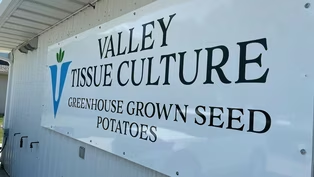
Preview: S36 Ep11 | 29s | Sandi Aarestad provides high quality seed potato stock. (29s)
Providing Support for PBS.org
Learn Moreabout PBS online sponsorship

- Home and How To

Hit the road in a classic car for a tour through Great Britain with two antiques experts.












Support for PBS provided by:
Prairie Yard & Garden is a local public television program presented by Pioneer PBS
Production sponsorship is provided by Shalom Hill Farm, Heartland Motor Company, North Dakota State University, Friends of Prairie Yard & Garden, and viewers like you.