Smart Start: A KET Special Report
Vaughn Nebbitt (Full Interview)
Clip: Episode 1 | 8m 27sVideo has Closed Captions
Full Interview with Vice President of Early Childhood Services Family & Children's Place.
Full Interview with Vaughn Nebbit, Vice President of Early Childhood Services Family & Children's Place.
Problems playing video? | Closed Captioning Feedback
Problems playing video? | Closed Captioning Feedback
Smart Start: A KET Special Report is a local public television program presented by KET
Smart Start: A KET Special Report
Vaughn Nebbitt (Full Interview)
Clip: Episode 1 | 8m 27sVideo has Closed Captions
Full Interview with Vaughn Nebbit, Vice President of Early Childhood Services Family & Children's Place.
Problems playing video? | Closed Captioning Feedback
How to Watch Smart Start: A KET Special Report
Smart Start: A KET Special Report is available to stream on pbs.org and the free PBS App, available on iPhone, Apple TV, Android TV, Android smartphones, Amazon Fire TV, Amazon Fire Tablet, Roku, Samsung Smart TV, and Vizio.
Providing Support for PBS.org
Learn Moreabout PBS online sponsorshipWe have two options in our Head Start program.
We get a little Head start.
The first option is our center based services, which is our typical services that are offered through child care centers throughout the city.
But we also offer a early Head Start program that is home based in which we come out and work with our families on those skills necessary to build those school readiness skills in our children.
So you have had a deeply embedded career in early childhood education.
Tell us where it started and take us along that journey.
Sure.
I, I had started out at the University of Kentucky working to just find my footing as an undergraduate.
Didn't do a very good job of that.
And so being sent home as a struggling student, I started doing Sunday school where I started teaching in pre-K, and that really began my passion for wanting to work with children.
So when I was able to go back to the University of Kentucky to continue my undergraduate studies, I was able to find classes that really piqued my interest and got that fire and that passion going.
Working with child development, especially child psychology and just understanding how children develop and grow over the lifespan of their life cycle.
And so I think for me, that's the real essence of where it all began is in church and and really doing Sunday school and really working with my my younger brother.
I come from a bigger family of five and and where my mother restarted our family with my like my younger brother.
I really filled that role that we needed of having that extra child care at home and having that extra set a pair of hands to help with how.
And where to go from there.
Once I was able to go back to the University of Kentucky and really do my undergraduate work is really working from there with the state of Kentucky as a child Protective Service agent and working to protect the children in our community there.
And then from there on the head, starting working as an educator in the classroom and then growing from there.
So the traditional way of thinking is that a child's education begins in kindergarten, and we know now that that's not true and that that line of thinking can be detrimental to the child.
So how important is learning before they get to kindergarten?
It's extremely important.
Research has shown that the first three years of development are so crucial to that child development as well, especially as it relates to school readiness goals.
And I think that when we look at what we do in early childhood between just the cognitive development as well as the social emotional development, that it shows that the work that we do is so very valuable to the development over the span of a child's development.
Kindergarten readiness is very important.
It's we hear the news about it and read the statistics about it.
So how important is it for kids to go into kindergarten already ready to learn?
It's very important for children to be ready to learn once they get into kindergarten, because research has shown that if they're not prepared, that they have gaps in areas such as literacy, language development, as well as mathematics by the time that they reach middle school.
Tell us the role that Headstart and early Headstart plays in a community.
The role that Headstart and early Headstart plays in the community is very vital because we offer the ability to really provide the resources and the connection that families need to provide that that overall support.
The thing with Headstart is that it's it's comprehensive services.
And so it's not just about the educational development or the cognitive development of the children, but it's also about the support of the family overall and what resources are necessary to ensure that families are able to make that move to self-sufficiency and support their children's lifelong development and learning.
New were a headstart educator, correct?
Yes, Bill.
So tell us how that was.
What lessons did you learn as an educator?
I think the most important lesson that I've learned as an educator, especially in early childhood, is how important it is to relate to children at that age and really get them to get that aha moment to get that lightbulb going, because that's when learning really takes place.
What is something you wished everybody knew about Head Start and Early Head Start?
I think the most important thing for people to know when it comes to Head Start or early Head Start is just the support that is given to the families beyond just the cognitive development.
I think that when we work with our families, we're looking to see if there are things that we need to put into place or resources to put in place to help the mothers, the fathers, the caregivers to meet those needs that they have overall, whether that's in getting food for their family or support with just what they need as far as job skills education.
I think that's the most important thing about Head Start is that it's a comprehensive, holistic approach to supporting the family.
And as a Head Start educator, you got to see some of those big successes.
You told a story about Aisha.
Do you mind to share that with us?
You don't mind sharing it all?
When I was an early, early childhood educator in the classroom, one of the things that we were taught to learn is how to work with our children individually.
I think that's the biggest aspect of of Head Start is individuality and working with children where they are to give them force, get them ready for school.
I had a child in my classroom who was struggling with her behavior.
Her mom and I had several conferences in which she expressed her concern for her daughter and just her ability to to relate to other children in the classroom.
As I worked with this child, Aisha, what we learned was that Aisha was very smart and she just wasn't being challenged in the classroom.
And it came out in her behavior.
And one of the things we always talk about in early childhood, especially in Head Start, is that behavior is a message for something that's going on with the child.
And so she was expressing her concern of not being challenged.
And so I started working with Aisha one on one with her reading skills.
And by the time she left us to get ready for kindergarten, she was testing on a second grade level and reading.
She's tested above her level in math.
And so it was important for me as an educator to be able to find that spark with Aisha and understand what it is that she's going through and be able to tap into that to move her forward.
And that is really going the extra mile as an early childhood educator.
What do people need to know about these teachers pouring so much love and accomplishment into these kids?
The most important aspect of the educators that we work with in Head Start is that they are tasked with doing so much, with so little.
And one of the things that we talk about is the respect factor for our educators with their peers in the school system and being able to make sure that our educators know that they are just as important as those educators in the school system, if not more so, as we talk about how important development is during those first three years of birth.
So if you had your way, what would be different with early childhood educators?
I think the biggest difference for for early childhood educators would be that respect as well as their ability to see that their efforts pays off in the long run.
I think there have been quite a few longitudinal studies in which we show the important effects of early childhood during that those first three years and being able to have our educators in that in our field be able to see that their work means something.
Tell me about the HANDS program here and how that makes a difference for a family.
I think the most exciting part about our Hands program is the fact that we are able to work with families before the children are even born.
I think the most important aspect of that is that we're able to provide those those caregivers, especially the expectant mother, the resources and the information necessary so they can be able to have that that ability to have that healthy birth from the get from the get go.
And I think that the most important aspect of that is the learning that the caregivers are given during that time as we're working with them over that course of their expectancy in the home.
So they can see those things that are necessary once their child is born of how they can work with their children with the things that they have around the house.
Biggest Factors for Kindergarten Readiness
Video has Closed Captions
Clip: Ep1 | 7m 32s | A panel of experts discuss the biggest factors in kindergarten readiness. (7m 32s)
The Challenges of Universal Pre-K
Video has Closed Captions
Clip: Ep1 | 9m 29s | A panel of experts discuss the challenges involved with universal pre-K. (9m 29s)
Child Care Industry's Impact on Kentucky Economy
Video has Closed Captions
Clip: Ep1 | 10m 34s | A panel of experts discuss the child care industry's impact on the Kentucky economy. (10m 34s)
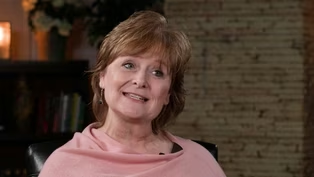
Donna Grigsby, M.D. (Full Interview)
Video has Closed Captions
Clip: Ep1 | 33m 32s | Full Interview with Chief of Division of General Academic Pediatrics. (33m 32s)
Video has Closed Captions
Clip: Ep1 | 6m 54s | A panel of experts discuss the impact of early learning. (6m 54s)
The Importance of Child Care Funding
Video has Closed Captions
Clip: Ep1 | 5m 54s | A panel of experts discuss the importance of child care funding. (5m 54s)
Video has Closed Captions
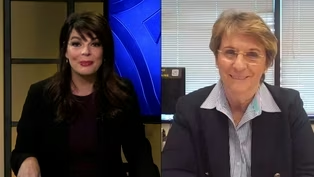
Clip: Ep1 | 27m 48s | Full Interview with Director of Early Childhood Initiative, Bipartisan Policy Center. (27m 48s)
The Need for Child Care Funding
Video has Closed Captions
Clip: Ep1 | 6m 47s | A panel of experts discuss the need for child care funding. (6m 47s)
Setting a Foundation for Learning
Video has Closed Captions
Clip: Ep1 | 8m 47s | A panel of experts discuss how early education sets a foundation for learning. (8m 47s)
The Status of Kentucky's Early Childhood Education Workforce
Video has Closed Captions
Clip: Ep1 | 4m 47s | A panel of experts discuss the status of Kentucky's early childhood education workforce. (4m 47s)
Providing Support for PBS.org
Learn Moreabout PBS online sponsorship














Support for PBS provided by:
Smart Start: A KET Special Report is a local public television program presented by KET