
Vegas PBS STEAM Camp: Solar Electricity and Pitch
Season 2021 Episode 3 | 26m 50sVideo has Closed Captions
Learn how electricity is made from the sun and how instruments make music.
Explore how energy from the sun is collected in solar panels and travels to homes and businesses with help from NV Energy. Then Christopher Vivas from the Las Vegas Philharmonic explains the concept of pitch and how instruments make music. Investigate each topic further through interactive at-home STEAM challenges and book talks with librarians from the Las Vegas-Clark County Library District.
Problems playing video? | Closed Captioning Feedback
Problems playing video? | Closed Captioning Feedback
Vegas PBS STEAM Camp is a local public television program presented by Vegas PBS
Vegas PBS STEAM Camp: Solar Electricity and Pitch
Season 2021 Episode 3 | 26m 50sVideo has Closed Captions
Explore how energy from the sun is collected in solar panels and travels to homes and businesses with help from NV Energy. Then Christopher Vivas from the Las Vegas Philharmonic explains the concept of pitch and how instruments make music. Investigate each topic further through interactive at-home STEAM challenges and book talks with librarians from the Las Vegas-Clark County Library District.
Problems playing video? | Closed Captioning Feedback
How to Watch Vegas PBS STEAM Camp
Vegas PBS STEAM Camp is available to stream on pbs.org and the free PBS App, available on iPhone, Apple TV, Android TV, Android smartphones, Amazon Fire TV, Amazon Fire Tablet, Roku, Samsung Smart TV, and Vizio.
Providing Support for PBS.org
Learn Moreabout PBS online sponsorship♪♪♪ (Jessica Russell) Hi, everyone!
My name is Jessica.
Welcome to the Vegas PBS STEAM Camp science lab.
"STEAM" stands for science, technology, engineering, arts and math.
And while it may sound like these are just subjects we learn in school, it's way more than that.
STEAM helps improve our lives and our community.
Today with the help of experts, we're going to learn about the STEAM that's all around us in Southern Nevada, which you might have never noticed before.
Then I'm going to show you some fun activities you can do at home to learn more.
You'll even have a chance to send us videos or pictures of your results, but more on that later.
To get started, we just need a question to investigate.
(ringing sound) I hear my favorite sound.
It means I'm getting a video call from my friend Carter.
-Hi, Jessica.
-Hey, Carter.
What question do you want to explore on today's show?
-I was wondering, how do we get electricity from the sun?
-Excellent question.
Let's visit my friends at NV Energy to learn more.
♪♪♪ Hey, good morning, everyone.
My name is Patricia Rodriguez.
I'm the director of energy efficiency, demand response and the clean energy programs for NV Energy.
This morning I am here at Silver State Solar.
♪♪♪ Solar energy has been used for years and years and years.
It has been used to dry our clothes.
It has been used to keep us warm.
When I was a little kid just like you in school, I remember having a solar calculator powered by the sun.
♪♪♪ As you see here in Nevada, there's lots and lots of sunshine.
Energy from the sun travels to the Earth and gets to these rectangular solar panels.
There are small little solar cells here where the energy from the sun is converted into electricity.
And here, this is a solar farm where we have lots and lots of these panels that can power a lot of different businesses and homes.
♪♪♪ At NV Energy, we want to serve our customers with 100% clean energy, and it is very efficient to have all of these solar panels here together in a solar farm.
A solar farm like this one can serve tens of thousands of customers.
As of right now, NV Energy has 30 solar farms just like this one serving customers or under construction, and next we're going to show you how energy from these solar panels will go right to your home.
♪♪♪ Hi.
My name is Scott Kaufmann.
I'm grid operations director with NV Energy.
Right above my shoulder here is a great big transmission tower.
♪♪♪ Let's take a minute and talk about what voltage is.
Voltage is the pressure or the force that will push the electrons from the solar plants into town.
At your house, the voltage is about 120 volts.
In our transmission system in Southern Nevada, the highest voltage we use is 500,000 volts.
Imagine transmission lines as the freeways that run throughout Southern Nevada.
If we think about roadways, some roadways can handle a lot of cars and some roadways can only handle a few.
The transmission lines are the highways, the freeways, that can handle a lot of cars all at the same time.
It's much more efficient to transmit electricity from faraway places at very high voltages.
Transmission voltages are too high to safely connect to our houses and businesses, so what we do is we take an off-ramp from that freeway we talked about a minute ago, and we go into a substation.
At that substation, we transform that voltage down to a much more manageable level.
♪♪♪ Hi.
My name is John Kriter, and I'm with NV Energy.
I work in our maintenance and construction group.
Today we're going to talk a little bit about substations similar to the one we have right here behind us.
The substations connect the high-voltage transmission lines to the lower-voltage distribution lines.
At a low level, we're able to safely distribute it to your homes and businesses and schools.
If you've ever seen a substation in your neighborhood, you've probably seen that there's a couple things with it.
There's a big fence around it or a block wall.
There's also many signs around there reminding you to keep out.
The reason why is because the voltage inside of a substation is higher and it's dangerous, and even for trained professionals like myself, it's important for us to wear the proper protective equipment.
Today I'm wearing my hard hat, my safety glasses, my clothing that is fire resistant and safety shoes.
♪♪♪ Hi.
I'm Courtney Martin, and I'm with NV Energy.
The distribution power alliance brings the electricity from the substation either overhead or underground into our residential neighborhoods.
♪♪♪ To make electricity safe for your home, it has to go through a transformer.
Transformers can be overhead on a pole, or they can be like this one sitting on top of the ground.
There's a warning label on here, and that tells us that this is dangerous.
Stay away, don't play or sit on these, and if you ever see a down wire, tell an adult and call 911 and stay away from that down wire.
♪♪♪ When I was a kid just like you, I really enjoyed math and science.
I never knew it was going to lead me to an exciting path into engineering, and now I have an amazing career at NV Energy where I've been for 16 years playing with electronics, solar panels and a lot of big equipment.
-My job at NV Energy is to make sure that the power is always on.
It's important to me to make sure that things are always working correctly, and when things do go wrong, to find the issue.
And I like being able to provide that to you.
Thanks, NV Energy!
Let's review what we learned.
Energy from the sun is collected in solar panels.
Solar panels have small solar cells where the sun's energy is converted to electricity.
Solar farms have many solar panels together in one place.
Electricity travels from solar farms to substations through high-voltage transmission lines.
Next, substations connect the transmission lines to the lower-voltage distribution lines.
Then distribution lines take the electricity from the substation to our neighborhoods.
Transformers lower the voltage of electricity to a safe level to distribute to our homes and businesses.
Thanks, NV Energy!
Now, I wonder if the sun's energy is strong enough to provide electricity to my home, is it strong enough to cook a s'more?
To figure this out, you can build a simple solar oven out of everyday items.
To do this, you will need a pizza box, a pencil, a ruler, a few sheets of black paper, scissors, foil, plastic wrap, strong tape, oven mitts and s'more ingredients like graham crackers, large marshmallows and chocolate squares.
You will also need some newspaper.
I collected grocery ads from my mailbox.
To make your solar oven, clean out the pizza box to remove any cheese, crumbs or sauce that might be inside.
Use a ruler to draw a square on the top of the box.
The sides of the square should be about one inch away from the edge of the box.
Ask a grown-up to help you cut three sides of the square.
Don't cut the side that's closest to where the lid connects to the box.
This is where you'll fold a crease to make a flap.
Next, line the bottom of the flap with a sheet of aluminum foil.
Remember to keep the shiny side out.
Keep the foil as smooth as possible and secure it in place with tape.
I folded the edges of the foil over the top of the flap so it would be easier to take.
Open the box and cover the square that your grown-up cut out with a sheet of plastic wrap.
Then use strong tape to completely seal each edge of the plastic wrap to the lid.
Make sure there's no holes in the plastic wrap.
Then repeat and tape a second layer of plastic wrap over the first.
Next, line the bottom of the box with black construction paper.
Then roll up newspaper ads so they fit perfectly inside all four edges of the box with the lid closed.
I taped each roll to keep them from unraveling.
Now prepare your s'more.
Cut a piece of foil and put it in the middle of your solar oven to capture any gooeyness that might drip down.
Then assemble your s'more by layering marshmallows on top of the graham cracker.
Top the marshmallows with a square of chocolate and then another graham cracker.
Close the lid and then use a pencil to prop the flap open at a 90-degree angle.
A 90-degree angle makes the shape of the letter "L" when you look at it from the side.
Then tape the top and bottom of the pencil to the box to keep it secure.
Now you're ready to test your oven.
Think about how to position your solar oven outside.
Should the foil face toward or away from the sun?
And what time of day do you think will be best to cook your s'more?
Look at your s'more every 10 minutes and take notes about what you see.
I think the perfect s'more is when the marshmallow and the chocolate are soft and they just start to melt.
Your oven is going to get hot, so be sure to use oven mitts when removing your s'more.
How long did it take to cook your perfect s'more?
Then celebrate your hard work by eating your s'more and think about how your solar oven works.
What was the purpose of the foil flap?
Why did you add plastic wrap to the opening?
And what does the black paper and newspaper do?
Can you figure out which part absorbs the sun's energy just like a solar panel?
Clean your solar oven and try the experiment again.
How does using it at a different time or location affect your results?
Now let's check in with Carter who's doing this activity at home right now.
-This is my solar oven.
It's made out of electrical tape, which sucks in the sunlight and tin foil, which reflects the sunlight.
I'm going to prop it up with a pencil, and I'm going to go outside.
It's like 100 degrees, and I'm going to go test it out.
♪♪♪ It was so hot outside that the chocolate melted in less than a minute.
♪♪♪ Next time I'm going to add more insulation so it cooks faster.
-Thanks for sharing your work.
An important part of being a scientist is sharing your work with others.
Visit our website at vegaspbs.org/steamcamp to submit videos and pictures of your results to us at Vegas PBS with your grown-up's permission, or ask your grown-up to share it with us on social media by tagging @vegaspbs.
Keep in mind if you're sharing a video, make sure we can see what you're doing and hear what you're saying, and try to keep that video to one minute or less.
We will post some of your projects on our website, and if your project is selected, we will send you this amazing PBS Kids bag and a new book.
When you visit our website, you'll also find detailed instructions for the solar oven and PBS Kids shows and activities to learn more about solar energy.
Speaking of learning more, one of the best ways to learn more about a topic is to check out a book.
Let's visit the library to discover some great reads to help you learn more about this topic.
♪♪♪ (Shana Harrington) Hi, kids!
I heard you learned a lot about solar energy today, and I thought I'd share some really cool books.
This book is by Alan Drummond, and it's called Solar Story.
It is about the largest solar energy field in the world, and this is in a place called Morocco and it's really-- this country, it's right here.
They built this solar field to help give people jobs and make electricity from sunshine, which you learned all about today.
You can learn a little bit more about this really amazing project that they did in Morocco and how it creates sustainability and creates jobs for all of the community.
Now, if you want to learn a little bit more about the science behind solar energy, I have another book for you.
That book is called Solar Power.
This is called Green Planet Solar Power.
This book is really cool because it talks about how we can fight global warming, but what I really like about this book is it's also got really neat activities and crafts that you can do.
You can find these books at any one of our fabulous Las Vegas-Clark County Library District branches.
Thank you so much, and see you soon!
♪♪♪ Welcome back to the Vegas PBS STEAM Camp science lab.
We've already learned so much today, and we still have time left to investigate another question.
(ringing sound) Here's another caller.
It's my friend Royce.
Hey, Royce.
-Hi, Jessica.
-Do you have a question I can help answer on today's show?
-I was wondering, how do instruments make music?
-That's a great question, and luckily I know a musician who works for the Las Vegas Philharmonic who can help explain.
Let's go talk to him.
(applause) ♪♪♪ Hey, my name is Christopher Vivas, music specialist with the Las Vegas Philharmonic, and I'm here with my viola to talk to you guys about "pitch."
So what you just heard me play was Elgar's "Salut d'Amour."
The way I was able to play that was through the vibrations in my viola creating a different series of pitches to make a piece.
The science of how my viola creates those vibrations is I take this stick, otherwise known as the bow, and I run it across my strings all through friction.
The strings are pulled, creating vibrations that travel through my viola.
They exponentially grow-grow-grow and come out these S-shaped holes in the front of my viola.
Now, you're probably wondering well, that's the science of how a viola works, but what about all the different pitches that I played?
Pitches have different lowness and highnesses because of how the waves travel to your ear.
The higher the string... ♪♪♪ The tighter or faster the pitches travel.
The lower the pitch, the wider and slower those waves travel to your ear.
♪♪♪ Pitch is the difference between a high and low sound traveling to your ear by means of a wave, and though these waves are invisible, you still can hear them.
So this is a bit of a step up from my viola.
This is a bass drum, and this huge membrane, when you strike it works just like my viola.
The vibrations of the face of the drum, travel through the hollow body and bounce back and forth, creating those invisible waves that travel to your ear.
But though they may be invisible, let's actually take a look at how they work.
Now, I may have said that those sound waves that travel to your ear are invisible, but I have a neat way to actually see them in action with the help of some confetti.
With all this confetti spread around, we should be able to see it blow out in the direction of the sound waves traveling.
Let's take a look.
♪♪♪ Do we see the confetti dancing, everyone?
What you guys are seeing is the vibrations and the sound waves across the membrane of the drum.
Next we're on to the pan flute, a great example of how pitch is done.
So as we can see, we have several different sizes of tubes.
As I blow wind across these different-size tubes... (whistling wind sound) The different lengths of tube make the air I blow in travel at different speeds.
Those lower speeds create lower pitches, and those higher speeds create those higher pitches.
Now, I may have shown you all these different kinds of instruments today, but would you know that you actually have the perfect instrument to practice pitch with you all the time, and that's your voice.
With your voice when you talk, in your throat you're actually tightening and loosening your vocal folds, creating different pitches when you talk.
We don't just talk like this, do we?
And while we can't dive into our throat to see our vocal folds work, we can use the example of a balloon to help demonstrate how they move.
Imagine you take yourself a balloon full of air acting like your lungs.
As we pinch the top of the balloon, we only let so much air out, releasing a higher pitch.
The wider you spread the neck of the balloon, the lower the pitch will be created.
And these are the same mechanics as in your vocal folds.
Our lungs are just like that balloon, and we release said air in the balloon when we talk or sing.
For example, I can create quite a dynamic range using just my voice going all the way up to here and even all the way down to here as I sing.
Thank you guys for joining me today at the Charleston Heights Arts Center and listening to me spin some pitches at you.
But if you don't mind, I got to get back to correcting some of my own pitches.
(applause) ♪♪♪ I've been playing viola for 12 years now, and I just love doing it.
Today I showed you a bunch of different ways that you can make music.
Viola, drums and pan flute aren't the only ways to do so-- wind instruments to brass to even more strings.
We need more violists.
Pick up an instrument today, guys.
Thanks, Christopher.
Today we learned "pitch" is how high or low a sound is.
Pitches travel through invisible sound waves to your ear.
High pitches produce tighter waves, and low pitches produce wider waves.
All musical instruments create sound by making vibrations or back and forth movement.
Drawing a bow across a viola's strings makes them vibrate; hitting a drum makes its tight membrane vibrate, and blowing across a pan flute makes the air vibrate inside its different-size tubes.
You can practice pitch with your voice.
It's the perfect instrument you have with you all the time.
Now it's our turn to think like engineers and build our own instruments.
In order to do this, we are going to use the engineering design process.
All engineers start their work by coming up with a goal or problem they want to solve.
Your challenge will be to design a musical instrument that plays more than one pitch.
To do this, you will need to gather recyclable items from around your house.
You might want to use things like boxes, straws, rubber bands, paper towel rolls, empty cans or other empty containers.
You might also need tape, scissors and glue, but these aren't the only things you can use.
Be creative and see what else you can find inside and outside of your home.
Then use your imagination to make a plan.
How are you going to use the items you collected in your design?
Are you going to make a stringed instrument like a viola or maybe a percussion instrument like a drum?
Maybe you'll blow on your instrument like the pan flute.
Your instrument could even be all three.
Draw a sketch of your design before you start and share it with a friend or grown-up.
The next step is to create your instrument.
Take your time and test the pieces as you go.
Testing your project as you go is a good way to save time and fix mistakes if you realize something isn't working.
After you've created your instrument, play it and see what happens.
Does it play a high pitch and a low pitch?
If so, great job.
Maybe you can add something to your design to make it play even more pitches.
Try it and see what happens.
But if you tested your instrument and it didn't make the sound or pitches you wanted, it's okay.
Think about what you can do to improve your design and test it again.
Now let's check in with Royce who is doing this activity at home right now.
-This is my diagram and this is my drum set.
First, I drew-- at first I gathered all my drum stuff, then I drew this diagram without the rubber bands of how my drum set would go, and when I made it, I made them all with different sounds.
These are high sounds, and this is a low sound.
This one is higher, and this one is lower.
This one is higher because it has a lid, and this one is lower because it doesn't have a lid.
(drumming sounds) And that's my drum set.
Goodbye!
-Thanks for sharing your creative instruments.
It's a really important step in the engineering design process, and kids, I want you to share your instruments with me.
Submit a picture or video of you playing your homemade instrument to me through our website at vegaspbs.org/steamcamp with your grown-up's permission, or ask your grown-up to share it with us on social media by tagging @vegaspbs.
And remember if you're submitting a video, make sure we can see what you're doing and hear what you're saying.
Also, try to keep your videos to one minute or less.
We will select some projects for our website, and if we choose yours, you get this awesome PBS Kids bag and a new book.
When you visit our website, you'll also find the steps of the engineering design process that you will follow to build your instruments and links to PBS Kids shows and activities to learn more about the science of sound.
Now I'm going to send it back to the library one more time to discover books you can check out to learn more about this topic.
♪♪♪ Hi, everybody.
I'm Mr. Joey from Spring Valley Library, and I'm here to talk to you about another musical instrument.
Earlier you heard a bit about the viola, and I have with me here a guitar, which is a little like a viola.
It's a big piece of wood with some strings on it and a big hole in the middle for sound to come out of.
With one hand you can pluck the strings which causes them to vibrate and creates notes, and with the other hand, you can press down on the strings up here and change the pitch that the strings create.
You can also play all six strings at the same time to make chords, which are great for playing songs.
I like to make songs up about books that I read at the library like one I found today.
This book is called White Rabbit's Color Book.
It's about a white rabbit who finds three buckets of paint.
The rabbit hops into the blue bucket and comes out a blue rabbit.
Then the blue rabbit hops into the red bucket of paint and comes out-- not a red rabbit but a purple rabbit, because blue and red mixed together make purple.
I wanted an easier way to remember this, so I wrote a song about it.
It goes like this.
♪♪♪ ♪ I had some blue paint, ♪ ♪ and I had some red paint, ♪ ♪ and I thought I'd mix them up ♪ ♪ just for kicks.
♪ ♪ And so the red and blue ♪ ♪ turned into something new, yeah.
♪ ♪ What do you think they made ♪ ♪ when they were mixed?
♪ ♪ They made purple, the color of a grape, ♪ ♪ and I thought wow, the colors ♪ ♪ in this world are so great.
♪ ♪ They make me want to move around ♪ ♪ and celebrate!
♪ ♪ So let's walk around in a circle ♪ ♪ because blue and red make purple.
♪ ♪ Bounce like you're on a trampoline, ♪ ♪ because yellow and blue make green.
♪ ♪ Swing like you're a door hinge, ♪ ♪ cuz yellow and red make orange.
♪ ♪ Now arms to the sky and cross them ♪ ♪ because mixing colors is awesome!
♪ ♪♪♪
Video has Closed Captions
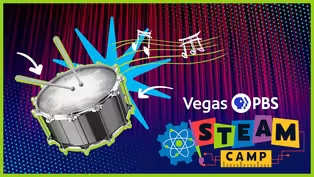
Clip: S2021 Ep3 | 5m 2s | Christopher Vivas from the LV Philharmonic explains the concept of pitch and how instrumen (5m 2s)
Video has Closed Captions
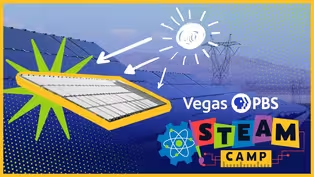
Clip: S2021 Ep3 | 4m 30s | Energy from the sun is collected in solar panels and travels to homes and businesses. (4m 30s)
Providing Support for PBS.org
Learn Moreabout PBS online sponsorship
- Science and Nature

Explore scientific discoveries on television's most acclaimed science documentary series.

- Science and Nature

Capturing the splendor of the natural world, from the African plains to the Antarctic ice.










Support for PBS provided by:
Vegas PBS STEAM Camp is a local public television program presented by Vegas PBS