Virginia Currents
Vet Center Readjustment Counseling
Clip: Season 29 Episode 6 | 14m 19sVideo has Closed Captions
Virginia Currents features the life-changing therapy of Richmond Vet Center on veterans.
Find out how the Vet Center’s readjustment counseling services helped save the lives of two veterans trying to adapt to civilian life after serving in combat zones. One veteran served in Vietnam & then rose in the ranks in Richmond Police Dept. The other veteran served in Iraq & Afghanistan. They both talk about how difficult it is to relate to their families & every-day living after coming back.
Problems playing video? | Closed Captioning Feedback
Problems playing video? | Closed Captioning Feedback
Virginia Currents is a local public television program presented by VPM
Virginia Currents
Vet Center Readjustment Counseling
Clip: Season 29 Episode 6 | 14m 19sVideo has Closed Captions
Find out how the Vet Center’s readjustment counseling services helped save the lives of two veterans trying to adapt to civilian life after serving in combat zones. One veteran served in Vietnam & then rose in the ranks in Richmond Police Dept. The other veteran served in Iraq & Afghanistan. They both talk about how difficult it is to relate to their families & every-day living after coming back.
Problems playing video? | Closed Captioning Feedback
Where to Watch Virginia Currents
Virginia Currents is available to stream on pbs.org and the PBS app.
Providing Support for PBS.org
Learn Moreabout PBS online sponsorship♪ For the land of the free ♪ And the home of the brave (The Supremes singing "Reflections") >>The Readjustment Counseling Service Vet Center program started 40 years ago.
So today is a day of celebration and reflection, a time of looking to the future and opportunities that lay ahead, as we serve those who have answered the call.
As we continue to help in binding the wounds, the unseen wounds, of war.
>>Days like today make everything worth it, that you went through.
Somebody celebrating.
>>We thank you for your service, Marine.
>>So my very first deployment was to Iraq.
We were the second rotation of troops, boots on ground after 9/11.
My second deployment, we traveled to Afghanistan in 2011.
>>I served in the United States Army from July of 1969 until January of 1972.
I served 12 months in the Republic of South Vietnam.
The unit I was assigned to was Company B, 39th Combat Engineers.
Our primary responsibility was to do, to build things, destroy things, and also to do what we call mine sweeps along the major highway, which was called QL1.
Some things that you see in Vietnam, in any war, it never goes away.
Back at LZ Dottie, I remember this truck that pulled in, it was almost like it was a dump truck.
The guy came in, he asked us for diesel fuel.
When you pulled the top up you saw the bodies of about six people in the back of the truck, and they were covered in maggots.
And he was asked to get the people off of the highway, and he was going to take the diesel fuel and he was going to burn the bodies, that's what he was going to do.
So things like that, when you see it you don't forget it.
Or when you see, when your friends get shot, Or maybe one of your friends get killed, you don't forget about that.
It never goes away.
Me being at the age of 19, I was old enough to carry a gun, I was old enough to carry a hand grenade.
I was old enough to carry an M-60 machine gun.
But I wasn't old enough to buy a beer.
We were too young for that, but we were old enough to go off to fight someone else's children, because the people that we encountered in Vietnam was basically the same age that we were, or younger.
We were children fighting children.
When the troops came home from places like Germany, they were in Germany, they came home from Japan, it was always someone there to welcome them home, to say thank you for your service.
Us Vietnam veterans, we didn't get that.
There was no one there to tell us that, 'cause we went over as individuals, we came back as individuals, no one told us that, you know, thank you for your service.
And then on top of that people meeting you at the airport and telling you, calling you a baby killer.
And I thought I was doing the right thing.
I thought I was defending this country, you know, because we didn't hear about it on the Armed Forces Radio station about what was taking place back here in the United States.
I was a member of the hostage negotiation team, and at one time I headed the detective division for the Richmond Police Department.
And then I also headed the organized crime section for the Richmond Police Department.
The reason why I went to the Police Department was basically because I liked the idea of having the structure.
It was almost was like, in the military we would say that, you know, we was like a band of brothers and sisters, it was the same thing within the police department.
When I came to this place, I would tell people that I was a broken person.
Even though I had a successful career, as veterans we learn how to hide things that we don't want other people to see.
And because we're afraid that if other people see it, it'll be a sign of weakness, but that's not really true.
It takes a brave person to walk in this building and say "I need help."
During the era of Vietnam, there was no such thing as PTSD or post-traumatic stress disorder.
You either had battle fatigue, or you had shell shock, or something like that.
So you were told, just basically, you'll be okay, deal with it.
And that's the reason why a lot of veterans, particularly from my era, will not walk into a place like this right here, because they'll be labeled as being weak.
When someone would tell me, I'd say "look, something is not clicking with you.
Something is not right."
I always put it off and said, "well, it's them.
It's not me."
And the day when I walked into the Vet Center, I realized it was not them, that was in fact me.
>>How many years later was that?
>>To walk into the Vet Center?
>>Mm-hmm.
>>About 40-some years later.
And that's not unusual for us Vietnam veterans.
But the very first time that I walked into this building, I realized that I was home.
The first thing you have to do when we come in, we have to, what we call checking in.
You have to explain to another veteran how your week went.
If something went wrong, if something was bad, you tell them what was bad.
And a lot of times before Ms.
Hall walk into the room, we're able to discuss that among the nine or eleven of us, to say, try this.
And then if we can't help the person solve it, then when she walk into the room, then the person would bring it up, and then she will say, try this, this, and this.
I refer to it as a toolbox.
You know, within that toolbox, is things that, inside that toolbox, that when something is bothering me, I know how to reach in that toolbox and pull something out.
I'm smart enough to know that if I'm really having a bad moment, call one of the other guys that's in my group, and run something past him, and if something is bothering them then they call me and run it past me.
And if that don't, that not work, then call Ms.
Hall.
But we have each others' back.
It's very valuable.
It's good to have somebody in that group who understand exactly what you're talking about, that comes and sometimes we use language that, if you were sitting in there, you wouldn't have a clue what we were talking about.
And we can sit there, and we can talk about things, and we may use certain words that we picked up in Vietnam, we all know what those words mean.
They will ask you when you come here, or when you go to VA, have you ever had suicidal thoughts.
Most veterans, they're going to be honest with you, they'll tell you that they have, because just about all of us have thought about it, at some point in our life.
But it's places like the Vet Center, and the VA, and so forth, that I wish more veterans would take advantage of, because when you look at what's taking place within this country today, an average of 20 vets a day committing suicide, that come out to be over 7,000 veterans a year are committing suicide.
That's an astronomical number.
If they don't want to go to the VA hospital, go to the Vet Center and ask for help.
I did it, and if I can do it, they can do it too.
>>Thank you for your service.
>>Okay, thank you.
>>We were all we had.
Day in and day out for 18 months.
So we had, I think, 45 to 50 females that our commander was responsible for.
We stepped up and did what was required of us.
So, I'm not gonna say that it wasn't scary, but because you were going over with a group of people that you had such a strong sense of family, a sense of protection, it was almost a blanket of comfort.
If you had to lay down your life for your battle buddy, then you knew that the person that was standing with you was prepared to do that.
And I was prepared to do that as well.
Do convoys to different camps for various reasons, usually if they are available, there's an explosive, an EOD team, that goes out in front of you, they go out and sweep in front of you, and they're looking for, back then we had a big issue with the daisy chain roadside bombings.
So you gonna thank the Lord that we had those people with us, that were going in front, because if not, you were just relying on your natural eye to spot piece of paper or bottles, something that's out of place, a rock.
So that changes you, right, when you come back home, you can't look at life through the same lens that you did before you left.
It's the high of being home, but then it becomes overwhelming 'cause everybody wants to come see you, they want you to come and visit them, and all you really want is time to yourself, like a moment to decompress.
It's just not as easy as, you know, snapping your finger and things go back to normal.
Everybody comes back from deployment different.
None of us come back the same.
You developed, you saw more, you experienced more.
I wanted to be more isolated, more alone, less going out and doing stuff with my friends.
You just really detach from having normal feelings or normal understandings of what other people may be going through, because, you know, for nine months it was just about you, the mission, your battle buddies, and what was going on around you.
It was just surviving, right?
And then you come home and now you have to deal with life again.
You gotta deal with bills, you gotta deal with arguments amongst family members, that you may think are petty.
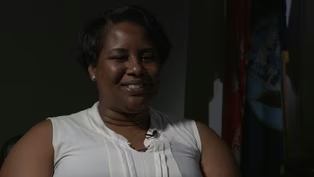
So I was diagnosed with post-traumatic stress disorder.
This week I was walking to get coffee with my co-workers, and there was a brown paper bag sitting on the sidewalk, top up, and they were walking and talking, and I'm not listening to what they're saying any more, because I wanna know what is in this brown bag, who put that there and why.
It just makes your mind race through so many different possibilities.
When I got out of the military, I got out of the military in 2016.
So I had worn a uniform from the time that I was 17, till the time that I was 33.
So I have no clue who I am, outside of my uniform.
When I put my uniform on every day, I had a purpose, I had a meaning in life, right?
I was giving back to society and that made me feel good.
When I couldn't do that any more that hurt me.
So Jesu, Ms.
Hack, helped me rebuild myself.
She said, "hey, you know what?
You are ... still a soldier.
You serving a different mission."
So yeah, the transition is not easy.
It's nowhere near as easy as you would think it would be, like you're so programmed, you're so accustomed to ... routines.
You never think about suicide.
If you would have asked me in 2011, would you ever think, I'm like "that is the stupidest thing ever, I don't know why people would want to kill themselves."
You don't understand it until it happens to you.
It's not a, it's a scary, you're scared of yourself, right?
Because it's a spontaneous thing.
So it's tricky for my husband because he works in mental health.
I didn't feel like nothing was wrong with me.
The Freedom Support Center.
And I called them that day, not to get help from them, I called them cursing her out because I want her to tell my husband to give me my gun.
Yeah, and she says "no, I'm not doing it."
And I said "how you can't tell me I can't take my own life.
It's my life, I do what I wanna do with it.
Tell him to give me my gun."
She said "you need to go and check yourself into the hospital."
Got some medications that work with me, and you know, help balance me out.
The Vet Center.
Came for individual therapy, as well as group therapy.
It restored my faith, my confidence in myself.
It helped me deal with my anger.
'Cause you know, we put our spouses through a lot.
But when we come here, and we've done marriage counseling, here you can do PTSD, marriage counseling.
I could tell 'em how I feel, and why I felt that way.
You're able to identify with your feelings, take ownership of your feelings, and then present yourself better to people, when you have been, when you feel emotionally vulnerable.
Every Monday, we get together, all of the female veterans.
We have our room full of love and we all get to share.
We get to connect with each other and we get to say "Sister, you are not by yourself.
You are not alone.
The same thing happened to me this week."
It's a no-judgment zone.
It's validation for you, you're not losing your mind.
These feelings are real.
You can have your relapse days, all right?
But you can deal with them a lot better, when you got a foundation.
On your relapse days you deal with it, and you know, tomorrow it might be better or it might not, but eventually you'll get back to your happy place if you try.
Gotta try.
The Vet Center.
It helped me redefine myself.
Helped me understand who I am outside of my uniform.
Goodness, yeah, definitely saved my life.
>>Thank you for your service.
>>Thank you.
>>The 300 Vet Centers and 80 Mobile Vet Centers serve combat veterans, active duty service members, family members, and veterans who encountered military sexual trauma.
For the full interviews of today's feature, go to vpm.org/virginiacurrents, and click on Currents Uncut.
(flag flapping in the wind)
Currents Uncut: The Vision Behind “Great Force” Exhibit
Video has Closed Captions
Clip: S29 Ep6 | 25m 21s | Learn how the riveting exhibition “Great Force” came to fruition. (25m 21s)
“Great Force” at The Institute for Contemporary Art
Video has Closed Captions
Clip: S29 Ep6 | 2m 49s | Virginia Currents explores “Great Force” at the VCU Institute for Contemporary Art (2m 49s)
Tapping: An Alternative Form Of Therapy
Video has Closed Captions
Clip: S29 Ep6 | 4m 11s | Virginia Currents features tapping - an alternative therapy for physical & emotional pain. (4m 11s)
Currents Uncut: Fighting High Military Suicide Rates
Video has Closed Captions
Clip: S29 Ep6 | 25m 55s | Watch a Currents Uncut interview with Vietnam Veteran Walter Allmon. (25m 55s)
Currents Uncut: Life Outside The Military Uniform
Video has Closed Captions
Clip: S29 Ep6 | 23m 15s | An interview with veteran on life-changing therapy of Richmond Vet Center. (23m 15s)
Providing Support for PBS.org
Learn Moreabout PBS online sponsorship New Episode
 New Episode
- News and Public Affairs

Top journalists deliver compelling original analysis of the hour's headlines.

 New Episode


 New Episode

 New Episode



Support for PBS provided by:
Virginia Currents is a local public television program presented by VPM