
Vietnam: Looking for Home
Clip: Season 2003 | 18m 7sVideo has Closed Captions
Decades after the Vietnam War, journalist Nguyen Qui Duc traveled to his homeland.
Decades ago, the Vietnam War shattered Nguyen Qui Duc’s childhood. Over the years, Nguyen, who came to the U.S. as a refugee, returned to his homeland as a journalist, reporting on the country’s culture and establishing connections with writers and artists living there.
Problems playing video? | Closed Captioning Feedback
Problems playing video? | Closed Captioning Feedback
Funding for FRONTLINE is provided through the support of PBS viewers and by the Corporation for Public Broadcasting. Major funding for FRONTLINE is provided by the Ford Foundation. Additional funding...
Vietnam: Looking for Home
Clip: Season 2003 | 18m 7sVideo has Closed Captions
Decades ago, the Vietnam War shattered Nguyen Qui Duc’s childhood. Over the years, Nguyen, who came to the U.S. as a refugee, returned to his homeland as a journalist, reporting on the country’s culture and establishing connections with writers and artists living there.
Problems playing video? | Closed Captioning Feedback
Where to Watch FRONTLINE
FRONTLINE is available to stream on pbs.org and the PBS app.
Inside the Scam
Follow scams as they unfold — and examine tactics used to manipulate victims. A collaboration between FRONTLINE and The Associated Press.Providing Support for PBS.org
Learn Moreabout PBS online sponsorship♪ ♪ (engines rumbling) >> NGUYEN QUI DUC: It's been a long while.
I've traveled halfway around the world, from San Francisco to this old city of Hue.
Relatives have all left, but still I come back, looking for home, for a bit of myself, for a country that exists always in my memory.
(speaking Vietnamese) The new owner of this house has made some changes.
When my grandfather built it, the gate was off to one side.
The new owner has kept an altar for my grandparents for many years.
We Vietnamese always stay connected to the past-- customs, history, the dead.
Just outside of town, I've found my grandparents' graves.
I'm not exactly a traditional man, but as you grow older, some things become important.
I light the incense and bow, hoping they know I'm back, that I carry memories.
(distant explosions echo) 35 years ago, Communist troops attacked the city during Tet, the lunar new year of 1968.
South Vietnamese and American troops fought for a month to regain the town, house by house, street by street.
Thousands of people were killed, scores of families destroyed.
Hundreds went missing; my father amongst them.
He had been a regional governor.
The Vietcong took him to the north and kept him as a political prisoner.
I was ten when he left, 26 when he finally was able to join me in the States.
(birds chirping) It's quiet in Hue now.
I've adopted the owner of my grandparents' house as an uncle.
The old historian takes me to visit a royal tomb.
I'm the tourist, he the guide.
We couldn't help talking about the war and where Vietnam is now.
>> (speaking Vietnamese) >> DUC: I am amazed to hear these words from a man who once went north to join the revolution and fought as a Vietcong soldier.
>> (speaking Vietnamese) (drumming) (drumming continues) >> DUC: This is where my mother went to school.
Some things haven't changed.
Her days, too, started with the same drumbeat.
>> (speaking Vietnamese) >> DUC: 60% of the population in Vietnam is under 30.
That's a whole lot of people who weren't even born when the fighting happened.
This school has always emphasized tradition, but the principal is worried about the kids.
The outside world is a few keystrokes away on the internet.
>> (speaking Vietnamese) >> DUC: The principal later asks me to be cautious with what gets aired.
Our conversation reminds me of how I could never bear the conservative attitude here.
And now, there are always the watchful eyes of the local Communist authorities.
(indistinct chatter) >> (speaking Vietnamese) >> DUC: Vietnam, one of the few Communist dinosaurs left in the world, has begun to change.
(quacking) The Communist party gave up on the Soviet-style economy more than a decade ago.
A policy called renovation opened the door to capitalism.
Hue, though, hangs onto its old ways.
(passing traffic hums) (woman playing stringed instrument) Out on the river, musicians play ancient songs about the eternal beauty of Hue.
I'm mesmerized by it, but I'm awkward.
The whole experience makes me feel like a tourist.
(continues playing instrument) Leaving the slow pace of Hue, I go where the action is.
(car horns honking) This is real capitalism-- life in the fast lane.
It's Saigon, or if you insist, Ho Chi Minh City.
(indistinct chatter) From retail to computer technology, you're in the right place-- eight million people jostling to carve out a living.
This town is always in a fever, and you will catch it, too.
Among those caught in that fever are Vietnamese who left as refugees but now have returned after years of living abroad.
Phuc Than, an old friend from high school, came back from the U.S.
to run the Vietnam offices of software giant Intel.
>> I think I came back at, at the right time, and I think this is just the beginning of a journey that will take Vietnam into the next century.
To me, I can't wait.
The faster, the better.
>> DUC: The faster the better, but no fast food, please.
This stuff is delicious.
>> The key thing that's gonna make Vietnam successful in the future is to open up itself more to the rest of the world.
>> DUC: Isn't that a danger to the Party?
Why would they want to open up to that degree?
>> I think if it wants to compete in a 21st-century economy it has no choice.
Look at China.
China's opened up more.
(honking) (bell ringing) (music playing in distance) >> DUC: In my unkind moments, I've thought of Saigon as an aging woman, a garish prostitute, a drug addict.
(horn honking) When the Communists first took over, they gave it a certain drab Socialist atmosphere.
But then it slowly got a new coat of paint, the neon signs came back on, and it got to be its old decadent self.
(pop music playing) >> ♪ Oh, baby, anywhere you go ♪ >> DUC: The old bars are back.
A few months ago this one had go-go girls dancing naked.
That got shut down pretty quick.
The government also cracked down on places where rich kids were passing out from Ecstasy.
(music continues) A few hours here and you start to smoke and drink like there's no tomorrow.
But the trick with Saigon is to leave it before the devil eats you for a midnight snack.
I escape the decadence to a small town where the heat isn't so bad.
(horn honking) But here, too, the fever is spreading.
Since September 11, Vietnam has claimed to be the safest place to travel in Asia.
Tourists are everywhere-- over two-and-a-half million of them last year.
>> I don't know why they put blue.
If they had put red, I could see it, but not blue.
>> Business is very good.
More and more customer, more and more tourists come to Vietnam to visit.
>> DUC: What about the government?
Is the government helping you a lot?
>> In the past, not.
But now they help very much.
They leave more freedom, you know, so we can open the business.
I can do what I like, but under the control of the government, you know?
But in the past, cannot.
If you do something, you're so careful, should be carefully, otherwise, you know, you have some problems with that.
>> DUC: And so you can't say things?
>> No.
I, I hope in the future we will have more freedom, you know, but now we already have a tiny bit, not much.
(hammering in distance) (indistinct chatter) >> DUC: It's astonishing to see the hope in this country.
This town will soon offer more resorts and a convention center right by the beach.
The future is just around the corner, and you'd better keep piling it on.
Brick by brick, this place is transforming itself.
For all the changes, a lot of Vietnam is still rice fields.
Out in the countryside, transformation is slow.
How fast can a buffalo go?
>> (speaking Vietnamese) >> DUC (speaking Vietnamese): >> (speaking Vietnamese) >> DUC: $130 a year, and she supports two sons with that.
It's northward from here, to Hanoi for Tet, for New Year.
>> (speaking Vietnamese) >> DUC: Hanoi is irresistible.
You simply fall in love with the yellowed walls, the quiet dignity of the people.
There's always the Ho Chi Minh mausoleum to quickly remind you this is still a Communist capital.
But the Ho Chi Minh portraits have all but disappeared from the walls.
His busts stay wrapped on the shelves.
It's cold.
I think of my father inside a prison cell somewhere here 35 years ago.
What I wouldn't give to be able to walk these streets with him now, to share a Tet in our homeland at peace.
Three years ago, he died in San Francisco, not having been back.
Tet has always been a drag for me.
Our family stopped celebrating the New Year after my father was captured.
His absence loomed over the holidays.
But here in Hanoi, I cannot help but get caught up with the frenzy.
Everyone's desperate for the last-minute gifts... (indistinct chatter) ...and a branch of peach blossom for the living room.
For my friend Tran Thuy Duong, Tet is a celebration, a time for hope.
>> Every family should have at least one kumquat in the family.
Have a look.
It's like golden coins.
>> DUC: (inaudible) >> It will bring a lot of money and a lot of luck for you.
>> DUC: Gold coins.
A hope for prosperity in a city with so much history, so much suffering in the last hundred years.
(indistinct chatter) American planes dropped tons of bombs here.
You wonder whether the survivors still have nightmares.
Today, the past is taking a back seat.
It's all about getting ready for the new year.
(horn honking) Time for renewal, for a new self.
Steady, steady.
Renewal, for myself, for my father, for Tet.
(fireworks pop, people cheer) I feel old next to these people.
They're looking forward to a bright future where dreams aren't shattered, like those of my father and his generation.
(whistling) This is Hanoi's elite high school, where my friend teaches English.
There was a time here when it was a crime to speak English.
What do you know about what happened in 1968?
>> In 1968?
Another question, please.
I don't know!
>> DUC: You don't know?
>> Yes, because I'm not good at history.
>> DUC: You're not good in history?
What have you been taught about the war in Vietnam?
>> The war?
(inhales) The war in Vietnam, um... >> They are teenagers.
They were born long after the war ended, and that's why even the parents don't want to tell them much about the war, because now we live in peace.
We should forget about the past.
We should know, we should learn, but we should forget.
(pop music playing) (clapping, cheering) >> ♪ Do you believe me ♪ ♪ After all you've said and done ♪ >> DUC: Go back a generation, and you'd find someone in his family who fought against the Americans.
>> ♪ I am the loser ♪ (cheers and applause) >> DUC: No wonder some people here think the Americans won the war.
But instead of democracy, they've only exported pop culture and the ability to forget the past.
But maybe it's just as well.
Better they dance than fight.
(drumming) This ancient art entertained villagers for thousands of years.
The water puppets tell the stories of farmers, scholars, and kings, history, and memory, but only for foreigners now.
(traditional music playing) Water.
That's the word we Vietnamese use for "nation."
Three hours' drive east of Hanoi, I've reached Ha Long Bay.
It's easy to remember.
Vietnam has a habit of adopting and resisting changes.
The culture, the people will survive.
(indistinct chatter) It is as though I've always known this woman.
She knows me and my bad habits.
(bottle clanks) My father never spoke with rancor.
Life had not been fair to him, but bitterness can't change anything.
That, too, is the history of this nation.
Vietnam is a country that insists on staying hopeful.
It's good to be home.
♪ ♪ ♪ ♪
 Now Playing
Video has Closed Captions
Clip: S2003 | 18m 7s | Decades after the Vietnam War, journalist Nguyen Qui Duc traveled to his homeland. (18m 7s)
A Conversation with Ahmad Chalabi (Excerpt 2)
Clip: S2003 Ep15 | 1m 52s | Martin Smith speaks with Ahmad Chalabi about the U.S. invasion of Iraq. (1m 52s)
A Conversation with Ahmad Chalabi (Excerpt 1)
Clip: S2003 Ep15 | 2m 24s | Martin Smith speaks with Ahmad Chalabi about the U.S. invasion of Iraq. (2m 24s)
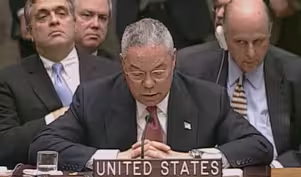
"Truth, War, and Consequences" - Preview
Preview: S2003 Ep15 | 33s | Why did the U.S. go to war in Iraq? What went wrong? And at what cost? (33s)
Providing Support for PBS.org
Learn Moreabout PBS online sponsorship New Episode
- News and Public Affairs

Top journalists deliver compelling original analysis of the hour's headlines.
 New Episode
- News and Public Affairs

Today's top journalists discuss Washington's current political events and public affairs.

 New Episode
 New Episode
 New Episode
 New Episode
 New Episode
 New Episode
 New Episode
 New Episode
Support for PBS provided by:
Funding for FRONTLINE is provided through the support of PBS viewers and by the Corporation for Public Broadcasting. Major funding for FRONTLINE is provided by the Ford Foundation. Additional funding...