
Vintage First Finds, Hour 1
Season 30 Episode 16 | 52m 45sVideo has Closed Captions
Travel back to ROADSHOW’s Season 1 and learn what those first treasures are worth today!
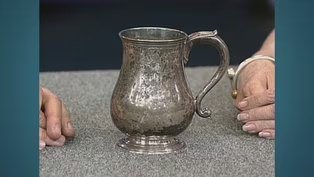
Travel back to Season 1 and learn what the series’ first treasures are worth today, including an 1895 UNC football, an 1856 Chinese export Canton fire oil, and a Jacob Hurd silver cann, ca. 1745. Which has the most dramatic value change?
Problems playing video? | Closed Captioning Feedback
Problems playing video? | Closed Captioning Feedback
Funding for ANTIQUES ROADSHOW is provided by American Cruise Lines and Ancestry. Additional funding is provided by public television viewers.
Support provided by:


Vintage First Finds, Hour 1
Season 30 Episode 16 | 52m 45sVideo has Closed Captions
Travel back to Season 1 and learn what the series’ first treasures are worth today, including an 1895 UNC football, an 1856 Chinese export Canton fire oil, and a Jacob Hurd silver cann, ca. 1745. Which has the most dramatic value change?
Problems playing video? | Closed Captioning Feedback
Where to Watch Antiques Roadshow
Antiques Roadshow is available to stream on pbs.org and the PBS app.
Buy Now

ANTIQUES ROADSHOW's 2026 Production Tour
Enter now for a chance to win a pair of free tickets to one of the three stops on ANTIQUES ROADSHOW's 2026 Tour. Sweepstakes entry deadline is April 6.Providing Support for PBS.org
Learn Moreabout PBS online sponsorship♪ ♪ My grandfather, who is my most favorite person in the whole world, got me started collecting glass when I was about 16.
GUEST: This is a Carolina football, and it belonged to my wife's granddaddy.
It came from my mother, and beyond there, I don't know.
♪ ♪ CORAL PEÑA: In 1996, "Antiques Roadshow" hit the road for the very first time with stops in the birthplace of our nation, America's East Coast.
It was here that we welcomed the public to bring in their yard sale finds and attic treasures, offering a new look into our collective past.
Now we're stepping back in time to relive those original appraisals.
Join us for hour one of "Vintage First Finds" and play along as you guess which values soared, stumbled or stayed the same over the last 30 years.
APPRAISER: When you produced this out of your bag, I got very excited because it's obviously an early American piece of silver.
Does-does it have a-any family history?
I don't know the full history.
I inherited it from my mother-in-law who inherited it from many generations on her side of the family.
She's from-- her family's from the Boston area.
Well, the Boston area would, um, explain a lot, because this was made in Boston in the 18th century.
It's by a-a very famous Boston silversmith called Jacob Hurd.
There was a whole dynasty of silversmiths of that name in Boston.
Um, he was working in the 1740s and '50s.
Um, this is actually a typical Boston cann.
Funny enough, the old English word cann, C-A-N-N, has continued in usage in America to describe a-a s-silver mug like this.
It's wonderful to get a piece of colonial American silver like this, which is in basically untouched condition.
Um, it's obviously been put away, uh, and I don't think seen the light of day for a while.
(chuckling): No, it hasn't, no, it's been in a drawer.
In a bag and a drawer.
Well, that's nice.
It's nice in that it hasn't been, uh, knocked around, it hasn't been over polished.
I should think underneath this tarnish, there's probably a very nice surface patina.
The-the collectors of American silver love a nice, warm colored surface patina on silver.
Um, it's interesting that on-on this particular piece, we've got Hurd's maker's mark, which typically for a Boston piece of silver is up by the left hand side of the handle.
There was no system of assaying and hallmarking.
For the most part though, they were pretty honest.
And, um, most of these colonial pieces are of the right silver standard.
There's always a premium in American silver of this date for things which come out of a family.
For that reason, it's worth more than something that say, has been up for sale and changed hands many times.
Have you ever had any idea what it might be worth?
Not really.
(chuckles) Well, I think one in this state, uh, fresh to the market, I think we could probably expect something in the region of $15,000 worth.
(laughing): Oh, my God!
(laughs) I-- Oh, my word!
Really?
You weren't expecting that, right?
(laughing): No, um!
I was thinking maybe $2,000, $3,000.
$15,000-- oh, my gosh, whoo, um, wow.
Mm.
It has all the factors that contribute to a high price: um, family history, great condition and a wonderful, clear mark and, uh, wonderful family initials on it.
It's a, it's a marvelous thing.
You're very lucky to have it.
So it's a good thing I didn't polish it.
(laughs) Enjoy it.
About 17 years ago, I was doing some work for a-a customer of mine.
After a-a few weekends of helping her out, she just asked me to come into her house, and she showed me a lot of antiques that she's been collecting from her family over the years.
Right.
And she asked me if I would like this chair, which at-at first I-I really wasn't sure if I should accept it or not, 'cause it was so beautiful.
But after a while, she convinced me that she wanted me to have it, and so I accepted it from her.
Were there some other things in the house, also, that you... that were really old that were with it?
She had, she had, uh, history... History.
...from, from her, uh, a-ancestors, I guess... It went... went way back.
...dating way back to the Mayflower.
Um, this chair, uh, she told me, was brought over to the United States by Captain Francis Winslow.
Okay.
I think she told me that it was brought over to this country in 1861 through 1864.
Okay.
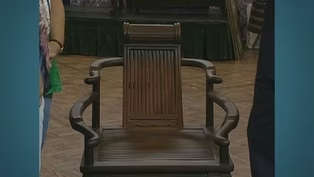
Well, it is, it is actually definitely a Chinese chair, and it's, it's made in the style of the Ming dynasty.
This style of the chair was made from about 1650 to 1750.
Wow.
Uh, it has all the characteristics of the Ming dynasty, with these rounded handholds.
Mm-hmm.
And then if you go down to the leg, there's this, this square, tapered leg with this open work here.
Yeah.
But this particular chair is not 18th century though.
So I see.
Although it has that... this... that-that look and certainly this-this style with these hooped arms and everything, it was probably made, I would guess, late 19th or early 20th centuries.
But, you know, sometimes stories get... ...sometimes stories get changed.
Discombobulated.
Yeah.
(chuckles) Yeah, they do, they do, you know?
But this is really unusual, because you have this, it's kind of a, a pretty elegant, uh, reclining chair.
It's not period, but still, it's a nice thing to have.
It has some style and-and a nice look to it.
And value-wise, it would be priced in the range of maybe $2,000 to $2,500 today.
Mm-hmm.
Still, not bad.
Now, is this something that's been hanging in your home since you were a child, or what's the history of the painting?
What do you know about it?
GUEST: It was my dad's painting, and he was from Maine, and it was in Maine.
Was he a collector or...?
Why do you think he purchased something like this?
I don't know where he got it-- I know that my father really loved it.
He wanted to be a dairy farmer.
Uh, and so he always loved this painting, um, because it was the life that he didn't have.
And when he died about a year-and-a-half ago, um, he wanted somebody who really loved the painting to have it.
Mm-hmm.
And I really loved the painting and brought it home, but it's been sitting in an attic ever since.
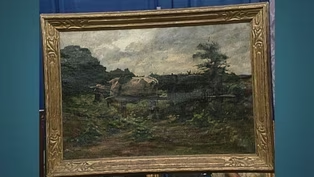
Well, it's a lovely painting.
It's an example of Dutch Impressionism.
Uh, you know, often we think of, when we think of Impressionism, we think of French Impressionism or American Impressionism.
And we think of, you know, bright colors and, you know, women in white dresses and that sort of activity.
Um, this is by an artist named Herman van der Weele, who was a late 19th century artist.
He died at the, at the turn of the century.
And this is an example of the Hague School of Dutch Impressionism.
It's a much more subtle, subdued subject.
It's not sort of the bouncy, uh, broken brushwork that you see in the, in the French Impressionism.
It's very quiet and, uh, very lovely and controlled.
Uh, it's interesting that, uh, he and the school were a great influence to, uh, Vincent van Gogh.
And to, and to later artists.
Uh, in general, the painting is in very good condition.
The signature is lower right.
Uh, I think being up in so many attics has probably saved it a lot.
(chuckling) Uh, you know, it hasn't been banged around.
And because of that, um, it's, it's in quite good condition.
I think it would brighten up a lot with some, um, with some cleaning.
I would estimate at between $5,000 and $7,000.
Mm... Is that a nice surprise?
(chuckling): Yes!
Yes, yes, that is, that is a great surprise, I had no idea.
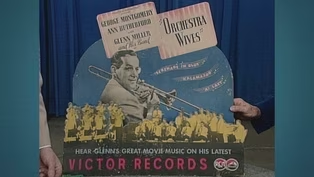
Could you tell us something about this Glenn Miller piece that you've brought?
This particular one is a-- fairly obvious, uh, an ad for "Orchestra Wives," the movie, and the, the RCA Victor music of the Glenn Miller Band back in the early '40s.
My husband is a very big fan, and he collected this from the local movie theater down in Williamsburg, Virginia, where he lived.
And what about this menu?
That I got in Chicago.
I had just graduated from high school, and all of us teenagers had gone down to the College Inn at the Hotel Sherman, the Panther Room, to see Glenn Miller and dance to his music.
That's marvelous-- well, of course, the thing that attracted me is this wonderful series of signatures on the back here.
Mm-hmm.
We have Glenn Miller.
And who have we got here?
Ray Eberle.
Ray Eberle, and I believe the vocalist.
Marion Hutton, the female vocalist.
And Ray Eberle was the male vocalist.
And I think it might be possible also to identify, perhaps, is that...?
I think this is Ray Eberle and this is Marion Hutton.
Isn't that marvelous?
And the other amusing thing about this all is that, um, your husband got this in one place in 19...?
Probably around 1940.
1940.
And I looked inside the... ...menu here.
And here we have July 17, 1940, but you got this in Chicago.
That's right.
Quite a few years before you were married, right?
Long time before we were married.
So... We weren't married till ten years after that.
Marriage was a... ...union of two Glenn Miller fans, right?
That's right.
And it's a sensational menu.
Look at these prices.
The, uh, flaming sword filet mignon was $2.75.
He was sitting in the booth behind you, you say?
That's right.
And I passed the menu over for their signatures.
That's wonderful.
Well, I think this group would be worth probably around... ...$1,500 on a menu like this.
And this, um, stand-up advertisement would probably be worth, oh, in the region of $300 to $600.
Wonderful.
Um, and I, I just can't get over the fact that the two things came together from separate places.
Wonderful, isn't it?
(chuckles) It's great, thank you so much.
Thank you.
My mother's brother was a man named Joe Kallus.
Who-- APPRAISER: The founder of Cameo Doll?
That's the guy.
Wow.
And he had met, when he was quite young, an artist by the name of Rose O'Neill.
Very famous.
Rose O'Neill was the one who... The Kewpie lady.
That's, that's the gal, that's right.
(laughs) And Joe decided to build this factory, uh, for the purpose of producing her dolls.
Well, I have to tell you, which you probably know already, Mr.
and Mrs.
Aron, you have Kewpies.
(chuckles) We have Kewpies.
Uh, let me take this one out of-- this may, or, did you put the, uh, wrapping on or is that just how you...?
Just, just as we received it.
We did not put anything on.
Very interesting.
Rose O'Neill Kewpie dolls, as you know, were a rage in the '30s and '40s, but she produced them even earlier than that.
They're still popular today.
People still love Kewpies.
Most of the Kewpies I run across are either bisque or composition, but Kewpies were made of tons of different things.
I would probably say that due to the... the-the, um, material used-- (squeaks) hey, what do you know?
It talks.
Um, that it was probably from the late '40s, especially by, um, let's see, is this an original?
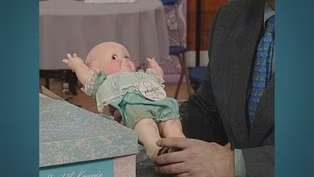
Yeah, we've got an original box with the "Kuddly Kewpie, a Cameo Doll."
It crosses over into two different areas.
It's a doll first and foremost, but it's also a character collectible.
But what fascinates me is that this one is in very good shape for a doll this age.
But there is some staining and some condition things here which will detract a little bit from the price.
I think probably this item, in this condition, is worth about $100 to $150.
The original box condition is tougher to tell, because people love... things in the original boxes.
And not only that, this is sort of a Christmas item because it's got a little jingle bell right here.
And again, I'm sure the tags are tied on.
And incidentally, if anyone... This was never taken out of the box.
I know, this is incredible.
This is, this is what most people consider mint in the box condition.
Collectors do pay a premium for it, so I would say that just the fact that this has never been taken out and played with, that it's probably worth twice as much as this one.
So even a bit more because people can get carried away, particularly in competitive or auction situations.
So I think probably this item, because it's just in such mint condition, is probably worth $300 to $400.
You know where they came from, they have great provenance because they came from the founder of the firm.
You know, that does add to the value.
And I just want to thank you for bringing 'em in.
They're great fun and you can see why people love the Kewpies.
They're really cute.
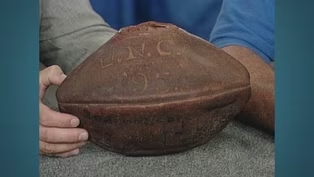
GUEST: This is a Carolina football from the year 1895.
And it was, uh, belonged to my wife's granddaddy and he was on the Carolina football team in the year 1895.
And when the season was over that year, he brought the ball home.
And it's been in the family ever since.
You were telling me that, that that team that year, wasn't that the year that they, they threw the first forward pass?
That's the story that-that I've been told, and I've got some documents that state that, uh, the first forward pass was thrown by this team in 1895.
It was thrown against the University of Georgia.
That resulted in a 70-yard touchdown.
That actually won the game for Carolina that year.
He also put all the scores from that year on this side here, I noticed-- I'm from Virginia, I had to notice down here that, uh, U.V.A.
was the only team that beat 'em.
And that was six to nothing.
That's correct.
That-that's the only-only team to beat Carolina that year.
And this game ball was from that, uh, that U.V.A.
game.
From that particular game.
Mr.
Merritt brought the ball home after the, uh, after the season was over that year, and put it on his mantle.
The thing that may affect the value on this more than anything else is the fact that it is something that has local appeal.
And it would, it would be something that would be of appeal to a Carolina graduate.
Sure.
Somebody who's a supporter of the football or the sports program over there.
Um, and the other thing is that, uh, I think it's significant that that forward pass was thrown with this.
Now you were telling me earlier about that, that it, that the referees didn't see that.
That's correct.
The, uh, I think it was a fourth down play and, uh, instead of kicking the ball, the, uh, the punter actually tossed the ball to one of his players and, um, it resulted in the touchdown.
That was in, uh, in the year 1895.
I-- the way I understand it, the forward pass was not legalized until 1905.
But, uh, the referees didn't see this pass and, uh, they let the touchdown stand.
Right.
Well, I would say that as far as value is concerned, if-if we were to auction this and-and sell it down in the area where the university is, and get some local people interested in it, or get national people interested in the fact that a forward pass was completed with it, there's a very good chance, uh, that this ball could bring anywhere from $1,000 to $3,000.
Well, that's great.
And, uh, we sure do appreciate you bringing this in today.
It was a lot of fun looking at it and talking with you about it.
Appreciate you taking a look at it.
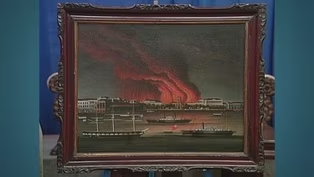
What attracted me to this picture, um, was the scene itself, just the fire.
Where did you come by it?
Well, it actually is one of a set of three that belonged to my parents, and um, they got them in the Philadelphia area, uh, over the past 30 years.
What's interesting about this, as I said initially, is the fire, because this is a view of Canton, which is one of the major trading ports, uh, in China.
And it was set up for trade with the western powers, England and France, the United States, and each of these buildings that you see across here are the various trading houses, uh, where merchandise would be bought and shipped and purchased.
One of the other interesting things about the picture is you have such a-an array of different types of ships in the foreground.
And the condition, uh, of it is very nice and bright and clear and easy to see what's going on.
One of the things about paintings that makes it difficult when you're trying to value them is the condition.
Mm-hmm And although, as I, as I said, on the surface, this looks very attractive and it's a pretty picture and the condition looks good, when you start looking at it closely, you see that here there's sort of a darkish area that I'm circling.
That is a hole that has been filled.
Mm-hmm.
There's another one that's here.
Mm-hmm.
That was punctured and another here in the sky.
So there was, there was some damage at some point.
Mm-hmm.
And in addition to that, this area here has been overpainted, which means the painting at some point was too thin.
And the restorer... Mm-hmm.
...came through and they repainted this area.
They repainted some of this area, this area and some of the area up here in the sky.
And over time, that oil paint starts to discolor, 'cause it ages this at a, at a different rate than the original oil paint.
Than the old.
So you start to notice a difference in the color.
Mm-hmm.
And-and if I were to have a black light... Yes.
...an ultraviolet light, and go over it, these things would fluoresce in a very bright color.
That would be quite easy to see... Much more noticeable.
...what had been restored and what had not been restored.
The other thing that makes it really interesting is that the frame of this appears to be original.
And if you look on the reverse, you'll notice that you can see the original pine surface.
Yes.
The pine frame that this is made from.
Right.
Pine was typically used because it was a good medium for which to put lacquer... Mm-hmm.
...which is what this is.
Right.
This burgundy colored lacquer which you often find used on furniture, is used on porous woods like pine, 'cause it adheres ver-very well.
It chips, though.
(laughing) It does chip, you're right.
Um... As we can see.
Because it's a, a very specific point in time, it's a rare, uh, view of, uh, of the fire at Canton.
And in a very important historical view, the value of the painting is going to be in the neighborhood of $15,000 to $25,000.
Mm-hmm.
That's great.
Thank you very much.
You're welcome.
Appreciate it.
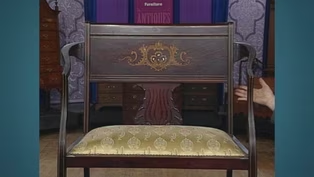
(chuckles) I purchased this about 20 years ago from an elderly man that had furniture for sale in his house and had some out on the porch.
Right.
And I walked into his house and this was kind of tucked away in the back, and it, it just stood out.
I said, I've got to have this piece.
And I've babied it ever since.
That's great-- well, I can understand that.
It's very, uh, unusual.
When I look at a piece of furniture, the first thing I do is I try to answer the question, what style is it?
Right.
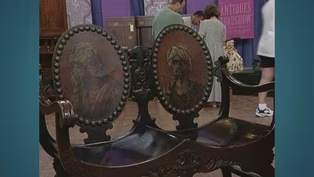
And, uh, what I see here is kind of an adaptation of a 17th-century style chair.
You've got a basic X-form chair.
It would have had a single back, two arms and an X-form base.
And they've expanded it to a loveseat size.
So this piece was adapted from a 17th-century style, but probably made in the late 19th century, maybe 1890 to 1900.
Mm-hmm.
And it's made of oak that's been stained a dark color.
Hand-painted oval backs with these Arab figures surrounded by brass bosses.
Very, very decorative.
Usually, we think of furniture with a solid wood seat for a hall, 'cause it's a tradition.
You come in from outside, maybe you're wet, whatever, you don't want to sit on upholstery.
So it may have been a very decorative piece for an entry hall in a Spanish-style home.
That's what I thought.
They're... the-the paintings themselves are signed, but I wouldn't say that they're valuable as paintings.
Whoever the artist was, it's not really that relevant.
It's really, how pretty is the painting and how much does it add to the settee itself?
Right.
What are the, what are the decorative merits of the piece?
Uh, we can also date it kind of by, by the quality of the carving here, we can see there's not much definition to it.
It's just a little bit of chip carving here, little chip here, a little bit of lines here, very flat scrolls.
And we-we can look at here where we have actually some leafage.
Pretty simply done.
So that also helps us to date it in that time period... Right.
...aside from the actual style of the piece.
So if I was estimating this for... to place in an auction, I would probably estimate it between $800 and maybe $1,500, somewhere in there.
Mm-hmm.
Thank you very much.
Okay, thank you for coming.
Grandma sent me on a mission to come to this show to try to figure out how much this thing was worth.
Uh, from what I understand, um, it's been in our family for quite a long time.
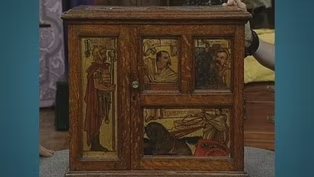
APPRAISER: The materials are interesting in that you have glass tesserae in a pattern, and then the cipher unknown, and the dates are executed in enamel.
Mm-hmm.
You have heraldic devices in gold and polychrome on the wood frames.
As far as use, you said at one point maybe ashes or-or...?
Yeah, yeah, maybe ashes.
Or something?
And then jewelry, and, uh, I'm not sure.
Uh, I think it was probably made as a humidor.
Conservatively, probably $3,000 to $5,000.
Hmm.
Wow.
So your mission was accomplished.
All right.
Yeah.
(soft chuckle) Can you tell us a little about how you started glass collecting?
Sure.
Oh, my, my grandfather, who is my most favorite person in the whole world, got me started collecting glass when I was about 16.
Wow.
And I have to give ver-- all the credit in the world to Mr.
Elwood L. Bigler.
Very good, and you found this piece locally, I understand?
Yes, I did.
I found it in an antique store in Deptford, um, which is in South Jersey, and it was a, a lady, a lady antique dealer there.
She had, she had it on her wall, and it was not for sale.
And every time I was in there, I admired it.
And when she passed on, her husband called me on the phone and said since I liked it, he offered it to me at a very nice price.
Well, I-I think you did a very good thing in buying it.
Um, and I'm not too surprised that you were able to find it in South Jersey.
Southern New Jersey has a long history of glass making.
Yes, it was one of the original centers for glass making in the whole United States.
That's right, going back over 200 years.
Yes, to the end of the 1700s with-with the Wistar Glassworks down, down here.
That's right.
And you've picked up a very nice example of glass from New Jersey.
Not quite that old, from the early period, but the kind of thing that was made about 100 years ago or so.
Yes.
Thinking it might've been used for a parade.
That's quite possible.
Uh, you-you could see it leading a parade in southern Jersey.
Yes.
And the way these things were made, you can see the several different colors of glass within this, in the form of long strips of glass.
There were four or five colors altogether, in fact.
Mm-hmm.
And they started out as little blobs of glass that were all put together rather like plastic, and then drawn out, perhaps using two men, one at each end, pulling it into a long strip.
That's right.
And then they'd be twisted together, and turned and made, ultimately, into a long walking stick.
Right.
Jack, tell me, you bought this from a little old lady.
Yes, I did.
Um, do you mind if I ask what you had to pay the little old lady for it?
I paid her-- I paid her husband $300.
Well, I think you did very well, Jack.
I think you've got a piece that's worth more than that.
Okay.
Uh, not a great deal more than that, but I would certainly be valuing it at least $500... Okay.
...and perhaps as much as $700.
Okay.
For a glass walking stick, probably made in and around the town of Glassboro, New Jersey... Okay.
...where the legacy of glassmaking is held in the name-- and you may know, but the history of these things goes back a lot further than that.
All the way to England... Oh really?
...uh, almost 200 years ago.
And glass walking canes were used to fend off evil spirits.
Ah!
I don't know if you've used it for that, but in fact, to be more precise, they were used to attract evil spirits.
The evil spirits would collect on it, of course... Uh-huh.
...and then every once in a while, you dust the glass walking stick, and the evil spirits would be wiped away.
Oh, wow.
This piece of furniture was made in this country sometime in the very late 19th to the early part of the 20th century.
It's a good quality piece of furniture.
Um, a good example of the craftsmanship that was still evident in the furniture manufacturing business, uh, in America at this time.
It is-- it couldn't be characterized as being any particular style.
It's sort of a, a combination of styles.
A, a design cooked up by some designer who worked for the company.
Uh, we could almost call it colonial revival in a sense.
Um, in the 18th century, you would not find a piece of furniture that looks precisely like this, but you would see certain elements, uh, in pieces, isolated elements.
If we go from top to bottom, we see that the piece is made out of s-solid mahogany and veneers.
Uh, veneers are used in this instance not because it's of lesser quality, but to achieve a certain effect.
In this case, they've matched these veneers right up the middle and then centered this really beautifully inlaid, uh, d-- cartouche design, embellished it with exotic woods and even, I think, a little bit of mother of pearl here that's yellowed a bit through a varnish.
The inlaid stringing, which outlines the back and continues on down the arms, down the leg supports and so on, again, is the mark of quality.
The difference between this piece of furniture and a piece of furniture that was made, uh, earlier, is in construction.
You can see through a little bit of shrinkage here that this lyre-form pierced, uh, back splat is doweled into the back.
An earlier piece of furniture would not be made in that way.
You would in all likelihood see a mortise and tenon joint, um, rather than the dowel, uh, situation.
Did you put the upholstery on this?
I-- It came from my grandparents' home, so I don't know what was added and what wasn't.
Well, someone selected a really wonderful textile.
I mean, it's appropriate for the piece, um, and it's in very fine condition.
Is it-- have you sat in it?
Is it comfortable?
Oh no, dear, no.
(laughing): I think you can sit in it.
Just don't lean back too much.
I think probably, in all likelihood, these brass cap casters are original to it.
It might have been a piece of furniture that, uh, matched a couple of other chairs, I don't know.
Because it is not an accurate copy of an early piece, but rather kind of a, a combination of styles.
There are those people looking for accurate, old quality copies who would not be particularly attracted to this piece.
On the other hand, I know of collectors who specifically will go after this, because of the wonderful combinations of, uh, design elements.
And it's pretty, it's small, so that makes it marketability a little bit more in that it would fit in a small apartment, could be used in a variety of situations in a sitting room, a bedroom, or whatever.
So, now I suppose we could get to the clincher here.
What's it worth?
(chuckles) Yeah.
Um, I would think in an-- in auction situation, for example, you might expect to see it, uh, bring somewhere between, oh, $300 and $500, something like that.
It's sort of an-- We could call it an antique of tomorrow and I'd hang onto it.
Just don't sit too hard on it.
(laughing): Okay, thank you.
All right, thanks a lot.
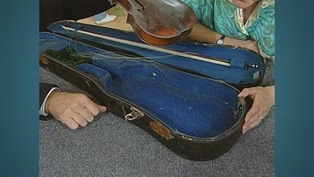
Well, it's a violin that I don't know much about.
Okay.
I have an older neighbor who gave it to me, and I was going to just display it in my house, clean it up, which obviously I haven't done yet.
Um... and so I thought I would bring it in and see what it was worth.
Okay, let's take a look at it.
Um... Barb, it definitely needs some cleaning, I think, before it goes up on the mantel.
Well, I was going to.
(chuckling): Okay.
Uh, we've got a bit of dust here, um... And a... (blows) Ooh!
Jeez.
(blows) Um, this is probably French work, mid-19th century.
Looking inside, I can see the label, and it says "François Richard, Paris."
Not dated, but it doesn't need to be.
It's classic-- not Parisian work, though it's labeled that, but, uh, Mirecourt, which is a, a town, uh, in... more south of Paris, a-a town of all violin makers.
That's just about all they do there.
And it's what we refer to as trade work.
It's sort of mass produced, uh, but all carved by hand.
Not the best fiddle around.
No.
No.
If it were restored, how would it sound?
Well, um... it'd probably sound pretty miserable.
(chuckling): Um, most of these French fiddles, because of the very hard... (tapping) crisp varnish that's on them, um, the length, they tend to be very long, tend to be awfully nasal-sounding, but probably great for the mantle.
The case is period, about the same time.
I'm going to say 1850, and... well, moth-eaten.
The moths are having a great time in there.
And also the moths are having a great time with the bow, which is why all this hair is all broken.
Okay.
Um, there's actually a beetle that eats it.
Really?
Yeah.
My advice is, uh, when you get this home, throw some mothballs in it.
Oh, okay.
But, uh, let's take a closer look at the bow.
It's what we say in the trade a nice stick.
Is it?
(chuckling): Um, yes, it's a very nice bow.
The bow is, uh, of about the same period, a little bit earlier, I'm going to say 1830 or thereabouts, and, uh, stamped by the maker, right at the butt end of the stick.
Uh-huh.
"J.
Dodd."
And that was John Dodd, working in London in the early 19th century.
Excellent bow maker.
This is a, a really quite a nice bow... Oh, is it?
Of-of-of very nice quality.
Silver-mounted.
Uh... The frog with a silver ferrule, abalone pearl eye, and an abalone slide.
The button again, silver mounted on ebony, and it has a wonderful, wonderful pearl eye on the end that looks like oyster, which-- English, when they weren't eating oysters, they were saving the shells and making bow eyes out of 'em.
We see this often, where, people open up a case, they look at the violin, and it's like, "Eh, it's, it's an okay violin," but yet the bow is worth more than the fiddle.
Um, any idea what this bow is worth?
No, do you want to tell me?
Well... Because I'm afraid that if it's worth money, I'm gonna have to give it back to my neighbor.
Well, if your neighbor's watching, he's going to come banging on your door.
Um, this bow would probably fetch easily $8,000 in this condition.
(laughing): No, you're kidding.
Yeah.
You know, It's a great stick.
(chuckling): Well, I'll have to think about what I'm gonna do with it.
Take up the violin?
Or, uh... Maybe.
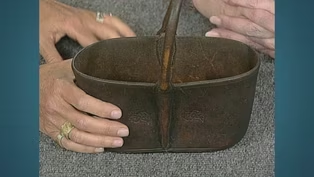
This leather key basket belonged to our great-great grandmother... Right.
...who lived, uh, in Warren County, North Carolina.
The plantation name was Fairmont.
Fairmont.
Fairmont, uh-huh.
And so it's been in the family since about... what would you figure the date would be?
The house was, uh, occupied by 1839.
1839.
And how-- and she lived a-about how long ago?
1850s, 1860s, something like that?
Probably, somewhere around that area, yeah.
Yeah.
Well, I-- you know, what's so interesting about this piece is, before you told me any of that, um, I, I knew that it had to have a really good, strong, Southern kind of tradition attached to it, because it's one of those pieces of Americana which is just generic to the South.
These things don't exist in other parts of the country.
And basically, um, they were made for young women at the point that they were betrothed for marriage as a kind of both symbolic and, and... and usable object which kind of forecast what the woman's responsibilities were going to be, and, and her domestic role in kind of keeping the... keeping the keys and, and being the gatekeeper of various buildings that existed.
So, what you've told me is really part and parcel of what the traditional history is for these things.
But these were also probably made by people who made saddles and were leather workers.
And you can see, if you examine the stitchery here, that it looks like... what a boot maker or saddle maker, the same kind of st-- stitching technique that they would have used.
They're just... they're, they're-- aesthetically, they're very pleasing.
Just to kind of, uh, place it in terms of a commercial value, of course, the family association is something which is invaluable and means a great deal to you, but there is a value to these things on the commercial market as well.
And the way that... the way that it works is if they're very ornate, with appliques and cutouts and hearts and different colors of leather, they can be worth tens of thousands of dollars.
This one, which is used but in good condition and rather simple in its decoration, would be worth less money, but it still would be worth somewhere in the vicinity of maybe $2,000 to $3,000 in an auction situation.
So, it's-- it's a lovely piece.
It's very... it's-it's very important to the history of this area.
Certainly very important to you in terms of the family association.
And it's, uh, one of the things that makes Americana so great, because you look at something like this, and you've got a piece of living history right in front of you.
Well, we have always thought a lot of it, and you just reinforced that.
Right.
(laughs) And it was well worth that.
Thanks so much.
Thank you.
Thank you.
I saw this, uh, coming across the room.
It's an amazing piece.
Something that you've had for a while, or... Oh, it was in my dad's family.
And was, and was-- There's, there's two of 'em.
Oh, wow.
They were too heavy, I couldn't bring both of 'em in.
(chuckles) Well, that's great.
Actually, a pair is much nicer than, than having one.
So, was he local or was he... No, he-- he was in Texas.
Oh, wow.
So these have traveled quite a distance.
Mm-hmm.
Okay, why don't we take a look?
Take the lid off here... (clinking) Oops.
Actually, you can see, there's a... there's a mark inside the lid cover here.
Put this down.
Are there any markings under the base, do you know?
Or... I think it's one on the bottom, too.
Let's see what... Oh, yeah, it's got the same mark under the base.
Do you know anything about these, or... No.
...or where they're from or anything, or?
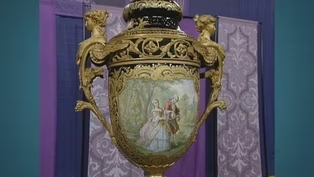
Well, they're, they're French, um, and the mark, uh, is for the Sèvres factory, so French, uh, porcelain.
But the mark is actually a, sort of a pseudo mark.
Um, they, they date from the late 19th century, but the mark is one that, that was used in the 18th century.
Mm-hmm.
So it's, uh, not really a forgery, but it's a, an earlier mark on a later piece.
Um, so what we sort of refer to as spurious.
Um, but that really doesn't affect, uh, the interest level in this type of vase, because they were very popular in the late 1800s.
Probably dates from about, uh, 1860 to 1880.
And people really love the type of decoration it has on the front, I guess scenes of, uh... is it, is it a couple in a, in a landscape?
Mm-hmm.
And it's signed, down here in the corner.
And then on the reverse, it has, uh, another landscape scene.
And these are all hand-painted, so there's quite a bit of work was involved.
They did the background, then they hand-painted, then they did all the gilding work.
This work in the base, was it original or was that added later?
No, it's all original.
It was a, sort of a gilt, a gilt bronze.
Very collectible, very desirable, and amazing piece.
For a pair, you're looking at a value, um, probably around $10,000.
Get out of here, really?
(laughing): Really.
You surprised?
Yes.
I guess you're very surprised.
I have a feeling you may know approximately what these are, because you're a collector, is that right?
Yes, that's correct.
Um, there's a pair of English castors that I bought at the antique dealer in Baltimore City.
And, do you like to put them in a period, do you... Um, I've d... I've dated them uh... just around the late part of the 17th century.
Ah.
Um, well, they, the form is actually a typical 18th century form.
Mm-hmm.
Um, the period you just mentioned is too early for the style.
At that period, you would have a cylindrical castor.
This vase-shaped castor is more typical of the 18th century.
So, um, I'd like to take a look at the marks to see whether that confirms my opinion or yours.
(clears throat) They get somewhat s... uh, scrunched up in the bottom here, but you have four London hallmarks.
Um, the maker's mark is C.A.
for Charles Alchorne, who was a specialist castor maker.
Uh, he was actually an apprentice to a man called Samuel Welder, who was also a castor maker.
Um, he worked in the 1730 period.
There is a little problem with these marks.
London marks should have a set of four, uh, including a date letter.
Instead of a date letter, here you have his mark struck twice.
Now, the reason for that is Charles Alchorne decided he was not going to pay the sixpence duty on the silver when he made these castors.
So, he's used marks which you got right, in a sense, from the late 17th century and put them in the bottom here.
Even though the actual castors belong in the 1730 period.
And he had to cover the original date letter from the 17th century with his maker's mark.
He's even put his maker's mark quite correctly on the sleeve of the covers of this cover.
And just see if the same thing has happened here... Yeah, there he is, marked there as well.
A lot of makers did this kind of evasion.
Uh, technically speaking, these could not be sold at auction, uh, in England, but in this country we're free to sell them.
There's no doubt about their age, their quality, or who made them.
But that tiny infringement of the British, uh, hallmarking laws means that they should not technically be sold without the marks being cancelled.
What do you think they're worth, Victor?
I really do not have an idea.
Well, the problem is partly the marks.
And also they're not tremendously expensive pieces.
Even if fully marked, uh, they're probably worth in the order of $800 to $1,200 for the pair.
Mm.
Uh, is that a disappointment to you?
No, actually, I think it's about a good price range.
I would pay that for 'em.
Great.
Well worth it.
So tell me, where did you purchase this car?
We actually purchased this from a dealer.
And about how much did you pay for it?
About $5,000.
We've had two offers for it and no, we will not sell it.
(laughs) How much have you been offered?
Um, one of the offers I know was about $7,500.
And-- $7,500?
And we've only had it a little over a year.
This is hard to believe.
I mean, this is, this is a toy.
This is a 1930s piece of cast iron.
The great thing about this car that I know, Parmelee was a Chicago cab company.
Arcade was a cast iron maker from Freeport, Illinois.
This was only made for one year and it was 1936.
They never made it after that.
And they used these unusual yellow and black colors for the Parmelee Cab Company.
Right.
Now, with a dealer offering you $7,500, you know that that's probably worth closer at least $8,500 to $10,000.
Right.
My husband is the real collector.
He was an auto mechanic, but he loves these cars because he doesn't have to work on them.
GUEST: I believe it was owned by my great grandfather in London, England.
APPRAISER: Mm-hmm.
He collected art... Yeah.
uh, for a period for The British Museum, and I believe this was his.
It came over to Canada just after the turn of the century with my grandfather.
We rescued it several weeks ago as my mother was about to throw it into the garbage.
You're kidding me.
She was gonna throw it out?
Oh yeah.
She had it in the garbage bin.
I, I guess she didn't, didn't look like much.
It was all beat up and that sort of thing.
Dusty.
Dusty, yeah.
Very much so, yeah.
Do you know who the artist is?
No, we know nothing more about it than the fact that it, uh, is old and-and looks old.
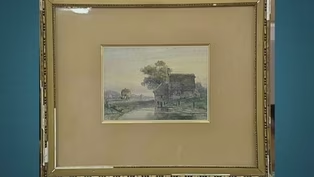
Yeah, yeah, well, it's actually a fairly important, uh, Dutch artist in the 19th century.
A man by the name of Johan Barthold Jongkind.
And it's a very early work for him.
He was born around 1819.
He did watercolors throughout his life.
And this one is, is-- it's actually signed and dated down here.
Right.
"Jongkind, 1844."
So he was 23 years old when he did this.
His academic training shows through.
In his early training, he later goes on and becomes influenced by the impressionists and becomes a very important Dutch artist.
There are a number of, uh, labels... ...by a variety of different people, French and English people, when this was owned probably by other dealers.
Yes.
You say your grandfather was... Great-grandfather in London.
Great-grandfather, okay.
So he may have picked this up somewhere in late 19th century.
Late 19th century, yes.
Which explains some of the sales notations on the back.
Yes.
Now, do you-- no one ever valued this at all or anything?
Absolutely not.
No, no.
You never had an estate appraisal or... It really-- that's why it was in the garbage bin.
(both laugh) Exactly.
In fact, today, um, my wife wanted to bring down a couple of pieces of silver, and, uh, when I initially went to take this out, she said, "you really don't want to take that old thing, do you?"
(both chuckle) Really?
This piece, as I mentioned, is an early work for him, before his Impressionist style.
Sure.
I think a nice early watercolor by Jongkind in this quality would probably be worth about $5,000.
Really?
That's great.
I'm a garage sale-type person.
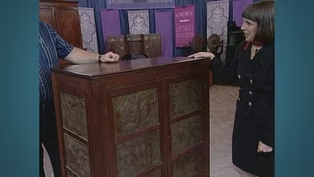
So there was an ad in "The Washington Post."
A guy advertised a walnut pie safe, rare.
That's all he said in the ad.
And I get up early anyhow, so I was there about 6:00. on a-- on a Saturday morning.
Mm-hmm.
Uh, he-- Thi-this was for his garage sale?
This was his garage sale.
And it was in-- actually in his basement, so... Uh-huh, so he had other things for sale as well.
Yeah.
So I went down with my wife and we looked at it.
I looked at the, you know, the eagles and I thought, this is-- looks to be a pretty good pie safe.
Mm-hmm.
So I asked him about it.
I said, "how long have you had it?"
And he said, "50 years."
Well, I would certainly agree with the gentleman who advertised it, uh, some years back that it was rare.
And the thing that separates this pie safe from all of the other pie safes that you see... Mm-hmm.
...are these incredible panels in it of eagle decoration.
Uh-huh.
You can see that the panels are pierced... Mm-hmm.
...and that really did let air flow in and out of this box.
Mm-hmm.
The thing that's-- as well that's rare about this pie safe, uh, is that the panels... open up on the sides, so you really get both sides open.
Uh-huh.
And the front doors fly open as well.
And you get great cross-ventilation, so that you can clean this out.
Mm-hmm.
Uh-huh, they could really get into it.
And there are little hinges, wooden hinges, that hold, uh, the panels in-in place.
Mm-hmm.
Uh, the thing that concerned me a little bit... Yeah.
...when I first took a look at this pie safe is the fact that all of these panels have been replaced... Mm-hmm.
...uh, in terms of the wood, uh, supports in-inside.
Uh-huh.
And that might trigger-- were these panels made at a later date?
Mm-hmm.
I disagree.
I think that they... Mm-hmm.
That this piece is, is homogeneous, and it is-- it is all in good condition.
Mm-hmm.
What may have happened is that-- I see, uh, some gnawing down here at the bottom.
Something got into it and chewed on it.
Probably a little mouse or rat or some sort was gnawing at some point.
Uh-huh.
Maybe these panels were floating and not really secure.
Uh-huh.
The wood is indeed walnut.
Mm-hmm.
And I'd also place it, in terms of a region, uh, in, in Pennsylvania.
Mm-hmm.
That's what he thought.
We see a lot of great country furniture coming out of Pennsylvania.
Uh-huh.
Mm-hmm.
Uh, it has a nice French foot on it.
Uh-huh.
A French foot?
(chuckle) It's a French foot, uh, which you see in a lot of, uh, Federal furniture.
Uh-huh.
So I would date this, uh, probably from about 1810, to say, 1820.
Okay.
Uh, which is... Oh, it's older than I thought then, yeah.
Mm-hmm.
Yeah.
It's, it's-- I think it's, it's quite early.
Uh, it-it's nice, uh, uh, dovetail construction on the piece... Mm-hmm.
...um, and-and really a marvelous, uh, piece.
Um, in terms of value, I think he paid $100, you said, in the '50s?
Yes.
I think today... '40, 1940.
In 1940.
I think we're, we're looking at close to a $7,500 pie... pie safe.
Oh my gosh.
Yeah.
(laughing): Oh, fine.
That's wonderful.
Thank you very much.
Good, good.
Well, it was in my stepfather's living room for many, many years.
And then, when I graduated from medical school, he gave it to me as a gift.
He says, "Now you're ready to have something worthwhile."
Mm-hmm.
GUEST 2: My husband always admired it as a youngster... Uh-huh.
...and his mother would not-- wouldn't let him look at it, because it was a nude.
Uh-huh.
(laughing): So when he graduated from school... Uh-huh.
...he said, uh, "Oh, you're ready to have it now, you've had anatomy."
(laughs) Oh.
Well, this is really a wonderful present.
This is by an American sculptor named Harriet Frishmuth.
It's one of her most, most famous models.
This is called "Crest of the Wave."
And many of her sculptures were of, uh, nudes, and especially dancers.
This piece is very clearly signed with her name, Harriet Frishmuth.
And it's dated here, 1925.
And just below it is the foundry mark, the Gorham Company Founders, same company that made silver, and for many years they had a bronze foundry.
It has its original patina on it, which is this wonderful greenish, uh, brown color.
This is a very popular model, and they actually made a version of it that was 65 inches high as a, uh, garden sculpture and fountain.
Hm.
Did you have some idea of the value of this?
Not exactly, although I had a friend of mine in New York who said that he read an article in the "Times" where a similar statue was sold at Christie's for about $13,000.
Uh-huh.
Well, actually, the last one that sold in New York brought $16,000.
Oh, wow.
My goodness.
So, actually, uh, you got a very, very nice graduation present.
Well, thank you very much.
(laughing): I'll say.
APPRAISER: You're welcome.
Gorgeous statue.
Mm-hmm.
Love it.
Have you owned this for long?
I've had it for... I would guess 30 years.
Okay.
It came from my mother, and beyond there, I don't know.
She never told me.
I see.
Well, as you may know, this is actually a Baltimore album quilt.
It is referred to as an, an album quilt.
Yes.
And it has these various patchwork sections here, depicting a basket of fruit, uh, leaves, as we, as we can see.
On the top here is a memorial to General Ringgold.
Stylized rifles here on the side.
We have an American eagle below with this album signed "H.M.
Smith," album.
This is-- this is made about 1850, right about then.
And, uh, these album quilts, very typical of this area, are extremely rare.
And this one has survived in amazing condition.
And it still has the bright reds and green colors worked on this white ground.
Really remarkable.
And do, do you actually have any idea of the value of the quilt?
I have no idea what the real value is.
Okay, well, it's-- this is worth in the range of about $50,000.
Mm-hmm.
Really is an extraordinary quilt.
And this one is unusually elaborate.
The fact that it has this watermelon r-- on a compote with a knife adds another folk el-element to the quilt that even makes it more desirable.
Mm-hmm.
And what's incredible also is the-- the size.
It's a huge size for... (chuckling): It is quite large.
You really made my day today.
Thank you!
(chuckles) You're making mine.
(both chuckle) PEÑA: You're watching "Antiques Roadshow: Vintage First Finds."
Travel with "Roadshow" anytime.
Stream full episodes, follow @RoadshowPBS on social, and sign up for our newsletter at pbs.org/antiques.
More vintage "Roadshow" right after this.
♪ ♪ (indistinct chatter) (wires shifting) (clattering) ♪ ♪ MAN: There we go.
♪ ♪ I don't think so.
♪ ♪ (grunts) PEÑA: Thanks for watching.
See you next time on "Antiques Roadshow."
Appraisal: 1844 Johan Barthold Jongkind Watercolor
Video has Closed Captions
Clip: S30 Ep16 | 2m 21s | Appraisal: 1844 Johan Barthold Jongkind Watercolor (2m 21s)
Appraisal: 1856 Chinese Export Canton Fire Oil Painting
Video has Closed Captions
Clip: S30 Ep16 | 3m 9s | Appraisal: 1856 Chinese Export Canton Fire Oil Painting (3m 9s)
Video has Closed Captions
Clip: S30 Ep16 | 2m 55s | Appraisal: 1895 UNC Football (2m 55s)
Appraisal: 1897 Arts & Crafts Humidor
Video has Closed Captions
Clip: S30 Ep16 | 1m | Appraisal: 1897 Arts & Crafts Humidor (1m)
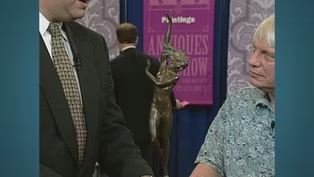
Appraisal: 1925 Harriet Frishmuth "Crest of the Wave"
Video has Closed Captions
Clip: S30 Ep16 | 1m 54s | Appraisal: 1925 Harriet Frishmuth "Crest of the Wave" (1m 54s)
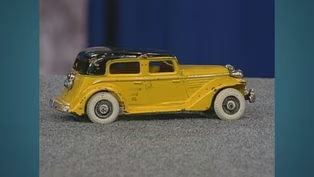
Appraisal: 1936 Arcade Parmelee Yellow Cab Toy
Video has Closed Captions
Clip: S30 Ep16 | 1m 10s | Appraisal: 1936 Arcade Parmelee Yellow Cab Toy (1m 10s)
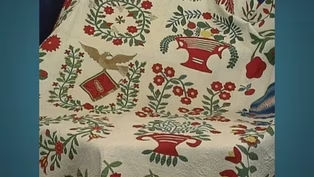
Appraisal: Baltimore Album Quilt, ca. 1850
Video has Closed Captions
Clip: S30 Ep16 | 1m 39s | Appraisal: Baltimore Album Quilt, ca. 1850 (1m 39s)
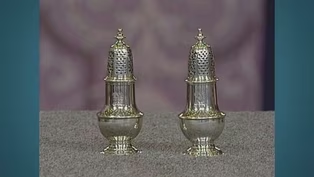
Appraisal: Charles Alchorne Silver Castors, ca. 1730
Video has Closed Captions
Clip: S30 Ep16 | 3m 4s | Appraisal: Charles Alchorne Silver Castors, ca. 1730 (3m 4s)
Appraisal: Colonial Revival Chair, ca. 1900
Video has Closed Captions
Clip: S30 Ep16 | 3m 20s | Appraisal: Colonial Revival Chair, ca. 1900 (3m 20s)
Appraisal: Glass Long Walking Stick, ca. 1895
Video has Closed Captions
Clip: S30 Ep16 | 2m 21s | Appraisal: Glass Long Walking Stick, ca. 1895 (2m 21s)
Appraisal: Glenn Miller Memorabilia, ca. 1940
Video has Closed Captions
Clip: S30 Ep16 | 2m 50s | Appraisal: Glenn Miller Memorabilia, ca. 1940 (2m 50s)
Appraisal: Herman J. van der Weele Painting, ca. 1880
Video has Closed Captions
Clip: S30 Ep16 | 2m 20s | Appraisal: Herman J. van der Weele Painting, ca. 1880 (2m 20s)
Appraisal: Jacob Hurd Silver Cann, ca. 1745
Video has Closed Captions
Clip: S30 Ep16 | 3m 2s | Appraisal: Jacob Hurd Silver Cann, ca. 1745 (3m 2s)
Appraisal: John "Kew" Dodd Bow, ca. 1830
Video has Closed Captions
Clip: S30 Ep16 | 3m 6s | Appraisal: John "Kew" Dodd Bow, ca. 1830 (3m 6s)
Appraisal: Kewpie Dolls & Original Box, ca. 1960
Video has Closed Captions
Clip: S30 Ep16 | 3m 5s | Appraisal: Kewpie Dolls & Original Box, ca. 1960 (3m 5s)
Appraisal: Leather Key Basket, ca. 1850
Video has Closed Captions
Clip: S30 Ep16 | 3m 19s | Appraisal: Leather Key Basket, ca. 1850 (3m 19s)
Appraisal: Ming-style Reclining Chair, ca. 1900
Video has Closed Captions
Clip: S30 Ep16 | 2m 1s | Appraisal: Ming-style Reclining Chair, ca. 1900 (2m 1s)
Appraisal: Painted Oak Settee, ca. 1900
Video has Closed Captions
Clip: S30 Ep16 | 2m 42s | Appraisal: Painted Oak Settee, ca. 1900 (2m 42s)
Appraisal: Richard P. Bonington Drawing, ca. 1820
Video has Closed Captions
Clip: S30 Ep16 | 1m 4s | Appraisal: Richard P. Bonington Drawing, ca. 1820 (1m 4s)
Appraisal: Sèvres Porcelain & Gilt Bronze Urns, ca. 1870
Video has Closed Captions
Clip: S30 Ep16 | 2m 14s | Appraisal: Sèvres Porcelain & Gilt Bronze Urns, ca. 1870 (2m 14s)
Appraisal: Walnut Pie Safe, ca. 1815
Video has Closed Captions
Clip: S30 Ep16 | 3m 7s | Appraisal: Walnut Pie Safe, ca. 1815 (3m 7s)
Preview: Vintage First Finds, Hour 1
Video has Closed Captions
Preview: S30 Ep16 | 30s | Travel back to ROADSHOW’s Season 1 and learn what those first treasures are worth today! (30s)
Providing Support for PBS.org
Learn Moreabout PBS online sponsorship New Season
- Home and How To

Hit the road in a classic car for a tour through Great Britain with two antiques experts.
 New Episode
 New Episode
 New Episode





 New Episode



Support for PBS provided by:
Funding for ANTIQUES ROADSHOW is provided by American Cruise Lines and Ancestry. Additional funding is provided by public television viewers.