
Vintage First Finds, Hour 3
Season 30 Episode 18 | 52m 45sVideo has Closed Captions
Go back to the beginning for value updates on finds from ROADSHOW’s very first season!
Go back to the beginning for updates on ROADSHOW finds from Season 1, including a pocket watch with fob chain, ca. 1885, a 1942 Donald Duck animation cel, and a New England miniature chest, ca. 1825. Which treasure increases to $55K-$60K?
Problems playing video? | Closed Captioning Feedback
Problems playing video? | Closed Captioning Feedback
Funding for ANTIQUES ROADSHOW is provided by American Cruise Lines and Ancestry. Additional funding is provided by public television viewers.
Support provided by:


Vintage First Finds, Hour 3
Season 30 Episode 18 | 52m 45sVideo has Closed Captions
Go back to the beginning for updates on ROADSHOW finds from Season 1, including a pocket watch with fob chain, ca. 1885, a 1942 Donald Duck animation cel, and a New England miniature chest, ca. 1825. Which treasure increases to $55K-$60K?
Problems playing video? | Closed Captioning Feedback
Where to Watch Antiques Roadshow
Antiques Roadshow is available to stream on pbs.org and the PBS app.
Buy Now

ANTIQUES ROADSHOW's 2026 Production Tour
Enter now for a chance to win a pair of free tickets to one of the three stops on ANTIQUES ROADSHOW's 2026 Tour. Sweepstakes entry deadline is April 6.Providing Support for PBS.org
Learn Moreabout PBS online sponsorship♪ ♪ APPRAISER: The pieces that will bring the most money are the naked ladies, the nymphs and things.
Oh, yes.
(chuckles) You're kidding.
APPRAISER: I'm not kidding.
You're not kidding?
I'm not kidding.
APPRAISER: Magnificent.
GUEST: Would it be worth more if I could prove the story?
Definitely, definitely.
That's what I thought.
♪ ♪ CORAL PEÑA: In 1996, "Antiques Roadshow" hit the road for the very first time, sparking a nationwide obsession with hidden treasure.
30 years later, we're headed back to where it all began.
From Seattle to San Antonio, Albuquerque to Denver, we're returning to season one Western tour stops that defined a generation.
The stories are legendary.
But are the price tags still life-changing?
Let's take a look at "Vintage First Finds."
APPRAISER: So tell me about this bear.
Have you had it for long?
No, it's only been in my possession probably about six years.
My father passed away and my mother remarried and it was in my stepfather's family.
In your stepfather's family, I see.
Mm-hmm.
It's absolutely a charming, wonderful bear.
Well, thank you, I think she is-- I call her Buffy.
You call her Buffy?
Uh-huh.
Now, did you say you had another one at home?
I have another one at home and he's darker and he's her companion.
About the same size?
Exactly, just like her.
Except he's darker and he is called Bucky.
Mm-hm.
He dates from, say, the 1920s, mid-'20s.
I figured both of them to be about 65, 70 years old.
So that would be right.
Well, what's really nice about this is that whoever had this bear, um, took very, very good care of it.
Now you haven't had this appraised anywhere.
This is the first time to really find out what it might be worth.
Yes.
But you have a sneaky feeling it might be worth... Well, I think it's a little bit valuable because it's a Steiff bear.
It is a Steiff bear.
And that's all I know.
Well, it's easy to tell it's a Steiff bear... I was-- ...because fortunately it has this little button in the ear.
That's when someone told me that, and I didn't know, I didn't know what she was talking about.
She said, "Oh, oh God, you have a Steiff!"
And I said, "I have a what?"
They still put the Steiff button in all their, uh, animals today.
Oh... They're Germany bears, right?
They're Germany.
They're all made in Germany.
Is that right?
Uh-huh.
But the, the style of the button has changed over the years.
This is a very early version of the Steiff button with the "F" coming down underneath it.
Mm-hmm.
That helps us date the bear.
Really makes this a really extraordinary bear.
Has a lot of the good features.
Number one, the size.
It's 24 inches, which is a very, very good size for a bear.
Mm-hmm.
It has these elongated arms, which also are one of the more desirable features in a really classic bear.
Has the hump back... Uh-huh.
...which is also a very, uh, important feature.
The other thing that helps with this bear is the color.
It's white.
Sometimes they call this champagne.
Mm.
Because more bears were brownish or goldish.
The white bears are a good bit more rare.
The plush is basically very good.
A little bit of a worn spot here.
It's naturally short on the snout, on the nose, because they were trimmed that way.
The felt padding on the feet is just perfect-- a little bit of a moth damage here, very minor, but overall, it appears in exceptional condition.
And my guess that at auction... ...this bear could easily bring $7,000 to $8,000.
(laughing): Oh, my God.
You're kidding.
I'm not kidding.
You're not kidding.
I'm not kidding.
And now-- You wouldn't say that, I mean... And you say you have one at home almost just like it.
My husband's out of town.
He's gonna die!
GUEST: I purchased this at an estate auction a number of years ago.
Right, okay, was it-- was it an auction (stammering): or a... where people auctioned publicly?
Or... Or more of a tag sale?
More of a tag sale.
Okay.
Um, I was the first one there that day.
Okay.
And when I went in, I picked it up, and I, I loved it.
Right.
I, I thought I had something that would be pretty valuable... Right.
...just because I had eight or ten dealers following me around, hoping I would put it down.
You did end up buying it, um, for a fairly good price.
Was it...?
Um... I think I paid a little over $100 for it... Okay.
All right.
...at the time I purchased it.
Okay.
Well, I think it's a wonderful little chest of drawers, and it's actually a miniature pro-probably made for a child; a lucky little child.
And probably made in New England, north of Boston.
It's made of mahogany.
And the drawer pulls are actually brass.
And above the drawer, you see this little line of rosewood actually veneered onto the front of the mahogany.
And each drawer actually has this diamond pattern of satinwood with patterned stringing, this really fine stringing, which you can see right over here.
And I, I want to take this drawer out.
I love this, because the secondary woods are all white pine.
This is white pine, which is typical of New England, of a New England piece.
And this has these, these inscriptions of probably the early owners.
And this one says "S.L."
and then you can, you can't really read the name, but the other one here says "S.L.
Wright, 1836."
And then J... what-- "J.C.
Sweet, 1861."
Do you know my mother's maiden name is Sweet?
Oh.
Makes it interesting.
So I think it's appropriate that I should have this, don't you think?
No?
(laughs) I mean just keep it in the fa-- get it back in the family.
Oh, I don't know!
I love this.
Um.
Okay, I, I'll understand if you don't give it to me.
But... (chuckles) But and then finally you have this date of 1913.
And I, I think it's wonderful to see this kind of, uh, progression of ownership.
These children might have written their names or their parents might have written their names there.
Yeah.
Now, would this been for a very wealthy child?
I think it was very-- probably a wealthy child, because of the woods involved.
You have this mahogany and the satinwood.
The-the skirt is shaped in a typical federal way, the way that large chests were shaped.
An adult's chest would have looked just like this with a shaped skirt on the end.
You have the shaping.
You have a scalloped apron with what they would have called a bracket, a bracket foot.
In the back, if we turn it around the back, we see this nice oxidized piece of white pine, which is not faked.
It's all authentic.
It's absolutely right.
If I scratch it like this, you can see it makes a little white mark.
And that shows that it's real oxidation.
It hasn't been stained up or faked.
So it really has a lot going for it.
The fact that this is American makes it quite rare.
And the fact that it dates from about 1820 to 1830 makes it even rarer.
As an American piece, it's worth at the very minimum, about $2,000.
So I wonder if the guys that followed you around that day would, um, are watching this and saying, there's that lady that got that chest away from us, that miniature chest, there she is, do you think they are?
They could be.
They could be.
Uh-oh, okay.
It pays to be first in line.
Absolutely.
At-at estate sales.
Congratulations for being first in line and getting a sleeper at a, at a tag sale.
Well, these are pieces that have been in our family for about three generations.
It's pottery from the Mimbres culture near Deming, New Mexico.
We'd like to have you tell us about 'em.
Well, uh, first of all, you're right about your, your identification on them.
They are from the Mimbres culture.
Uh, it's one of the prehistoric cultures of the southwestern United States.
Uh, the, the larger culture area is known as Mogollon.
Uh, these bowls are, uh, ceremonial in nature and were painted with zoomorphic designs.
You can see clearly that the small one has what would resemble, probably, a turkey.
This one has either a, maybe a water bug or possibly a tick, interestingly enough.
But, uh, these are, these are fairly, uh, standard examples of the painted ceremonial Mimbres pottery from around, uh, 900 to 1100 A.D.
These two pieces probably made in the 11th century, which would be 1000 to 1100 A.D.
Um, I would evaluate the small bowl, um, probably in the, I would say $3,000 to $5,000 range, uh, partly because of it's, it's intact, it's unbroken, which is unusual for these.
Uh, many of these were actually intentionally broken or ceremonially broken.
Uh, the value, therefore, isn't, isn't that much higher on intact examples, because it seems-- the norm seems to be for them to be broken and restored.
Uh, usually, all the pieces are-- when they're found, usually all pieces are found.
This one also is intact.
Probably, uh, may well have come from the same site, may have been found at the same time.
The fact that they are both intact would indicate that whoever, uh, interred these or buried these may well have been the same person because they didn't ceremonially break them.
This one being somewhat larger in size, uh, also with a, a zoomorphic element.
I would, uh, appraise this slightly higher.
I would think probably more in the $5,000 to $7,000 range on this one.
GUEST: Uh, about the location.
Mm-hmm.
Do you have different locations in mind that this Mimbres, uh, area?
The, the area that, uh, these, these could come from would be anywhere from around uh, Silver City, which is in central New Mexico, all the way down to around the Deming, uh, Lordsburg area.
There have even been examples of these found in northern Mexico.
There have been examples of them found, uh, in, uh, western New Mexico, uh, even farther north of that.
Um, in most cases, those are believed to have been traded in during prehistoric times.
But the areas of production for this type of pottery would be central to southern New Mexico, would be the core area.
Uh-huh.
And where do you think this type of artwork originated from?
Aztec or uh...?
That's a good question, and that's not one that's, uh, that's certainly up for, uh, debate.
Some of the bowls have images that remind, uh, anthropologists and Native Americans of Mayan iconography... Of Mayan.
...which of course would be thousands of miles away.
And their particular style of pottery is unique to the Southwest.
Uh, there's nothing else quite like it in all of the Southwest and there's nothing like it in Mexico.
Since.
So they had their own very distinctive and unique cultural pottery tradition that it really, at this point, it's impossible to say exactly who these people were.
GUEST: My father was in the second hand business in Kalispell, Montana for 45 years.
And in the process, he collected these.
APPRAISER: "Studies of Western Life," by Charles M. Russell.
Copyright 1890 with the Cascade, Montana imprint.
The scarcest of all his titles that I know of.
And in this condition, this is worth at least $1,000.
That's interesting.
Isn't that interesting?
(laughing): Yeah.
Wait, you're from Montana, you know, take it slow.
(laughs) Uh, if it's the first impression of this, which I have a feeling it is, we're then talking about $5,000.
I see.
You get more reserved the higher the number goes, huh?
(laughs) It came from our house in Montana.
Uh, my great-grandfather made a great deal of money and my grandfather spent it all and he was helped to spend it by his wife, who just loved possessions and was an avid shopper and bought everything in sight.
And this just happened to be one of the pieces that, uh... Great.
(laughing): ...went through her hands.
So it arrived here from Montana.
It was sold... ...when, when we closed down the house, which was about, our family lived in the same house for 100 years.
And so we closed it down.
We sold most things at auction, but we took some things that we really liked amongst the three children.
And, uh, this I just kept for myself.
Great, well, you have awfully good taste because what you've chosen to keep is a piece of Tiffany Favrile glass.
Tiffany, Louis Comfort Tiffany was the son of Tiffany who founded the jewelry store in New York.
This is a piece of floriform glass.
And the reason why we say that, it's in the shape of a flower.
It's a compote, which was really never meant to hold anything.
The, the, uh, fact that it was floriform was enough.
It was a flower in itself.
So it really wasn't meant to serve any purpose except to be a beautiful object on the table.
Now, if you would turn it over, you'll see that this is signed... ...um, on the base.
So it is.
I've never noticed that.
Yeah, it's signed "L.C.T.," Which stands for Louis Comfort Tiffany.
And this is also the original paper label.
Oh, cool.
I never noticed that.
There's another mark around the top, which might be a model number, but this in fact does not have it.
One of the reasons why you also know that it's Tiffany-- and I really don't go by a signature, because anyone can add a signature-- is you will have these rolled over borders or edges here.
You usually won't have on a vase this size a flat edge.
So that this is a definite trademark of Tiffany Studios.
You also have these very pretty striated feathering devices on the underside of the, um, of the bowl.
And because this is quite large and in perfect condition and it dates from between 1892 and 1928, I would think at auction this would fetch between, um, ...$4,000 and $6,000.
Great.
Well, I love it.
And, uh, I thank you for telling me more about it.
That we can't put a price on.
How much you care for it.
Yes, that's true.
(laughs) That's most important.
Uh, but that's good to know, because it's been in the family and nobody's known.
You know, my aunt, my grandmother had sometimes good taste and sometimes bad taste and I think it was just a matter of which day she happened to be buying.
(laughs) So this must have been a good day.
(laughs) Absolutely.
GUEST: We used to go to a lot of auctions and I think we got that somewhere in Ipswich.
APPRAISER: Well, this figurine, as you may already know is an antique English Staffordshire figurine.
It's very much similar to the type that was made by a man named Obadiah Sherratt.
And this is a fairly early one.
This one probably dates somewhere between 1800, 1830.
The way we can tell that it's a much older one than the ones that we normally see is, uh, the hollow bottom, which is not the only clue, but the hollow bottom and the glaze is a slightly blue color, and that's a good sign for age.
Another good thing that, that shows us that it's really old is the color-- it's painted all over, front and back, in wonderful, bright exciting colors.
The later ones, which were much cheaper, much more cheaply produced, had very little color, and they were very, very clunky and primitive.
And although this is kind of primitive, it has a lot of excitement and, uh, vibrancy.
Mm.
Uh, and the condition is one of the most exciting things about it.
Because these were very inexpensive when they were new, for the most part, people didn't take care of them.
The heads got broken off, the hats got chipped, the-the hands were broken.
And this one's in really good condition.
Most Staffordshire figurines are worth somewhere between $200, $500.
Some of the times that they're really large, they'll be worth more than that.
This one is quite small, but because of the, uh, the great, uh, colors, the interesting subject matter, the flowers in the hat, I would say that this is probably worth somewhere between $1,000 and $1,200, which is really quite a lot for that sort of thing.
Mm-hmm.
And something that we don't get to see that often here in Texas, it doesn't show up very often.
(chuckles) GUEST: My husband was in the military.
We were living in, um, Japan at the time.
APPRAISER: Really?
And I, um, got them, I guess, maybe through the antique trader.
Yeah.
I corresponded with people and got... How long ago was this?
It was in probably the early '60s.
What I want to focus on in particular is this center doll here, which is very nice.
Um, do you remember how much you paid for this piece?
Um, I think almost $600.
Right.
$595, I believe.
(both laugh) In the '60s.
And that, that's great.
Right.
And did you acquire this in Japan at the time as well?
Yes, it was sent there.
Uh-huh.
Oh, that's great.
That's great.
Mm-hmm.
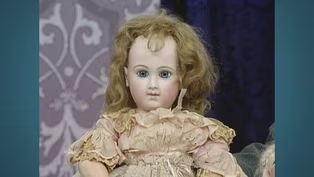
Well, this is a very fine example of a Jumeau doll.
Um, it's an EJ, and there are some features that I'd like to point out on the doll that I think really make it stand out as a fine example.
Um, the first thing is the paperweight eyes.
You can see the eyes here, the blue eyes, the paperweight eyes, as well as the closed mouth.
Closed mouth dolls are more valuable than open mouth, for some reason, they, they have-- collectors look for the closed mouth.
Also the, the bisque itself.
You can see how nice the bisque is, all in this area.
This is very important because if there are any hairline cracks or anything else, that really makes it less collectible.
The other nice thing is, is that you can see on the hair there's a pate, a cork pate that is right here.
And that's very important, and that appears to be original.
The final thing that makes the-- in determining its value is on the back here.
There is an incision.
And you can see incised here it says "EJA10."
Right.
And that gives us some indication of when the piece was made.
Which with that marking, it appears to be around 1880 through about the 1900s, is when they produced that.
The final stamp on this, which really makes it important, is the body is very important.
Um, it's a composition body, uh, which was very common.
Jumeau made a number of composition bodies.
But if I can turn this around, I will show you that on the back here... ...is a stamp that says Jumeau as well.
Which means that the body and the head both match, which is also very important.
A stamped Jumeau body is much more desirable for a collector than just a regular... ...body.
Now, what would you think something like this might be worth?
I really haven't kept up with them.
You haven't-- really?
Really?
No.
Well, what would, what would you do if I told you this could, this could possibly bring $10,000?
Whoa.
(laughs) That would be very nice.
Yes.
Um, it's, it's a fine example.
And because the head and the body are both marked... Mm-hmm.
...I think you have a wonderful potential here to bring that much at auction.
Great.
You've brought two instruments, I see.
Um... Right.
But you both play these, is it?
No, no.
No?
And whose instruments are these?
They were my, my adopted father's.
...on down.
And I think this was passed down from my-- to my father, from my grandfather.
From your grandfather, so a representation here of four generations, amazing.
Or more.
Or more.
Can you tell me anything about this instrument that, that you know about?
The history of it?
The only thing that I know is that my grandfather and my father both played it.
And what did he ever tell you about this instrument and where it was from and who made it?
Well, he told me that it was a Stradivarius.
That it was a Stradivarius.
Right.
And that, um, it was named after his second wife.
Your husband's sec-- no.
No, no.
An-Antonio Stradivarius.
Antonio Stradivarius's second wife.
Right, and her name was Faciebat Anna.
Her name was?
Faciebat.
Faciebat Anna.
Mm-hmm.
And her name, Faciebat Anna, would be in here.
Right.
Okay.
Um, that's... ...actually, I wasn't aware of Stradivarius's second wife, um, but, uh, it-- this is amazing.
Amazing story connected to it.
Any history here on this one?
This one, I just, I don't really know... Mm-hmm.
...that much about this one, I do know this one, but not, not so much this one.
Not so much on this one.
Right.
Well, this instrument, I, I hear that word "faciebat anno," and though I, I failed Latin, I think, uh, I think it's going to tell us something in here once we look and we light it up.
Um, and in fact, yes, it says in there, "Antonius "Stradivarius, Cremonensis, Faciebat Anno 17."
And then there's a blank.
"Faciebat Anno" actually means "made in."
"Facie," made to construct, made in the year.
"Anno," "anno 17," and then a blank.
There-there's a date on that.
Mm-hmm.
Um, but looking at the instrument, I'd have to say that it is not Italian work, not the work of Stradivarius, but in fact, trade work, German mass-produced early 20th century.
And we can identify that by the quality of the varnish, the quality of the work, not the workmanship that we want to see in Stradivarius.
So not quite as exciting as maybe the, the family history goes along with.
But what's interesting is I'm looking at this violin and I find it a little more exciting.
And this is the instrument that you don't know much about.
This violin, on the other hand, uh, is German work again, but much earlier and of a very high quality.
Um, made in probably Saxony, that eastern region of Germany, and made by one of the makers.
I would probably guess Hammig was a very prolific maker at that time, about 1850, 1860s, thereabouts-- and a very nice fiddle.
This violin, though purported to be a Stradivarius, has a value of maybe only $200.
While this instrument quite easily would be worth about $4,000.
Or better-- it's very excellent quality work.
And it's, it's a, it's a good example where a false label placed in an instrument... ...masquerades for quite a long time as being wonderful work.
While this instrument, unlabeled, is really the finer piece.
GUEST: I know that it was purchased by my grandparents in 1911.
APPRAISER: Mm-hm.
In, uh, Denmark.
Uh, my grandfather was from Denmark.
And they had to return because they had a set of twins, and so... Return-- oh, okay.
Return to the old country.
(chuckles) I see, I see.
And at the time my grandparents had bought this... Yeah.
...uh, they were homesteaders in South Dakota.
And, uh, those were tough times.
Really?
And I can imagine them making a late night cup of tea when it was 40 degrees below zero outside.
Yeah.
Because obviously it's been used.
Um, there was-- Well, I was going to say it, it, it has a, you know, very, uh, elegant look for somebody who was homesteading at that time.
(laughing): Yeah.
Yes.
It's interesting that you said that they bought it in Denmark, because the marks that are on here indicate that it was made in Germany.
There is a little, um, monogram here.
I noticed that, yes.
It's actually kind of a little ostrich running in a, in a diamond.
And it's, uh... Is that what that is?
(laughs) It's, it's the mark for a German metal company... Uh-huh.
...uh, WMF or, uh, Württembergische, uh, Metallwaren... ...Fabriken.
Fabriken.
This was made around 1911.
This has a little alcohol burner here.
Is this, is that what the fuel would be?
Yeah, it would have been, uh, uh, alcohol.
Okay.
If we, if we pull this out, uh, it, I've never tried to light it, but it does adjust up and down.
It adjusts, absolutely, yeah.
Uh, quite a bit, and, uh, obviously it's been well-used.
Uh, but it is, uh, it kind of epitomizes a school of design that was, was occurring in, in both Germany and Austria at the time.
Mm-hmm.
Uh, in Austria, it was the, uh, Secessionist.
In, uh, in America, it was, uh, Frank Lloyd Wright and the Arts and Crafts movement.
Mm-hmm.
In, uh, Germany, they called it the, uh, "jugendstil," meaning modern movement.
Oh yes.
Mm-hmm.
And so from 1911, you have this very, kind of, severe and conscientiously-designed teapot.
I don't know if we could put an exact designer's name to the piece, uh, but it certainly is inspired by some of the designs of-of Vienna and Germany.
Notably, a designer named Peter Behrens comes to mind, but I don't think it's by him, but merely by a factory designer... Mm-hmm.
...from, uh, the factory at the time.
But today there's been a resurgence of interest in, in this period-- in this condition, which is nice, original condition, uh, it may have a value of around $800 to $1,200.
Mercy sakes.
Yeah.
That's a, a surprise.
Thanks for bringing in your interesting tea kettle.
APPRAISER: This image from Donald was from "Der Fuehrer's Face."
GUEST: Yes.
Which was a Disney short from 1943.
Yes.
Mm-hmm.
And it also has the original Walt Disney production stamp on it.
Yes.
These were paintings that were done originally for the film.
Some of them were rewashed and reused.
A very similar image to this just sold, and it sold for over $4,000.
I would certainly value yours at around that, or even a little higher.
GUEST: I've been involved with a program called the Amigo program.
And it's for students from all over the world to come here and learn English.
And I've been sponsoring students mostly from West Africa and Central Africa.
There was a student from Dahomey-- at the time, it was Dahomey.
It's now called Benin, West Africa.
We spent time together.
He brought his wife over toward the end of his stay here, and they brought this as a gift and presented it to me.
Oh, great.
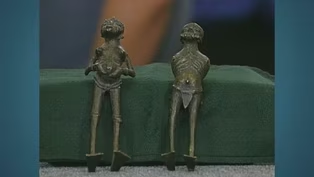
At the time, he just said they were antiques.
I knew-- didn't know too much about them, and still don't know too much about them, but I was fascinated by them.
Bronzes from West Africa are highly collectible, and consequently, they can be extremely expensive.
And, in fact, the, uh, tradition of bronze making in Africa really goes back to the 15th, 16th century.
Wow.
Bronzes can be very tricky.
And one of the things that we look for is we look for the style of the piece.
We look at the surface to see if it's had wear on it.
Now, these objects here... are cast, but the casting is-- is just not very fine.
There is a, a foundry which is actually not in Nigeria or Old Dahomey, which is the Republic of Benin, but it's in the Cameroons.
Oh.
And most of this material now comes from the Cameroons.
And these objects, I believe, are in that group.
Oh, okay.
And... Stylistically, as the aesthetics of the piece... Mm-hmm.
...they're very long and drawn out.
This is not what the old ones really look like.
They're actually new pieces.
Okay.
And they can be really admired and enjoyed as African folk art.
Yeah.
Yeah.
And I would say that these are probably worth about $50 apiece.
Oh, okay.
And, and how old would you think, just recently would you say?
I-I think they're very new.
Oh, okay.
I think that they're certainly not, um, older than maybe the '50s.
Okay, okay.
Do you have any questions?
Not really.
I just love them regardless.
Well, great.
I think they're beautiful.
I hope you enjoy them, and thanks so much for coming.
I will.
Thank you, I appreciate it.
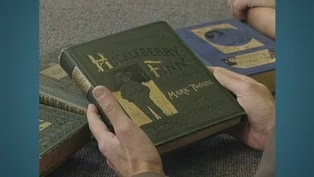
Debbie, you have a very generous aunt, it seems.
She sent you these books and some more, you were telling me?
Yes, I get boxes from her about twice a year.
My uncle and her were both avid collectors.
One of these books caught my eye, uh, as being quite a bit more important than the others, and I wonder if you might know which it is.
The Mark Twain.
Well, that's right.
This is a first edition, and it's quite a valuable book.
But more important, in a way, it's a very important book in... American literary history.
The copyright is 1884, and that's when the book was first published in London.
But it wasn't published in America until the next year, 1885.
Now, we know this is a first edition not only because of the date, but from several other points that I was able to look at.
If you can look in the... margin here, you see that little stub that runs along the title page?
Uh-huh.
Originally, this was printed with a date of 1884 on the title page.
And they realized the book wasn't going to be published in time for them to get it out that year.
So they cut out all of those title pages and glued in a title page with the correct date.
If this did not have this tipped-in title page, but a printed title page part of the book, it wouldn't be that first printing.
There are several other things that show that.
In the list of illustrations you can see, for page 88, it calls for an illustration, "him and another man."
Mm-hmm.
When we turn to page 88, however... There's no illustration.
Here is the illustration, "him and another man" on page 87.
On page 57, there's something similar.
Near the, uh, about two-thirds of the way down, uh, there's a line that should read, "he ripped a hole in the bottom of it with the saw."
But in fact, it says, "he ripped a hole in the bottom of it with the was."
They misspelled the word saw.
That was also corrected.
Page 155 was misprinted in the first edition.
There's 156, there's 154, but 155 came out simply as 15.
And finally, on page 283... there was an illustration of... Huck Finn meeting, uh, Uncle Silas, Tom Sawyer's uncle, actually.
Mm-hmm.
And while the book was being printed, someone drew a naught-- rather a naughty addition... (chuckles) to, uh, Uncle Silas's trousers, uh, if I can put it that way.
So again, they had to cut out all of those pages, print a new one, and glue it in, which again, you can see in the margin here.
Now, oftentimes, a first edition of Mark Twain's "Huckleberry Finn" will have some of those points, but it's very unusual to find one that has all of them.
Now, you picked this out as the most important book.
What do you think it might be worth?
I have no idea.
None.
I-I just, I, I can't even imagine.
Well, as I say, it's very important in, uh, American literature.
And in this condition, which is quite good, a little bit worn at the top and the bottom of the spine, a collector would probably pay something in the range of $1,500 for it.
I would say, uh, in this particular box, your aunt was extra generous.
(chuckles) GUEST: It's a coconut.
It was hand-carved for my aunt over 100 years ago, uh, in Veracruz, Mexico.
It has-- it's covered with marigolds and, uh, little ivy, uh, wreaths.
It has her initials on the front.
I was named after her, so it's very special to me.
On the other side, there's, um... Well, these are the initials of the man who had it carved.
And then, on, uh... a little further around... there's a fortress in Mexico.
And, uh, we were told that the coconut was carved by, uh, uh, one of the prisoners.
Well, all the information you have is correct.
And according to her age, uh, this was probably carved in the mid-1890s.
Mm-hmm.
Um, most of these come from a prison in Veracruz and that's where this fort that is located on the side.
The detail in the carving is just wonderful.
What's really nice is that it does have her initials and the initials of her-- I guess her boyfriend?
On this side.
And, uh, these were carved from the mid-1800s, 1830s on through the turn of the century.
From time to time they are carved now, but not very often and never with this kind of detail that you see on this.
Uh, do you have any idea of what it's worth?
No, I don't.
These generally, when they show up for sale, which is rare, bring anywhere from $350 to $550.
Every so often, you'll find one with military scenes or battle scenes from prior to 1850, and they'll bring over $600 apiece.
Mm-hmm.
So, it's... It's interesting.
It's really a beautiful little piece of folk art and a lot of people see them and don't know what they are.
I'm really glad you brought it in today.
Well, thank you.
That's-- I appreciate the information.
Thank you.
So you've been telling me that your aunt was the original person... Yes, yes.
...in your family to own this.
Yes, uh-huh.
And where did she have it?
In Kenilworth, Illinois.
Okay.
Yeah, she and her husband built a new home there in 1931.
And this is one of the things that they bought to decorate, and it was used in his den.
Wow.
We've got a very, very beautiful painting here.
It's actually on porcelain rather than canvas or board or anything.
And the qualities of the light and the dark and the shadows and the use of that is really very beautiful.
And so we look a little closer and we try to find a signature.
And on this one it's actually sort of easy to see.
Right.
Sometimes it's hidden under the frame, but if you look right in this corner, just in dark, you can see it's signed Wagner.
Uh-huh.
Now, he was a very well-known painter of the 19th century.
Oh, really?
Great.
He painted on porcelain, and many of his things have come up before, um, privately and at auction.
Okay.
And the quality of his work is collected, um, by many people.
He did very many different styles, um... The pieces that will bring the most money are the naked ladies... (laughing): Oh, yeah, sure.
...the nymphs and things, in sheer... ...uh, drapes, et cetera.
But you can see that the quality of his work is very good.
I would expect this piece to be by the Berlin factory, the King's, uh, Porcelain Factory.
Right, right.
And to do that, um, it's... probably going to be signed on the back.
So I want-- just want to take the back off... All right.
...if that's all right with you.
We have something here already... Um... we have the title of it.
It's called "Smoker," in German.
It also has a country name, which would have been for export.
Now, looking in this corner, it's very, very difficult to see, but perhaps you can see there is a scepter mark... I see that, right.
...and the initials "K.P.M."
It's a beautifully painted piece.
It's by someone very well-known.
Um, its size is good.
So, because this one is... maybe not one of the beautiful maidens that's num-number one in the collecting category, I'd say for a piece in this size, we'd probably be seeing about $2,500 to $3,500 at auction.
That's extraordinary.
(both chuckle) Unexpected.
Exac-- So... This is one of my favorite things, so it's a keeper... Good, see?
...as far as I'm concerned.
Good eye.
Good eye.
We have here is the interior of a Pullman, uh, train car.
We have all the mattresses, the blankets, the extra pillows.
This particular example is in amazing, original condition.
It's a absolutely lovely toy, and you've been certainly very good in taking care of it.
Mm-hmm, thank you.
APPRAISER: You really brought something very interesting to our "Roadshow" today.
Oh, well, thank you.
And it has all the right marks on it, Where the dark spots are, you have Russian hallmarks.
And also on the gold motif right over here, you have a 56.
In Russian, that means 14 karat.
And it even goes further and says who made it.
The man's initials are on there.
So you can look it up and get a rough idea when it was made.
Now, getting back to the uniqueness of this particular piece, uh, it's been put together.
It's not original.
Oh, really?
It's been put together by some good craftsman and some bad craftsman.
Okay?
(laughs) I think there was two hands on this one.
Mm-hmm, mm-hmm.
If you look, it's supposed to be a Russian egg.
Mm-hmm.
There's one egg on top and one egg on the bottom, see?
Right.
Now, the enameling on the egg is done beautifully, and the engraving underneath the enamel is also done magnificently.
It's in the realm of Fabergé, but it's not Fabergé.
Oh, really?
Yeah.
Next thing.
Whoever put this together used some sort of enamel epoxy... Oh.
...to adhere this egg to that egg.
Hm.
Because Fabergé would never put two eggs together.
He'd put one egg inside another egg, but he would never put one on top of the other.
On top of the other.
The other thing is the, uh... I think that's St.
George the dragon... Mm-hmm.
...but it's not really St.
George, because St.
George is really on a horse.
This particular person is standing up.
Mm-hmm.
So that tells me it's also not original.
Oh, really?
If this was original and was Fabergé, it would bring somewhere around $4,000 to $5,000.
In the state it's in, married, it's only going to bring somewhere between $300 and $500.
Oh, really?
Yeah.
I'm sorry to tell you the... Well, that's all right.
...some good news and bad news.
(chuckles) GUEST: I inherited it from my uncle.
I guess he wouldn't have had it if he, he didn't think it was pretty good.
APPRAISER: Was he a collector or was he a traveler, or... No, he was a little bit of a collector, but he was an artist also.
He was.
Did he travel to Australia at all?
Oh, yes.
He traveled, uh... actually in-- to 93 countries in the world.
Well, he brought your family back a wonderful treasure.
This is a watercolor done by an Aboriginal artist, an Australian Aboriginal artist... Yeah, mm-hmm.
...by the name of Namatjira.
What we have here in terms of the market and the, the desirability of it, it's something that, you know, several years ago would've been seen as an ethnographic piece.
As the world gets smaller and smaller, and as the art market gets more local artists like this, from the '30s, painting in Australia, from a small tribe, are getting much more world recognition than they had before.
And because of that, there's a great deal of desirability for the piece.
One of the things that we also look at is the condition of the piece.
You must be keeping this in a nice, dark room.
In the basement, really.
(chuckles) Sometimes the basement is the best place to keep pieces, because they don't get all banged around and have problems with light at all.
So it's in really wonderful condition.
Uh, a great Australian scene by an Aboriginal Australian artist whose work comes up infrequently at market, but enough that there's a very good following for the artist and people look forward to seeing his work sold.
A piece like this in this condition, I would probably value at between $3,000 and $5,000.
So, did... (laughing): I had no idea it'd be that much.
Well, that's great.
Did he bring you any other treasures or is this it?
Well, I better look around.
(laughs) Better look around.
GUEST: It belonged to my grandparents, who came from New England.
Okay, uh-huh.
It was in the family before I was... I was raised by them.
Right.
And, um, it sat in our house and had linens in the bottom, and, and writing paper.
I don't remember anybody ever using it really... Nobody ever... ...to write with.
Okay.
It's a little high.
And I don't know much about it.
Okay.
We used to have an antique shop.
My grandfather had what he called the big clock museum.
Really?
And I can remember having open houses and, and-- people coming by when I was a little kid... Okay.
...saying how beautiful it was, and it was a curly maple, da-da-da-da-da, I don't remember.
Right, right.
'Cause it has-- it has pizzazz, right, right.
Yeah, and I didn't remember any of it.
Well, this would've been-- this would've been kind of the 18th-century, uh, Rolodex or Filofax a gentleman would've kept, or a lady.
There's things in here.
Their inkwell with some papers and, uh... quills inside.
Okay.
And your desk was made in New England, probably New Hampshire.
Okay.
Uh, between probably 1750 and 1785 or 1790.
That old!
Okay.
Yep.
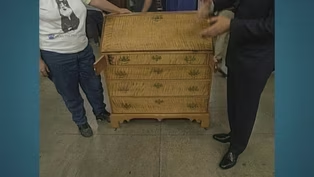
It's a Chippendale, uh, slant-front desk, is what we call it.
Chippendale slant-front, okay.
Front-- slant-front desk.
And this tiger maple makes it especially wonderful, 'cause you have this vivid, contrasting, uh, tigering that, that brings your eye up the front, up the lid.
You have this contrasting tiger maple here, and even on the top... And the sides, because tiger maple was really special.
The sides are fairly, fairly plain, as you can see.
Right, right.
And, it... condition-wise, 'cause it's a wonderful desk-- condition-wise, it has some problems.
Okay.
Somebody, because they probably revered it so much, they refinished it.
So they took all the original surface off.
And so you have this-- it's al-- it's what we call in the business "skinned."
Okay.
It's been skinned, because it's really been cleaned off.
Okay.
They've also replaced the brasses.
These are not period brasses.
They're copies of 18th century brasses.
Ah, okay.
And you can see that by looking inside, and you see the-- a, a hole, which is one good way of telling that the brass is replaced.
You can see the hole... The original hole.
Okay.
...where the original width was.
They put a replace set that didn't have the same width on it, and put them in.
Okay.
But they do the trick.
And most importantly, the entire base, Fritzie, is new.
Okay.
And... How new?
It's probably-- I guess it's probably made-- it was done within 30 or 40 years, but, it's... it may be even 45 years.
All right.
They didn't try to fake it up... It has-- see how sharp and crisp it is?
You can almost cut yourself here.
Yeah.
It's-- it's just a new base in the Chippendale style.
Okay.
And it's a little bit out of whack.
This scroll is a little too close to this bracket to look authentic.
So they didn't quite get-- you know, capture the-- Okay, okay.
What would have been there originally.
But this is fairly good.
This nice drop pendant, that's done fairly well.
I like this break on here, I don't-- was that always, has that always been on here?
Uh, I have that piece, at home... Okay.
...because I didn't want it to get lost.
Well, it's nice 'cause it shows the dovetail, uh, on the side.
You can see how it was made.
The front slides onto the side and makes this wonderful dovetail.
Right.
Fritzie, if this had its original finish, its original brasses, and its original feet... Okay.
...it would be worth in the range of about... (clears throat) $15,000 to $17,000.
Okay, original with everything, okay.
Everything original.
As it is... Mm-hmm.
...because it's been refinished, because the brasses are replaced, and most importantly, because the feet are new, it's worth about $1,200.
$1,200.
Okay.
$1,200.
Big difference.
Now, you might in a shop, get somebody to... somebody might mark it $1,500, but in that range is what it's worth.
Okay.
About a tenth of what it would have been worth.
Okay.
APPRAISER: I see there's a nameplate with initials and a date on it.
GUEST: Well, yes, it's the monogram of my great-grandfather, who I'm told designed the railroad system in Germany.
Tsar... it must've been Alexander, came to Germany and said that he wanted a railroad system comparable to Germany's.
And so it ended up that he became a consultant, or he hired my grandfather, who was an engineer, to design the system in Russia.
Don't know the value of-- of this set.
It was a gift by Tsar Nicholas.
Um, the, the dates on the top are 1873 to 1898.
Well, let's open it up and see what the set is.
Um... we have-- The thing that I-- I think is so remarkable is the fact that it's lined in doeskin, and then that little tufted pillow, in all these years it hasn't fallen apart.
And what's very interesting about the case is each piece has an individual niche to hold it.
So there's no mistaking where anything goes.
And it's a combination of silver and porcelain.
But the silver is of Russian manufacture.
Uh, the porcelain is Sèvres, it is French porcelain.
What is the gold brushing on the silver?
Um... Is that, is that typical?
It's, it's gilding, uh, it's called silver gilding.
And it's a wash of gold placed over the silver.
What's happened through the years, it's, it's become a little worn from polishing.
Uh.
but there's another interesting technique involved in the silver manufacture called niello work.
And that's the black stain that you see... on the silver surface itself.
Yes.
It's a permanent black dye.
So it's, uh, not only silver, but it's silver gilt and niello.
According to the marks on the back, uh, the, the items were made in Moscow in 1871.
So the set is older than the date it was presented to your great-grandfather.
Um, and it was put together.
They found a nice three-piece tea set with matching tray and added the teacups and saucers.
Probably because of the association with the tsar, with your great-grandfather, what he did in the country, the interesting silverwork... Uh, probably a fair market value would be around $4,000 for the set.
And it's very nice.
Well, thank you.
GUEST: The story is that Pancho Villa killed a man in Mexico City and took the watch off of him.
Then, he ended up in Alpine, Texas, where he traded this watch to Mr.
Kasner for a brand-new Buick automobile.
Mr.
Kasner sold it to a Dr.
Middlebrook from Del Rio, Texas.
My father told the doctor, "if you ever want to sell that watch, please give me first chance at it."
Dr.
Middlebrook died several years later and his widow called my father, and my father bought the watch.
And he never would tell anybody what he paid for it.
(chuckles) Now, I can't-- I cannot... I cannot prove any of this, and believe me, I've tried.
I understand.
Well, let's take a look at the watch... All right.
...and talk a little bit about what could be true about the story.
Um, if you examine the watch on the dial, it does have the name of a jewelry store in Mexico City.
La Esmeralda.
It is from the era.
The story could be true.
Right, right.
The watch is from before the turn of the century.
Right, La Esmeralda's closed up.
I had a friend in Mexico City check that out.
The initials of the original owner are mounted on the case, which is 18-karat gold and rose diamonds.
And then there's a watch fob charm in 18-karat gold that matches.
It opens as a locket.
There are no pictures left in it, which is too bad.
No.
Pancho Villa probably took 'em out.
There are diamonds all the way down the chain, which is in two colors of gold.
The casework is French or Swiss.
And the watch movement is a Swiss chronograph.
It does moon phase, it counts off the days of the month.
It has a stopwatch function that works by pushing this here.
The lever here is to make it chime, which is sometimes called blind man's function.
It-it-- people who couldn't see could tell the time by pushing this lever and counting the chimes.
Oh, how interesting.
Let me see... (faint whirring, chiming) It is a separate little spring that makes it ding.
(faint chiming) Faintly, faintly hear it.
I love to hear that.
But it's considered a very, very complicated watch because each dial has to have a separate part of the watch movement.
It's enhanced by, by the fact that the materials in it are very, very high quality and that the chain and, and fob match the watch and are original to it.
Would you have a guess as to how much this watch might be worth in today's market?
No idea.
That's, that's what I... That's what I'm doing here.
Somewhere between $30,000 and $50,000.
It's magnificent.
Would it be worth more if I could prove the story?
Definitely, definitely.
That's what I thought.
(chuckles) I've tried.
But it is possible, from the serial number of the watch to find out for whom it was originally ordered and trace the story back that way.
It'll take... Well, that'll be a nice job for you, Fred.
Take some time.
(laughing): Yeah.
Thank you very much for coming to show it to us.
It's a fabulous watch.
Thank you.
Thank everybody.
Thank you, everybody.
It was fun.
PEÑA: You're watching "Antiques Roadshow: Vintage First Finds."
Travel with "Roadshow" anytime.
Stream full episodes, follow @RoadshowPBS on social, and sign up for our newsletter at pbs.org/antiques.
More vintage "Roadshow" right after this.
♪ ♪ (indistinct chatter) (wires shifting) (clattering) ♪ ♪ MAN: There we go.
♪ ♪ I don't think so.
♪ ♪ (grunts) PEÑA: Thanks for watching.
See you next time on "Antiques Roadshow."
Appraisal: 1885 Mark Twain First Edition
Video has Closed Captions
Clip: S30 Ep18 | 3m 51s | Appraisal: 1885 Mark Twain First Edition (3m 51s)
Appraisal: African Folk Art Bronzes, ca. 1950
Video has Closed Captions
Clip: S30 Ep18 | 2m 15s | Appraisal: African Folk Art Bronzes, ca. 1950 (2m 15s)
Appraisal: Chippendale Slant-front Desk, ca. 1775
Video has Closed Captions
Clip: S30 Ep18 | 3m 38s | Appraisal: Chippendale Slant-front Desk, ca. 1775 (3m 38s)
Appraisal: Emile Jumeau Doll, ca. 1890
Video has Closed Captions
Clip: S30 Ep18 | 3m 13s | Appraisal: Emile Jumeau Doll, ca. 1890 (3m 13s)
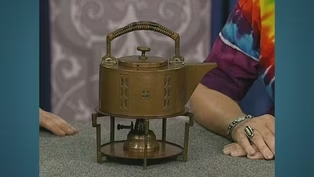
Appraisal: German Tea Kettle-on-Stand, ca. 1911
Video has Closed Captions
Clip: S30 Ep18 | 2m 32s | Appraisal: German Tea Kettle-on-Stand, ca. 1911 (2m 32s)
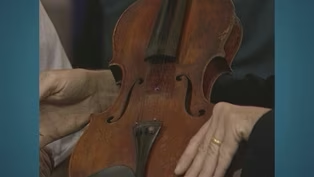
Appraisal: Hammig-attributed Violin & German Violin
Video has Closed Captions
Clip: S30 Ep18 | 3m 42s | Appraisal: Hammig-attributed Violin & German Violin (3m 42s)
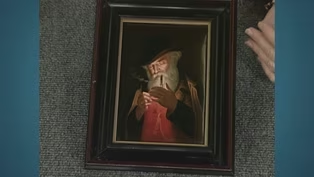
Appraisal: Late 19th C. Wagner Painted KPM Plaque
Video has Closed Captions
Clip: S30 Ep18 | 2m 34s | Appraisal: Late 19th C. Wagner Painted KPM Plaque (2m 34s)
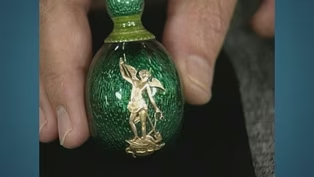
Appraisal: Late 20th C. Faberge Style Egg
Video has Closed Captions
Clip: S30 Ep18 | 2m 9s | Appraisal: Late 20th C. Faberge Style Egg (2m 9s)
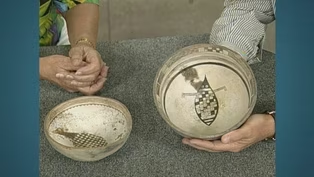
Appraisal: Mimbres Pottery, ca.1050 CE
Video has Closed Captions
Clip: S30 Ep18 | 3m 39s | Appraisal: Mimbres Pottery, ca.1050 CE (3m 39s)
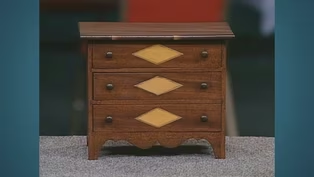
Appraisal: New England Miniature Chest, ca.1825
Video has Closed Captions
Clip: S30 Ep18 | 3m 29s | Appraisal: New England Miniature Chest, ca.1825 (3m 29s)
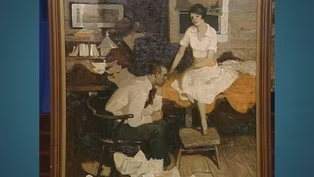
Appraisal: Oscar Namatjira Watercolor
Video has Closed Captions
Clip: S30 Ep18 | 1m 57s | Appraisal: Oscar Namatjira Watercolor (1m 57s)
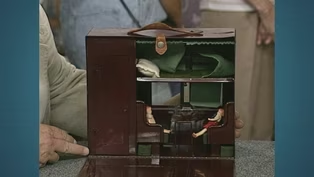
Appraisal: Playskool Pullman, ca. 1930
Video has Closed Captions
Clip: S30 Ep18 | 1m 4s | Appraisal: Playskool Pullman, ca. 1930 (1m 4s)
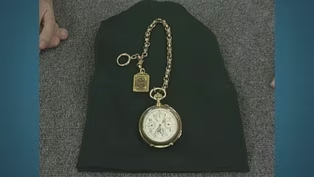
Appraisal: Pocket Watch with Fob Chain, ca. 1885
Video has Closed Captions
Clip: S30 Ep18 | 3m 10s | Appraisal: Pocket Watch with Fob Chain, ca. 1885 (3m 10s)
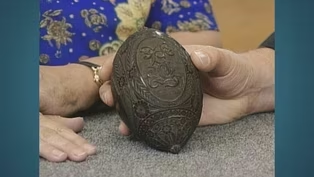
Appraisal: Prisoner-carved Coconut, ca. 1895
Video has Closed Captions
Clip: S30 Ep18 | 2m 12s | Appraisal: Prisoner-carved Coconut, ca. 1895 (2m 12s)
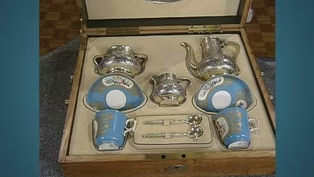
Appraisal: Silver & Porcelain Tea Set in Box, ca. 1898
Video has Closed Captions
Clip: S30 Ep18 | 2m 44s | Appraisal: Silver & Porcelain Tea Set in Box, ca. 1898 (2m 44s)
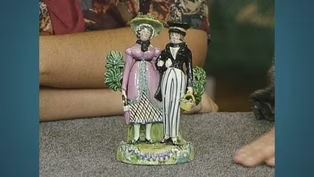
Appraisal: Staffordshire Figurine, ca. 1815
Video has Closed Captions
Clip: S30 Ep18 | 1m 54s | Appraisal: Staffordshire Figurine, ca. 1815 (1m 54s)
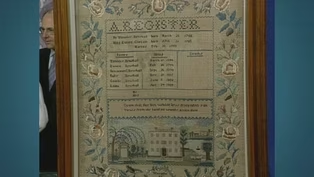
Appraisal: Tiffany Favrile Glass, ca. 1910
Video has Closed Captions
Clip: S30 Ep18 | 3m 10s | Appraisal: Tiffany Favrile Glass, ca. 1910 (3m 10s)
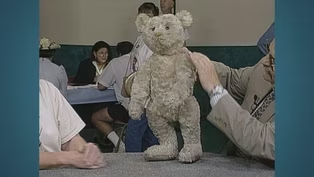
Appraisal: White Steiff Bear, ca.1925
Video has Closed Captions
Clip: S30 Ep18 | 3m 10s | Appraisal: White Steiff Bear, ca.1925 (3m 10s)
Preview: Vintage First Finds, Hour 3
Video has Closed Captions
Preview: S30 Ep18 | 30s | Go back to the beginning for value updates on finds from ROADSHOW’s very first season! (30s)
Providing Support for PBS.org
Learn Moreabout PBS online sponsorship New Episode
- Home and How To

Hit the road in a classic car for a tour through Great Britain with two antiques experts.
 New Episode
 New Episode

 New Episode







Support for PBS provided by:
Funding for ANTIQUES ROADSHOW is provided by American Cruise Lines and Ancestry. Additional funding is provided by public television viewers.