
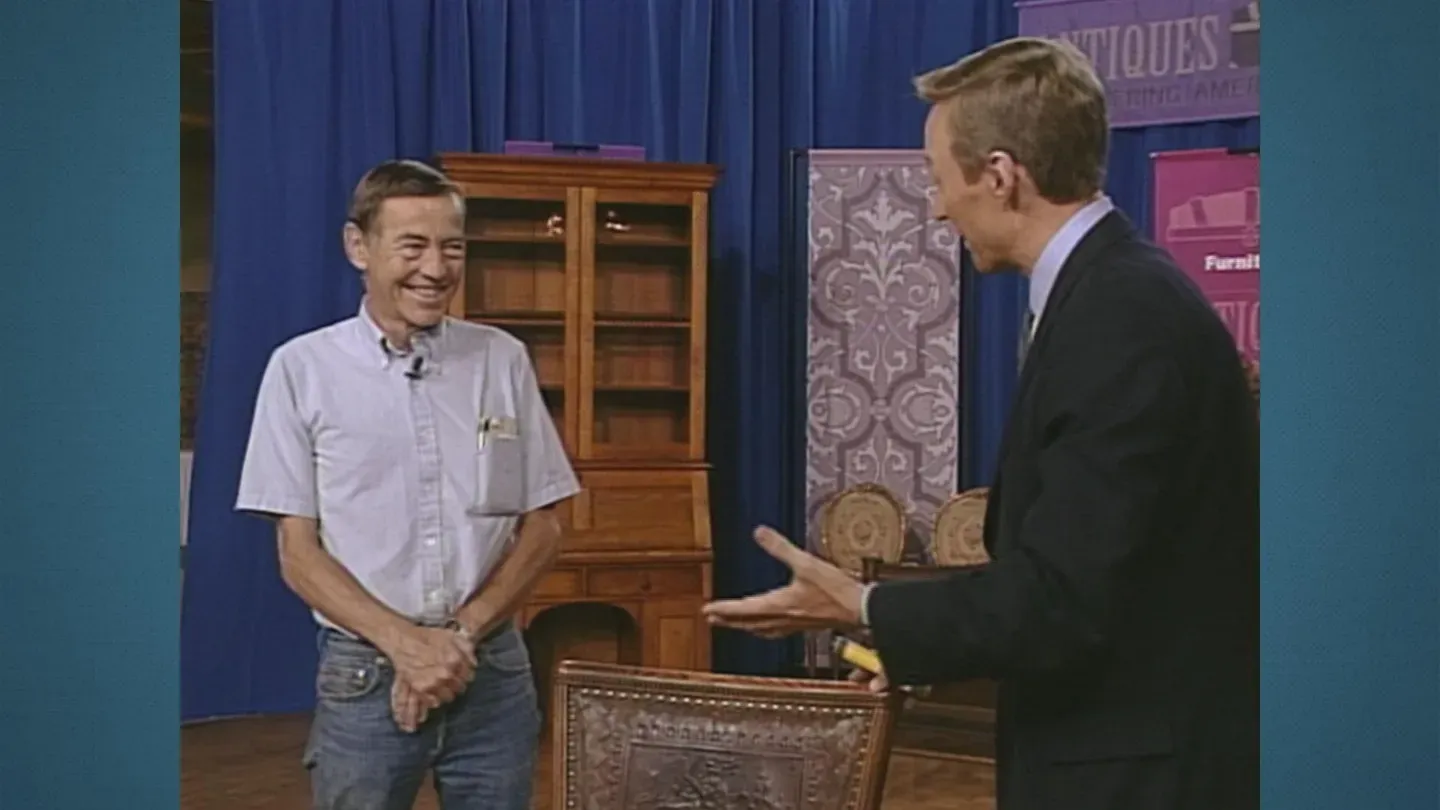
Vintage First Finds, Hour 4
Season 30 Episode 19 | 52m 45sVideo has Closed Captions
See fabulous finds from ROADSHOW’s first season updated with today’s values!
See fabulous finds from ROADSHOW’s first season updated with today’s values including an Albrecht Dürer engraving, an 1870 J. L. Stone limestone temperance jug, and an 11/22/63 news ticker tape. One treasure increases in value to $60K-$90K!
Problems playing video? | Closed Captioning Feedback
Problems playing video? | Closed Captioning Feedback
Funding for ANTIQUES ROADSHOW is provided by American Cruise Lines and Ancestry. Additional funding is provided by public television viewers.
Support provided by:


Vintage First Finds, Hour 4
Season 30 Episode 19 | 52m 45sVideo has Closed Captions
See fabulous finds from ROADSHOW’s first season updated with today’s values including an Albrecht Dürer engraving, an 1870 J. L. Stone limestone temperance jug, and an 11/22/63 news ticker tape. One treasure increases in value to $60K-$90K!
Problems playing video? | Closed Captioning Feedback
Where to Watch Antiques Roadshow
Antiques Roadshow is available to stream on pbs.org and the PBS app.
Buy Now

ANTIQUES ROADSHOW's 2026 Production Tour
Enter now for a chance to win a pair of free tickets to one of the three stops on ANTIQUES ROADSHOW's 2026 Tour. Sweepstakes entry deadline is April 6.Providing Support for PBS.org
Learn Moreabout PBS online sponsorship♪ ♪ Well, you were a good little boy.
You kept this toy in very good condition.
Oh, my God.
Was just hanging there in the hallway.
We just walked by it.
APPRAISER: So is that a surprise?
It certainly is.
♪ ♪ CORAL PEÑA: Three decades ago, we set out on a 13-city mission to find America's greatest treasures.
Join us now as we revisit four Western cities from our inaugural season.
We're dusting off the archives to see how 30 years have transformed the value of these memorable finds.
Everything old is new again, as we look back in this episode of "Vintage First Finds."
First, I want to show the jug just a little bit for the camera.
It is absolutely an incredible piece of ceramic art, with writhing snakes and spiders all over the jug.
There's a little bit of blue decoration on a man who is sitting in the center of the jug.
His hands are sticking out of the jug, and a snake is biting him on the head.
Tell me everything that you know about the history of this jug.
Well, I acquired it from my mother, and we had it in the house when I was growing up, and I always thought it was kind of neat.
And she told me that it had been on, sitting on a highboy outside her bedroom in the family home when she was growing up.
She's from Leavenworth, Kansas, and my grandfather was mayor of the town, and he also owned the creamery and dairy in Leavenworth.
And, um, she has no idea how he got it.
We assume someone probably gave it to him as a gift.
And since then, I've found out it's from Texas.
Right.
And we have no idea how it got to Kansas.
Well, tell me, how did you find out that it was from Texas?
Well, about, about a week after I brought it back from my mother's, I went to a yard sale near my house, and, um... I use a lot of quilts making crafts.
And this gentleman told me that he had a quilt.
So I went to his house, and he had all these crocks.
And I said, "Oh, I have a crock I got from my mother."
And I told him about it, and he says, "I know someone who would want to see this."
So he called, um, Georgeanne Greer, who was a local, um, Texas pottery expert.
And we went over to her house and, um, she went wild when she saw it, and, um, she told me that the gentleman who made it was an East Texas potter... Mm-hmm.
...from Limestone County, Texas, and was from the 1870s.
Well, Georgeanne Greer, I am familiar with her.
Unfortunately, I never did meet her.
But she passed away several years ago, after you met her, and she's looked at your jug.
And she was a very well-known collector, scholar, and author about Texas and Southern pottery.
She was very knowledgeable about all types of stoneware and pottery made all over the United States.
Did she tell you about the rarity of this jug?
Um, she said that there were prob... As far as she knew, there were only about six or eight of these jugs in the entire country.
And as far as she knew, there, there were none made in Texas.
Mm-hmm.
And so as far as she knew, this was possibly the only one.
Did she say something like that?
Yes.
Because Georgeanne Greer was so well-known and so knowledgeable in this field, if she says it's probably the only one known in Texas, it may well be.
Possibly, there are others undiscovered at someone's home, but, uh, it may be one of the very few around.
And what did Georgeanne Greer tell you that this jug might be worth when you talked to her a number of years ago?
Um, she estimated between $5,000 and $6,000.
My, that's quite a bit of money.
Um, there has been a lot of new interest in Texas pottery by Texas collectors, primarily, in the last few years.
And some examples, especially the rarest and most unusual examples, the prices have gone up considerably in the last few years.
There are a lot of museums who like to represent this sort of pottery in their collections.
And there's also a number of major private collectors who like this sort of thing.
I definitely agree with her that it would, might sell for, easily, $5,000 or $6,000, but who knows?
It might sell for $8,000, $10,000, $12,000.
I would not be shocked if it sold for that much, provided the jug was given a lot of promotion and all the right people knew it was for sale.
Because this is such a very specific and small area of collectibility, primarily just here in Texas.
Just like there would be regional things that would be popular in other parts of the United States, Texas things are popular with Texas collectors.
I'm really thrilled that you brought this in.
This is a great pot... Oh, I love it.
...and I hope you really tr, treasure it and enjoy it your whole life.
Oh, I do.
APPRAISER: Tell me about this toy-- when did you get it?
GUEST: It was given to me in 1945 for Christmas by my, uh, mother.
It was one of my favorite toys as a kid, and as a, uh, dealer and collector, it was probably the first toy I ever bought as a collector.
And it started a collection which started my career.
This is... As you know, it's a comic character toy.
It's based on the comic strip character Li'l Abner.
And this was one of the first postwar toys.
It was very, very popular.
It's fairly easy to find today, but seldom in such fine condition, with all the component figures with the original decorated box.
Box of a toy of this period adds a lot of value to it.
And what did they sell 'em for then?
Here you have an original price tag of $2.59 from F.W.
Woolworth.
Well, you were a good little boy.
(laughing) You kept this toy in very good condition.
I wish you'd kept the box a little bit nicer.
Well... But we... Hard to do.
(both laugh) This toy in today's market, at auction, would bring... ...a lot more than $2.59.
Do you have any idea?
No idea at all.
No idea.
Well, this toy would probably sell at auction for between $450 to $600.
Depending on the auction, depending on the day and the luck of the sale.
That's quite a increase in value.
Yes.
It's a beauty.
I haven't seen a lamp like this for some time.
Uh, can you tell me a little bit about it?
My uncle Joe Taylor-- my great-uncle, I guess-- he went to buy a house for he and my Aunt Zora, and he saw this lamp in the house.
He told the people, "I will buy the house if I can have the lamp."
They agreed.
Uh-huh.
So that lamp has been in the family.
I see.
We're looking at somewhere around 80 to 90 years.
I see.
That we know of.
Uh-huh, uh-huh.
So beyond that, I don't know.
Are you still in the house?
Uh, no, no, the house... (all laugh) The house is, is long gone.
We'll take a look at it with the, uh, with the shade off of the base.
We sometimes find a mark on the shade itself.
And this one, I don't, uh, I don't see the mark on it.
But we've established from the particular design that this one is a Pairpoint lamp made in New Bedford, Massachusetts.
Oh, really?
Oh!
This is what we call a reverse-painted lamp, because it's been painted on the inside.
The lamp has... ...right across this part of the, of the puffy, a mark that indicates... GUEST 1: Hm.
...a crack in the lamp.
Right down from here, at the top of the corner, following down to the base, is a crack that goes through the glass.
And while it's still fairly secure... GUEST 2: Mm-hmm.
...it is a, a fairly significant damage.
That affects its dam, its, uh, value quite a good deal.
I would tell you that its value, if it were perfect, would be roughly $5,000.
Mm-hmm.
And unfortunately, with a crack in it, its value is somewhere closer to $500.
Mm.
Oh, that's a shame.
That's a big, that's a big difference.
Yeah.
(chuckles) It is a shame, and unfortunately, w, we have no way of, uh, repairing a, a, a piece like that.
Mm-hmm.
It's what makes our remaining antiques more valuable.
What really sort of attracted me to this, uh, chair, Douglas, is this wonderful splat in the back.
Mm-hmm.
Uh, it's an Egyptian, uh, Revival, uh, splat.
And I, as you can see by my hair, I like things Egyptian.
(both laugh) And, uh, uh, this great scroll work, it looks as though it's a column holding up a, a temple in the Valley of the Kings, uh... Mm-hmm.
Can you tell me where you got this chair?
I got it in a fairly small shop.
I walked in, and I usually don't buy American furniture, so... Mm-hmm.
But I saw it, and it looked interesting.
And after about a week, I actually went in and bought the chairs.
Now, you've done some research on this chair yourself, correct?
A little bit, yes, yeah.
Yes?
And what did you find out about it?
Um, I found out that it could be attributed to a furniture maker called Duncan Phyfe.
Mm-hmm.
Mm-hmm.
And I know that there have been a lot of reproductions of Dun, Duncan Phyfe things, but I think... Yes, yes-- yes.
...that tended to be earlier-looking things.
Well, Duncan Phyfe is, uh, a maker of American furniture in New York City in the early 19th century.
Mm-hmm.
And he really was the premier, uh, furniture manufacturer.
He was a designer, and had, uh, many floors of, of craftsmen turning out his designs.
Mm-hmm.
Uh, he flowered, uh, in New York, and really put New York on the map in terms of furniture in the early 19th century.
I believe this indeed is a Duncan Phyfe chair.
Okay.
And it, uh, as you know, has a similar example in the Metropolitan Museum of Art in New York.
Yes.
It's wonderful that you found one in an antique shop in Seattle.
Uh, it's pretty terrific.
Yeah-- two, actually, but... Do you have a pair of these?
Yes.
That's even better.
Do you mind me asking what you paid for them?
Um, between $200 and $300 apiece.
Well, that, that indeed, uh, was a find, uh... I think, were I to place these chairs at auction... Mm-hmm.
...uh, that I would, uh, estimate them more aggressively than that.
I think they're chairs that, probably, the pair of them ought to fetch between $2,000 or $3,000.
Mm-hmm.
Uh, they're really quite wonderful.
Okay.
It's by the firm of Rookwood... GUEST: Yeah.
...which was, uh, manufactured in Cincinnati, Ohio.
The Rookwood Manufactory, um, uh, has everything very clearly marked on the bottom of these vases.
"RP" for Rookwood Pottery.
These little flame points around the monogram.
And then later, they used these Roman numerals.
And here we have an XV, which means this was made in 1915.
I bought it at a, um, at a sale, a, um... It's not a garage sale.
What do you call it when somebody's getting... An estate sale?
An estate sale.
And they had the prices on everything.
And I looked at it and I liked it.
Mm-hmm.
And I thought, well, I thought it... No, I didn't want it.
So I left.
Mm-hmm.
They had taken my name down.
And about, uh, ten days later, I got a call.
The house was empty, but she was still hanging over the fireplace.
And they said, "We will give you a good price on this "if you want it.
"We don't want to take it with us to California."
Mm-hmm.
So I bought it.
Well, it's a, it's a lovely portrait.
As we can see, uh, it's an 18th-century-style portrait of a woman.
Uh, we have a label here that says "Carl Van Loo."
Carle van Loo was a very well-known and important 18th-century French artist.
It would be consistent with him to be painting a beautiful court figure.
Uh, the issue with van Loo, though, and one that is consistent, again, with artists who were very popular during their life, is that you have pieces that are actually and completely by the hand of the artist, and then there are pieces that are studio, circle of, attributed to, friends of... Mm-hmm.
Uh, acquaintances.
So, in that, in that analysis of who the painting is by, you very quickly go from the high, high price, complete attribution, to pieces that are valued less... Right, right.
...uh, less than the original.
Right.
Uh... My sense, in looking at the quality and style of the piece, uh, based on issues such as the painting of the hand, so, it's rather rough, you know?
It's not as detailed and as sensitively done.
In general, there are some inconsistencies with the piece throughout.
Uh, you know, the handling of the drapery, for example.
Here, again, uh, it's rather heavy-handed.
So I do think that we're looking at someone who was looking at the artist, at, at van Loo, but perhaps not by van Loo himself.
Uh-huh.
And given that, uh, the value that I would put on the piece is a portrait in the style of the artist... Mm-hmm.
...rather than by the hand of the artist, with an estimate under $10,000.
GUEST: Mm-hmm.
APPRAISER: Perhaps $3,000 to $5,000, $4,000 to $6,000.
I recall this, the... Rodney Dangerfield, the comedian... (chuckles) ...he told a joke, he said... He'd s, say to somebody, "Your mama's cooking is so bad..." (chuckles) ...that when he went to fix the, the hole in the screen door in the kitchen, the flies pitched in to help.
(laughs) You know?
And the reason I mention it is because this is what this thing did, is, it kept out the flies... Yeah.
...and mice and all kinds of other things.
But how did you come across that?
I was in Santa Fe about 18 years ago with my mother... Right.
...and they were having an auction up there.
And she had seen this piece, uh, a year or so earlier in, in an antique shop in Albuquerque.
And at that time, they wanted $700 or $800 for it.
Okay.
And, uh, she didn't think too much about that.
She d, wasn't interested in paying that much, so... We saw the piece, then, about a year later in Santa Fe... Mm-hmm.
...and the... She paid, uh, uh, somewhere between $200 and $300.
She doesn't really remember.
It was quite a while ago.
At, at the auction?
At the auction, so... And you were there with her, you watched her buy it, and...?
Yeah, uh-huh.
Now... You'd gone to a lot of auctions, or did... No, she had been to quite a few auctions before.
Right.
But, uh, I think that was the first one in Al, in, uh, Santa Fe she did a bid to.
In Santa Fe.
Well, there, there's a good chance that it w, that it was made right around here.
At least we can say it was made west of the Mississippi.
Yeah.
It's very difficult to be specific about regions out here.
Yeah.
It could have been made in Colorado.
But it is wonderful, because it's, it's typical of furniture made west of the Mississippi in the, in the West, because it is of this ponderosa pine, this nice, soft pine.
It has a, a, a rustic quality about it, which makes it special in and of itself.
It doesn't need fancy carving or shiny mahogany.
It really has a charm about it.
And I love the verticality of it.
Doesn't it, it's, it's... It's very tall.
(laughs) How t, you're probably about... You're about six foot?
Six-four.
And so it's probably almost eight feet tall.
Yeah, in fact, it wouldn't fit in the room we were going to put it in.
We had to put it in another room.
It, it is, uh... It is very nice, and if you... If, it, it, it has these punched-tin panels, which, which actually, uh, are, were often made from containers that came west, uh, along the Santa Fe Trail.
They came west-- things like pickled oysters would come west in the 1860s and the 1870s.
And sometimes they made, they reused those tin containers and re-punched them to use them for pie safes.
And I'm not sure that this is where these came from.
Mm-hmm.
But I've seen others that have the name of a, of a, an oyster company or something from an, an eastern piece of tin that came west.
And the, the owners' names.
So... You can see, H.W.
We, we can only guess who that was, right?
(chuckling) That's right, that's... And, um, the nice thing about the inside is this salmon pink paint.
And at one time, the whole outside had salmon pink paint on it, which must have been really very vivid.
Did your mom keep, uh, pies inside, by the way?
Or... No, she used it mostly for a bookcase.
We had a lot of cookbooks, mainly, in there.
Okay.
And, uh, various kind of books, and that's all that was in it.
And I'm sure your mama's cooking was good, right?
Yes.
(laughs) Contrary to the Rodney Dangerfield, uh... I met her earlier.
Yes.
So I think she's, she probably was good.
This paper, I, I bet you knew that wasn't original, right?
No.
(both laugh) It's kind of nice to see this.
It's part of its history, and I think I'd leave that in there.
Yeah.
Here are some cows and s, some ducks over that salmon paint.
I won't try to peel it off.
Well, your... I think your, your mother should be, be happy, because having paid, you said, about $200 to $300 for this, for this pie safe, made around 1870 or 1860, out here in the West, um, I'd say that the value today would be, because of its height, that, because of its verticality, and because of its wonderful construction, which includes these through tenons-- not through, but into the door with pins.
On the side, you have typical construction, see?
Down here with these through tenons.
And because of just the rustic quality of it, I'd say the value would be about $3,500 or so today.
Oh, that's, well, um, she'll be glad to hear that.
(laughs) Okay, great.
I see you've brought a very impressive punch bowl in today, which I understand comes from your family.
Yes, uh, it's a trophy that was won by my grandfather in 1892 for his Hackney stallion on exhibit in, uh, Madison Square Garden.
It's interesting because it is the ultimate symbol of the Gilded Age in America.
In this period, in the 1890s, there were elaborate trophies made for horse races, yachting races.
And this is a classic of some of the finest trophies from this period, presented to winners of all sorts of sport.
I'm going to read the inscription.
Mm-hmm.
Uh, which pertains to your grandfather.
Right.
It says "the first American championship cup "for Hackney stallions, won by John A. Logan, Jr.
's, Bonfire"-- the name of the horse.
Right.
And it was "presented at "the National Horse Show Association, Madison Square Garden, New York, 1892."
So these presentation bowls often have a lot of in, information right on them... Mm-hmm.
...about their original purpose.
Hackney stallion refers to a winner of a carriage race.
So this cup has very special decoration.
You see here, it has carriage wheels on the base, which refer to the nature of the competition.
But the best part of your bowl, which I think you know, uh, is the other side, where it has a marvelous picture of the horse itself, Bonfire.
And here you have Bonfire, which is etched into the top, and he is prancing above flames, which come from this fire, which is cast and applied onto the base.
So really, it's a, uh, special commission and a unique item made for your grandfather's winning horse.
So it's just superb.
The manufacturer is Whiting.
That's a firm you may not be familiar with.
Oh.
Many of these trophies were made by Tiffany, Gorham, and other, uh, makers whose names we know today.
But in the period in the 1890s, Whiting was just as fine a maker as Tiffany.
They were a superb silversmith, as you can tell by the sculptural detail and the care, uh, with which the images are worked in.
And there are collectors today who value Whiting silver very highly.
So a market value for this trophy.
I know it's a family piece.
Mm-hmm.
Something that has immeasurable value to you.
Yes.
Uh, but a, a market value for a collector of a, a period like this would be about $10,000 to $15,000.
Well, thank you very much for your opinion on it.
I know you're a woman of very good taste.
Thank you.
(laughing) Can you, can you tell us how this came into your life?
Uh, yeah.
This is a, a picture that was in my husband's family.
I believe, believe it probably belonged to his grandparents, and they were an old Seattle family.
And I believe that the photographer was in Seattle.
This is a piece by Edward S. Curtis, who was a famous American photographer, and he lived between 1860s and he died in the '50s.
He put together a very famous volume called "The North American Indian," where he, he really... It was an ambitious attempt at photographing all the Indian tribes in North America.
To keep his project alive, he would print up some of the photography he had done and sell it in virtually any format he could imagine.
And this is one of 'em-- this is called a gold tone.
Uh-huh.
Because this is a glass plate image.
You see Navajos going through the canyon here.
The frame is even original to the period.
Um, this is known as one of his batwing frames, because it has sort of a similarity, as you look at it, of bat wings, on the corners.
Oh, I see it.
This is a wonderful piece.
And there's a label on the back that mentions Seattle.
So this came out of the Seattle studio.
I also understood that they, they did it in other colors.
Like, some were silver, or something else.
He did a platinum tone, also.
Platinum?
And then he worked in three types of paper.
Um, two were vellum-quality and one was a tissue format.
But these were published in portfolios.
And the only reason they exist outside the portfolios, they were dismantled.
What you're looking at here for, uh, value, and again, you're talking about a glass plate image, it's signed in the negative, and they're highly collectible.
So the piece that you own, on a auction market today, would fetch between $5,000 and $7,000.
Oh, my goodness.
And that's a little conservative.
Is it?
Mm-hmm.
Because it is such a popular image.
Oh, I see-- that's exciting.
So... They were also heavily reproduced.
What about this kind?
Were they reproduced, as well?
They are showing up in the market... Really?
...um, as being, um, reproductions that are not, not marketed as reproductions.
I see.
So it is something that you do need a little knowledge to be careful of.
Yeah, what would you look for?
This is... What you would look for is crispness of image.
Uh-huh.
Because they would have had to have photographed it, reproduced it, and put it to press.
We have no glitches in your sky.
There's no little particle of dust.
It's really a very beautiful image, and people would be very happy to come forward... Oh!
...and give you that $7,000.
Oh, that's exciting.
Very good-- thank you very much.
Thank you for sharing it.
APPRAISER: You've brought a great-looking piece of art glass.
Tell me a little about how you ended up with this.
It was left to me, uh, by my mother-in-law.
She left me lots of lovely pieces, but this happened to be one that was named in her will.
So I had a feeling that maybe it was one she wanted me to pay particular attention to.
Have you ever had it valued before, or...?
No, I never have.
Oh, good, well, let's... No, I... Of course, I, I love glass, and the Lalique pieces that I've, just have looked at, basically, ones that have been selling in the retail stores new-- new pieces.
Well, it is, as you say, by Lalique.
Particularly, it's designed by René Lalique, who was the founder of the company in the Alsace region of France, where this was made, and where indeed Lalique is still made today.
If we wanted to confirm that this was Lalique, all we need do is turn it over, and we can see a well-impressed signature on the bottom there.
Yes.
It just spells out the word "Lalique" with the L extended underneath.
This is typical of an impressed signature that we find on this vase and others around 1920.
The name of it, and every Lalique design had its own name, is "Courges," which is a French word meaning, uh, "gourds," as we would say.
Mm-hmm.
Uh, and you can see the gourd design on here.
These strange-looking kind of fruits are gourds, which are also very Japanese in taste.
René Lalique was very heavily influenced by the art and design of Japan, uh, which he was exposed to as a youngster in Paris in the 1870s and the 1880s.
Uh, and that influence stayed with him throughout his life.
One of the things I like about the "Courges" vase is the way that Lalique has made the decorative elements here-- the courges themselves, or the gourds-- uh, different from one another.
In one case, you can see in this example, the surface of the vessel is kind of frosted.
Yes.
Uh, it comes out of the metal mold, in fact, that way, and very little has been done to it to keep this frosting on the surface.
The one next to it, or just behind it, you can see, though, uh, it's been polished.
Uh-huh.
After the vase was molded, uh, someone has taken this, when it's in a cold state, and polished this and other, uh, pieces of the design to make them stand out a little from the background.
It's a clever little technique, and the kind of detail that René Lalique was very good at conceiving... Mm-hmm.
...and, and executing.
You've got a valuable vase, Eileen.
Today, this piece, if you were to see it, uh, on the auction market, would sell for at least $8,000, and perhaps as much as $10,000 or even $12,000.
Well, I appreciate that-- I had no idea.
It's marvelous that it's in its original fitted case here.
It still has the original label on it.
The carving on this is beautiful.
As you probably know, meerschaum is a, a soft, soapstone-like material.
Right.
It is mined, as well, in Turkey, which is one of the reasons why this particular pipe, although it says "meerschaum," also says "made in Turkey."
I see you've brought us some fascinating bits of Americana here: two letters from, uh, Daniel Webster and a locket.
And I'm very interested in finding out what you know of their history.
Sure-- my great-aunt married what we understand to be the last male heir to the Van Rensselaer fortune... Mm.
...uh, when she was quite young and he was quite old.
Mm-hmm.
Um, when he died, she, of course, inherited everything he had.
And when she died, it went to my grandmother, and then to me, when my grandmother died.
Well, Van Rensselaer is another famous name in American history.
So it's a very interesting association between the Rensselaer family and Daniel Webster.
Normally, the autograph of Daniel Webster doesn't have a very high value, because he signed so many things.
He was a prolific writer.
$75, $100 in that.
But I find these especially interesting.
This letter, he speaks of the artist Harding, at his request, has painted a portrait.
Now, I don't know where this portrait is.
Maybe it's well-known, maybe not.
Maybe this is a clue that would help some scholar determine who a particular portrait was by.
So this has some very, very good historical content.
This other letter, he's writing to a young man who has suffered financial reverses, and he's commiserating with him.
And, uh, evidently, the young man lost his money in a way that, uh, still happens.
Uh, as he says here, "You know, I never did like your employment.
Dealing in stocks is mere gambling on a larger scale."
So what's true then is still true today.
Right.
The locket, which is a very interesting enamel on gold, has on one side a small shield with the initials D.W., for Daniel Webster, and on the other side, inset with pearls.
On the inside, a date, October the 24th, 1852.
That's the day they obtained the lock of Daniel Webster's hair, which is encased on the other side, underneath a crystal protective cover.
So, all of these three things-- uh, the correspondence, the historical content, the general name recognition-- is so good that instead of a few hundred dollars, I would think that this group is worth the better part of $2,000, right in that neighborhood, so... I take it, a little pleasantly surprised there.
It is.
Thank you very much.
I, I'd say we're looking at a... Sort of a rare model of a, a circa 1888 or 1890, uh, rocker, which is a spring-seat rocker with a rare patent cast-iron mechanism underneath.
It's probably made by the Hunzinger Company in Brooklyn, New York, in about 1888, 1890.
Of course, the great thing about your chair, which all the other chairs don't have, is a little brass plaque, which is right at the back of the seat here.
And it's inscribed, "chair used by Benjamin Harrison "when president of the United States, "and presented by him to Colonel William Crook, March 1893."
So this was actually used, of course, by, uh, President Harrison and given to his friend, with the unfortunate last name of Mr.
Crook.
And so tell me how you, you actually acquired this chair.
Well, it was in the family.
I don't know exactly how it got in the family, I... Okay.
But it was there, and I noticed it as a young boy, about ten years old.
And I asked my parents if I could go ahead and be the keeper of the chair, and they said, "Fine, it's yours," so... That's great-- so, have you been using this ever since, or do, do you...?
I noticed you replaced the seat.
Well, I, I... Do you...?
Yes, I have it at a, a nice desk in the house.
I don't use it that much.
This chair has a great provenance, with this 19th-century plaque, and has a good, good history with it.
And it's probably worth, uh, in the area, if it came up at public auction, probably in the area of about $5,000.
Oh, really?
Yes, yeah, absolutely.
Well, that is very interesting.
(laughing) So I'm glad you're taking such good care of it.
I am thrilled that you brought a very curious little item, um, in to us today.
Um, could you tell me exactly what you have?
It's a little unwieldy, so I'm going to hold onto it... Okay.
...as you describe exactly what you have, and we can talk a little bit about it.
Okay, so what I have is a copy of the Dow Jones News ticker tape of the day that President Kennedy was assassinated, of course, November 22, 1963.
At that time, I was working for a stock brokerage company.
And this is a, a, a ticker tape that ran all day during market hours, giving blow-by-blow detail of everything that was going on in the world.
It's, it's very interesting, because you do start with the regular running day, um, with the Dow Jones.
GUEST: Mm-hmm.
APPRAISER: And it's interesting, as we go halfway through, that there is the first report, and it says, "President Kennedy was shot today just as his motorcade left Downtown Dallas."
It's-- what I really think is very special about this particular item is the fact that it makes that moment in history come to life.
Right.
There are, I'm sure, ticker tapes, um, with this information that still exist, but this one happens to be in fabulous condition.
Something like this, um, on the market would do extremely well, because, number one, there is the aura of JFK.
Right.
Um, I think that, you know, with the latest sales of Onassis material, there is such a feeling, a very special feeling, about JFK and a huge interest in anything relating to him.
Right.
Something that relates to his assassination, especially, would have an, an enormous amount of value.
I would think that something like this, even though there is no autograph, there is no signatures, there is no actual manuscript material, the fact that it is such a pristine report... Mm.
...um, would make it valuable at auction.
There would be a lot of collectors who would have JFK material... Really.
...but would like to have this as part of their collection.
Collection.
And I would think that my preliminary estimate would be about $1,500 to $2,500 for it.
It would do very well, because you've retained a wonderful piece of history.
Well, thank you very much, I appreciate it.
I just had no idea, you know?
Uh, just, I ran across it in a box when I was cleaning out the basement, and... Well, this has, uh, has been in my family for quite a few years.
And it was in a family before that that we, we were closely associated with, in friendship.
And, uh, I've taken care of it for, uh, 65, 70 years now-- I've been... So it actually belonged to your grandfather.
That's right.
And where was he living at the time that... Uh, Kaufman, Texas.
In Kaufman, Texas.
Uh-huh, yeah, that's right.
And your f, and your feeling was that it was, uh, it was maybe Cherokee from Oklahoma?
Yes, that's, that is correct, uh-huh.
It's-- buffalo hide is one of the main, uh, features of it.
And the fine quillwork that's on it has, uh... I've had a, uh, Blackfoot Indian check this very carefully, and they said they've never seen a finer quillwork than this, on this piece here.
It's not buffalo hide.
It's moose hide.
Moose hide.
It's moose hide.
Oh, all right.
And it is not actually, uh, Cherokee from Oklahoma.
Uh-huh.
It's actually either Cree or Athabascan from the Can, interior of Canada.
Oh, for goodness sake.
This particular type of, of what we call loom quillwork... Uh-huh.
...is especially fine.
Oh, for goodness sake.
Um, these, these panels, which we, we find starting to be made in the earlier part, uh, of the 18th century... Mm-hmm.
...continued that tradition, and continued all the way up into the 19th century.
Oh, yes, uh-huh.
As you know, to gather these individual porcupine quills and flatten them between your teeth... Uh-huh.
...uh, and then to, to get the dyes and dye all the individual porcupine quills... Right, oh, yes.
...was an enormous job.
Oh, I'll bet.
And so, these particular geometric panels here are, are exquisitely done.
Mm-hmm.
As you can notice, the, the epaulets are actually f, somewhat finer than the central panel.
Oh, yes, hm.
So, this took many, many hours of work.
Uh-huh.
Uh, I judge this to be, uh, late 19th century.
Uh-huh.
Have you any idea yourself in terms of value?
No, I haven't.
I've never had it appraised before-- never... Well, I judge this to be around, uh, $15,000 to $20,000.
So, is that a surprise?
That's a-- it certainly is.
I'd say it is, but, uh... (laughs) Well, I knew it was valuable, or I wouldn't have packed it around all these years.
That, that's right.
APPRAISER: What a wonderful Erté piece you have.
GUEST: Thank you-- I think so.
I've had it a long time.
Now, you can tell me.
Were you a model for this great piece?
You... Of course!
(both laugh) No, it's really grand-- what's the history of the, of your ownership of the piece?
I bought it in London from Charles Spencer... Uh-huh.
...who is an authority on Erté.
Uh-huh.
And I paid, uh, $10,000 for it.
Uh-huh.
Which was a lot.
Yes, it was-- when did you purchase the piece?
Um, 1985.
Uh-huh-- all right, well, I'll tell you something about the, the background of the piece.
You know, Erté was a great Russian émigré... Yes.
...who spent a great deal of his very theatrical life in, in Paris... Yes.
...painting the girls of the Follies and doing great costume designs.
Uh, this is a wonderful example of an earlier Erté piece that, that we have.
And it's also in wonderful condition.
Have you kept it safely?
(stammers) Yes, acid-free paper-- I've done the works.
Okay.
Yes, I really have.
No, it's a, it's a very nice example of his work, with, with a great palette of the yellow and the orange and, and that, that bright blue.
We also have a nice example of his signature in graphite on, on the lower right.
Yes.
Uh, one of the issues with valuing Ertés now, uh, is the fact of his recent demise.
Yes.
And in many cases, when an artist dies, the, the market is, is necessarily stopped.
Uh, an issue that Erté had, and Dalí, and several other artists was that they became very prolific towards the end of their lives... Yes.
...and made many, many pieces.
And with Erté, that was true, especially with prints and multiples.
Yes, yes.
And because of that, the market has been a little contaminated, a little overblown.
So in terms of a value of this piece, while you paid $10,000 for it, you know, ten or 12 years ago, because of this unsettling of the market with his death and with the number of pieces that are out there, it really hasn't developed as much as one might think it has.
I see.
So in terms of resale, I would be thinking of it closer to $10,000 to $15,000.
Somewhere closer to where you paid for it... Yes.
...than, than beyond that.
Yes.
But... Will it ever go up again, do you think?
Yes, it's really a matter of the market settling out.
The earlier pieces from the '30s, '40s, and '50s are the ones that you really appreciate.
Yes.
And what you have is a great example of this... Yes.
...uh, to enjoy.
Thanks so much for coming.
Thank you very much.
APPRAISER: You've really brought in a, a fascinating archive, I would call it.
It's not simply a letter, but a group of 13 letters by William Tecumseh Sherman.
They range in date, uh, mostly from the 1870s.
Of course, Sherman is best known for his foray into Georgia and the taking of Atlanta during the Civil War, and his Civil War-period letters are extremely sought-after and very valuable.
But he continued to have, uh, an active and controversial career in the military and politics after that.
Well, as far as I know, it's, uh... Bartow Matteson is the name of the painter.
Uh, it was done in the early 1900s.
Mm-hmm.
And I believe that he's an illustrator for "The Saturday Evening Post."
Mm-hmm.
And I bought it at an auction.
Mm-hmm-- good.
Well, it is an interesting piece, and it's definitely an illustration, an American illustration, from the early, uh, first part of the century.
Mm-hmm.
Actually, it's easy to say.
It's dated '27, so it was painted in 1927.
Mm-hmm.
The artist was born in 1894, and he lived and painted in New York.
Mm-hmm.
And he was an illustrator for Scribner's, um, who published "Saturday Evening Post," along with a lot, lot of other, uh, periodicals.
These illustrations were created to go with stories that were, of course, published in "The Saturday Evening Post."
And what it looks like is, we have a gentleman here who's very pensive, and he's thinking.
He could be a writer, because there's a desk here.
Mm-hmm.
There's an overflow of paperwork here.
And then there's a woman here, and she has a very loving, gentle look, like she's trying to encourage him to get through maybe a, a writer's block, is what I think.
Uh-huh.
But it's, it's, it's hard to say without actually knowing the story.
Um, the artist's works don't come up for sale at auction terribly often.
So you were fairly lucky to find this work.
I would say that it would probably bring somewhere between $3,000 and $5,000, maybe around $4,000, to be more precise.
It is a, it is a good piece.
It doesn't appear to have ever been cleaned.
You can see, if you go very close into the brushwork, you can see a buildup of varnish that has, that has turned, which is good.
You want things in original condition, as long as the paint's stable and it's still... Mm-hmm.
...easy to see.
Okay?
Thank you very much.
Well, thank you for coming.
Can you tell me something about this vase and how you found it?
Well, we know it's, uh, signed Tiffany, and my husband found it, and he can tell you that little story.
Tell me that story.
Well, I went to the East Coast to see an Arts and Crafts show, which is a lot of Art Deco stuff.
Mm-hmm.
And, uh, then I took off and came across the country looking for stuff to buy.
And I found this in a antique store in Colorado.
Mm-hmm.
And it was just marked "green art glass vase."
And I, I was attracted to it, and the price was right, so, then I bought it.
The lady thought it was ugly.
Oh, she did?
Yeah.
(laughing): She didn't like it.
She didn't like green, I guess.
And what do you think it is?
Well, it's got a signature underneath it that says "Tiffany," so I assumed that it was made by Tiffany Studios.
And you've done some research on this, and...?
Yeah, we have an art glass book.
Yeah.
Uh-huh.
And I looked up and, and found out that, uh, he did sign it a number of different ways.
Right.
And, uh, Favrile is the type of glass.
Mm-hmm.
And then the dating system has to do with a, a number and a letter before or after.
Right.
And I dated it, according to that book, 1907.
Great.
Well, the first thing I do is just look at the vase.
Look at it to see what the shape is, the decoration, the color.
I never, ever look at a signature.
Okay.
Ever.
Um, a, anyone can add a signature... Right.
...to an object.
When I first saw this, my initial reaction was that it is not by Tiffany.
That's fine.
That it is not old.
Mm-hmm.
That it was probably made in Italy.
Mm.
What leads me to believe that?
The shape is not typical of a Tiffany shape.
Okay.
The glass is too thick.
These little tiny flowers here are called millefioris.
Right.
GUEST 1: Mm-hmm.
This is not the way Tiffany would have done it.
GUEST 2: Okay.
This green is, is too green.
Again, the glass is too thick.
Mm-hmm.
And it does, in fact, have a Tiffany signature on it right here.
Right.
It says "L.C.
Tiffany Favrile," which, in my opinion, was added at a much later date.
And this was made to deceive.
Okay.
These are made in Italy.
We see quite many of them on the market.
And I think the antique dealer who sold it as a piece of iridescent art glass... Mm-hmm.
...was correct.
That the, the signature is not Tiffany.
It was added.
Um, another thing that you might want to look at is the iridescence inside.
This amber iridescence is not, um, something you would find in exactly that color on a piece of Tiffany.
How much did you pay for it?
GUEST 2: A little under $400.
Well, that's probably what it's worth... No, it's a fair price.
...as a very beautiful piece of glass.
Thank you for coming.
You bet.
This is wonderful.
Yeah.
To come over here, and someone educate me as to what I have.
(laughs) Okay, so you don't know anything about this?
I know almost nothing, other than that I like it very, very much.
Yeah?
Can you tell me about where you, you got it?
Yes, um, this was bought in Oklahoma, of all places.
(laughing) Yeah?
Okay.
A lot of wealth came into Oklahoma in a hurry in the oil boom.
And those people wanted to furnish their homes with Oriental rugs and, and other... Antiques, yeah.
Other beautiful things.
Well, it's a Kazak rug from the Southern Caucasus, made by nomadic people who roamed around the mountains, in the Caucasus Mountains.
They are rugs which are very thick.
They have very thick pile, long pile... Uh-huh.
...um, probably for warmth.
For, for cover.
They would use them as, on, on, on divans, on beds, and also on the floor.
Okay?
Oh.
Um, they're not particularly finely knotted... Uh-huh.
...and they have thick, thick wool.
The colors are generally a primary color palette, and they have very geometric designs.
This rug is probably from the 1880s.
1880s.
And it's-- yeah.
It's been very well-preserved.
It's in wonderful condition.
Uh-huh.
And... You were about to tell me a story about how someone's been hounding you to buy it, right?
No, um, a dealer has wanted to buy this for a number of years, but he's always been very pleasant about it.
But he would drop by my house... Yeah.
...and we would talk about it.
Yeah.
And so finally, he decided that he had to have it.
So he called on me.
(laughs) Yeah.
And, and offered me, um, money for it.
He said, "How much longer are you gonna tease me with this rug?"
Uh-huh.
And I said, "I'm not teasing you at all, "'cause I've never called you.
You are the one that's pursuing me."
Right.
And that was a very interesting, interesting thing to see.
Are you interested in knowing what this rug is worth?
I would like to know the... Yeah?
...the value of it, uh-huh.
It's a good Kazak, in wonderful condition.
So you're probably looking at $8,000 to $12,000.
$8,000 to $12,000?
Yeah.
Uh-huh.
Well, I'll be sure to tell him.
(both laugh) Has he offered you more or less than that?
No, much less.
Ah, okay.
See?
There, you're s... Much less.
You're very shrewd.
Uh-huh.
Very smart of you not to sell it outright.
Well, I, I wasn't ready to sell it.
APPRAISER: It's a wonderful, um, engraving by Albrecht Dürer.
Um, is there any history behind the, the acquisition of the print?
Yes-- my grandfather was a physician in New York City in, like, 1910, 1920.
And he bought it from a small shop.
I don't quite remember where it was, but a small shop somewhere in New York.
Right.
Well, it's come quite a long way from where it was made.
Yes.
It was made in, in Nuremberg.
It's one of Dürer's largest engravings.
And Dürer, as you probably know, was the great engraver, um, of the German Renaissance.
He was the great painter of the German Renaissance, as well.
Hm!
Um, and this is called "The Great Fortune."
It's a large figure representing Fortune.
She's standing on a sphere that constantly rotates in space... Mm.
...uh, symbolizing the rise and fall of man's fortunes.
Oh.
Um, she's bearing certain symbolic objects.
This wonderful Nuremberg or, or perhaps Augsburg cup, um... Mm-hmm.
A saddle.
She has this great sweep of tr, of tr, of drapery coming out behind her, and these fantastically detailed wings.
What one has to understand about engraving is that Dürer was working directly with an engraving tool onto a piece of copper to make this.
One mistake, you're in a lot of trouble.
In the, the wings, I think you can see the, the, the detailing and the way in which this is printing so very beautifully.
Um, this indicates really that it's a very early impression, probably printed by Dürer and possibly sold by Mrs.
Dürer... Oh, my goodness.
...who is the, uh, the retail agent.
Oh!
His wife would go to fairs around Germany... Oh.
...and, and sell the prints to the general public.
Um, when we open the mat, we can see, uh, that we don't quite have the whole sheet on view.
Another way of indicating that you have an early impression is here, where, at the edges of the sheet, there, there is ink.
Mm-hmm.
It indicates that the plate was still quite rough... Oh.
...um, when the, when the print was made.
Mm-hmm.
Um, and there, there are little bits of ink being held in the odd bits of copper that are hanging around the edge.
Mm-hmm.
Do you have any idea on how much you think this, this print might be worth?
I have no idea.
Absolutely no idea.
I just don't know that much about art history.
Right.
I'm really glad we have this in our family.
(chuckles) But I have no idea.
Well, the, the valuation of, of Old Master prints is always a slightly, um, sticky point.
Um, it depends very much on the earliness of impression.
With an impression such as this, I would have thought that we are talking perhaps $30,000 to $50,000.
Oh, my God!
It was just hanging there in the hallway.
We'd just walk by it!
Well, it's a very beautiful thing.
PEÑA: You're watching "Antiques Roadshow: Vintage First Finds."
Travel with "Roadshow" anytime.
Stream full episodes, follow @RoadshowPBS on social, and sign up for our newsletter at pbs.org/antiques.
More vintage "Roadshow" right after this.
♪ ♪ ♪ ♪ (talking in background) ♪ ♪ ♪ ♪ There you go.
♪ ♪ I don't think so.
♪ ♪ (grunting) ♪ ♪ PEÑA: Thanks for watching.
See you next time on "Antiques Roadshow."
Preview: Vintage First Finds, Hour 4
Video has Closed Captions
Preview: S30 Ep19 | 30s | See fabulous finds from ROADSHOW’s first season updated with today’s values! (30s)
Providing Support for PBS.org
Learn Moreabout PBS online sponsorship New Season
- Home and How To

Hit the road in a classic car for a tour through Great Britain with two antiques experts.
 New Episode
 New Episode
 New Episode





 New Episode



Support for PBS provided by:
Funding for ANTIQUES ROADSHOW is provided by American Cruise Lines and Ancestry. Additional funding is provided by public television viewers.