Articulate
Virtuous Reality
Season 8 Episode 11 | 26m 46sVideo has Closed Captions
Yusef Komunyakaa and Jennifer Weiner know that honest work can reveal new truths.
Poet Yusef Komunyakaa and writer Jennifer Weiner know that honest work can reveal new truths.
Problems playing video? | Closed Captioning Feedback
Problems playing video? | Closed Captioning Feedback
Articulate is a local public television program presented by PBS39
Articulate
Virtuous Reality
Season 8 Episode 11 | 26m 46sVideo has Closed Captions
Poet Yusef Komunyakaa and writer Jennifer Weiner know that honest work can reveal new truths.
Problems playing video? | Closed Captioning Feedback
How to Watch Articulate
Articulate is available to stream on pbs.org and the free PBS App, available on iPhone, Apple TV, Android TV, Android smartphones, Amazon Fire TV, Amazon Fire Tablet, Roku, Samsung Smart TV, and Vizio.
Providing Support for PBS.org
Learn Moreabout PBS online sponsorship[Narrator] Articulate with Jim Cotter, is made possible with generous funding from The Neubauer Family Foundation.
(bright chiming music) - Welcome to Articulate, the show that explores the big ideas behind great creative expression.
(classical string music) [Jim] And on this episode: virtuous reality.
Poet Yusef Komunyakaa survived the Jim Crow South, and later the Vietnam War.
Over the years, he's kept his faith in the future.
- I think there's always hope that might be more revolutionary than anything else.
This is what I believe.
[Jim] And Jennifer Weiner has channeled early unhappy episodes in her life into character driven novels that have sold millions.
- I do feel that unhappiness is kind of the secret sauce, and you don't have to be unhappy all your life, but I think that you have to have been lonely at an impressionable age and always able to access that loneliness.
[Jim] That's all I had on Articulate.
(classical string music) (soft string instrument plays) [Jim] Yusef Komunyakaa was just a little boy when his great uncle Jesse told him about his experiences fighting in World War I.
Uncle Jesse held his young nephew's hand as he shared his stories, but didn't hold back the truth about the brutality of what he had experienced.
- He was very descriptive about war, because it didn't internalize.
If you could go there, any war, I suppose, with a sense of history, and tangled up in all kinds of internal confusion, and automatically you want to question why you're there.
[Jim] Little could the two of them imagine, that uncle Jesse's stories were preparing Yusef to later become a chronicler of one of America's most devastating wars.
(classical music) - And so, after what he had learned about real life combat, young Yusef wasn't keen to play dead in games of war.
He preferred to imagine far away places, like those his uncles had seen while they were abroad.
He remembers their photos being displayed with pride in his family's living room.
- No one grows up with a certain kind of indoctrination, and it's hard to push against that, but also it was a different time.
It was almost religious in a certain sense, when you think about it.
[Jim] Yet the rest of Yusef's family rarely spoke about the wars their men had fought in.
Life centered around work and worship.
So while his father labored and his grandmothers prayed, Yusef sought books that showed him a world beyond the limits of his home in Bogalusa, Louisiana.
But finding something to read wasn't easy.
Komunyakaa was born in 1947, the dusk of the Jim Crow era, the dawn of the Civil rights movement, his local library didn't allow African Americans to check out books.
So his mother saved up for a collection of encyclopedias for her book hungry son.
When he wasn't reading, he spent hours alone in the woods, learning the names of the flowers, animals, and trees that kept him company during the day.
When he returned home at night, he imagined where he had been as the outskirts of lush new worlds.
- We don't have to physically travel always.
Emotionally, psychologically.
[Jim] As a boy Yusef Komunyakaa felt safest when he was able to retreat into nature outside of his segregated town, with its open presence of the Ku Klux Klan.
But as he got older, he wanted to better understand the world around him.
He first turned to the Bible for answers, but it never seemed to explain the existence of racial injustice, or how to deal with it.
But when he encountered James Baldwin's essay collection Nobody Knows My Name, Komunyakaa did find some of the answers he had been searching for.
The collection describes the author's reasons for leaving America in the 1940s.
Like Komunyakaa, Baldwin feared that his life would be ended by racial violence.
Though in the late 1950s, Baldwin would return home to be part of the fight for civil rights.
Komunyakaa read and re-read Baldwin's stories dozens of times.
- I was actually practicing to become James Baldwin.
[Jim] When Komunyakaa graduated from high school, he traveled to Phoenix, then Puerto Rico, but he knew that the military was his real ticket to see the world.
So he enlisted in the army, and shortly after training was sent overseas.
- I started reading about Vietnam before I got there, because I wanted to know where I was going.
I didn't want to be totally surprised.
I wanted to know something about the people, just the land itself and the rituals there, the culture, and the fact that they had been fighting a war forever, it seemed.
[Jim] Komunyakaa was surprised to feel at home in Chu Lai.
The terrain was similar to what he'd grown up with in Louisiana.
And he related to the people, country folk like him.
- If I had been born in the city, it would have been entirely different.
I identified with the landscape to an extent, and I can imagine myself in that landscape at a different time, and I could negotiate it.
[Jim] But despite his ease in the Vietnamese countryside, Komunyakaa knew that as an enemy soldier, he would still need to protect himself.
Among the survival skills that helped him in the heat of combat, was his imagination.
- When one's fate hit the ground, it's a different realm.
(chuckles) You realize that yeah, this could be the place where this is your Waterloo and such, you know.
Without, you know, really thinking about it everyday, because I think that impedes one's own imagination and this humanity and such.
Because it is imagination as well, that keeps you alive.
[Jim] Yet have the war wasn't the only conflict that Komunyakaa needed to navigate in Vietnam.
Though the US military was officially integrated, when troops were off duty, segregation was still the norm.
And as Komunyakaa sought to survive the war, he couldn't understand why other black soldiers would sacrifice themselves for a country that was denying them their rights.
- I have a poem called Grenade, and it's about 14 or 15 African-Americans.
Young men who threw themselves on grenades to save members of the platoon or squad, or what have you.
And I'm still trying to make some sense out of that.
How can one be tutored to have that (snaps fingers) thoughtless quick reaction?
Because that's what it is.
You can't think about it.
If a grenade fell here, you know, who would dive on it, right?
I think it is unrehearsed.
There's no questioning in there, for sure.
I couldn't have, have done that, who would want to.
[Jim] Yusef Komunyakaa wasn't prepared to imagine willingly dying in Vietnam, especially as he came to realize that he didn't support the war.
He considered going AWOL, but the more he saw in the midst of battle, the more he felt he needed to stay.
And so he did, as a combat reporter for the military newspaper The Southern Cross.
Still under the influence of Baldwin, Komunyakaa felt duty to bear witness to the war and to record what he saw.
[Yusef] Do you remember the man left in the jungles?
The others who owe their lives to this phantom, do they feel like you?
Would his loved ones remembered him if that little park or statue, erected in his name didn't exist, and does it enlarge their lives?
You wish he'd lie down in that closed coffin, and not wander the streets or enter your bedroom at midnight.
The woman you love, she'll never understand.
Who would?
You remember what he used to say: "If you give a kite too much string, it'll break free."
That unselfish certainty.
But you can't remember when you began to live his unspoken dreams.
[Jim] Komunyakaa entered the war wanting to become a writer and went on to win a bronze star for his reporting.
But when he returned home in 1970, he didn't want to talk about the war and avoided writing about it for almost a decade and a half.
In 1984, Yusef Komunyakaa posts his first book of poetry.
Copacetic, a collection of autobiographical poems about his childhood in the rural South.
It wasn't until years later in the midst of renovating his home in New Orleans, that he was finally able to write about Vietnam.
- I had a pad of paper at the bottom of the ladder, you know, because I was doing this in August as well.
So if you're talking about hot at this moment (chuckles) so I just find, I found myself writing a poem and it just happened.
You know, I couldn't stop writing about what I internalized when I had the experience, as such.
But I think that's just a natural.
[Jim] Once he got started, he couldn't deny that there were more stories to be told, and so he kept writing.
These first poems would eventually become part of the collection.
1988's Dien Cai Dau, the word for "crazy" in Vietnamese, the title was a reference to what Vietnamese civilians called American soldiers.
The book became one of the most highly regarded works of American poetry about Vietnam.
But for Komunyakaa, the poems weren't just a recollection of battle.
They were a record of what had grounded him as he witnessed what he calls the blood and guts of war.
And just as he had done as a young boy, Komunyakaa turned to nature to make sense of what he had experienced.
- I just immersed myself in nature, and nature taught me a lot.
[Jim] These experiences will become the acclaimed collection, Neon Vernacular, which won Komunyakaa the Pulitzer prize for poetry in 1994.
--- But the ugliness was unsolved in the heart and mouth.
I've seen the quick-draw artist crouch among the chrysanthemums.
Do I need to say more?
Everything isn't ha-ha in this valley.
The striptease on stage at the Blue Movie is your sweet little Sara Lee.
An argument of eyes cut through the metaphor, and I hear someone crying among crystal trees and confetti.
The sack of bones in the magnolia, what's more true than that?
Before you can see her long pretty legs, look into her unlit eyes.
A song of B-flat breath staggers on death row.
Real men, voices that limp behind the one-way glass wall.
I've seen the legless beggar chopped down to his four wheels.
[Jim] Like his uncle Jesse decades earlier, Yusef Komunyakaa was finally able to face what he had internalized by sharing his experiences of war.
Now in his seventies, he's continuing to look into the dark places of his past and of human history in his 2021 collection, Everyday Mojo Songs of Earth.
- You have to be able to go there as a, just as a human being.
Some would say desperate place, but I see it as a place of enlightenment as well.
[Jim] And by acknowledging great destruction alongside great beauty, Yusef Komunyakaa has found a way to survive the most troubling realities of life.
- I think there's always hope that might be more revolutionary than anything else.
This is what I believe.
[Jim] There was a time when Yusef Komunyakaa tried to hide from the world.
Poetry helped him to face it.
Through hope and despair, he's maintained his faith and a great narrative's ability to guide us.
And through his stories, he's achieved the goals of his own heroes, to face the hard truths of our culture, and of ourselves.
(playful piano music) [Jim] Jennifer Weiner was 15 when her parents told her and her siblings that they were getting divorced.
For her father, it wasn't just the end of his time as a husband, but also as a parent.
- He said, you should think of me as a fun uncle.
And I said, okay, that sounds really like perverted and disgusting.
And no, like you're not my uncle.
You're my dad.
Like, you don't get to just vanish for a year.
Like what, what the hell.
[Jim] He did vanish, and largely kept out of Weiner's life.
But the impact he made on her stayed long after.
- My father made me feel like no one would ever love me.
It made relationships very hard.
It made trusting very hard.
It did a number on my self esteem, but it made me a storyteller.
[Jim] Stories for Jennifer Weiner were an escape from much of her strained childhood.
Growing up she wasn't very social and didn't have a lot of friends.
So she turned to books, devouring everything from her father's medical textbooks, to picture books, poetry, and presidential biographies.
And also at the encouragement of teachers, she created her own stories.
For Weiner, telling a good tale wasn't just a pastime, it was a necessity.
- When you're one of four children in a noisy household, you learn to tell a story, you know?
When you're sitting at the dinner table and you know that you're not going to get your parents' attention just by existing, the way some kids, possibly mine, do.
You better come with a hook, like you better bring your material and it better be polished, and you better, you know, it better be tight.
(snaps fingers) You better have that set ready to go.
[Jim] Decades later, Wiener has moved beyond dinner party raconteur, to globally renowned author.
She's written more than 20 novels and short story collections, selling millions of copies in dozens of countries.
Much of that success she believes came out of reflections on the instability of her early life, and her own perceived shortcomings.
- More and more I'm meeting writers who did have happy childhoods.
And I'm always like, what was that like?
What do you, how do you sit down and write a book, if you're okay?
Because I do feel that unhappiness is kind of the secret sauce, and you don't have to be unhappy all your life, but you have to, I think that you have to have been lonely at an impressionable age and always able to access that loneliness, always able to go back and know exactly what it feels like to not get picked in gym class, or to not have anybody to sit with in the cafeteria, or to not have anybody ask you to dance at the dance.
That open sore has to live somewhere inside you.
And you have to be able to poke it every once in a while.
[Jim] But it would take years for Weiner to understand how to share that on happiness in her writing.
As an undergraduate at Princeton University, she studied with some of the great writers of the 20th century, including novelists Toni Morrison and Joyce Carol Oates and journalist John McPhee.
After college, she jumped into journalism, reporting for local papers in Pennsylvania and Kentucky.
An experience, she says, she'll always be grateful for.
- You learn to treat writing like craft.
You're not sitting around waiting for divine inspiration, or, you know, like you're a wind chime and the muse is going to come blow across your strings.
You sit down, you put your butt in the seat, you put your fingers on the keyboard and you write.
There's a lot of, you know, very wifty ideas about inspiration and creativity, and only special people can do this.
But inspiration's not enough, talent's not enough.
I mean, the world is full of talented people who never finished a short story, let alone a novel.
And I don't know if I'm, well, I can tell you, I am certainly not the most talented person out there, but I work hard.
[Jim] That hard work enabled Weiner to make the jump from daily reporter to New York Times bestselling author.
Her books focus mainly on women and the day-to-day challenges of family, friendship, love and career.
[Jennifer] I want women who read my books to feel seen, because sometimes that doesn't happen.
[Jim] Writing for Weiner is also a way for her to see herself better.
At 30, she was coming off a decade of dieting.
She was frustrated by the fairytale weight loss journeys of many women in books.
So she panned her debut novel, 2001's Good in Bed, as a roadmap for what she wanted out of life.
A story about a larger woman who falls in love and finds her voice, and gets her happy ending, and does it without becoming thin.
- Toni Morrison has this very famous quote, where she says, "If there's a book that you need to read, that you need to see on the shelf, and it's not there - you have to write it."
And when I finally had a story to tell in fiction, I had to decide, you know, I knew it was going to be about a girl who went through a breakup, girl who lived in Philadelphia, girl who was a newspaper reporter, crazy dysfunctional family, that whole thing.
And I thought, well, do I, you know, do I make her look like me?
Do I give her, you know, I don't know if you want to call them weight issues or self-esteem issues, or do I make her a plus sized character?
Because the only plus size women who existed in literature at that point, they could be funny best friends, or they could be women who lost a hundred pounds through some magical fictional diet that only exists in novels.
Because if it really existed, we'd all be on it.
And then she could get the prince, the job, the money, the happy ending, the big wedding.
[Jim] But once she wrote that journey, it was still an uphill battle to get herself an agent and get her book published.
- I remember I sent out 25 query letters and got 24 rejections.
Just not taking new clients, not taking new fiction, not taking new women's fiction.
And the one agent who agreed to read the manuscript, and then wanted to work with me, said that one of the problems that she had, and one of the things that she wanted me to change was the size of my heroine.
She said, "this is a fat girl, and no one wants to read a book about a pathetic, lonely fat girl."
She said, "maybe make her more like Bridget Jones, where it's just like, maybe 15 extra pounds."
And I didn't want to do that.
[Jim] Weiner's determination paid off.
Good in Bed was a best seller, and it set the stage for much of Weiner's subsequent commercial success.
But over the years, she's also come to see the limits of what writing and storytelling can give her.
- There's a very human instinct to think like, if I only get X, then everything is going to feel fantastic.
For women, I think a lot of it is tied to "If I could only lose 20 pounds, everything will be great and everything will fall into place."
And so for me, it was like, if I ever publish a book and can walk into a bookstore - that will soothe every hurt feeling that I've ever had in my life.
And it will finally shut up these voices in my head that say that I'm not good enough and no one's ever gonna love me.
Cause people love me.
Cause my book's in a bookstore, and that wasn't what happened.
Then you have a book, and it becomes a best seller.
And it's like, okay, that feels really good, but I can still feel unhappiness or insecurity, or self-loathing, or self doubt.
Eventually, you just get to the point where, where you figure out there's nothing external.
There's no, nobody is going to hand you a crown and a Sceptre.
And suddenly every hard, sad thing will fall away.
It doesn't work like that.
Eventually you realize it's just never, ever, ever enough.
[Jim] Much of Weiner's recent happiness has come from decisions made off the page.
In 2010, she and her husband ended a nearly decade long marriage.
But this time it wasn't a painful separation, like when her father left.
- The thing about my ex and I, both of us had been children of not at all amicable divorces.
Like mine - much, much worse than his.
But I think that his parents went through a period where they couldn't be in the same room together.
And he and I just both decided like, we're not going to do it that way, because it was damaging.
I say all the time that we didn't have a successful marriage, but we had a very successful divorce.
[Jim] Eventually, in a plot twist fit for publication, Weiner had a second marriage to an old boyfriend from her newspaper days.
They live close to her ex-husband and his wife, so their daughters can move easily between the two homes.
It's not quite a happy ending.
Unlike books, our life journeys aren't over until the last breath.
But it is a time of balance, where Weiner has found a space to enjoy beautiful moments when they arrive, like a recent morning bike ride.
- I was so happy.
You know, just being outside, being on these two lane roads, riding under these canopies of shade trees, and it was quiet and it was beautiful, and it wasn't too hot.
And I thought, this is what being rich is.
You know, it's not money or big houses, or fancy cars, or fur, or jewelry or whatever, art.
I like art, but, it's time, and just being able to do something, just purely 'cause you wanna do it and it pleases you to do it.
And knowing that there's no fire you have to go put out, and that your kids are happy.
[Jim] Unhappiness, Jennifer Weiner has learned, is as essential to life as it is to any good story.
But that doesn't mean we have to dwell within it.
Instead we can move through it, process it and keep it with us as a memory, an anecdote or a well-worn paperback.
Something to take out and reflect on occasionally, but then put away, so we can go out and create our next good story.
(joyful ukulele music) [Jim Cotter] For more Articulate, find us on social media or on our website, ArticulateShow.org On the next Articulate: through poetry, Paul Muldoon sought reconciliation of the vines of his early life in Northern Ireland.
He found tolerance.
And Daniel Arsham has thrived in fine art, architecture, design, film, fashion, and performance by approaching each with creativity, intellect and science.
I'm Jim Cotter.
Join us for the next Articulate.
(lively string music) [Narrator] Articulate with Jim Cotter is made possible with generous funding from the Neubauer Family Foundation.

Jennifer Weiner: Mrs. Everything
Video has Closed Captions
Clip: S8 Ep11 | 11m 45s | Jennifer Weiner has channeled early unhappy episodes into character-driven novels. (11m 45s)
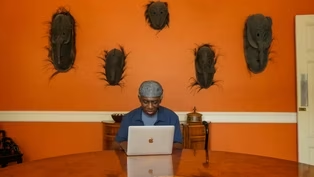
Yusef Komunyakaa: War and Peace
Video has Closed Captions
Clip: S8 Ep11 | 13m 51s | Yusef Komunyakaa’s hope has survived the Jim Crow South and the Vietnam War. (13m 51s)
Providing Support for PBS.org
Learn Moreabout PBS online sponsorship

- News and Public Affairs

Top journalists deliver compelling original analysis of the hour's headlines.













Support for PBS provided by:
Articulate is a local public television program presented by PBS39