
Wayne State Black studies, Detroit Policy Conference 2023
Season 51 Episode 3 | 26m 46sVideo has Closed Captions
A $6 million grant for Wayne State and conversations from Detroit Policy Conference 2023.
Wayne State University President Dr. M. Roy Wilson discusses a $6 million grant from the Mellon Foundation that will be used to create the Detroit Center for Black Studies and hire more faculty members with interest in the Black experience. Plus, conversations from the 2023 Detroit Policy Conference with Michigan Lt. Gov. Garlin Gilchrist II and Metro -Detroit Black Business Alliance CEO Charity D
Problems playing video? | Closed Captioning Feedback
Problems playing video? | Closed Captioning Feedback
American Black Journal is a local public television program presented by Detroit PBS
Wayne State Black studies, Detroit Policy Conference 2023
Season 51 Episode 3 | 26m 46sVideo has Closed Captions
Wayne State University President Dr. M. Roy Wilson discusses a $6 million grant from the Mellon Foundation that will be used to create the Detroit Center for Black Studies and hire more faculty members with interest in the Black experience. Plus, conversations from the 2023 Detroit Policy Conference with Michigan Lt. Gov. Garlin Gilchrist II and Metro -Detroit Black Business Alliance CEO Charity D
Problems playing video? | Closed Captioning Feedback
How to Watch American Black Journal
American Black Journal is available to stream on pbs.org and the free PBS App, available on iPhone, Apple TV, Android TV, Android smartphones, Amazon Fire TV, Amazon Fire Tablet, Roku, Samsung Smart TV, and Vizio.
Providing Support for PBS.org
Learn Moreabout PBS online sponsorship- Coming up on American Black Journal.
Wayne State University receives a major grant to expand its work in African-American studies.
President Roy Wilson is here to explain.
Plus, the Detroit Policy Conference examines the future of downtown Detroit.
We're going to hear from two of the guest speakers, Lieutenant Governor Garlin Gilchrist and Charity Dean of the Metro Detroit Black Business Alliance.
American Black Journal starts right now.
(gentle music playing) - From Delta faucets to Behr Paint.
Masco Corporation is proud to deliver products that enhance the way consumers all over the world experience and enjoy their living spaces.
Masco, serving Michigan communities since 1929.
Support also provided by the Cynthia Edsel Ford Fund for Journalism at Detroit Public TV.
- The DTE Foundation proudly supports 50 years of American Black Journal in covering African American history, culture, and politics.
The DTE Foundation and American Black Journal partners in presenting African American perspectives about our communities and in our world.
- Also brought to you by Nissan Foundation, and viewers like you.
Thank you.
(gentle music playing) (gentle music playing) - Welcome to American Black Journal.
I'm your host, Stephen Henderson.
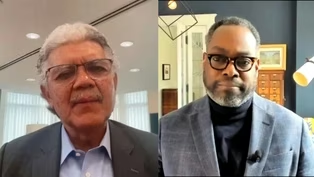
Wayne State University has been awarded a 6 million grant to expand its black studies faculty, and establish the Detroit Center for Black Studies.
The funding comes from the Mellon Foundation, and will enable the university to increase its curriculum, and research centering on the African American experience.
I got the details from the university's president, Dr. M Roy Wilson.
Dr. Wilson, welcome back to American Black Journal.
- Oh, good to be here.
- So this is a really exciting development at Wayne State University, and one of the things I think is really exciting about it is that it seems to recognize the importance of Detroit, and Detroit's black history in an economic context or in an academic context, I should say.
Tell me about this grant from Mellon, and how it will change Wayne State.
- Yeah, so there's two parts to the grant.
The first part and by the way, in terms of background it's a 6 million grant from the Mellon Foundation, one of the largest grants that they've given.
So there's two parts to the grant.
The first part is recruitment of 30 scholars, faculty members, full-time faculty members who are interested in studying black culture, African-American history, anything related to the African diaspora.
So that's one part of it.
And on that part it'll be 30 faculty, and different stages of development.
There'll be 10 who are tenured faculty who we'll recruit from other institutions.
They're already have proven themselves.
They're typically four professors, and they're seasoned investigators.
Another 10 will be tenured track.
So they're on their way to becoming tenured, but they're a little less seasoned in their career.
And then a third are those who had just finished their postdoc, their doctoral training in either in postdocs or early stages of their career.
And we want to nurture them so they become good faculty members.
So 30.
Then the second part of the grant is something that I think is really, really exciting.
And that's the Detroit Center for Black Studies, I think is the name of it.
Yeah, Detroit Center for Black Studies.
And this will be not just Wayne State, it'll be centered here at Wayne State, centered in Detroit, but it'll be a research institute basically to bring people, scholars from throughout Michigan universities to be able to do research on the African diaspora, as I mentioned, to do community outreach activities, do other activities that connect with the black experience.
- And I know that this is, the timing of this is somewhat about the funding, and the availability of the funding.
But it comes at an important time at the university, and it will have an effect across a broad spectrum of the university.
I think one of the things that sometimes is presumed about things like this is that it's just in an African studies department, this is something that affects all of Wayne State.
- We're going to be recruiting faculty throughout the humanities at Wayne State.
So in all departments basically throughout the humanities departments anyway.
So they'll come from different perspectives.
Some of them will be in the African American Studies Department, many of them will not.
But the thing that they will all have in common is that their aerial scholarship will be in that area which brings up another point.
They don't necessarily have to be African American.
There are scholars who are not African American who are still interested in that scholarship.
And so these will all be people who are interested in that scholarship, which I think is really important that it's centered here in Detroit because Detroit does have a population of African Americans about 80% which I think is larger than any other city in the country.
And we're centered here in Detroit.
We've been here for 153 years.
We have a history of promoting diversity, and history of bringing in immigrants from all over the region who have been disenfranchised.
And so we kind of have that social justice bent anyway.
And so to marry that with the funding that allows for us to really scale this in a way that we just would not have been able to do without the funding.
I mean, most universities, most of the time, we're recruiting, two or three faculty for specific areas.
It's unprecedented to recruit 30 for a specific area.
- Talk a little about how the Detroit Center for Black Studies will also connect with the community here in Detroit, as you say, will connect with other universities, but it's also important that that's here in our city.
- Yeah, I think so.
I mean, as I mentioned, Detroit is 80% African American.
So I'm happy that that will be here.
Scholars Fund throughout Michigan, particularly University of Michigan, Michigan State, and the three campuses of the University of Michigan, Michigan State, Oakland University, various community colleges will all be able to participate.
And it'll be a central place for that type of scholarship to be able to be supported, and nurtured.
Along with the scholarship, as I mentioned, there will be certain activities, whether it's community events, activities related to training, activities related to educating the wider Detroit community about issues of African-American culture.
That would be a centerpiece for that.
- What's the timetable for all of this?
How soon will people be able to notice this difference at Wayne?
- Well, we're going to start the recruitment process right away, but this is a project that we think would take four to five years before we have all the recruitment and before everything is set up the way we want it to be set up.
- And the other significant thing about the timing of course is that this is your last year as president at the university.
You're going to go off and have a sabbatical, and then there'd be some other things.
But talk about this as part of the legacy of your leadership at Wayne State.
- Well, as I mentioned, when I wrote a few words about my not renewing my contract, I mentioned that Wayne State gave me my voice.
And what I meant by that is that I care deeply about issues about diversity and inclusion.
And Wayne State is unapologetic about that.
And one of the last things that we did over the last couple years is really look at social justice in a systemic sense, and throughout the university to see what we could do better in terms of social justice, in terms of increasing diversity, in terms of really being more inclusive society.
And I think this would be this ability to scale this African-American, in African diaspora studies as an output of that effort.
That social justice effort that we put in is kind of like a capstone I think too.
That's something that we care deeply about as an institution, and that I care deeply about as an individual.
But to be able to actually do something, and hopefully have it be a transformative initiative for the institution and for Detroit.
- The Detroit Regional Chamber held its Detroit policy conference last week at the Motor City Casino Hotel.
This year's theme was the Future of Downtown Detroit.
Hundreds of civic business and community leaders came together to discuss the next phase of the downtown resurgence.
I had the opportunity to interview the keynote speaker, Michigan's Lieutenant Governor Garlin Gilchrist.
Here's a portion of that conversation.
- Governor Gretchen Whitmer and I are excited about the state of Michigan, and what we can do for the next four years.
And that always is grounded in what's happening in Detroit.
This city is the most important city for our economy, for our culture, and helps to really set the trajectory for our future.
And so thinking about downtown Detroit is very personal to me in my childhood, spent the first half of my childhood living just East of downtown in Elmwood Park.
And my father worked downtown, so I remember coming in with him so often, going to the Grand Prix downtown.
Super excited to have that going back through the streets of downtown Detroit.
Remember going to Trapper's Alley and thinking riding a people mover was the most awesome thing ever to go get off a trapper's alley.
- An amusement park ride for kids.
- So I think how things have evolved, what's become clear is that it's important that every part of our city can advance together.
And you can't think of an amazing city, an amazing city of experience without having an amazing downtown experience.
And that experience must then be able to create value for others who live in other parts of the city.
And I think we're beginning to really see elements of that take shape.
And so the state has been very aggressive in being partners with many of the people in this room and many people who are part of this organization to make sure that those investments are targeted, that we are building on everything from transportation infrastructure with the ongoing investment that the state is committed to in the queue line, to amazing event spaces.
And continue to support those with the support we've done of Huntington place to building up the technology ecosystem and the amazing, whether it's incumbent technology companies or startups that are driven by people with ideas especially in the software space where I come from, we're excited to see Detroit being named as the number one startup ecosystem for emerging companies.
And adding that, yes.
(audience clapping) Adding to the sense that Detroit is the place for a person with an idea to come and thrive and grow and be successful.
That's always been true of our city.
And if it's true downtown, it can be true everywhere.
Detroit is better represented in state leadership than it ever has been.
Certainly I'm a Detroiter serving as Lieutenant Governor alongside, Governor Gretchen Whitmer.
House speaker Joe Tate is a Detroiter.
And so the city.
(audience clapping) This is a moment for the city to recognize that leadership in (indistinct) is not only responsive, but that Detroiters are literally in place.
And so when we're thinking about what our priorities are, they're the same priorities that Governor Whitmer, and I have been talking about and making progress on for the last four years.
And I think it really starts with how are we laying the foundation for the future in the city of Detroit.
The way that we've invested in public education I believe is laying a solid groundwork for transformational educational experiences.
Our administration has worked with a Republican legislature for the last four years to put more money into your schools into Detroit public schools.
The schools that my children attend fourth grade in right now than ever in the history of education in the state of Michigan and doing so equitably, positioning young people to realize whatever dreams that they have are available to them in the economy that we are building and growing in the state of Michigan.
We are going to continue to be committed to that educational investment, even going a step further by ensuring that kids have access to individualized learning experiences.
Because a lot of kids might need a little bit more support coming out of Covid or just might need people to meet them where they are in a more aggressive way.
And we're very excited to be bringing that to reality here over the next four years.
- When you think of other things that you need to have working, to make the city thrive, to make Detroiters thrive, education is huge on that list, but also workforce development, and you guys have been doing some work from the state level augmenting the things that we're already doing locally to grow that.
- That's right.
So when I think about skills training, and workforce development.
Let's start with a goal that Governor Whitmer and I set back in 2019, something called 60 by 30.
That goal means that by the year 2030, we hope to have at least 60% of Michigan's adults having either a college degree, a community college degree, a professional training or certification, a skill that they have a credential for that can translate into work.
And we have formed a program called Michigan Reconnect that was passed on a bipartisan basis that provides tuition free pathways to community college and skills training.
And we're excited to say that when we fully funded that program in 2020, we've already made, we started at 45% of Michiganders that had this kind of credential.
We had to make up 15%.
Well, just in two years we made up almost 5% of that gap.
We are ahead of schedule, and want to continue full steam ahead to get to that credentialed state because when we're talking to businesses that are growing in Michigan, that they're looking to come to Michigan the number one question they ask for is can we find enough talented Michiganders?
Can we find people who have the skills that we need to grow our business?
- Your name has been mentioned along lots of others for the soon to be empty Senate seat in Washington.
I wonder what you think about that.
- I was wondering if he was going to ask me this question.
- I was looking at the clock making sure I left enough time for you to answer that question.
- I mean, well so where this conversation needs to start is the fact that Michigan has been amazingly served by Senator Debbie Stabenow.
(audience clapping) Like amazingly served.
She has defined the fact that people across the country and the world understand that Michigan is a place where we make and grow things.
She has been an example and a mentor to pretty much every public servant currently serving in the state of Michigan, myself included.
I got to tell you, we came into this conversation today because I'm excited about the next four years with Governor Gretchen Whitmer, and all the work that we can do, all the things that we can deliver, the fact that we have democratic governance for the first time in my life, we have a chance to show that that makes a difference for people in a way that people can therefore think you know what, this is something that we should continue to support because this is something that is stronger for our communities and for our economy.
I didn't expect the senator to announce that she wasn't going to seek reelection.
And so this is something certainly that my wife and I are thinking about 'cause that has significant implications on our family.
But what's important and what I am focused on is making sure that we can deliver for Michiganders right now using the tools that the voters of Michigan blessed me with in reelecting me as Lieutenant Governor alongside Gretchen Whitmer.
And I'm going to do that to the highest, and best of my ability.
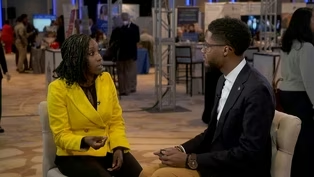
- One of the best sessions at the Detroit Policy Conference focused on empowering black-owned businesses in downtown Detroit.
The guest presenter was Charity Dean, who is president of the Metro Detroit Black Business Alliance.
Prior to taking the stage, she sat down with Bridge Detroit's Orlando Bailey talk about closing the racial wealth gap.
- So you're giving a policy perspective, a power perspective today at the policy conference on empowering black owned businesses.
Can you preview what that's going to look like for us?
- Yeah, so I'm going to talk about where downtown is now.
We talk about where we've been 10 years ago, we emerged into bankruptcy.
The largest city in the United States in municipal bankruptcy, and look at where we are today.
We have a tendency, a pattern of actually doing what I think people might say is impossible.
And so because of that, what I'm going to do is challenge the audience to continue to do the impossible.
I'm going to call out the racial wealth gap that exists in our country, in our state, in our city, in downtown Detroit.
Less than 10% of the businesses downtown are black owned, and less than 2% of the buildings are black owned downtown in a city that is over 75% black.
- How do we get there?
How does that happen in a city that is over 75% black?
- How do we get there?
So the story is not unique to Detroit.
In fact, we probably have more black owned businesses in downtown Detroit than maybe a downtown Chicago or downtown New York, Manhattan.
But the story is the same.
And it's in every major city, across the country.
And it started when enslaved Africans were brought to this country.
And then you had decades and generations of discrimination, and legal prohibition of black people to acquire land.
It was literally legal.
The federal government prohibited black people from buying land and accessing land.
You had restrictive covenants and deeds.
My great-grandmother, Rosa Malone, integrated a neighborhood in Detroit in 1973 and was the second black family in 1973.
How many generations of wealth have we missed?
When we talk about the wealth gap we're talking about capital and land.
We didn't get the Fair Housing Act until 1968.
1968.
That's when redlining was prohibited.
So how did we get here?
Oh, I mean, we got here very intentionally.
- Yeah.
I want to talk about this capital gap that you were talking about and this wealth gap, it's less overt now.
Banks love the word risk, and we know that risk sort of has a color.
What are you seeing?
What do your members see it?
- What we're seeing is that black businesses still do not have access to capital.
And I think risk is subjective.
Risk has always been subjective.
Credit has always been subjective.
We hear stories time and time again of members that are trying to acquire property for development deals.
For some folks the risk is more than the other folks.
And the only difference is the color of their skin.
And until we have real, I mean real transformative form at the federal level, we're always going to be behind.
What we are trying to do at the Metro Detroit Black Business Alliance is do what we can within our limited power.
But at the end of the day, the problem of racism, and the problem of the racial wealth gap should not be on the burden of black people.
How do we get ourselves out of the tunnel that we did not put ourselves in?
And until the United States government, and until corporate America identifies this as a problem for them to solve we're going to continue to be putting bandaids on.
We got the best bandaids possible, but we've got to advocate for policies, and we need real policy change in order to help close that wealth gap.
- Well, it's a tall order and here at the policy conference you have the corporate community, you have the government community, the philanthropic community, all of these folks who have their hands on the levers of power that can change some of the systems of inequities that you are highlighting.
How are you feeling about laying bare?
Some of.
- I'm going to sit on this stage.
I'm going to stand on the stage and I am going to talk about black bottom, and I'm going talk about the removal of black businesses in a neighborhood.
And then I'm going to ask the corporate community to find those descendants or those black businesses and give them land.
I'm going to say that today.
- Wow.
Because it's already happening.
This development.
- Yes.
- This resurfacing of 5375.
- We literally have the opportunity.
Here's the thing, Detroiters do things that other people don't do.
We hustle hard.
We do the impossible.
We have emerged from bankruptcy in a way that no one ever imagined.
Why can't we close the wealth gap?
Why can't we be first?
Why can't we be a model for the nation to say they did it in Detroit, and wait, they did it in downtown Detroit.
Look at what happened to black bottom, and look how they were able to solve that problem.
So, it's up to us.
- The other interesting thing that the Metro Detroit Black Business Alliance is doing, it's really shaking and moving in this policy advocacy space in a way that I haven't seen a black business alliance here in the city do in a really, really long time.
You're at the city council table, you're in Lansing, you're putting that law degree to work.
Tell me about why that's important toward the advancement of black owned businesses here in the city.
- When we first started the Black Business Alliance we said our mission was to create programs, and advocate for policies.
It's been in our mission statement from the very beginning.
Why is that important?
Because you cannot make change without policy.
We can do our Capital Connect program and train people, but if the rules that exist remain the same, then we're spinning.
And so we've got to create policy change.
We have to make sure that the people at the state, local and and federal level are thinking about black owned businesses when they're making decisions.
They have to understand the racial wealth gap when they're making decisions.
They have to understand how we got here when they're making decisions.
And they won't do it if they don't know we're here.
So we are very engaged.
You'll see we're going to roll out a 2023 policy agenda for black owned businesses.
We view black businesses as one of the ways to help close that racial wealth gap.
And it's not just us.
Goldman Sachs put out a report saying the same thing.
The Kellogg Foundation put out a report saying the same thing.
So if we know this, where's the urgency?
We're going to bring it.
- So give me a little bit of the origin story.
We got about two minutes left, of the Metro Detroit Black Business Alliance.
I mean, you were a lawyer and a city employee.
How does one go from being an attorney, and a city employee to launching really one of the largest black businesses alliances we've seen in a very long time.
- I was created to solve problems.
That's it.
I was created to solve problems.
And when I was at the city of Detroit, I was the director of civil rights.
And I found myself doing a lot of work on behalf of black businesses and not another organization to partner with.
There were other organizations we would reach out, but no one that was really doing the work.
And so I thought, well, this doesn't make sense.
We're convening black business but I'm convening them on behalf of the city, and I'm not helping them convene on their own.
And so got with a group of other black business owners and we said, we want to do this, we need to create a space.
Black businesses are the lifeblood of the city of Detroit.
They bring jobs, they hire Detroiters, they revitalize commercial corridors.
They need a voice and they need a loud one.
And so I'm kind of loud.
- That's going to do it for us this week.
Thanks for watching.
You can find out more about our guests at americanblackjournal.org, and you can always connect with us on Facebook, and on Twitter.
Take care and we'll see you next time.
(upbeat music playing) - From Delta Faucets to Behr Paint, Masco Corporation is proud to deliver products that enhance the way consumers all over the world experience and enjoy their living spaces.
Masco, serving Michigan communities since 1929.
Support also provided by the Cynthia Edsel Ford Fund for Journalism at Detroit Public TV.
- The DTE Foundation proudly supports 50 years of American Black Journal in covering African American history, culture, and politics.
The DTE Foundation and American Black Journal partners in presenting African American perspectives about our communities and in our world.
- Also brought to you by Nissan Foundation, and viewers like you.
Thank you.
(gentle music playing)
Closing the wealth gap for Black-owned businesses in Detroit
Video has Closed Captions
Clip: S51 Ep3 | 7m 26s | Metro-Detroit Black Business Alliance CEO Charity Dean discusses the racial wealth gap. (7m 26s)

Lt. Gov. Garlin Gilchrist II on downtown Detroit’s future
Video has Closed Captions
Clip: S51 Ep3 | 6m 56s | Michigan Lt. Gov. Garlin Gilchrist on the administration’s investment in downtown Detroit. (6m 56s)
Wayne State receives $6 million grant for Black studies
Video has Closed Captions
Clip: S51 Ep3 | 8m 39s | Wayne State University receives a $6 million Mellon Foundation grant for Black studies. (8m 39s)
Providing Support for PBS.org
Learn Moreabout PBS online sponsorship
- News and Public Affairs

Top journalists deliver compelling original analysis of the hour's headlines.

- News and Public Affairs

FRONTLINE is investigative journalism that questions, explains and changes our world.












Support for PBS provided by:
American Black Journal is a local public television program presented by Detroit PBS