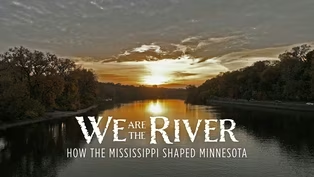
We are the River: How the Mississippi Shaped Minnesota
We Are the River: How the Mississippi Shaped Minnesota
Special | 1h 26m 19sVideo has Closed Captions
The Mississippi River is as complicated as it is captivating – filled with heartbreak and hope.
From her source at Lake Itasca, the Mississippi winds through Minnesota's prairies, valleys and cities—her constant presence easily taken for granted. To the Dakota she's a sacred relative and source of life; to settlers, the key to prosperity. What do the stories of Native stewards, industrialists, immigrant families and wildlife guardians reveal about the river's future?
Problems playing video? | Closed Captioning Feedback
Problems playing video? | Closed Captioning Feedback
We are the River: How the Mississippi Shaped Minnesota is a local public television program presented by Minnesota PBS
We are the River: How the Mississippi Shaped Minnesota
We Are the River: How the Mississippi Shaped Minnesota
Special | 1h 26m 19sVideo has Closed Captions
From her source at Lake Itasca, the Mississippi winds through Minnesota's prairies, valleys and cities—her constant presence easily taken for granted. To the Dakota she's a sacred relative and source of life; to settlers, the key to prosperity. What do the stories of Native stewards, industrialists, immigrant families and wildlife guardians reveal about the river's future?
Problems playing video? | Closed Captioning Feedback
Where to Watch We are the River: How the Mississippi Shaped Minnesota
We are the River: How the Mississippi Shaped Minnesota is available to stream on pbs.org and the PBS app.
(determined music) - [Whitney] My dad used to take me down to the river as a small boy.
He would talk about the Native American history, and I was fascinated with the fact that many people for thousands of years had walked these same paths that we were walking.
- [Kate] The Minnesota and Mississippi River is where, those two rivers come together is a bdote.
It's a place of our creation, and it's a space that is in need of a lot of healing.
(determined music) - [David] The falls of St.
Anthony, for the Dakota People it was their homeland, but for Europeans like Father Hennepin really saw the falls and the landscape as a commodity.
- [Michael] The ways in which they see the Mississippi River is so profoundly different than the Indigenous people and nations that live here.
It's New Englanders who understand the ways in which St.
Anthony Falls represents money.
- [Sharon] Along our river banks, we had the grain mills.
We were fed based on what was going on here at the river.
- [Larry] I can remember seeing some of my neighbors floating down the street, saw my mom weeping at the table, my dad bringing us all together and said, "We gotta go."
- [Cory] You don't conquer the river.
You ask her for safe passage and you pray that she gives it to you.
- [Whitney] It's an ecological resource of global significance.
It's a flyway for about half of North American birds.
It's a source of drinking water for 20 million Americans, including most of us who live in Minneapolis and St.
Paul.
- [Eddy] It has always been important to the foundations of the country.
For one thing, it was the frontier.
It was the limit of British America.
And then it becomes a pipeline, and it becomes a transportational hub, and then it becomes the myth that we know.
- [Kate] She's a living, guiding being that we are in relationship with and not something to be exploited and not something to be forgotten.
(determined music) (gentle compelling music) - [Narrator] The Mississippi River occupies a unique space in America's consciousness, especially in Minnesota, where she is known as the Misi-ziibi, Great River by the Ojibwe, and the Haha Wakpa, River of the Falls by the Dakota.
Her story is as complicated as it is captivating, filled with heartbreak and triumph.
And it begins here.
- [Anton] If you take a scientific perspective, it's hard to even say Lake Itasca is truly the source of the Mississippi River.
You have multiple sources, from springs and wetlands and different smaller bodies of water, and they kind of pick up enough flow to be identifiable as the Mississippi River.
So Itasca is what you'll find on the map, but really it's a region where it originates.
And Native people find it very humorous, even looking back at the history of all of the white explorers who wanted to name the headwaters of the Mississippi after themselves or their beloved family members and usually got it wrong.
So Beltrami has a lake named after him.
Schoolcraft already named a river after himself thinking that was the headwaters before he gave up and actually asked a Native person.
Cass did the same thing.
And eventually, they did just give up and they asked a native person.
They said, "Well, I'll show you."
- [Narrator] From her pristine beginnings near Lake Itasca, the Mississippi River winds through Northern Minnesota, growing wider and deeper as she passes through lakes, absorbing tributaries on her way to Owamniyomni, or St.
Anthony Falls.
Among 475 miles, this modest prairie river begins to transform, revealing a complex nature and soul.
- The river changes from the headwaters to the Iowa border as it changes all along its length.
As it gets bigger, as you find your way through the marshland, through the rice fields and into the various lakes it passes through, Lake Winnibagoshish, Lake Bemidji.
It's just a different animal in even as far down as Lake Pepin.
It's not the same in any two reaches, in any two stretches.
It changes a lot.
And the more you know it, the more you appreciate all of it in all of its aspects.
(lighthearted music) - [John] The Mississippi comes into the metro region as a prairie river.
There's banks, not bluffs.
You never hear about anybody sandbagging on that part of the river.
There's not much floodplain.
There's some islands.
And then at St.
Anthony Falls, the Mississippi River drops into an eight and a half mile gorge.
The river drops about 110 feet over that eight and a half miles.
The bluffs are a third to a quarter of a mile apart.
It's the steepest drop through the narrowest canyon anywhere on the upper Mississippi.
And then at the mouth of the Minnesota River, we meet the big river, the large floodplain river, the river of Mark Twain, what one writer calls the river of image, myth, and metaphor.
And that's the Mississippi River most people think of.
Nowhere in the entire Mississippi does it change so much in such a short distance as it does here.
The gorge was created in part by the retreat of St.
Anthony Falls.
St.
Anthony Falls at one time was the River Warren Falls downtown St.
Paul.
In over 12,000 years, it began retreating up the Mississippi River to where it is today, as the Owamniyomni or St.
Anthony Falls.
- [Carrie] Waterfalls move.
They don't stay in the same place.
And the reason waterfalls form in the first place is because there's a resistant upper layer and then something underneath it that's more easily eroded by the water plunging down and being turbulent there at the base of the falls.
And in the Twin Cities, that is the Platteville limestone is the resistant upper layer, and the very soft buff-colored St.
Peter Sandstone is the one that you can just erode with a spoon if you chose to.
So the plunge pool of the waterfall undercuts the Platteville, and the ledge breaks off and the waterfall takes a step backward.
So that's how a waterfall moves.
The Owamni or St.
Anthony Falls, where it is now, is pretty much where it was when European settlers came to the region and decided to take advantage of that power to run mills.
As I mentioned, it's moved a little bit, you know?
From 1680 when Father Hennepin saw it and other explorers, they were seeing it march back.
And one of the reasons it is reinforced the way it is now is because it was retreating more quickly during a period of time when the north part of Minnesota was being lumbered and logs were being sent over that rocky ledge and degrading it.
And so there were some catastrophes in that area, some tunnel collapses, and it needed to be reinforced if it was gonna stay in Minneapolis.
It would like to keep moving farther north.
- [Narrator] For more than 10,000 years, humans have inhabited the land surrounding the Mississippi, beginning with the Dakota, whose culture and history are profoundly intertwined with the river.
(cheerful singing) (Shelley speaking Dakota) - I said, "Good morning, my relative.
I greet you with a good heart handshake.
My Dakota name is Manny Buffalo.
My English name is Shelley Buck.
I am Dakota from Prairie Island, and they call my people the Spirit Lake Dwellers."
(cheerful singing) When you talk about Minnesota history, you have to start with Dakota history.
This is our place of creation.
This is our homeland.
Our creation story has us coming into human form from the rivers here in Minnesota.
There are a couple different locations of that.
One's down at Bdote and one is at Bde Wakhan, which is Mille Lacs Lake.
So for us, when we say, "Mni Wiconi," "Water is Life," it literally is life.
Without the water, we wouldn't be here.
The way we have our worldview, rivers, the land, the plants, the animals, they're all our relatives, they all have a life force and a spirit.
And when you tend to look at things in that way, you tend to treat them better.
- [Kate] The river for us was a place of sustenance.
It was a place where we fished from.
It was a place that guided us.
It was a place that we navigated.
We get teachings from the universe and from the land and from the waterways, and so it taught us a lot and it connected us out into the broader world.
- There are many significant places along the Mississippi and just off the Mississippi for the Dakota people, and I think that is just more proof of our connection to the river.
They were places where our people used to and still to this day go and pray, give thanks, have ceremonies, just go to be one with nature.
- The water is the veins of Mother Earth and it's the connector across the land.
We've retained a connection to that river in a way that's really powerful.
It's a river that's guided us and guided us home even when we've been displaced.
It's always had a sort of mothering feeling to it.
It's a place of comfort.
It's a place that nourished us.
It's a place of home.
The Minnesota and Mississippi Rivers where those two rivers come together is a bdote.
And there are bdotes all over the world, but that is a particular bdote that is really powerful because it is a site of creation for us.
We came from the Pleiades and came down to where those riverways are connected and came into being at Wita Tanka, which today people call Pike Island.
- [Ramona] Islands along the Mississippi River were used for birthing.
And that was because of the cultural importance of the child that was coming into this world and to bring them into this world in a way that is as least traumatic as possible because this is a spiritual moment.
This is a moment where the Creator is handing us the spirit of this child.
There's this beautiful energy.
And so we wanna recreate that same kind of atmosphere as to not traumatize both mother and baby.
So we have that child in a place surrounded by water.
One of the other ways the islands were a perfect place for birthing is that all of the medicines that grow to treat a woman after the trauma of childbirth grow around these islands.
And so if we're observing the natural world and we're looking at the natural world to teach us, we understand that, hey, if the medicines are here, this is where we come.
We have this idea called Kapemni.
Kapemni, it means as above is below.
The sky mirrors the earth.
Our spiritual connection is that Milky Way.
We also call it the Wanagi Tachanku.
So the mirror directly reflects the Milky Way.
And so we would build our burial mounds along the Mississippi River.
So when our ancestors are making their journey, they can see where they go.
There were over 30,000 burial mounds along the Mississippi River before colonization.
And some of them are still there, some of them are not there anymore, have been pushed over the side because they kind of block the view.
But that's our spiritual understanding and even our scientific understanding of observing one place for thousands of years.
- When you're looking at maybe 1700, most of Minnesota is in Dakota hands.
And during that time, there were some prophets who appeared amongst the Ojibwe and said, "Move west to the land where food grows on water."
And that has usually been interpreted to mean a reference to the wild rice, which is abundant in Wisconsin and Minnesota lakes and rivers.
We have a clan system where there are animals, birds, or fish that kind of double as a symbol for your family, but also a spiritual guide of sorts.
And most of those animals, birds, and fish are connected to the water one way or another.
And so it's just a very central part of culture, belief system, travel, life and worldview.
If you look at the three biggest reservations in Minnesota, Red Lake, Leech Lake and White Earth, both in terms of territory and population, they're all on or adjacent to the Mississippi River.
- [Michael] Thinking about rivers as the primary means of transportation means thinking about the ways in which rivers were so crucial, absolutely critical for Dakota people, for Anishinaabe people, for Ho-Chunk people as they move around the landscape.
Because we have to think about the Mississippi River not just as a river, but as a watershed.
And as soon as you do that, you start thinking about all the many tributaries to the Mississippi, and you see the significance of the river and its tributaries in the creation of complex human community.
Those ways and routes of transportation are, of course, absolutely critical then to the European people that come here, that encounter and interact with those Indigenous people.
And of course, they're the ways in which commerce starts to become more and more important.
And it's all focused on the river.
(bright music) - [Narrator] Nearly 500 years ago, Europeans, often with the help of Indigenous guides, explored their way across Minnesota.
The first white people were French fur traders, followed by other traders and missionaries eager to conquer Indigenous lands.
(tense music) The horrific US-Dakota War led to the largest mass execution in American history with 38 Dakota men hanged in Mankato.
What happened afterwards was equally horrible, but not nearly as well known.
- After the US-Dakota War, the men were, the 38 were hanged.
The other Dakota were shipped to a stockade in Davenport, Iowa.
And our then first governor, Alexander Ramsey, still wasn't finished with the exile of the Dakota.
He told the legislature, "The Sioux Indians of Minnesota must be exterminated."
So the first phase of that work had been done, got rid of the men, and then they went on to the women.
So they rounded up the women, children, elders on November 7th, 1862.
They're forced march to the river to be exiled.
So the women, children, elders are consistently battered, beaten, attacked, and killed every step of the way.
They're freezing to death.
They have no shoes.
They have no time to prepare for this long walk.
And so hundreds die along the way.
And when they get to the place where they're gonna get on this steamboat to fulfill Governor Ramsey's quote to the legislature, the river's frozen.
And so they create this concentration camp.
And one of the really important considerations about this is the Dakota are a matrilineal, matricentric, matrisocial group of people.
And so the women had the strongest voice and the women were highly revered.
And so you have this patriarchal group telling these women, which they'd never had.
So this is a pivotal point of understanding that in history, this is the moment our women lost their voice.
Completely.
So from November 13th to May 5th, they are kept in this camp where four on average die per day.
And there is a protocol about death.
There's a protocol about burial, right?
And so all of the ones that were killed along the way didn't get those protocols.
So the Dakota women now in this concentration camp have a little bit of leverage about what happens when their mother dies.
So they decide to bury those bodies in a very shallow grave underneath the only earth that is not frozen, which is inside the lodge that they're in.
So not only in those six months are they in a concentration camp, but they are also in a mass grave.
This mass grave is the bdote, their most sacred place.
This place where women would travel many, many miles to have their children.
And that was the place that was chosen for them to suffer.
- My relatives were among those who were force marched to the concentration camp.
One of my grandfathers died in that camp and our family still is looking for his remains.
We still don't know where the remains of those who died while imprisoned there were put.
The bdote down at what is now often called Fort Snelling is a difficult space to go to.
It's heavy.
You can feel it.
The memories of our ancestors, the spirits of our ancestors, we can feel them there.
And it's also so incredibly close to the place of our creation.
That is the place of our creation.
And so we're one of the only Indigenous people whose place of creation is also our place of genocide, which is something that I don't think a lot of people really understand.
The impact of that experience on us and of our connection to that place, to feel like your place of coming into the world is in need of such healing is a really remarkable thing.
- [Shelley] Healing is naming, you know?
We have to name what happened.
As Dakota women, many, many Dakota women, allies, got together and we walked those 150 miles.
And we acknowledged the suffering of our ancestors.
We said their name.
And we did that for 14 years.
We walked to take back our voice, and we did that.
(calm music) (light music) - [Narrator] For many centuries, the only major waterfall in the Mississippi was known by the Dakota as Owamniyomni, later called St.
Anthony Falls by Father Hennepin.
His account of the falls spread throughout Europe, turning them into an overseas tourist destination.
This included artists who traveled to the falls to capture their majestic beauty on canvas.
- [David] One of those artists, George Catlin, floated the idea of a fashionable tour to the falls of St.
Anthony that actually caught on in the 1840s and '50s.
A wealthy tourist from the East Coast and the Deep South would take the steamboat up the Mississippi and visit the falls of St.
Anthony.
A number of tourist hotels popped up, especially in the 1850s, that catered to wealthy tourists.
They could also drink the health tonic of the mineral springs that flowed out of the bluff.
It was called the Chalybeate Mineral Springs.
And a little bit later, a man named Manisee P. Pettingill built a resort hotel right on the bluff above the springs.
People would spend their summers there and come and drink the health tonic of this iron-rich water that flowed from the bluff right next to St.
Anthony Falls.
He touted it as this health elixir that came deep from in the earth.
But a few years later, a geologist was studying the spring and discovered that instead of being an artesian well, it was just draining a murky swamp just a few blocks away.
- [Narrator] This era of tourism turned out to be short-lived, but another grander venture at the falls was already underway.
(lighthearted music) - The power of falling water and the potential in that is something that's very much alive in the imagination of so many settlers when they come here and they see St.
Anthony Falls and they see this drop that's from anywhere between, depending on how you measure and who's measuring it at any given time, between 15 feet and 60 feet.
That represents an immense amount of potential power if it can be harnessed.
The ways in which settlers see the Mississippi River, the ways in which they see the features of the Mississippi River is so profoundly different than the Indigenous people and communities and nations that live here.
And it's New Englanders who understand the ways in which St.
Anthony Falls represents money.
(curious music) - [Narrator] By the 1850s, the falls powered over a dozen lumber mills from trees harvested in Northern Minnesota.
But like the tourism boom before it, the thriving lumber industry was destined for a similar fate.
(curious music) - Lumberjacks would spend their winters cutting down logs.
And then in the spring during the thaw, they would use the high water of the Mississippi to float the logs down to market and to lumber mills downstream.
In the mid 19th century, the people that were building lumber mills sent out scouts to the Northern Forest to see the extent of the forest and how much lumber they could get from that.
And the reports came back that centuries could hardly exhaust the white pine forests of Northern Minnesota.
As it turns out though, the lumber industry grew so quickly and so fast that they cut down the trees in a matter of decades rather than centuries.
(curious music) By 1900, 1910, a lot of the white pine forests were largely gone in Northern Minnesota.
And by the 1910s, the last sawmill shut down in Minneapolis.
- [Narrator] As lumber mills exited the falls, flour and textile mills took their place.
And soon, Minneapolis became the flour milling capital of the world.
A title it would hold for 50 years.
(upbeat music) - Wasn't until the 1860s when the railroads arrived at Minneapolis that Minneapolis milling really got going.
Even then, Minneapolis flour took some time to find a market.
It wasn't that good.
It would tend to be black and speckled with bran.
The germ was left in there, so it tend to spoil quickly.
All that changed though with a technological innovation in the 1860s.
The Minneapolis millers perfected a technological revolution called The New Process, where they were finally able to mill the spring wheat of the upper Midwest into a high grade bread flour for the first time.
And the result was some of the best bread flour in the world.
- And this bread flour coming out of Minneapolis is seen as energy and some of the purest energy you can get.
And of course, in say 1900, about 30% to 40% of the American diet is based on white flour.
So we're talking about a very significant category of the food industry.
- Companies like the Washburn and Pillsbury really mastered the new technology of milling flour and grew quite quickly.
- [Narrator] Minneapolis millers built larger mills and then replaced them with even bigger ones.
The world's largest at the time, the Washburn A Mill, exploded in 1878 with a force so loud it could be heard as far away as St.
Paul.
This flower dust explosion killed 14 workers before a massive fire spread, killing four more workers in neighboring mills.
But even an exploding mill couldn't stop progress in the flour city.
Cadwallader Washburn quickly rebuilt on the same site.
And across the river, Charles Pillsbury constructed the Pillsbury A Mill, stealing the title of the world's largest mill.
Flour milling at the Falls continued to break records, reaching peak production in 1916 during World War I. With 25 flour mills employing over 2,000 workers.
It produced over 18 million barrels of wheat that year, enough to make 12 million loaves of bread per day, enough to feed the nation and its allies for the remainder of the war.
When the war ended, the flour millers of Minneapolis tapped into new markets, leading to some of the most iconic brands in US history.
(bright cheerful music) ♪ They're crispy and crunchy the whole year through ♪ ♪ The kiddies never tire on them and neither will you ♪ - The first radio jingle in world history is a Wheaties radio jingle on a brand new radio station that's owned by the Washburn-Crosby Company with the call letters WCCO, changed to reflect the company's ownership starting in the early 1920s when radio is still very experimental.
And so what you see is Washburn-Crosby thinking in very creative ways as a business in addressing the central structural problem, which is that Minneapolis is no longer gonna be the major flour producer in the United States or in the world.
You start to see a shift as you move into the early 20th century, and that shift is actually about the Mississippi River and it's about St.
Anthony Falls.
And it's about a particular type of monopoly that the Minneapolis millers have had.
You can have these large factories 'cause you have enough power being generated to work machinery on 10 or 12 different stories in a large industrial mill.
That monopoly on power is actually what gives way.
And that's because of the emergence of electricity.
And it becomes one of the primary factors in the slow decline of milling at St.
Anthony Falls.
And that's simply because you don't need to be at the waterfall to power a mill anymore.
- [Narrator] Companies gradually abandoned the district except for Pillsbury, which was acquired by General Mills in 2001 and operated the A Mill until 2003.
But the relentless pursuit of power and commerce had already left a scar.
Spirit Island was quarried for limestone to build the growing city, completely destroying a sacred Dakota site.
- [Shelley] Spirit Island, or Wita Wanagi, is a very important place to my people.
It was an island here along the Mississippi near the Upper Falls or Owamniyomni, and some of our women would go there to give birth.
It was a place of prayer.
It was a place of solitude.
It was a place where the spirit world and the physical world could connect.
So it was very important to us.
And unfortunately, when the Europeans came in, they wanted to harness the falls for her power instead of admiring her for her beauty.
I didn't know about Spirit Island until I started getting involved with Owamniyomni Okhodayapi on the Native Partnership Council.
And so I think when something's not there, generations lose that knowledge.
Just because a place has been destroyed or desecrated doesn't mean that that life force, that spirit isn't still there.
She's still there.
And we need to find a way to honor her and make sure people know about her and that she once was big and beautiful.
(gentle vocals singing) - [Whitney] We've had a very big sea change in the way that we relate to the Mississippi River here in the Twin Cities, but I think this is probably true in many places along the river.
When I was coming up, the river was still pretty gritty and pretty industrial.
Now the St.
Anthony Falls area of Minneapolis is kind of the heart of the city.
It's where people wanna live and where people wanna come and recreate.
- [Katie] When I was in college, certainly like the downtown Minneapolis Riverfront had not come alive yet.
It was where people would go tailgating before Vikings games.
I remember the first time seeing the North Star condo building go in, and I remember thinking, "Wow, they're really like building condos on the river?
Are people gonna wanna live there?"
Which is funny now because of course it's the highest priced real estate in town is the stretch of river in Minneapolis.
- The Washburn A Mill sat empty after its closure in 1965, mostly unused.
In the winter of 1991, the Washburn A Mill was largely destroyed by a large fire.
We think a small fire that someone used to keep warm on a cold February night got out of control and gutted the building in a massive fire.
But right away, people recognized the importance of the Washburn A mill as a national historic landmark, and rather than tearing down the damaged building decided to save what was left of this important building and preserve it.
And the result was building Mill City Museum and the office spaces above it.
A new building that was placed within the ruins of the old and the shell of the old Washburn A Mill left as an open air courtyard, a reminder of the milling legacy and the multiple fires that have happened here.
[Michael] It's easy for us in the 2020s to forget that between the 1920s and the 1980s, people in the upper Midwest largely turned their backs, literally and figuratively, on the Mississippi River.
You can see that most clearly in downtown Minneapolis when the formerly industrial spaces were either abandoned or ignored.
And how the actual industrial transformation of St.
Anthony Falls and the riverfronts on both the west bank and the east bank were no longer the focus of energy.
They were no longer the focus of capital.
They were no longer the focus of cultural transformation.
When people imagined making the city better, they weren't thinking about the river.
And in fact, the river by the 1930s is incredibly polluted.
It's literally become the sewer for all the people that are living in the region.
And it's only after changing how we see that we begin to see the river anew.
- [Sharon] Back in the '80s, I don't think most people really had a relationship with the Mississippi River.
In the early days when we were trying to sell the vision, I would often invite business leaders from downtown to join me for a drive along the river.
And I can't tell you how many times they got in the car with what we would call the titans of industry, and I'd ask the question, "When was the last time you were down here?"
Or, "Were you ever down here?"
And very often the answer would be no.
There was no reason to come down here.
And then we would talk about St.
Anthony Falls and all of the rich history that we have associated with this river being the economic engine for the state and definitely for the city and the county.
(uplifting music) - We see the ways in which the river is a space that is potentially rich ecologically.
We see the ways in which the river has cultural meaning, religious meaning, spiritual meaning.
We see the ways in which the river can produce money, no longer through powering industrial factories, but through creating essentially what are various forms of tourism and residency by making the riverfront a really cool place to live.
It's that transformation of these abandoned industrial spaces.
These are all reflective of our changing relationship with the Mississippi.
And the one thing that's the through line is that the Mississippi matters.
Even when we were ignoring it, it mattered.
The Mississippi has always mattered and will continue to matter for decades to come.
(hopeful music) - We ended up with two cities, a twin cities, because of that eight and a half mile gorge.
So you have that very steep drop.
You have those limestone boulders.
So it was almost unnavigable.
But in 1858, steamboats came and went from St.
Paul at 1,000 times and only 50 times from Minneapolis.
(upbeat playful music) - [Narrator] All those steamboats brought thousands of immigrants up the river during the 1850s and '60s, establishing St.
Paul as Minnesota's port city.
As they moved across the water, searching for a channel in the ever-shifting floodplain, early travelers saw a river that looked much different than today.
- When you talk about the natural river, let's talk about the river below the gorge.
In that long reach of the Mississippi River, the average depth of the Mississippi River between St.
Paul and St.
Louis was two feet at low water over the sandbars, 24 inches.
The idea that you could wade across the Mississippi River at hundreds of places was real.
There was a clear pulse.
As the spring snow melt and the spring rains came, the river would rise up.
And then by summer, it started to drop down and get to that very low water stage where you could wade across it in different places.
That was a natural Mississippi river.
But that wasn't very good for navigation.
So the Corps of Engineers in 1866, Congress authorized them to begin dredging the Mississippi.
They start pulling snags out of the river.
They start cutting back those overhanging trees.
But the river could re-scramble everything with a single flood.
In 1878, Congress authorized a four and a half foot channel project.
It would introduce the greatest changes in the upper Mississippi since the glaciers retreated.
What the corps is gonna do is they're going to put these rock and brush dams kind of perpendicular to the sides of the river, sticking into the middle of it.
And it's like the nozzle of a garden hose.
You turn the dial to the jet spray.
And the faster the river moves, the more it can suspend sediment in the center of the river.
And then as it flows between those wing dams, it settles out and the banks start building up and coming in, so you're constricting the Mississippi physically.
- [Narrator] Those early dams were of little use whenever the water level dropped, as it often did in the fall when the farmers needed to ship out their grain.
But when the railroads arrived in Minnesota after the Civil War, the Mississippi got some competition.
- [Rosaura] While you had the use of the river from the very beginning, you see a decline in the use of the river because you have the expansion of the railroad system itself.
And the railroad system becomes such a monopoly that they're controlling the rates and how much they're charging the farmers.
- So an organization called the Grange or Patrons or Husbandry formed by Oliver Kelly, whose house is just up in Elk River north of the Twin Cities, he forms this organization that has over 850,000 members.
And they become one of the most powerful political forces in the country.
And they begin challenging railroads with court actions, trying to force railroads to lower their rates.
But they also realized that if the river was a competitive alternative to railroads, then railroads would naturally have to lower their rates.
- [Narrator] Challenging the railroads became difficult as they began to wield enormous political power over nearly every aspect of American life.
Fearing that the railroads would completely monopolize transportation, farmers and businesses looked back to the Mississippi River.
- And so by the 1920s, another movement starts, and this is a movement to build locks and dams.
If you can build a lock and dam, then you can hold the river up as it begins to fall and guarantee navigation on it.
So in 1930, Congress authorizes the nine-foot channel project.
It authorizes 23 locks and dams for the Upper Mississippi River from Red Wing to just above St.
Louis at Alton, Illinois.
That project succeeded where all the others had failed.
Commerce begins coming back to the Mississippi far beyond the expectations of the boosters.
By the 1980s, millions of tons of commerce are going up and down the Mississippi River.
- [Voice Over Radio] Just gotta drop it temporarily here and then move to Fleming.
- [Hokan] That's a good plan.
Let's do that.
The company that I work for is a harbor service in St.
Paul.
You can say that we provide valet parking for barges.
Barge lines run barges back and forth New Orleans to St.
Paul.
The line boats with their 12 or 15 barge tows are very efficient at moving that tow up and down the river, but when they get into the confines of the harbor, then they need a tug assist.
One jumbo barge, the kind that we see in downtown St.
Paul, is the equivalent of 16 rail cars or 60 semi-trucks.
When you leave St.
Paul with 12 barges, you go to Red Wing or Winona and pick up three more, and then you have 15 and go to St.
Louis, add another 15 and go down the river with 30.
And that gives the river a tremendous boost in efficiency.
- [Narrator] After more than eight decades, the Corps of Engineers still maintains the nine-foot channel for commercial navigation.
The system also allows safe passage for canoes and kayaks and other vessels, but the river struggles to sustain plants, fish, and wildlife.
(quiet somber music) - [Solomon] We've manipulated the Mississippi River from the headwaters all the way down to the mouth.
And a big part of that is the damming and the leveeing of the system throughout.
If you were to look at the historic watershed, the expanse of the Mississippi compared to what we have now, those dams and levees have greatly reduced the floodplain.
And that floodplain, that flood pulse really brought a sort of a charging of nutrients into the floodplain, sort of depositing sediments, providing nursery habitat and spawning habitat for all kinds of fish, and therefore food for other types of wildlife.
Now that we've got the dams and the levees, we've cut off a lot of species from the natural flood plains.
And so with that, we have modified that landscape to where we've kind of drained certain types of wetlands.
The system itself is a little bit more channelized.
And so certain species that might have been spawning there 1,000 years ago don't have that same access.
- What it is now is a series of stepped pools.
You know, it's a flat reach of water with no current between two locks and dams, and then a next pool, lower flat reach of water, and so on.
So it's a place where the river's not really moving sediment anymore, water's kind of still.
So that's very different than what the river would've been doing unconstrained.
- Dams destroy rivers.
They kill the native ecology of those rivers.
We've taken away the pulse.
The river used to go down, the soils and the sediments would compact, aquatic plants could anchor themselves in that compacted sediment, grow.
Today, when they do that, when they start growing, waves come across those open reservoirs and can cloud up the water and prevent photosynthesis from happening.
They can tear the plants out by their roots.
- [Anna] Climate change is exacerbating the problems we had decades ago.
We are seeing more frequent rainfall events that are increasing both the volume and the intensity of rainfalls.
And with that, it is also bringing more pollution to our rivers.
It's also leading to higher flows that are eroding the riverbanks.
- [Narrator] From frequent flooding and loss of floodplains to agricultural runoff and high concentrations of mercury in fish, the Mississippi is now considered the most endangered river in the nation.
Removing locks and dams won't solve all these problems, but restoring her to a natural state will improve the overall health of the river.
The locks and dams in the Twin Cities are no longer in use and could be removed, yet their future remains uncertain.
- I think the potential to restore the natural hydrology of a really important stretch of the river, reconnecting fish habitat and many migratory fish species on the river that would have found the rapids here below St.
Anthony Falls very, very important from a spawning standpoint.
So I think there's a lot of reasons to be excited about the possibility, but we do need to make that decision fully informed.
- For the first time since the creation of the Twin Cities, we have a chance to think about what we want this river to be in the heart of the metropolitan area.
My hope is that through continual testing and better science, we will somehow be able to pass this test in the end.
Otherwise, someone in the coming generations is gonna have to make a choice between reclamation and navigation and ecology and the environment and recreation.
Very, very hard choices to make.
(cheerful music) - [Narrator] Several immigrant groups in the Twin Cities called the banks of the Mississippi home.
These communities were often poor, overlooked, and marginalized.
And today there's virtually nothing left of these once vibrant neighborhoods, but their presence, living on the river's edge, deeply influenced Twin Cities' culture both yesterday and today.
(cheerful music) - [Patrick] There are not many places on the full length of the Mississippi River that have the right topography to have these kinds of flats communities.
The settlement would be in such close adjacency to the river that you would hear it, you would smell it, you would feel it, it would be a flood threat.
And you had a cohesiveness of ethnic and cultural identity that was not available in the community as a whole.
There were about 1200 people living in this area called Bohemian Flats along three distinct streets.
The Upper Levee community in St.
Paul also had three streets.
Probably only had about 400 people at its height.
And the West Side Flats, which was across the river from downtown St.
Paul, had a larger number of people spread out over a bigger distance, it's a bigger geographical space.
(cheerful music) - [David] Bohemian Flats was a low lying area on the river that would tend to be flooded during the spring.
And because of that, it wasn't an area that was really prized for industry or housing, but people built there anyway.
There were so many immigrants from Eastern Europe that would settle there, including from Bohemia, but many other countries as well.
This immigrant neighborhood persisted all the way up until the 1930s.
- The WPA Writers Project on Bohemian Flats is probably the main way most people now know about the flats.
It is looking at the past through rose-colored glasses, partly because the people they were talking to were well away from that space.
They may not remember so much the floods, but they're remembering people who spoke their language, they remember sharing things up and down the street.
The city decided to clear the space out because it wanted to put in a barge terminal.
The Ford Lock and Dam had gone in in 1917, so that created the possibility that commercial navigation could come up as far.
So they wanted to do that.
So the landlord worked with the city to basically work out evictions for most of the families here.
It was very clear in the legal records and on the flat books and so forth that one guy owned most of this territory here and he could just run folks off.
- [Narrator] The Bohemian Flats community eventually dissolved, save for a few holdouts.
The last resident, an 80-year-old man who had lived there for 50 years, was forced from his home in 1963 for the construction of the new Washington Avenue Bridge.
Today, this area is known as Bohemian Flats Park.
(gentle music) - I was born down the levee.
- We lived on the river until I was 10.
- When we come home from church on Sunday, you'd walk down the levee.
Every house was making spaghetti sauce.
You'd smell it.
- [Narrator] The Upper Levee near downtown St.
Paul is known for its Italian community, but it didn't start out that way.
New immigrant groups came in waves to the levee, including Germans, Kashubian Poles, Czechs, among others who arrived from the nearby St.
Paul Depot.
The Italians started arriving in the 1900s, mostly from the Molise region of Italy.
- [Patrick] Italian workers and laborers came over and wrote letters back home to the two villages that they had come from saying that things were okay over here.
- [Angie] Everybody was Italian.
The only problem was so many of them spoke Italian, and my parents wouldn't teach us, my brother and I, because they said, "You're an American.
You speak English."
And so we were never able to be taught Italian.
But we never knew what half of them were saying, you know?
We didn't.
And I'd always shake my head yes.
And sometime it should have been no, you know?
And I was told that.
- [Josephine] It was a nice place to live.
It was very, very nice.
I had friends down there, I had cousins down there.
- [Don] All the guys would get together at a certain time and after you get your lunch, you go down and sit on the shore and fish for whatever comes to the hook.
- Some of the kids did swim in the river and they would go across to Harriet Island and back again.
But my mother said that when she came from Italy, they used to ice skate on the river.
- It was so tight you didn't dare do anything wrong 'cause if you did something wrong at somebody else's house, by the time you got home, the parents already had called your mother.
It was like family, like one whole family.
You took care of one another.
It was just a great life.
(playful music) - [Narrator] Many overlapping groups lived on the West Side Flats, including Jewish, Mexican, Lebanese, Syrian, Black, Indigenous, Irish, and more.
But it's the Jewish and Mexican communities that have the deepest, most enduring connection to this Mississippi River neighborhood.
- So in the early part of the 20th century, the Russian Jews on the West Side were joined by Mexicans who had largely been following the migrant farm trails.
- My great-grandma and great-grandpa came from Mexico.
And my great-grandma's brother was like, "Hey, I'm working in a meat packing factory in South St.
Paul.
They're looking for workers."
And that's kind of how they navigated up to Minnesota.
(old smooth music playing) Our family comes from a lot of musicians.
My great-uncle Kico Rangel.
And then my aunts would do Mexican folk dancing, which we still continue today.
(upbeat cheerful music) - The kids that I grew up with, and before me and after me, our parents didn't speak Spanish to them.
We didn't learn Spanish.
Much of it was because of the experiences my mom and dad had for themselves going to school.
- My father didn't learn Spanish.
His mother coming off of the flats and her parents telling her like, "Make sure you know the English language, so you're not treated differently," and that.
I feel like it skipped a lot of the second Mexican American generation.
- [Larry] We were a very poor community, but didn't realize how poor we were.
We were very rich in relationships and connectedness.
(somber music) - [Angie] When we got flooded out, we were just crushed.
Every day we would open the door, go into the basement and see how far the water would come up.
- I can remember walking out of our first floor porch in the back and seeing fish swimming.
- [Don] We could drive a boat in our front kitchen.
That's how bad it was there.
- [Josephine] We went through the streets in a rowboat.
- [Larry] I remember people helping each other.
As an example, my ma would make tortillas and beans, and my dad would take it to other people in the neighborhood and vice versa.
I remember those things 'cause I wanted to go with my dad, but he would not allow me to.
Of course, as a young kid, I didn't understand the damage that it did to houses.
- I can remember my mother coming in, screaming, "Our house is underwater."
We lost everything.
- The flood of 1952 had really wreaked havoc on the housing stock at the Upper Levee and on the West Side Flats, and so the city decided that rather than continuing to protect a bunch of what had become really substandard housing, they would go ahead and assist the communities in relocating.
Now they didn't help them relocate to a particular shared space, but they gave them a few bucks and said, "Go, you gotta leave."
- Some moved on the east side, some moved West 7th, some moved up the hill from the levee.
So we were all scattered.
- It was the older people that screamed and hollered because that's where they had been for many, many, many years.
- Now the city comes in and takes everything out of there.
And now they really start cleaning out the people.
Before you know it... Before you know it, they're gone.
The people are gone.
- When you lose everything, it was hard to keep in communication with people that moved all over, and they had their own trouble.
And I don't know, we just accepted it.
- [Narrator] The West Side Flats community was the next to be uprooted by the city of St.
Paul with over 2,000 people displaced.
- [Patrick] So over a period of years, they went in.
Some used imminent domains sometimes, sometimes they paid folks.
But the city basically ran the community out so that by 1962, all the population was gone.
What people are still bitter about is that it was at that point that the city built a flood wall.
It's a flood wall to protect the industrial park that it was investing in through its port authority, but not to invest in the property of the people who had been there before.
- My family left in 1961, September, October, because they told us, "If you don't move, we're gonna take the house anyway."
I was 11 years old.
I was in sixth grade at Lafayette Elementary.
I came home, saw my mom weeping at the table.
I remember my dad bringing us all together and said, "We gotta go."
What was our community before '61 became a very fragmented move.
- My great-grandfather did pass away not too long before they actually had to move out, so my great-grandmother had to kind of navigate the whole family.
And later on when they saw the flood wall coming up, it was, "Well, why now?
Why couldn't it happen before?
You could have saved that neighborhood."
- [Narrator] While the West Side Flats and Upper Levee neighborhoods are gone, their stories and connections to the life from the Mississippi River's edge live on.
They left an indelible imprint still visible today as community members continue to reclaim and celebrate their history, culture, and traditions.
- [Solomon] So we're here in what we call GarLab at the University of Minnesota in the Department of Fisheries, Wildlife and Conservation Biology.
So we're on the St.
Paul campus, not far from the Mississippi River.
So we're working with a lot of fish species that are found in the Mississippi River.
And so we've got some fish right here on campus, and we also get out in the field.
If I had to describe a gar to somebody who's never seen one before, I'd say picture an alligator with fins instead of legs.
So they've got a long snout, lots of teeth, an elongate body, and they've got these armored scales that are made out of a compound that's basically like tooth enamel, and they can also breathe air.
And they've been around relatively unchanged for over 150 million years.
So it really is like a swimming dinosaur.
And that's what our lab focuses on, is conservation of gars and what those species can tell us about conservation ecology and stewardship of our freshwater natural resources.
Before the 1600s, when we think about colonization of the region, you would actually see a lot of the same fish that we do still see here today, maybe not as common or as abundant.
Fish like the lake sturgeon, which is one of those sort of living fossil or dinosaur type fish.
They've been around for millions of years relatively unchanged.
The suckers, white suckers, red horse, and buffalo fish, also pretty abundant, probably more abundant back then than they are now, but also utilized for food by Indigenous peoples.
Those suckers which feed off of the bottom on invertebrates and other types of detritus sometimes are good indicators of water quality.
They also move energy, they move nutrients from further down the Mississippi, moving it up the Mississippi, sometimes into the floodplains, into its tributaries.
And with that connectivity idea, it connects ecosystems, it connects food webs together.
And that interconnectivity is important when we think about the challenges that we face thinking about climate change or conservation challenges.
And those are threats even to us as people.
So a healthy aquatic system is going to be good for us.
And what helps us understand how healthy our freshwater is, is looking at those populations of invertebrates, including freshwater muscles.
So we need all of these things in balance.
And all of these things are connected, from the algae to the invertebrates to the fish all the way up to us.
- [Sharon] So we're at Marshall Terrace Park in Northeast Minneapolis, and this rookery is such an amazing story.
It actually used to be about two miles upriver and it was destroyed by a tornado.
The tornado went through the whole island and destroyed the entire rookery.
And we though that was gonna be the end of that rookery and who knows what the birds would do next.
That same summer, they moved down here and started to rebuild.
It was just the great blue herons, but now it's grown to include double-crusted cormorants and the very beautiful white great egret.
There's the Atlantic Flyway, the Mississippi Flyway, there's the West Coast Flyway.
Basically what's happening is, as birds are migrating, they want the path of least resistance.
And they also want the path that has a lot of food.
So they don't like to fly over the Great Lakes.
They don't like to fly over mountain ranges necessarily.
So the Mississippi River is ideal because it's got water, food, and shelter.
And it's right in the middle.
So a lot of the birds coming from Central Canada are getting funneled down, especially by Lake Superior, and then they get diverted to the Mississippi River and it takes them all the way down to the Gulf.
(birds chirping) (bright music) The biggest thing that birds face on their migratory journey is uncertainty and us.
They're taking a leap of faith to go out there and fly down to their grounds for the winter.
But habitat can change.
Sometimes that's because of a storm, sometimes that's because we decide to bulldoze some great bird habitat and then put up a new building with windows that they might fly into.
- The Mississippi River here in Minnesota is facing a lot of different challenges.
When you think about pollution, habitat loss, invasive species, but we're working on the pollution, the water quality is improving.
When you think about habitat loss, the dams and the levees kind of blocking off the main channel of the Mississippi with its floodplain.
But that's a high priority of conservation organizations throughout the country, is to reconnect the floodplain with the main channel.
And we think about invasive species, we're trying to keep invasive carp from making their way further up the Mississippi River.
They pose a threat because they feed towards the bottom of the food web.
They feed on plankton, and that's food for other fish species.
So that would greatly impact our sort of native ecosystem food webs.
(quiet bird chirping) - [Whitney] Climate, of course, has a big impact on the health of the river in many, many ways.
But our approach to addressing climate change also is gonna have a big impact on agriculture.
And of course, agricultural land use is the predominant source of pollutants to the Mississippi River.
And so how we shape our policies around climate change, about biofuels could have a very positive or a very negative impact on the river.
And so we're deeply engaged in those kind of policy conversations.
One of our goals is to make sure that when the Mississippi River leaves Minnesota, it's as clean as when it started.
- I know right now it looks bleak and that there's a lot of work to be done and we may not be able to do it.
Don't think like that.
When I grew up, we did not have California condors in the wild.
Where I grew up, we never saw bald eagles.
We didn't see peregrine falcons.
Canada geese were also a rare bird where I grew up!
Turkeys, that's another one.
We have had tremendous success stories.
It's a lot of work, it takes a long time, but it can be done.
(birds calling) - [John] 2024 is the 100th anniversary of the Upper Mississippi National Wildlife and Fish Refuge, a 261 mile long refuge created in 1924 by Will Dilg and other members of the Izaak Walton League.
Dilg was a Chicago businessman who came frequently to the Mississippi River with his wife to vacation.
And he began seeing the impacts of overuse, of pollution, of channel constriction, and especially of the drainage of wetlands for agriculture.
And so he initiates a movement to start preserving part of the Mississippi River for fish and wildlife.
- [Scott] And it's in the driftless area.
And the driftless area is this incredible landscape where the last glaciers didn't go.
And so on both sides of the river, you have these huge hills and you just expect a dinosaur to emerge at any time.
And when I've paddled there, sometimes it's really evocative with like a foggy scene.
(atmospheric music) And the river valley is quite wide between the hills and the river doesn't take up the full valley unless it's in flood stage.
So you have all this floodplain islands and floodplain forest all around you that's filled with coyotes and birds and animals and the river sort of weaves through it and you have these huge hills, almost like mountains on both sides of you.
So it's spectacularly beautiful.
It's an incredible resource for humans and especially for wildlife because it's this big corridor.
So it's really preserving something very special.
- [Tucker] A lot of people don't know that there is a National Park unit sitting right in their backyard.
When people hear the word National Park, they think of the bigger national parks.
And in Minnesota, we have five National Park units.
So we sit here with the National River and Recreation Area as our kind of designation to know that we are preserving those characteristics that have made this a river that is known worldwide for the culture and the history and the natural beauty.
That's really important.
- The National Park that's right here in the Twin Cities, it is truly a treasure.
The river in that 72 miles encapsulates an astonishing variety of things to look at.
And it does an amazing thing to the brain and to the soul when you're in such a huge environment, you're seeing mostly natural things.
And with every paddle stroke, the light changes, the clouds change, the islands change, the trees change.
- [Anna] Today, I believe Minnesotans are turning towards the river.
We're all doing so in small and large ways because today the river is teeming with life.
We're seeing a rebound in the eagle population, higher diversity and quality of fisheries, and mussels are rebounding in the river, which is wonderful to see.
And I think that is in large part due to the fact that the public understands how the health of our communities are inextricably linked to the health of the river and all of life that it serves.
(hearty music) - If you think about the Ojibwe birchbark canoe, it was a pretty novel development.
Throughout the world, human beings had developed watercraft, usually dug out from tree trunks, or with planks and boards assembled into some sort of ship.
So the idea of having a framed water vessel covered with bark was something kind of new and novel, and it made the watercraft lighter, more buoyant.
And so it was such an advantage, I think probably underestimated.
Today, the architectural design for the canoe survives, which says something about its importance and practicality.
- I knew I loved canoeing and I knew I loved canoeing on the Mississippi River, but it had never occurred to me to do the whole thing, much less to do it as fast as possible, until I came across a live video in 2018 of three people making an attempt and I was just captivated.
And setting the goal of trying to set the Guinness World Record on the Mississippi, the point of it was it would allow me to spend as much time as possible in the river environment because we had to do a lot of training trips in various places along the river.
And then we would get to spend 17 days 24/7 in the river.
And the three guys that I did it with in 2023, they were all very experienced long distance paddlers.
And I think it's the kind of thing you have to be completely passionate for.
It has to light your soul on fire.
It's the only way to do something like this, is to be completely engulfed in it.
And I think all of us were.
There are so many memories.
I guess one that's specific to Minnesota is just the headwaters.
It's so spectacularly beautiful.
The 50 miles from Itasca to Bemidji, it's such a small winding creek and it goes through these huge sort of wild rice swamps that are so many- It's like being on a huge lake, but it's filled with grasses and then the little river winds through.
But then you go into these places in the forest where you have the pine trees and there might be wolves howling and there's rapids and there's trees and there's sticks sticking out, and it's a very intense experience and very beautiful.
And it's like that for the whole 50 miles to Bemidji.
(bright gentle music) I got to meet all kinds of river angels and wonderful paddlers and people in the river environment, in the river community, and build and build and build through all the training trips and over the years of training, and eventually pull off this big thing.
♪ Mississippi River, what do you need from me ♪ ♪ I've been looking for some answers ♪ ♪ From these long forgotten trees ♪ - [Cory] My career started in canoeing with five-day trips and they were some of the most wonderful, wonderful trips I've ever taken.
And naturally, I started leading longer and longer trips.
Eventually I led a two-week canoe trip, then a 22-day canoe trip.
Then I got the contract to lead River Semester and we paddled from Minneapolis to the great confluence of the Ohio River and the Mississippi River.
It's like the Illinois, Kentucky, Missouri border.
And that's like a study abroad.
So instead of the students going to Ecuador, going to China, they spent one whole semester paddling the Mississippi River.
And that was when I really, really became emotionally and spiritually intertwined with the Mississippi.
I mean, how can you not if you're paddling for 100 days?
And on that journey, I started to wonder what the rest of the river looked like.
But I really wanted to make sure that I wasn't just going to be a cool person doing a cool thing.
And I felt like I had a moral obligation that I needed to make my trip more than just about myself.
I wanted to help uplift the visibility and the voices of people that looked like me, brown people, women, fat-bodied people, immigrants, and open it up to anyone else who also feels underrepresented.
And eventually the word "decolonization," I became much more familiar with that word after the murder of George Floyd.
And all the things I learned from Floyd Summer, I used to help form the why, the mission, the message behind why, and how I wanted to paddle the entire Mississippi River.
♪ Wichita, do ya, do ya, do ya ♪ - It can be hard for people sometimes to even want that experience if it looks like only rich white people are doing it.
If you're a person of color and you don't see any other brown people in an area, or you may be scared of water and the river if you haven't been exposed to swim lessons, canoeing, summer camps, you might be uncomfortable with nature itself.
And you might also be uncomfortable around white people.
And that's really valid.
Both of those things are really valid.
But when people see and hear people of color doing this, it helps plant that seed like, "Maybe I could do this."
♪ Wichita, do ya, do ya, do ya ♪ ♪ Wichita, do ya, do ya ♪ - [Devin] Kayaking is a very white male dominated sport and I want more women out there to enjoy and more women of color specifically because some indigenous African cultures believe that Black people are the people of water.
There was that period of time where the river was just filthy and contaminated and people just didn't see it as this thing of beauty and glory, so they stayed off.
And another thing is that people don't know that you can get on the river to recreate.
A lot of people when I'm in my community of North Minneapolis will be like, "You can get on that river?"
And I'm like, "Yeah, that river is the Mississippi River, and yes, you can get on her, you can access her.
You can fish, you can do all of these things on her."
Like, "Come join me on the river."
Like, "Let me show you."
(gentle tender music) When I'm in that boat, when I'm on the Mississippi River, I am whole.
I am best version of myself.
Nothing really matters.
The troubles of the day have gone away.
I can make sense of the challenges or all of those random thoughts that are floating around in my brain.
And then I can get out of my boat and execute those things that just came to me on the river that would've never happened if I was sitting in an office or driving around in my car.
Things just make sense when you can connect to nature.
(gentle tender music) - [Eddy] I wanted to be a writer.
And I needed to do something because seven years after I had finished university, nothing was getting published, I needed to do something to change my life.
The idea was not to write this book based on this trip.
The idea was to take this trip and see who I was.
So I asked everybody who I thought might have some time to come along with, and the response was, "You're out of your mind."
Nobody thought this was a good idea.
I am not an outdoorsy guy.
Or I wasn't.
I'm a city kid.
I'm arriving at Lake Itasca and my first thought was, "This is the most beautiful spot I have ever seen."
There was just something about it.
The water, the lake, the greenery all around, and I just kept breathing in the air of Lake Itasca.
It was fantastic.
Every day I asked, "What the heck am I doing here?"
The emotions run from fear, to ecstasy, to joy, to singing out loud on the river.
The entire gamut of human emotion I felt on this river.
But I'm convinced it's who we are.
The river is who we are, this sort of generosity of encounter is who we are.
Everybody wanted to know, "What are you doing?
Where are you going?
Come have a coffee.
Come have a beer."
And part of that generosity, I think, comes from the fact that I'm meeting people on the river.
And most people who are on the river have a relationship with the river.
And they see one river guy, and, "I'm a river guy, you're a river guy, we're river guys.
We're not a Black river guy and a white river guy, we're just river guys.
Come and let's talk about the river.
Let's share this experience."
And I am convinced that everybody in America should do it simply because we need to recognize that we are in the same canoe together.
We're in the same boat all together.
And the more we know each other, the easier it will be.
(gentle tender music) I learned two basic things on the river, and one is how much I like myself.
I had to make peace with this person who was in the canoe with me all the time.
And the second thing is that with very, very little experience in a canoe and none on big water, I came away with the feeling that I could do anything.
If I can learn how to make a fire with wet wood, if I can paddle this river, learn how to navigate alongside these barges, I can do pretty much anything, including be a writer after seven years of failure.
I talked to a lot of young people.
I encountered a group from Wilderness Inquiry, and we had this conversation.
And in the conversation, one of the things I tried to underscore for them was that this river is ours.
It was a group of kids who do not have a relationship with the river.
And I pointedly asked them, "Why do you think you don't?"
The response was, "We don't think it's ours."
And that's what I think we have to come back to.
It is our river.
Let us have a relationship with it.
Let's get to know it.
Let us protect it and take care of it.
(water flowing gently) (wind blowing softly) (calm compelling music) - We're on our way to 10 billion people on planet Earth.
That's a lot of people.
And the demands that they place on the planet are gonna be pretty profound.
I think we have to place a priority on a healthy environment.
I think it is reasonable to swim everywhere in Minnesota and to eat the fish, but we have to make the decisions that will make that possible.
I also think that tribes have a great role to play in showing people what that looks like.
- [Kate] What's frustrating is that we have to continue to remind people that we're still here and to connect with us, that we have perspectives, and that we are people with rights to these lands.
Because we never gave up those rights.
And so we still are the stewards, we're still the caretakers of that land.
And I think the ways in which historically we engage with the river on a daily basis, that was healthy, that was normal.
It should be that way today.
- I'm extremely encouraged by the embrace of the river, by Indigenous-led organizations that we work closely with.
At St.
Anthony Falls, Owamniyomni is an inspiring new organization, Wakan Tipi Awanyankapi Organization down at Lower Phalen Creek.
I am very excited about the potential for these organizations to bring new wisdom, new ideas, new approaches to place-based restoration.
- You can go into a classroom and learn about the river, but once you're down there and you touch it and have this visceral experience with the river, it's transformational.
It really is.
And it was for me, and I've seen it with hundreds of people over my time on the river.
It really changes people, and it's always for the better.
If we want future stewards of the Mississippi River, the experience is essential.
- When kids can walk down, put their hand in the river, and know that they've touched one of the world's great rivers from what they've learned that day, it's awe-inspiring.
It's a special moment.
- If we don't love it, it is hard to care about it.
If we don't care about it, it's hard to love it.
We need that kind of intersectional involvement.
Recognize that it's commercial.
Recognize that it's something that sustains wildlife and nature.
Try to find a balance between all of those things.
I think it's doable.
It just takes some political will, but it also takes personal involvement and decisions to live life maybe a little differently, and not necessarily as selfishly as we tend to do.
- Every drop of water for most of the state will eventually flow into the Mississippi.
And so that means that the Mississippi is ever present, but it's not ever anything we should take for granted, simply because it's had such a powerful role as an agent in history.
In particular, all the different ways in which it's meant different things to different kinds of people.
- If we don't take care of nature, and if we don't take care of our bodies of water, then we lose the ability to take care of ourselves and thrive.
So learn how to love the river by any means necessary, whether it is in a boat, whether it is by fishing, whether it is by just dipping your toes and skipping rocks.
Learn how to appreciate all of our bodies of water so that they can be healthy, so that we can be healthy.
Because without healthy and well-kept water sources, we don't stand a chance.
(water flowing gently) (tender music) - Water is sacred.
If there's nothing else that we do in leadership roles is to create a relationship with that water, to understand it as a medicine and not a resource, and to make sure that we take care of it.
(tender music) I have a lot of hope that the efforts to talk more about the Mississippi will reveal the efforts of the Dakota.
And as we spotlight and amplify the power of the Mississippi River and the beauty and the nutrients and all of the ways that it can enhance our lives, we can celebrate its importance and learn from people who already knew that.
Our history is covered up purposefully, but if we focus on the water, I feel like everybody's in.
(tender music) (tender music ends) (gentle lighthearted music) (gentle lighthearted music ends) (bright music)
We Are the River: How the Mississippi Shaped Minnesota | Preview
The Mississippi River is as complicated as it is captivating – filled with heartbreak and hope. (30s)
Providing Support for PBS.org
Learn Moreabout PBS online sponsorship New Episode
- Science and Nature

Explore scientific discoveries on television's most acclaimed science documentary series.












Support for PBS provided by:
We are the River: How the Mississippi Shaped Minnesota is a local public television program presented by Minnesota PBS