
WGPR-TV/Mr. Soul!/Sphinx
Season 49 Episode 8 | 26m 46sVideo has Closed Captions
WGPR-TV/Mr. Soul!/Sphinx | Episode 4908
Another historic designation for Detroit’s WGPR-TV 62. Plus, remembering Karen Hudson Samuels, a driving force behind the preservation of WGPR and black history in the city. Also, this year’s Sphinx Competition for classical musicians of color. Episode 4908 Episode 4908
Problems playing video? | Closed Captioning Feedback
Problems playing video? | Closed Captioning Feedback
American Black Journal is a local public television program presented by Detroit PBS
WGPR-TV/Mr. Soul!/Sphinx
Season 49 Episode 8 | 26m 46sVideo has Closed Captions
Another historic designation for Detroit’s WGPR-TV 62. Plus, remembering Karen Hudson Samuels, a driving force behind the preservation of WGPR and black history in the city. Also, this year’s Sphinx Competition for classical musicians of color. Episode 4908 Episode 4908
Problems playing video? | Closed Captioning Feedback
How to Watch American Black Journal
American Black Journal is available to stream on pbs.org and the free PBS App, available on iPhone, Apple TV, Android TV, Android smartphones, Amazon Fire TV, Amazon Fire Tablet, Roku, Samsung Smart TV, and Vizio.
Providing Support for PBS.org
Learn Moreabout PBS online sponsorshipComing up on American Black Journal, another historic designation for Detroit's WGPR TV 62.
Plus we'll remember Karen Hudson-Samuels, the driving force behind the preservation of WGPR and black history here in the city.
Also, we'll hear about this year Sphinx Competition for classical musicians of color.
Don't go away, American Black Journal starts right now.
Announcer 1: From Delta faucets to Behr paint, Masco Corporation is proud to deliver products that enhance the way consumers all over the world experience and enjoy their living spaces.
Masco: serving Michigan communities since 1929.
Announcer 2: Support also provided by the Cynthia and Edsel Ford Fund for journalism at Detroit Public TV.
Announcer 1: The DTE foundation proudly supports 50 years of American Black Journal in covering African-American history, culture and politics.
The DTE Foundation and American Black Journal partners in presenting African-American perspectives about our communities and in our world.
Announcer 2: Also brought to you by AAA.
Nissan Foundation.
Ally.
InPACT at Home.
UAW: solidarity forever.
And viewers like you.
Thank you.
♪♪ Welcome to American Black Journal.
I'm Stephen Henderson.
The country's first African-American owned and operated television station received a special honor during this Black History Month.
Detroit's WGPR TV 62, which is now a broadcast museum in Michigan Historical Landmark was placed on the national register of historic places.
Sadly, the good news was followed by the tragic loss of a founding member of the WGPR TV Historical Society, executive director, Karen Hudson-Samuels.
Family and friends gathered at the station this past week to release balloons in Karen's memory and a stroll through the museum that she worked so hard to create.
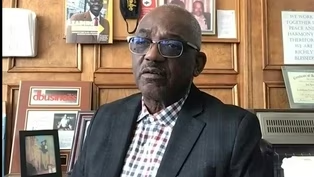
I spoke with the president of the WGPR Historical Society, Joe Spencer, about the void left by Karen's passing and the legacy of this wonderful television station.
Joe Spencer, welcome to American Black Journal.
Well thank you, Steve.
It's so nice to be here today.
Thank you very much.
So let's start with our deepest condolences here at Detroit Public Television and American Black Journal to you at WGPR for the passing of Karen Hudson-Samuels.
I was stunned as everybody was to learn that she had died and I've said a couple of times over the past week that Karen, and you to some extent, I kinda considered you guys almost co-hosts of American Black Journal and certainly part of the American Black Journal family 'cause you're on so much and you've contributed so much to the work that we do here trying to preserve black culture and history and lift up black voices.
So, just personally, the sense of loss from Karen dying is just really, really hard to imagine.
So again, our deepest condolences to you guys.
Thank you, Steve.
Yes, it's a great loss for me personally 'cause Karen and I have been friends since 1976 when she first started with WGPR, and of course it's a great loss to the museum.
It's a great loss to the city of Detroit because Karen had so much involvement in so many different things.
As you said, she'd been on your show for a lot of reasons, for all kinds of projects that you've been involved in not only with the museum, but also with the Black Historical Sites Committee and just other things that she was engaged in, which had her involved in a lot of things that you found interesting enough to bring on to present to your public.
And so we appreciate that, we appreciate you as well.
And thank you for your condolences.
Yeah, yeah.
And of course the timing, though, of her passing I think reminds us of, again, the power of the work that she did, this designation of WGPR as a National Historic Site.
And it happening in large part because of the work she did.
It absolutely was because of the work she did.
Karen worked tirelessly to to bring WGPR's museum up and more awareness in the public.
And she was the one who started the whole effort to get us designated as such and went to all the meetings and did all of the stuff that she had to do to make it happen.
She did the same thing to get us designated as a Michigan Historical Site.
So it was absolutely her work, and it's huge for us.
And it's just absolutely huge for WGPR to be promoted to that status, to be now be designated as an historical site and to be listed, you know?
I had a meeting, not a meeting, but an interview the other day by way of phone from a person from National Geographics that wanted to do a story now on us now that we're designated as a National Historic Site.
She jammed, she banged it up, and then she dropped the mic.
(laughs) She went on to glory and she will never be forgotten, she will always be a part of what we've done.
And to much of our success has been credited to her.
Yeah.
I feel like I've lived through, with you guys, the journey of the museum from an idea to a sort of opening and now to its existence and now this National Historic Site.
But catch us up where you are with the museum and especially how the disruption of the pandemic has played out for you guys.
Well, yes, we have been disrupted by the pandemic.
We closed at certain times because the radio station closed.
Because you know we are housed in the WGPR FM radio station building.
And so we did have to close, but we are currently open.
We are open every Friday and every first Saturday of the month, so we will continue that.
And in fact, we are now even discussing expanding the amount of days that we're open and we're really gonna make a big thrust to get more people involved so that we can expand the amount of time that we are available for the public to see us, especially with the new designation.
We think it's really important.
Yeah.
And of course, as somebody who grew up here in the city in the '70s and '80s, I have incredibly vivid memories of WGPR TV and all of the groundbreaking television that came out of it.
But just as I said in the open, the idea of the first black owned and operated television station that's right here in the city of Detroit is something you just can't-- You can't overstate the importance of that and of preserving that history for people to be able to go and see and touch now.
Yeah, before Barton, before BET, and so much of the, of the media that we're seeing now, WGPR was the very first.
And you know, we were also the first to do some things that hadn't been done in broadcasting, not in the Detroit market.
For example, we were the first television station to use digital video cameras, that is, for news collection.
Everybody else was using film, we were the first to video.
We were the first station to go on the air 24 hours.
Used to be, you know, 1:00 everybody put up that little signal, you get that-- (imitates beeping) And hey, they were off the air until six, 7:00 in the morning.
We were the first to do that.
And of course we produced a lot of our programming because we had no network affiliation.
So therefore we had to fill our hours with programming of all.
So we did have syndicated programming and we did have films and those kinds of things but we produced an awful lot of talk shows, dance, we had the dance shows, entertainment shows.
Karen, in fact, at one time hosted a program called Black Theater.
And it featured films from the '30s and '40s that were produced and starred black people in them.
So, you know, we just had a lot of programming that nobody else was doing and we'd get a lot more of it.
And as a result of that we also gave a lot of young African-American men and women their first opportunity to be brought into the world of broadcasting, their first opportunity to produce a show, to write a script, to appear on camera, to operate a camera.
And as a result of that, many of these people went on to have wonderful careers in broadcasting.
And I think you know one or two of those people as well that had that benefit and have been a great contributor to black media in this town and to media in general.
Your producer, in fact, is-- That's right.
(laughs) Got her start with WGPR and just a fabulous person, Miss Daphne Hughes.
So, yeah, it's been great, you know, and the journey from the time that we just decided that, hey, that this is the legacy of WGPR should not go into darkness and no one ever hear about it anymore and that we should do something to preserve that legacy, that journey from there to now being designated as a historical site has been a wonderful journey.
And you have been there for a good part of this, Steve, because I think that from our very first public event, which was when we had a fundraiser at the Detroit Historical Museum, you brought us on and you could help to share that and we had a very success night and we just went on time after time with one event after another to eventually come to the point where we are now.
Yeah, yeah.
Okay, well, Joe Spencer, congratulations again on the National Historic Site designation that is a huge deal and a great way to honor not only the museum but of course, Karen Hudson-Samuels, who passed recently.
Thank you very much for joining us here on American Black Journal.
Thank you.
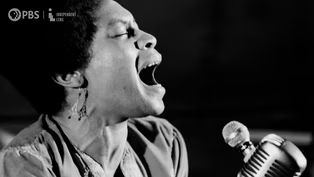
America's first black variety show is being celebrated in a PBS documentary that's airing right here on Detroit Public Television on February 22nd at 10 p.m.
The show was called Soul!
and it debuted on public television in 1968.
The host and producer, Ellis Haizlip, created the groundbreaking show as a way to celebrate African-American contributions to the arts.
The documentary is titled Mr.
SOUL!
Take a look at a preview.
(exciting music) I'll never forget when the show started and you'd strike up the band, this is, wow, live and in color, the Soul!
Show.
ANNOUNCER: Live and in color from New York City, Soul!
welcomes-- And now the very first musical performance of our show, Sarah Dash, Nona Hendryx, Patricia Holte, also known as Patty LaBelle and the Bluebelles.
♪ Somewhere over the rainbow ♪ Way, way up high NARRATOR: We look at the first show.
Essentially we got stars and future stars.
Patti LaBelle and the Bluebelles.
Yes, they'd been around, but not on television.
♪ Why oh why ♪ Can't ♪ I ♪ Why, why Patricia was, I don't know how to explain it, the air was electric.
♪ Let me tell you one and all NOVELLA: We were all very excited because we knew it was something new and special.
WOMAN: The very first show starts and Novella Nelson's face is the face of the introductory sequence.
♪ This hole in the wall MAN: Ellis would bring in people who he had seen or heard or knew.
Novella Nelson who had never been on television.
♪ It would be heaven for a cat, a cold water flat ♪ (audience applauds) MAN: And then there was Billy Taylor who was known in the jazz world, but not in the television world.
We were so excited about someone who at last was beginning to do something that really wasn't done often enough for us on radio and television.
And helping people understand what black music was about.
Ellis did that very well.
And the moment that went on that television, it went boom, you know?
You're bad.
Ain't he bad?
Yeah.
You walked down the street and you were badness.
(laughs) You know?
Again, Mr.
SOUL!
airs Monday, February 22nd at 10 p.m. That same night, you can also watch a replay of this year's Sphinx Competition beginning at nine.
The Sphinx Organization brings together young black and Latinx classical string players to compete for cash prizes and the chance to perform with major orchestras.
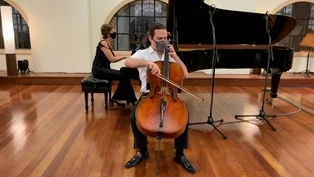
This year's finals concert was a virtual event because of the pandemic.
We spoke with Andre Dowell, chief of artist engagement at Sphinx.
So the Sphinx Competition is of course one of my favorite events of every year.
I just love not only the celebration of black and brown young people and their love of classical music, but boy, the elevation of these performances and the skill level that is on display, always just blows my mind.
And this year, of course, this is no different.
But talk about what's different about this year because of the pandemic.
We're not able to do Sphinx quite the way we're used to.
Absolutely, and you know the talent every year has always increased and that's something that we are very proud of in terms of how we're able to recruit new musicians to enter the competition and bring them here to really give them the tools that they need to succeed.
Of course, this year is like no other in terms of the pandemic and being able to shift how does the Sphinx Competition look and how do we adjust and adapt to today?
I mean, there's something that we've always done with our Sphinx Competition and our organization work that we do is how can we adapt to make sure that we are staying relevant while also providing the support to the musicians?
So this year we were able to keep the competition and go virtual.
Most people who have followed the competition know that we are able to usually bring in an entire 60-member orchestra.
The Sphinx Symphony Orchestra who comes in and acts as mentors to some of these musicians.
Unfortunately, we weren't able to do that with the pandemic but we were able to shift things so that the musicians still had masterclasses with some of the world's greatest judges that we have been able to bring in.
And so this year, basically what happened, the format was such that the musicians were able to record their works in their own home space.
Traditionally, they would come to Detroit at the orchestra hall, Max M. Fisher and Marjorie S. Music Center, they will come there to do the competition.
But this year they were able to do things from their own home.
We provided the support that they needed in terms of recordings and just kind of walk them through that process.
And we were able to actually reach a wider audience because everything is virtual, or everything was virtual for the competition.
So we were able to reach new audiences, reach out to some new venues and partners to ensure they have students and people attending the competition as well.
So it's been great.
And hopefully next year we'll be able to do it back in person again, but if not, we're set up for success from this year for sure.
Yeah.
So talk about the level of competition this year.
That's always I think the real highlight of Sphinx.
As you say, it gets better and better each year.
Yeah, yeah, the level of competition is really something that comes from the musicians themselves.
Sphinx puts the musicians in a place where they feel supported and where they feel valued.
And I think that's something that's really important not just in arts, but just in life in general is for people to feel valued so that they can put their best foot forward.
So from our end, we wanna make sure that they have access to a hall if they need a hall to record, or recording equipment.
In this particular case, piano accompanist and for them not to worry about having to pay for those types of things.
We provide that type of support for them as well.
So as long as Sphinx is doing, as long as we're doing our job of making the musicians feel valued and supporting them, then they have the opportunity to really focus on their art and their craft so that they can be in a practice room or being with their teachers and studying scores and music and listening, and really preparing for the competition.
And that's one of the main ways and reasons how and why the competition this year was very competitive in both the junior and the senior division.
I think the jury panel had a very hard time deciding first, second and third place this year.
Anyone could have won in this year.
Yeah.
And of course, the idea of Sphinx is to, as you say, give people the opportunity and a showcase for their talent.
But the goal really is to increase the numbers of black and brown kids who, A, wanna do this, right?
Wanna be musicians.
And also have the opportunity to get to that high level.
Talk just a little bit about how we're doing with that.
When Sphinx started, of course, we were in a really different place.
Where are we in 2021?
Yeah!
I'll say in 2021 that we have seen some changes happening across the field.
Of course, we do have a long way to go still.
As you said, the Sphinx Organization is really to support the artists and so we've been able to do that in a host of ways, some of them through not just the Sphinx Competition but also through some of the programs where the people who participate in the Sphinx Competition are able to have an impact.
So for example, the winners of the competition are able to play with some of our partner orchestras.
Well, the great thing that is when they go to play with the partner orchestras in a different community, they are now reaching other students, and not just students, but other audiences, audience members, teachers, patrons who can not only experience it but also see black and brown musicians onstage.
And that's a very important part of this that gets lost in the shuffle sometimes is that it's not just about talking about it but we have to actually see it onstage.
And so we've seen an increase through some of those efforts.
Of course, there's a long way to go.
And a lot of programs that we have to support not just from the musician side but also the artistic administration side as well on this.
So those are things that we continually will put in place and as I said before, continue to adapt and evolve what we do as an organization.
Yeah.
And of course, classical music as a field, as a profession, is changing too in terms of the opportunities that exist.
Orchestras don't look like they did just five or 10 years ago.
And I think one of the fears is that those changes also make it more difficult to to maintain access to those who didn't have it before.
Talk about how we're doing with the change in classical music and maintaining that black and brown presence.
Yeah well there's a lot of changes that are happening, especially in terms of how the-- When we talk about entry points into classical music, of course that's changed.
When we talk about who's even coming to the concerts, of course, that has changed over the years as well.
And as far as from a place of understanding and commitment by the organizations, not just from the musicians who you see on stage, not just the administrators who are behind the scenes, but also from a board level as well.
So when we're talking about the changes over the past five to 10 years, from our perspective, we're actually pushing orchestras to have those conversations at the board of directors level, at the full-time staff level, the part-time staff level, even in terms of the vendors that you're able to bring in.
Because when you really diversify in that way and you talk about vendors and you talk about the board presence, you're bringing in outside sources that would have otherwise not been able or even thought about coming into that type of environment.
And so those are the types of changes that we would like to see and to continue over the next five to 10 years.
One of the things that we are really tackling right now is the idea of how orchestras are doing their audition processes and things of that nature.
And so that's something that we're really focused on right now, orchestra audition processes, how you are recruiting artistic administrators, how are you recruiting your boards, ensuring that you're not keeping things in a circle in terms of your circle of friends and people that you know.
We have to look outside of the bubble and create opportunity.
And that's what the Sphinx Organization is about, that's what the competition is about is really creating opportunities and providing this support for everyone.
That is gonna do it for us this week.
Thanks for watching.
You can find out more about our guests at americanblackjournal.org, and you can always connect with us on Facebook and on Twitter.
We're gonna leave you with a performance by the first place winner in the junior division at the Sphinx Competition, Amaryn Olmeda.
Enjoy and we'll see you next time.
("Concerto for Violin No.
3" by Mozart) Announcer 1: From Delta faucets to Behr paint, Masco Corporation is proud to deliver products that enhance the way consumers all over the world experience and enjoy their living spaces.
Masco: serving Michigan communities since 1929.
Announcer 2: Support also provided by the Cynthia and Edsel Ford Fund for journalism at Detroit Public TV.
Announcer 1: The DTE foundation proudly supports 50 years of American Black Journal in covering African-American history, culture and politics.
The DTE foundation and American Black Journal partners in presenting African-American perspectives about our communities and in our world.
Announcer 2: Also brought to you by AAA.
Nissan Foundation.
Ally.
InPACT at Home.
UAW: solidarity forever.
And viewers like you.
Thank you.
(piano music)
Video has Closed Captions
Clip: S49 Ep8 | 2m 46s | Mr Soul! | Episode 4908/Segment 2 (2m 46s)
Providing Support for PBS.org
Learn Moreabout PBS online sponsorship
- News and Public Affairs

Top journalists deliver compelling original analysis of the hour's headlines.

- News and Public Affairs

FRONTLINE is investigative journalism that questions, explains and changes our world.












Support for PBS provided by:
American Black Journal is a local public television program presented by Detroit PBS