Living While Black
What is Racism?
Clip: Season 1 | 9m 24sVideo has Closed Captions
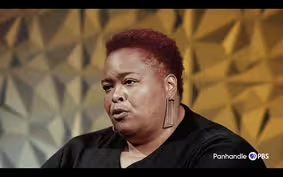
Amarillo residents discuss their definitions of racism.
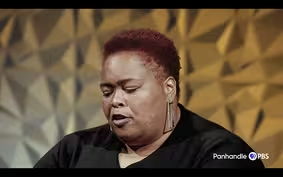
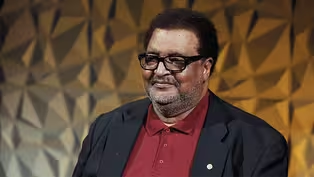
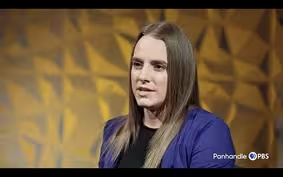
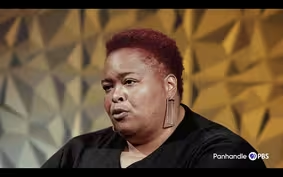
Amarillo residents discuss their definitions of racism, as well as their experiences with racism in the Texas Panhandle and beyond.
Problems playing video? | Closed Captioning Feedback
Problems playing video? | Closed Captioning Feedback
Living While Black is a local public television program presented by Panhandle PBS
Living While Black
What is Racism?
Clip: Season 1 | 9m 24sVideo has Closed Captions
Amarillo residents discuss their definitions of racism, as well as their experiences with racism in the Texas Panhandle and beyond.
Problems playing video? | Closed Captioning Feedback
How to Watch Living While Black
Living While Black is available to stream on pbs.org and the free PBS App, available on iPhone, Apple TV, Android TV, Android smartphones, Amazon Fire TV, Amazon Fire Tablet, Roku, Samsung Smart TV, and Vizio.
Providing Support for PBS.org
Learn Moreabout PBS online sponsorship- [Melodie] I think racism is not liking someone because they have different attributes from you, but I think it combines power.
There's a sense of power that goes with racism.
People want to feel like they can exert power over certain people, When I was dating my wife, she's from Wheeler.
and one day we had went out to her grandfather's land and we were riding four wheelers.
We went down to the creek and her father wanted to show me something so I was like, okay, I follow them, vroom, vroom, vroom, going around the corner and we came up on a guy and he has a rifle and my father-in-law "We're getting out of your way."
And as soon as he, as soon as I say that to him, he looks at me and he begins to raise the rifle and when he begins to raise a rifle, I look at him and I'm like, is this guy really doing this?
And I hit the gas on my four wheeler and I get out of there.
As soon as I hit the gas, pow!
and I got to the top and reality just hit me.
Like I was almost shot and killed.
- [Karen] Because?
- [RJ] Because of being a Black American in the country and having somebody who, I guess, didn't believe I belong there - [Karen] What does racism look like to you?
I can feel it if I would let myself, but I know better because I know that, that racism, it doesn't bother me because I know I'm the same as they are, just a different color, and I'm proud of my color.
Let me put that in because that's very important to me.
I wouldn't change it for nothing in the world, but that racism is something that you can feel when you know that somebody don't want you where they are.
It was the summer of '62.
No, it was '61.
My sister, Carol, was sick and my father was in Air Force, too.
So we lived there, in Fort Worth.
So we had to take the bus from Stop Six and go all the way across town till about Eagle Mountain Lake to Carswell Air Force base to get my sister to see a doctor.
And you had to change bus three times, and there was this juke joint or cafe there on the corner.
The guy, I don't know if he was the owner or a cook or whatever, come to the door and, what do you want?
And she said, sir, can I have a glass of water?
My daughter's sick.
And I need to give her some water to take her medicine.
And he said, well, we don't serve y'all here.
And she said, I'm not asking to be served, sir.
I just need a glass of water to give her my daughter so she can take her medicine.
I can't do that.
I told you, we don't serve y'all.
So you need to go on about your business.
She said, sir, I'll pay for the glass.
I'll even pay for the water.
I just have to give her medication.
And he cursed her out and said, if you don't get away from here, I'm going to call the police.
So, we, my mother, you know, stepped down and the only other place we could get a drink of water for my sister was in the colored section of the Greyhound bus station.
we had to walk about six blocks or so.
You know, city blocks down there to get my sister a glass of water.
Well, you know, to drink out of the colored water fountain in the colored side of the colored section of the Greyhound bus station.
of the Greyhound bus station.
And then we had to walk back to the bus stop and the bus had come and left and we had to wait another hour before we could get on the bus to go home.
my sister and I were walking through the Walmart on Tascosa road.
We were walking through the parking lot and there was a man who was outside and he saw us and he just started screaming the N word.
And he started screaming about how much he hated us.
and he screamed that he was gonna kill us.
And I think it was probably one of the most terrifying moments of my life.
And we just didn't understand because we hadn't done anything.
We didn't know this man, we were both just walking through the parking lot.
- [Allison] I think there are two kinds of racism.
I mean, there's the blatant in your face calling you names and you know what I mean?
And then there's the ones that just want to act like you don't exist or that you're not on the same level.
And I think that one hurts the most.
It's fine if you wanna call me names or things like that say ugly things, but to treat me like, I didn't go to school but to treat me like, I didn't go to school or that I haven't worked somewhere 17 years.
That's the difficult part, 'cause I know how hard I work.
- [Karen] Let's talk about your background.
- [Ebani] Yes there has been times that there has been very direct racism towards me, but I try not to.
That can be an abstract kind of feeling or thinking.
So sometimes it's not something I can concretely say yes, you're being racist against me.
It can be as subtle is a look or just a no, or just the phrasing of things that I think in some instances wouldn't be that way if it were not for the color of my skin.
So with that, it can be very abstract.
You know, it's a very different kind of feeling.
It's kind of like, oh but you get it when it happens.
If that makes sense.
I mean, it could be something as simple as a waiter or waitress in a restaurant being really communicative and talkative to the other patrons of that restaurant and then coming to you and just, basically, abrasively asking you what your order is, not having any form of communication with you at all, and not even looking at you to form that connection, looking past you as if you don't exist.
So, I mean, racism exists in all types of forms.
- [Karen] What does it feel like, physically, when somebody looks past you and like you don't exist?
- [Patrick] You feel neglected, obviously there's pain there.
You don't understand it.
You question yourself like, "Did I not dress right today?
Did I not smile enough?"
You question your every movement throughout that store, that restaurant like, "Did I do something that offended somebody?"
You are the one that feels all of that guilt, but you shouldn't.
- [Curtis] The very first time I experienced it was, I would say, I remember around either kindergarten or first grade, I remember that feeling about I wasn't being accepted for some reason, it wasn't very familiar to me, I didn't know as I was a child, but as I tried to speak to different young men or our young girls in that age group, or in my classrooms, I'm more along I got the look, that feeling of you don't want to address me, or you don't wanna speak to me based off of what, and as it continued on, I caught an understanding of it's because I'm Black.
It does sting, okay?
It's like put an alcohol on a wound.
It stings, it hurts, but after the, the end, you've got to figure out a way to make it better and that's where I would just take it with a grain of salt and show them that whatever assessment that you made of me was incorrect and you can't group everyone and if I'm gonna have to be your example, then I'm gonna have to be your example, because all you saw was the news and when I went over to your house a few times, you all you're watching was Cops.
So in your mind, your assessment is correct, but I'm gonna continue to be the one person who makes your eyebrow raise a little bit and say, well, I can't say all, and then after a while, well, I can't say most, and then after a while it goes to, well, it's just something I saw on TV, okay?
Now we're getting somewhere.

Video has Closed Captions
Dr. Derald Wing Sue discusses defining a vocabulary of racism. (3m 35s)
 Now Playing
Video has Closed Captions
Amarillo residents discuss their definitions of racism. (9m 24s)
Video has Closed Captions
Amarillo's Black and biracial community weighs in on the death of George Floyd. (9m 24s)
Video has Closed Captions
A look at some of the common responses from white people in conversations about race. (6m 16s)

What does it mean to be anti-racist?
Video has Closed Captions
What is the difference in being non-racist and anti-racist? Dr. Derald Wing Sue explains. (3m 11s)
Video has Closed Captions
Black Amariloans discuss the importance of voting. (3m 15s)
Video has Closed Captions
Amarillo residents discuss the best courses of action to take in order to make change. (9m 31s)

Video has Closed Captions
The Tascosa High School mascot and flag used to look a lot different. What changed? (1m 36s)
Video has Closed Captions
A look at AISD hiring practices and efforts to diversify employees in the district. (5m 15s)
Video has Closed Captions
Black Amariloans discuss a common piece of advice they got when they were younger. (3m 18s)

Video has Closed Captions
A look at the desegregation of Amarillo schools. (11m 16s)
Video has Closed Captions
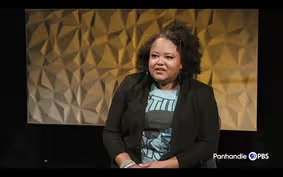
Black Amariloans discuss things they're tired of explaining or being asked. (3m 26s)

Video has Closed Captions
A look at the history of segregation at Amarillo College and West Texas A&M University. (10m 48s)

Video has Closed Captions
Black Amariloans discuss the aspects of Black history that are often left out. (11m 55s)

White privilege with Dr. Derald Wing Sue
Video has Closed Captions
Dr. Derald Wing Sue defines and discusses the concept of white privilege. (2m 28s)
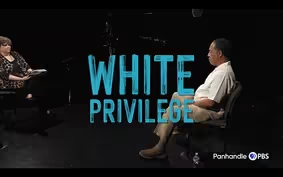
White privilege with Alphonso Vaughn
Video has Closed Captions
Alphonso Vaughn discusses what the term "white privilege" means. (2m 54s)

Video has Closed Captions
A look at how a flawed system impacts our communities of color. (8m 13s)

Civil Rights vs. Black Lives Matter
Video has Closed Captions
A look at the differences in the Civil Rights Movement & the Black Lives Matter Movement. (9m 57s)
Video has Closed Captions
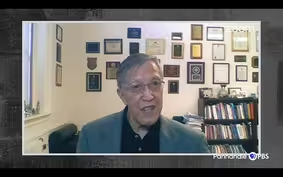
Dr. Derald Wing Sue discusses microaggressions. (7m 14s)
Video has Closed Captions
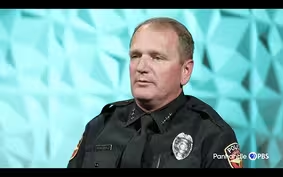
A look at the relationship between the Amarillo Police Department and city residents. (12m 32s)
Video has Closed Captions
An examination of data that shows Black people are more likely to be stopped by police. (5m 57s)
Providing Support for PBS.org
Learn Moreabout PBS online sponsorship















Support for PBS provided by:
Living While Black is a local public television program presented by Panhandle PBS