Articulate
What Might Be
Season 8 Episode 13 | 26m 46sVideo has Closed Captions
Samuel R. Delany and Orkan Telhan interrogate the present to glimpse the future.
Writer Samuel R. Delany and interdisciplinary artist and designer Orkan Telhan interrogate the present to glimpse the future.
Problems playing video? | Closed Captioning Feedback
Problems playing video? | Closed Captioning Feedback
Articulate is a local public television program presented by PBS39
Articulate
What Might Be
Season 8 Episode 13 | 26m 46sVideo has Closed Captions
Writer Samuel R. Delany and interdisciplinary artist and designer Orkan Telhan interrogate the present to glimpse the future.
Problems playing video? | Closed Captioning Feedback
How to Watch Articulate
Articulate is available to stream on pbs.org and the free PBS App, available on iPhone, Apple TV, Android TV, Android smartphones, Amazon Fire TV, Amazon Fire Tablet, Roku, Samsung Smart TV, and Vizio.
Providing Support for PBS.org
Learn Moreabout PBS online sponsorship- [Announcer] Articulate with Jim Cotter is made possible with generous funding from the Neubauer Family Foundation.
- Welcome to Articulate, the show that explores how art tells all of our stories.
(lively orchestral music) And on this episode, "What Might Be."
In his lifetime, the celebrated science fiction writer Samuel R. Delany has witnessed great positive change, and he has hope for more.
- It's getting better, but I'm a big believer in the dialectic, and I think the way to the, time doesn't go, it's not circular.
It moves, and the technology moves, and the only way we're going to solve it is some active encouragement of positive, technological change to do something radical.
- [Jim] And curiosity and collaboration have been driving forces in the life of interdisciplinary artist Orkan Telhan.
- Most important thing for me is to come up with the good questions, and sometimes I'm capable of answering the questions myself, or I initiate conversations where we ask those questions together.
- [Jim] That's all ahead on Articulate.
(lively orchestral music) - [Reporter] A dark page on the annals of America has been written to the crack of an assassin's bullet.
A nation mourns, the world grieves.
The man who became the 35th president less than three years ago is dead.
- [Jim] The night before President John F. Kennedy was assassinated in 1963, Samuel Delany finished the novel he had been working on for five years.
Then his agent lost it.
The only copy Delany had, he says, was in a filing cabinet in a house that was demolished.
- Probably it's underneath pounds and pounds of cement, or somewhere in the Jersey flats, I don't know.
- Right.
What did you do after you found out that that book was completely vanished from the earth?
Because the only ways to prove that you are a creator, is that there's a creation.
- Right.
You start again, and you do something else.
That's all you can do.
- [Jim] Samuel, or Chip, Delany is no stranger to building and rebuilding.
For over half a century, he's been constructing worlds on the page.
Since putting out his first novel at 19, he's since published more than 40 others.
The New York Times has described him as one of America's foremost living science fiction writers, and his work as fiction that reflects and explores the social truths of our world.
Delany's mammoth output is thanks to a balance between desire and discipline.
- Writing is an addiction, but it's such an easy addiction to break.
It's like a very, very, slight addiction that you have to, you have to feed the addiction.
- [Jim] But his penchant for fictional worlds isn't for lack of engagement in the real world.
As a black gay man in the United States, he's lived through some of the country's greatest social transformations.
Born in Harlem in 1942, Delany's father ran a funeral home.
His mother was a senior clerk at the New York Public Library, and supported his various artistic and intellectual interests, but racial tensions also loomed.
Growing up, his father was afraid of what might happen if his son were ever to be alone with a white woman, this in the wake of the brutal murder of a 14-year-old black youth in Mississippi for allegedly flirting with a white woman.
- The kind of thing that happened to Emmett Till.
The rally for Emmett Till was, happened outside my window when I was a kid, you know?
And I would, and I sat there and listened to it.
- [Jim] Delany was in his late 20's when a police raid on the Stonewall Inn, a gay club in New York that is now a National Historic Monument set off confrontations that sparked an international gay rights movement.
- About '68, I think, the awareness that gay people existed started, and by '69 with the Stonewall riots, that was a big change.
That was a really, really big change.
- [Jim] Samuel Delany unabashedly inhabits his sexuality, and it seeps into his writing, so much so that he's been called a sex radical.
- There were several times when I was sure my particular peculiarities had become common knowledge from one end of the bridge to the other, thanks to his banter with the other boys, only to discover it'd never even occurred to him to mention them from nothing more than a natural reticence, which would have done honor to someone far more nobly born.
Therefore, I see no need to detail the particularities of his tastes, suffice it to say they were harmless, even charming, and I was touched that he chose to confide them in me.
- [Jim] Still, for someone who has written so openly about desire, Delany never did get a chance to discuss his sexuality with his own mother.
- My mother liked the theater a lot, and there was a period when my mother was constantly inviting me out to see this gay play, and that gay play, in which we would talk about the play.
And we talked about what the play was about, but it was, there was never any coming out.
And then I was writing The Motion of Light and Water, which is my autobiography, biographical essay, book-length essay, and I thought, "Well, I'm going to have to come out to her," and that's when she had her stroke.
So I never got a chance to come out to my mother, 'cause I was all prepared, and if she had had the stroke three months later, I would have.
That first night back in the city at my mother's suggestion, we spent at my childhood Harlem home, which my mother still owned, up at 2250 Seventh Avenue, and where brothers sometimes lived above my father's old funeral establishment.
We slept on the couch, really a double-width day bed with a bolster along the back, on which, when I was not yet three, I'd been first allowed to hold my baby sister, newly returned from the hospital.
I began to cry from seeing the furniture, among which I'd lived till I was 12, covered with dust and practically unmoved since my family had left the place, the hand-carved boat I'd been given for my 12th birthday askew in its stand before the fireplace, its sails torn and fallen over the jib.
The same drapes, still at the back windows, heavy with the dirt of four years, while Marilyn tried to comfort me.
We left before five in the morning.
- [Jim] After her stroke, Delany's mother lost her ability to use language.
The only phrase she could say for the remaining eight years of her life was, "I know, I know, I know," but Delany also built his own version of domestic normalcy.
In 1961, he married his high school sweetheart, the poet Marilyn Hacker.
She was pregnant when they took a Greyhound bus to Michigan, the closest state they could find that would allow them to marry, given their age and racial differences, but she miscarried shortly after.
In the following months, Delany was motivated by what he has called a set of obsessively vivid dreams, and began working on what would become his first published novel, The Jewels of Aptor.
- What do you know of the Island of Aptor?
Nothing, ma'am.
This boat has been to Aptor once, and now will return again.
Ask your ignorant friend the bear to tell you tales of Aptor; and blind wise poet, you will laugh, and probably he will too.
But I will tell you: his tales, his legend, and his fantasies are not a tithe of the truth, not a tithe.
Perhaps you will be no help after all.
I am thinking of dismissing you.
- [Jim] Life with Marilyn helped Delany to write, and also pushed him to grow up.
- We had an older friend who lived with us, another woman named Sue Scholly, who was wonderful, who was an old graduate student at Columbia.
And once I went off and disappeared, I literally, I went off to buy one or the other- I never smoked, but I went to buy one or the other of them, a pack of cigarettes, and I stayed away for three days, having a fairly good time, and when I came back, Sue said, "Chip, that's not acceptable.
You can't go out and say, 'I'll be back in 20 minutes,' and vanish for three days."
You know, and I that's true.
I mean, you have to learn how to be responsible.
I had to learn how to handle my own life, and I was, you know, and I was learning that at the same time, and we were learning together.
- [Jim] Still, learning didn't mean conforming to a traditional sense of marriage.
Hacker knew Delany was gay, and eventually she would too come out as lesbian.
- What is this part of me that lingers to overhear my own conversation?
I lie rigid in the rigid circle.
It regards me from diametric points without sex, and wise.
We lie in a rigid city, anticipating winds.
It circles me, intimating only by position that it knows more than I want to.
There, it makes a gesture too masculine before ecstatic scenery.
Here, it's suggests femininity, pausing at gore and bone.
It dithers and stammers, confronted by love.
It bows a blunt, mumbling head before injustice, rage, or even it's like ignorance.
Still, I am convinced that at the proper shock, it would turn, and call me, using those Hermetic syllables I have abandoned on the crags of broken conscience, on the plains of charred consciousness, at the entrance to the ganglial city.
And I would raise my head.
"You," he said, suddenly.
It was dark.
"Are you happy?
I mean, living like this?"
We had one wonderful period.
I think of it as one of the happiest moment, times in my life.
It was only, at its best, it was only about three months long, where we were living with another guy.
It was a lot of fun.
And then of course he brought his wife, who was several years older than he was, and it was really strange, but it was only, but at the best it was as nice as it could, things that had ever been, but we never could reestablish something like that.
- [Jim] Delany and Hacker had a daughter, Iva, but the marriage didn't last.
Eventually they divorced.
Still, Delany continued to build his life as a writer.
In the 1980s, his story, The Tale of Plagues and Carnivals from the collection Flight from Nevèron was the first work of fiction about AIDS published on a major imprint, Bantam Books.
- There is danger in Kolhari of plague.
To date, there have been 79 probable deaths, and of the several hundred who have contracted it, no one has yet recovered.
We advise care, caution, and cleanliness, and Her Majesty, whose reign is brave and beneficent, discourages the indiscriminate gathering of crowds.
This is not an emergency.
No, this is not an emergency, but it is a situation Her Majesty feels might develop into one.
And on the bridge, and in the market, and on the street corners, and in the yards, people gathered, heard, glanced at their neighbors, and dispersed quickly.
- [Jim] In 2013, the Science Fiction and Fantasy Writers of America named him a Grandmaster.
Today, Delany's joy comes from simpler moments with his longtime partner, Dennis Rickett.
- I'm perfectly happy, and I right now, I mean, Dennis and I, you know, lie around and hold hands most of the time, you know?
And he likes that, and that's basically what we do.
- Sounds very sweet.
- Yeah.
- [Jim] But Samuel Delany has never lost his drive to venture to improbable places, both on and off the page, including the college classroom.
- I have a high school degree, and I have a year of college, and then suddenly, you know, 15 years later, I found myself a professor, you know?
I mean, what's the, what's the old joke?
You know, yesterday, I couldn't spell, spell professor, and today I are one.
- [Jim] Delany taught at several universities after retiring from teaching in 2015.
He feels like he wasn't a very good teacher, but teaching takes many forms, and happens in many places.
Over the past 60 years, Samuel Delany has turned countless bedrooms and subway cars, library desks and park benches into their own sort of classrooms, places for us to read about exotic worlds, and see our own world through the eyes of a man, constantly building and rebuilding.
(lively orchestral music) Orkan Telhan knows that he didn't need to grow steaks from human cells.
- I could've made a picture of them.
I could have used papier-mâché and plaster to fake it, but I'm showing you how they really look like if you grow these cells in six months.
I spend the money.
I collaborate with scientists.
It's a team of people working on it.
After all this effort, they are not just drawings, or film, or documentation.
They are the real thing.
- [Jim] Telhan grew the coin-size steaks as part of Breakfast Before Extinction, an installation reflecting on the future of the human diet, but as word spread, so did outrage.
He received threatening emails and accusations that the project was promoting cannibalism.
Faking human cell steak would have been a less provocative approach, but provocation was his aim.
- And some people overreact.
Some people feel, you know, threatened about it.
Some people think that, you know, it's the worst idea in the world, but there's a conversation about this.
So sometimes the conversation happens in the galleries, but most of the time, the bigger conversation happens outside the gallery space.
So I care about the bigger space.
How can we create these artifacts so that they really reach to broader audiences, not necessarily to become popular, but to provoke new conversations around these big, tough issues?
- [Jim] Whether growing human cell steaks, constructing a chapel that plays recordings of opinions on political and religious issues over electronic music, or designing a sculpture that tells the history of the Istanbul Community Gardens from the perspective of microorganisms, Telhan is an artist and designer more interested in sparking curiosity than finding answers.
- The most important thing for me is to come up with the good questions.
And sometimes I'm capable of answering the questions myself, or I initiate conversations where we ask those questions together with other people.
Because sometimes we don't realize that we live in a world that's constructed by others, other people's imaginations, other people's values, and so on, so how can we push this a little bit so that we ask ourselves the tough questions, and then we can really push our boundaries of imagination?
- [Jim] Born in West Germany in the 1970s to Turkish parents, Telhan's childhood was shaped by two opposing forces, immense curiosity, and a feeling that he wasn't very interesting.
- I was a very boring kid from my own standards, like, no amazing drawing skills, no amazing like, prodigy, you know, things that parents will say, "Oh, he was a great guy."
But I would say books were fascinating, right?
I mean, the earliest memories that I still have, even before I probably was capable of reading books were spending time in bookstores, looking at the covers and things, and I think that sense of like, looking this book relates to this book, and this book, that overview of how you can connect the things is the most important thing for me.
Like, now I don't think that I have a great imagination, but I know the importance of connecting things that are not necessarily easy to connect with each other.
Things, when you're an adult, you can, you know, filter out, and say that, "Okay, well, this makes sense."
But when you're a kid, nothing makes sense, and the important thing is that nobody said no.
- [Jim] Language was another force that shaped Telhan.
For the first seven years of his life, he spoke German.
Then he was enrolled in a Turkish-speaking school.
It took several years for him to feel comfortable with his parents' native language, but the process pushed him to see the world from fresh perspectives.
- I think it caused something in the brain that had like, these two different, you know, worlds that had to translate things with each other.
And during every translation, you create a new worldview, a new reality.
So that weird thing about like, using a, translate one thing, to another thing, and another thing was probably still a method that I'm using today.
- [Jim] Decades later, Telhan's interest in language and questions collided in United Colors of Dissent.
The piece, which Telhan describes as data-driven performance, invited passers by on the streets of various cities to answer questions on their phones.
The interface allowed them to answer in any language of their choice, and then display the answers in real time, as well as the languages represented for everyone to see.
It allowed people to answer, anonymously, questions they might have otherwise felt uncomfortable with, such as, can you travel freely around the world?
Have you ever felt suppressed?
And do you have faith?
- It's a different kind of politics than asking the question, because now we are enabling people who are silenced to contribute to the project.
It's a different thing than saying that, "Are you, you know, oppressed by this regime?"
You know, if you ask the question like this, people say yes, no, but then what?
But if you see your friend who is answering the question next to you saying something, then, and you, after answering the question, then you can have a private conversation about what was your experience?
What was going on?
That I think is the most powerful part of the project, not what we accumulated or presented in public, but how it, it created a new conversation among people, because they are publicly participating at the same time, so the kind of dialogues that emerge.
- [Jim] Cultivating conversation and exploring differences isn't just a message Telhan weaves into his work.
It's also something he practices as an Associate Professor of Fine Arts at the University of Pennsylvania.
- I have students coming from all kinds of different value systems, religious systems, and financial commitments, or investments to different types of values, let's put it this way.
And I try to listen their concerns, and think about how they can be more diversified, because that's what we can do.
Like, if you have a different opinion, I have a different opinion, to be able to understand each other's values to be, we need to really empathize with each other.
We can still keep your opinions- - And still disagree.
- And disagree, but now you'll be in a more powerful position if you know my, if you know the extent and the details of my values.
So I'm trying to make sure that we can see the complexity and operate in that complexity, even though we don't have a solution to deal with individual differences.
We are probably more dependent on each other, not only because we are depending on this human level of connection, but the food that we eat, the air that we breathe, the soil that we step on has a big connectivity across this microbial realm that makes us all dependent on each other.
So individually we are maybe siloing ourselves, using that you're yourself like, you know, the confines of your body, you go around.
But I think that that's an illusion.
That's a reality that we've constructed ourselves, and deep inside, it's all very much connected.
(lively orchestral music) - [Jim] But Telhan isn't just interested in relationships between people, or even between people and the environment.
He questions why people should be the focus of our concerns in the first place.
One of his recent projects, Microbial Fruits of Istanbul, is an installation that tells the history of that city's community gardens from the perspective of microorganisms collected across the city.
(parrot squawking) - What is happening, when humans were claiming all these territories, having all kinds of conflict with each other, never getting along or, and also lots of peaceful things as well.
- Sure.
- So I have to acknowledge that too.
What was happening to the non-humans in the backgrounds, like, whether it's organisms, whether it's animals, whether it's plants?
So I'm interested in, again, challenging the human-centric thinking about history, and archeology, and so on, because these places have hosted many, many gene pools of species for thousands, or maybe millions of years, right?
I mean, people are talking about like, you know, people moving from Africa to the Middle East.
It was one of the gateways to where the homo sapiens spread around.
So in a space like this, like, focusing on the last 2000 years, to me is a little bit like, maybe it's arrogant, right?
I mean, I'm not interested in preserving gardens so that humans go and grow more vegetables in them, because again, that will be human exceptionalism, leaving them alone so that they can be themselves.
- [Jim] Telhan wants to decentralize humans from our world views, but his position isn't a cold, calloused disregard.
He's neither pessimistic nor optimistic about the future of humanity.
Instead, he's tried to tap into a broader interpretation of our world, an understanding fueled by humility.
- I believe in the species, I don't think that it needs to go extinct.
I don't, it doesn't have to be so radical, or it will never learn, and it will just be like, bumped out, like, because it will conflict with another species, and it will lose the priority.
So we will not know, and that not knowing part is, I think, a good, humble place to be as a human.
I believe in science, we need to learn, but we won't be able to know what's going to happen 10,000 years down the road.
So let's make sure that we really calibrate our own knowledge, based on the, what we can think about right now.
(quirky music) - [Jim] Orkan Telhan's interests and work don't fit neatly into a box or category, because he won't allow them to.
He remains open to new questions, and new curiosities, never content to take any part of our complicated, interconnected world for granted.
For more Articulate, find us on social media, or on our website, articulateshow.org.
(lively orchestral music) On the next season of Articulate, in a career that's lasted almost three decades, singer-songwriter Ben Folds has become a national treasure, in part by not trying to be perennially cool.
- The idea that you have to hang on to the glory years of your turbulent, 18 to 30 year old self, the pressure to remain in the extremely marketable age group seems unhealthy to me.
- [Jim] As a child, the Ghanaian-American novelist, Yaa Gyasi's family moved around a lot.
It turned out to be a boon for a young girl, constantly observing the world, in search of who she might become.
- I was aware of the fact that in each new place that we lived in, there is like, a new set of rules, new ideologies, what people thought to be kind of inherent to them.
And so I like, became kind of obsessed with doing these little thought experiments.
Like, if I stayed in Ghana, who would I be?
If I, you know, stayed in Ohio, who would I be?
- [Jim] As a young man, music theater lyricist and composer, Stephen Schwartz dreamed of finding his place on Broadway.
The dream came true, but its reality was not as expected.
- I was so naive.
I was such a romantic, and had this vision of what it was gonna be like if I could possibly work in that world, and how I was going to feel, and what the people were going to be like, and you know, none of that was true.
- [Jim] And contemporary theater director Ping Chong has spent his life intensely creating uniquely innovative work.
- Going full-tilt for almost 50 years, and I would be producing three or four works a year.
I'm not afraid to push the boundaries.
If you're gonna look at something for the truth, you can't go halfway.
You have to go all the way.
- [Jim] I'm Jim Cotter.
Join us in 2022 for these, and much more on the next season of Articulate.
(lively orchestral music) - [Announcer] Articulate with Jim Kotter is made possible with generous funding from the Neubauer Family Foundation.
(musical notes)
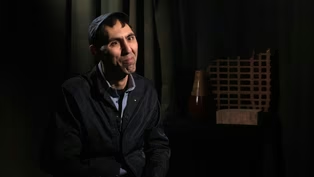
The Explorations of Orkan Telhan
Video has Closed Captions
Clip: S8 Ep13 | 10m 50s | Curiosity and collaboration drive interdisciplinary artist Orkan Telhan. (10m 50s)
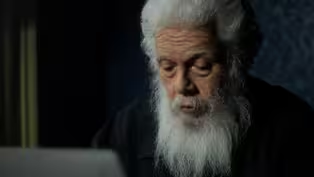
Video has Closed Captions
Clip: S8 Ep13 | 13m 1s | Samuel R. Delany has witnessed great changes, and he still has hope for more. (13m 1s)
Providing Support for PBS.org
Learn Moreabout PBS online sponsorship

- News and Public Affairs

Top journalists deliver compelling original analysis of the hour's headlines.













Support for PBS provided by:
Articulate is a local public television program presented by PBS39