Docs on Call
Why Obesity Rates Rose—and What May Be Changing
Clip: 4/23/2026 | 2m 52sVideo has Closed Captions
A physician discusses processed foods, GLP-1 drugs and changing nutrition advice.
Dr. David Tennant discusses factors he sees behind rising obesity rates, including ultra-processed foods, reduced physical activity and decades of changing nutrition advice. He also explains why newer knowledge about added sugars and refined grains, along with wider use of GLP-1 medications, may begin changing weight trends.
Problems playing video? | Closed Captioning Feedback
Problems playing video? | Closed Captioning Feedback
Docs on Call is a local public television program presented by WTVP
Docs on Call
Why Obesity Rates Rose—and What May Be Changing
Clip: 4/23/2026 | 2m 52sVideo has Closed Captions
Dr. David Tennant discusses factors he sees behind rising obesity rates, including ultra-processed foods, reduced physical activity and decades of changing nutrition advice. He also explains why newer knowledge about added sugars and refined grains, along with wider use of GLP-1 medications, may begin changing weight trends.
Problems playing video? | Closed Captioning Feedback
Where to Watch Docs on Call
Docs on Call is available to stream on pbs.org and the PBS app.
Providing Support for PBS.org
Learn Moreabout PBS online sponsorshipthe average American consumes 55% of their calories from an ultra processed food source.
And stipulated the term ultra processed, it's not, like, precisely defined.
You might get slightly different definitions, but you know it when you see it.
The basic definition is if you didn't make it or your wife didn't make it, it's fast food, right?
So if it's coming from literally a drive through or something frozen or in a bag, something that you could not create in your own kitchen, it's an ultra processed fast food.
And these tend to be obesogenic for a variety of factors.
Now, is it the sugar, is it the refined grains?
Is it something else, like, all the salt or the pesticides?
You know, who knows?
Like, the microplastics?
I don't know.
There's all sorts of possibilities.
But very broadly, it does seem to be the combination of large percent, the majority of our calories coming from an ultra processed source, reduced exercise, 'cause we're doing less physically demanding work, that plays a role, less than nutrition, and yeah, just the environment.
And we just, there's no question about it, the weight's been going up over the years.
- But you mentioned that you wouldn't be surprised if it goes down a little bit when this next set of info comes out.
Why is that?
- I have two theories.
The first is kind of the obvious, the use of GLP-1 medications.
This has been true for, you could maybe say 10, but certainly over the last five years, GLP-1s to address weight as a chronic disease is in widespread use, and it's all over the news, and I'm sure everyone has at least some passing thoughts on it.
The other thing, and I don't wanna give short shrift to it, I think the knowledge has changed.
You know, knowledge is kind of everything.
I heard it once before, that we have all the same resources as cavemen.
Actually, we have less, 'cause we've used some of the resources in the ground, right?
But what we have that they don't have is the knowledge of how to use them.
I was born in 1985.
I remember shopping with my mother in the '90s.
It was fat-free everything.
You know, I Can't Believe It's Not Butter, like, et cetera.
You can still go to the candy aisle today, and you could find something listed as a, quote, fat-free food.
And it's true as far as it goes, there's no literal fat in this thing in a package, but that's not really, they're not answering the question that you're asking.
The question that you're asking is, I, as the consumer, am I gonna get fat?
And the answer is yes.
So it's not really like a quite fat-free food.
And I think this is changing, where we're kind of understanding all of these... You know, the classic boogeyman is the food pyramid, which was, I mean, it was taught to every school child, at least when I was in school, and just these huge quantities of, like, refined grains, and that's just, what's the word?
Bad advice, you know?
So, and that seems to be going away, reducing the added sugars, reducing the refined grains.
People do seem to come in, at least coming in see me, to know that.
Like, how to execute that, I'm not saying it's a simple problem, but at least conceptually we're understanding it.
So I think it's a combination of medical advances and just improved knowledge across the board.
Is Healthy Home Cooking Really More Expensive?
Video has Closed Captions
A physician argues that cooking whole foods at home can be affordable and accessible. (54s)
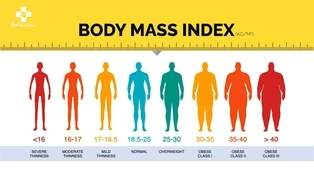
What BMI Can—and Can't—Tell You
Video has Closed Captions
A physician explains how BMI defines obesity and where the measure can fall short. (58s)
Providing Support for PBS.org
Learn Moreabout PBS online sponsorship New Episode
- Science and Nature

Explore scientific discoveries on television's most acclaimed science documentary series.






 New Season



 New Season

Support for PBS provided by:
Docs on Call is a local public television program presented by WTVP