
Why Some LA Neighborhoods are Hotter Than Others
Clip: Season 6 Episode 4 | 5m 11sVideo has Closed Captions
Can urban tree canopies help cities beat the heat?
Trees do more than beautify neighborhoods—they help improve air quality and reduce the impacts of extreme heat. As climate change raises temperatures, communities across Southern California are expanding urban tree canopies. But tree cover isn't distributed equally, some communities have easier access to green space than others.
Problems playing video? | Closed Captioning Feedback
Problems playing video? | Closed Captioning Feedback
Earth Focus is a local public television program presented by PBS SoCal
Why Some LA Neighborhoods are Hotter Than Others
Clip: Season 6 Episode 4 | 5m 11sVideo has Closed Captions
Trees do more than beautify neighborhoods—they help improve air quality and reduce the impacts of extreme heat. As climate change raises temperatures, communities across Southern California are expanding urban tree canopies. But tree cover isn't distributed equally, some communities have easier access to green space than others.
Problems playing video? | Closed Captioning Feedback
Where to Watch Earth Focus
Earth Focus is available to stream on pbs.org and the PBS app.
Providing Support for PBS.org
Learn Moreabout PBS online sponsorshipFerdman: Trees are not a resource that's equitably distributed.
We know that there is inequitable access to tree canopy all across the county, and that inequity in access is not random.
Thomas: The lack of trees and the lack of green space is just one component of the inequity that exists in our society and certainly in the City of Los Angeles.
I think the term for it would probably be "environmental racism," "environmental injustice."
Ferdman: We know that those historic injustices are compounding in the same communities in the same locations over and over again.
Thomas: We know areas that historically have been more disadvantaged where there's a lack of urban greening because, very specifically, the people who live in these communities are African American, Black, Latino, often immigrant populations, and it's very apparent--for example, South Central Los Angeles, the density of population in these areas adjacent to freight train lines, adjacent to industrial areas, adjacent to freeways.
Ferdman: The same places that don't have access to trees are the same places that don't have access to other kinds of green space, clean air, or clean soil or affordable housing or fresh and healthy foods, so even though those policies are in the past, you know, the legacies of those policies are very much still present and felt by communities who live here today.
♪ Narrator: Temperatures between neighborhoods can vary drastically based on tree coverage.
Studies have measured differences of 10 degrees or more between areas with tree coverage and without, impacting not just outside temperatures, but indoor temperatures, as well.
de Guzman: We had one of our study sites, which was a home in Huntington Park with no shade, with no trees.
We had a temperature reading of 107 degrees on the hottest day recorded in Los Angeles.
To have an indoor temperature of 107 degrees over a sustained period of time, you could be among the healthiest, you could be an Olympic athlete, but that kind of exposure over a few hours is bound to have sometimes irreparable, you know, consequences on the body.
Narrator: Research has shown that LA's urban forest initiatives could reduce heat-related emergency room visits by up to 66% if the total allowable tree cover across the city is filled.
The lives and health outcomes of Los Angelenos could be drastically improved.
de Guzman: So this little sensor is a Bluetooth-enabled device that collects data continuously about different weather conditions, including temperature and relative humidity among other factors.
It's kind of neat to be able to tell what the heat signature of different surfaces is, and that's what that thermal camera does.
So this is pretty remarkable.
Just within the space of a few feet, what I'm seeing is, that shaded part of the sidewalk, surface temperature is about 86 degrees.
The portion that's in the sun right in front of us here is 110, 111, and at the same time, the street is 120 or so.
In this particular case, the grass is actually just about the same temperature, maybe even a little bit warmer than the sidewalk is that's in the shade.
♪ [Birds chirping] At UCLA, we went through a whole process that took several months of doing research, engaging with the community, understanding what residents want.
Our purpose for collecting the visual data, both thermal imagery as well as the ambient temperature data, is to be able to see what the baseline conditions are and then to be able to come back and show how we have made an impact by virtue of planting more trees and providing more shade in those neighborhoods.
♪ About 3/4 of this neighborhood is paved, which means that we have incoming solar radiation during the day to be retained which then is released at night and creates sort of an ongoing cycle of exposure to heat during heat waves, which, of course, we know are getting longer and more intense, so what we want in every corner of the city is for people to have a place to go, have a place to enjoy, have a place to get a break from the heat.
This park can be one of those places if we had shade here, if it was more inviting.
Having a pocket park that can provide that--and shade, again, is the number-one way to reduce outdoor temperatures--is a vision that we want to realize for the city.
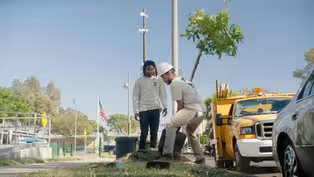
Combating Climate Change with Trees
Preview: S6 Ep4 | 30s | Rising heat is causing communities to plant trees in their neighborhoods to cool off. (30s)
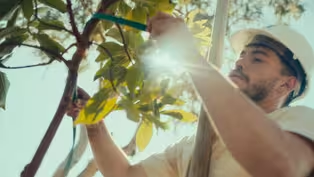
Why Los Angeles is Expanding The City's Tree Canopies
Video has Closed Captions
Clip: S6 Ep4 | 3m 41s | By planting trees around Los Angeles, neighborhoods gain shade, relief and natural beauty. (3m 41s)
Providing Support for PBS.org
Learn Moreabout PBS online sponsorship New Episode
 New Episode
- News and Public Affairs

Top journalists deliver compelling original analysis of the hour's headlines.

 New Episode
 New Episode

 New Episode

 New Episode
 New Episode

Support for PBS provided by:
Earth Focus is a local public television program presented by PBS SoCal