Docs on Call
Why Some People Are More Prone to Joint Injuries
Clip: 4/9/2026 | 1m 55sVideo has Closed Captions
Experts explain how body structure, movement and weakness can increase injury risk.
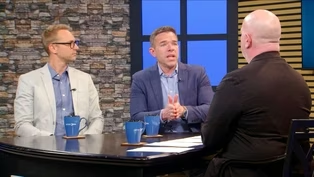
Dr. Charles Miller and physical therapist Brandon Fritz discuss why some people may be more prone to arthritis, plantar fasciitis or repeated ankle sprains. Genetics can play a role, but body structure, weight, activity, joint motion and muscle weakness can also create risk factors that physical therapy may help identify and improve.
Problems playing video? | Closed Captioning Feedback
Problems playing video? | Closed Captioning Feedback
Docs on Call is a local public television program presented by WTVP
Docs on Call
Why Some People Are More Prone to Joint Injuries
Clip: 4/9/2026 | 1m 55sVideo has Closed Captions
Dr. Charles Miller and physical therapist Brandon Fritz discuss why some people may be more prone to arthritis, plantar fasciitis or repeated ankle sprains. Genetics can play a role, but body structure, weight, activity, joint motion and muscle weakness can also create risk factors that physical therapy may help identify and improve.
Problems playing video? | Closed Captioning Feedback
Where to Watch Docs on Call
Docs on Call is available to stream on pbs.org and the PBS app.
Providing Support for PBS.org
Learn Moreabout PBS online sponsorship- Is there anything genetically that some people have that would make them more prone to some of these injuries?
Like, say, you're not an athlete.
You're relatively young, but maybe you have, say, plantar fasciitis.
I mean, is there anything that genetically, again, that may just be affecting people, and it's not necessarily their own fault?
They're not exerting themselves too much.
- Sure.
There are a few things here and there.
One of the questions that I get a lot is, "I have, you know, a painful knee, and Dr.
Miller diagnoses me with arthritis in my knee.
Well, my mom had arthritis, so it must be something genetic, right?"
And the really specific answer for that is, well, technically it's probably not really genetic, but from a genetic standpoint, you are built like your mom and dad.
And probably our build and some of things like how much we weigh and how active we are is a little bit of a product of both nature and nurture and that if you're built similar to Mom and Dad, there's some similarities there.
You have similar risk factors for developing things like that.
There can be some genetic factors, but they're gonna be the sort of the odd-liers out, things like connective tissue disorders that are genetic.
You have any other examples you can think of?
- Yeah, I mean, you mentioned plantar fascitis.
So, this is maybe gonna go one step beyond the genetics, but there are things that we look for in physical therapy for plantar fascitis, for chronic ankle instability and ankle sprains, where, you know, if people have only this much ankle motion or this weak of ankle muscles, then they're kind of predisposed to some of these things as well.
So they might not, you know... And we try to catch things as early as we can because sometimes people come in years later, and they say, "Well, I should have gotten PT, you know, several years earlier."
So there are definitely some things that we can look at and try to improve
Arthritis Isn't Just About Getting Older
Video has Closed Captions
An orthopedist explains why age alone does not determine who develops arthritis. (2m 11s)

A Better Warm-Up for Preventing Sports Injuries
Video has Closed Captions
An orthopedist explains why a dynamic warm-up may help prevent sports injuries. (2m 36s)
Providing Support for PBS.org
Learn Moreabout PBS online sponsorship New Episode
- Science and Nature

Explore scientific discoveries on television's most acclaimed science documentary series.






 New Season



 New Season

Support for PBS provided by:
Docs on Call is a local public television program presented by WTVP