
Willa Goes to Washington & More
Season 15 Episode 7 | 27m 10sVideo has Closed Captions
Willa Cather takes her place in National Statuary Hall and more.
Willa Cather takes her place in National Statuary Hall; family, football and love in Memorial Stadium. Segments include "Willa Goes to Washington", "Love and Football", "A Story Set in Stone", and "Cosmic Films". We see the dramatic unveiling, speak with sculptor Littleton Alston, who created the work, and explore Cather’s long journey through her life.
Problems playing video? | Closed Captioning Feedback
Problems playing video? | Closed Captioning Feedback
Nebraska Stories is a local public television program presented by Nebraska Public Media
Willa Goes to Washington & More
Season 15 Episode 7 | 27m 10sVideo has Closed Captions
Willa Cather takes her place in National Statuary Hall; family, football and love in Memorial Stadium. Segments include "Willa Goes to Washington", "Love and Football", "A Story Set in Stone", and "Cosmic Films". We see the dramatic unveiling, speak with sculptor Littleton Alston, who created the work, and explore Cather’s long journey through her life.
Problems playing video? | Closed Captioning Feedback
How to Watch Nebraska Stories
Nebraska Stories is available to stream on pbs.org and the free PBS App, available on iPhone, Apple TV, Android TV, Android smartphones, Amazon Fire TV, Amazon Fire Tablet, Roku, Samsung Smart TV, and Vizio.
Do you have a Nebraska Story?
Do you have a story that you think should be told on Nebraska Stories? Send an email with your story idea, your name, your city and an email address and/or phone number to nebraskastories@nebraskapublicmedia.org. Or, click the link below and submit your information on nebraskastories.org.Providing Support for PBS.org
Learn Moreabout PBS online sponsorship(gentle music) (upbeat music) - [Narrator] Coming up on Nebraska Stories, Willa Cather takes her place in National Statuary Hall.
Family, football and love in Memorial Stadium.
(upbeat music) The Kentfield twins, and a passion for petrified wood, (upbeat music) and an amateur filmmaker's cosmic playground.
(upbeat music) (upbeat music) (upbeat music) (upbeat music) (upbeat music) (Mozart's "Eine Kleine Nachtmusik") (Mozart's "Eine Kleine Nachtmusik") - [Littleton] And here we are walking to the Capitol, (Mozart's "Eine Kleine Nachtmusik") and it was a perfect day, it was beautiful, the sky was blue with clouds.
(Mozart's "Eine Kleine Nachtmusik") But we saw the dome and the fountains and all of it, and it was just entering this beautiful space.
(Mozart's "Eine Kleine Nachtmusik") It was just gorgeous.
(Mozart's "Eine Kleine Nachtmusik") When we walked through the main hall, the hall opened up, and there were photographers from all around the world there.
The place was packed.
(Mozart's "Eine Kleine Nachtmusik") - [Narrator] Sculptor Littleton Alston arrives in Statuary Hall, on the second floor of the US Capitol, on the most thrilling day of his professional career.
(announcer chatting) His seven foot bronze of Nebraska writer Willa Cathar.
-is hidden under cloth.
-(ethereal music) Today, she'll be unveiled for the world to see.
(ethereal music) - (Littleton) Her novels, her writing, her presence, her influence, (ethereal music) I think that's what makes her great.
(ethereal music) Telling a story about our nation, through her characters, (ethereal music) in a way that allows all of us, even today, -to connect, -(ethereal music) to feel a sense of connectedness to the past.
(ethereal music) We're nothing if we don't understand our past, we're nothing if we don't have artists who understand that.
(mob clamors) - [Narrator] What would Willa Cather think of the recent past when protestors stormed the US Capitol and moved through Statuary Hall on their way to challenge the US election?
(ethereal music) - [Reporter] Unbelievable.
We are televising the breach.
- [Reporter] Listen, you can't get through with a hairbrush that's metal, how do they get through with a flagpole?
- [Rioter] That's right, we own it.
We own you.
(ethereal music) - [Narrator] Two and a half years have passed, the physical evidence of the insurrection is gone, as Willa Cather prepares to take her place in Statuary Hall.
(ethereal music) (Attendees applaud) - [Kevin] I know you're excited, but I'm more excited, because this is the first statue I get to do as being speaker.
You know, every state sends two statues of extraordinary citizens to the US Capitol to represent them in Washington.
By law, the statues have to be made of bronze or marble.
(ethereal music) But make no mistake, the men and women we honor here are living symbols who represent our national memory, our patriotism, and our shared American creed, "E pluribus unum", out of many, one.
(ethereal music) - [Narrator] It was 2019 when Littleton Alston was chosen from among 70 artists to create a bronze of Nebraska's world famous author.
(ethereal music) He began by listening to her books and looking at her many portraits.
(ethereal music) - [Littleton] I look at each of the images and, just to sort of get a sense of her, but also just to make sure that, because I sculpt from the inside out, that everything is there.
So I'm not making a doll, I'm actually making a human form.
(gentle music) There are times when, when you're moving, when you're sculpting a form that's moving through space, (gentle music) there are a lot of dynamics going on.
You may not recognize it as just a viewer, but to the artist, there's a thousand things happening, and you're trying to orchestrate all of that.
And there are days in which I would go in and make changes, (gentle music) and think, oh, I've got it, oh yeah, that's it, (gentle music) and then I'd go home and come back in the morning and go, oh, no, that's not it.
(gentle music) That was the most frustrating.
(gentle music) (gentle music) - [Narrator] Alston unveiled the first version of his statue in Willa Cather's hometown of Red Cloud Nebraska.
(gentle music) - [Littleton] I look at the maquette as a poem, (gentle music) and then I look at the four-foot version as a short story.
And then the seven-foot, which will be in bronze, of Willa, in Statuary hall, will be the novel.
-(gentle music) -(Attendees applaud) - [Narrator] The next time he unveiled Willa Cathar in his Omaha studio, she had changed.
(gentle music) Members of the Willa Cather National Statuary Hall Selection Committee were impressed.
(gentle music) The poem has become the short story.
(gentle music) - [Littleton] I wanted to capture (gentle music) that wind surrounding her and her vision.
Also, I put in around her the memories of Nebraska, so there's the wagon wheel, and the arc of the wheel here, as well as here.
And then the cane, coming up with her pen, -and her writings.
-(uplifting music) So she's striding forward (uplifting music) into history.
(uplifting music) - [Ron] Now I like this better than, I liked that when I saw it in Red Cloud, but this is less matronly.
(uplifting music) And I like that, because she doesn't need to be portrayed matronly, (uplifting music) she needs to be alive, and I love the look on her face, like she is thinking and she is looking ahead, (uplifting music) it's quite moving.
(uplifting music) (gentle music) - [Narrator] Finally, at a foundry in Colorado, Alston supervises the finishing touches on his vision of Willa Cather.
The novel.
(gentle music) - [Littleton] It's like an adrenaline rush, (flames blowing) and it's beautiful to see it.
(flames blowing) The heat and the fire, and just the way in which it becomes almost a primal emergence of a form, doesn't it?
It's just astonishing.
It's almost like we're pulling it out of this cradle, right?
And it's just, you know, it's coming alive right in front of you.
(whimsical harp music) (whimsical harp music) - [Narrator] After that, Willa had to go into storage.
(whimsical harp music) She was ready, but Statuary Hall was not.
(whimsical harp music) -(indistinct chatter) -(cameras flash) It would be almost two years before Congress was prepared to dedicate another statute to the collection.
(whimsical harp music) By the time Willa Cather joined the Hall of Statues, it was the 150th anniversary of her birth.
(whimsical harp music) -- You ready?
-- Yep.
-- Okay.
Three, two, one.
-(whimsical music continues) (All applaud) - [Deb] Littleton, she is beautiful.
(applause) Willa is stepping forward, just like you told us she would.
Thank you.
Cather's vivid reflective writing has become synonymous with the pioneer spirit of Nebraska.
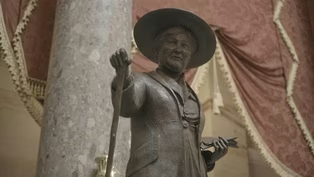
(gentle music) - [Narrator] Littleton Alston's bronze statue, on its granite pedestal, stands 10 feet tall and weighs nearly 1200 pounds.
(gentle music) The gold inscription on the front reads, "Nebraska, Willa Cather, author, 1873-1947," (gentle music) And as she wrote in her novel "O Pioneers!
", the history of every country begins in the heart of a man or a woman.
(gentle music) - [Littleton] There's a sense that a lot of things had come full circle, (gentle music) and I feel as though I've been lifted onto a carpet and just sort of flown around, - it was very beautiful.
-(gentle music) - [Narrator] Littleton Alston is the first African American to create a statue for the collection.
(gentle music) His Willa Cather replaces Jay Sterling Morton, founder of Arbor Day, who was also a fervent supporter of slavery.
(gentle music) Four years earlier, Nebraska replaced a bronze of orator and politician, William Jennings Bryan, with Chief Standing Bear of the Ponca Tribe, whose famous courtroom battle established Native Americans as persons under the law.
(gentle music) - [Littleton] I think Nebraska is more than you think.
(gentle music) I think the people of Nebraska are so diverse, (gentle music) and so independent, in so many ways, that you'll be surprised at what you'll find.
(gentle music) And I think that that's the great strength of Nebraska, (gentle music) we are capable of always accepting others who are on that journey in trying to find a home, (gentle music) and also inviting them into the home of Nebraska, and letting them understand and appreciate what it is -to be a part of this.
-(Crowd applauds) And I think on that day of the dedication, we were unified, all of us, and it was joyous.
(gentle music) (gentle music) - [Narrator] Memorial Stadium's status in Nebraska is unquestionable, (gentle music) a true touchstone of the state.
(gentle music) The stadium has become intertwined in the lives of Nebraskans.
(gentle music) Memorial Stadium's ability to connect goes beyond the playing field.
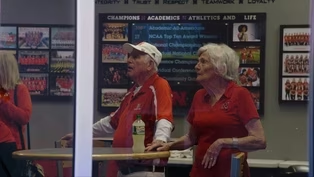
(gentle music) - [Denny] The very first day we met, we both loved Nebraska football, and our kids love Nebraska football.
- My mom.
- Oh!
(gentle music) - [Narrator] Denny and Joyce Korinek have a unique connection to the stadium that brought the two of them together.
- My father bought two tickets in 1929, during the Depression, on the 50-yard line, halfway up in the West Stadium.
(gentle music) I think he paid 50 cents.
(gentle music) That's 90-some years that those seats have been sat in by my father's relatives.
- [Denny] I signed this in 1954.
My number was 31.
(gentle music) Memorial Stadium, to me, is probably more important to many people because I ended up playing here.
(gentle music) I did not only play football, but I also played baseball for the University of Nebraska.
In football, I was offensive running back, right and left halfback.
And during that time that I was playing, (gentle music) we ended up having to play defense also going both ways.
(gentle music) - [Narrator] Happenstance would bring the two of them together later in life, (gentle music) through A love of the University of Nebraska.
(gentle music) The couple, who reside in Florida, travel back to the stadium for each home game.
(gentle music) - [Joyce] My son is a retired pilot for Southwest Airline, which allows us to fly as parents, so we have no excuses.
We can fly back and see a game, and fly back to Florida.
We don't miss games.
(gentle music) (birds chirping) [Narrator] Denny and Joyce have seen the stadium and team evolve over the years.
(gentle music) Their passion and dedication to all things Nebraska shows no signs of stopping.
(gentle music) -(upbeat music) -(crowd cheering) - [Denny] Listen, never coming back to a game?
As long as I can walk and talk, and drive, and steer, and ride a horse, I will be coming back for Nebraska football.
(upbeat music) To me, this stadium is a shrine to all of Nebraska.
(upbeat music) End of story.
(upbeat music) - [Joyce] I can be so proud that this beautiful stadium has added on very gracefully.
(upbeat music) My compliments not so much to the concrete, but to the people that sit on that concrete in that stadium.
(crowd cheering) We have the best fans in the whole world.
(crowd cheering) (energetic rock music) (big band music) - Twin brothers that are 93 that have the same hobby and have had the same hobby all their life.
They've always been together.
They were together in Korea.
And then after that, they started collecting and they wanted a hobby that was free because they didn't have a lot of money.
- The Kenfields returned home from the war and bought land near the town of Ogallala, where they built two identical houses and put a shed out back to house their hobby.
23 years later in 1976, the first Ogallala petrified wood gallery was born.
- And they have stepchildren and had no place to really hand this down to so, in 2007, we established a foundation.
We have visiting artists in our hallway, and then we have the exhibit that Howard and Harvey have put together, as well as Native American artifacts that were brought in by various people in our community.
And so we're hoping for the future of the gallery that it will always be here and Howard and Harvey want it located in Ogallala and that's the agreement that we made with them.
They are special men, very humble men, and very talented.
- [Sean] Howard and Harvey's talents grew from collecting artifacts and stones, to creating art with a very unique medium.
- I believe I like the music box, It's probably the best.
("Memory" from CATS plays lightly) (melodic tune on music box) (melodic tune on music box) (Americana banjo music) - [Sean] Steady hands, careful eyes, and a lifetime of patience has led the Kenfields to some incredible finds.
- And there is a piece of swamp bog that's blue in color that is just debris that's gone to the bottom of the swamp and fossilized and it's probably my favorite piece of petrified wood.
- [Sean] And speaking of stools.
- They they've got a good sense of humor.
(jazz music) - [Sean] And naturally the twins want their collection to continue to amaze and inspire.
(gentle upbeat music) (gentle music) BILL HEDGES: What drew me to filmmaking was when "Star Trek" came out, and "Lost in Space."
They were such fantastic TV series about space.
NARRATOR: Bill Hedges loves sci-fi movies so much that he's built his own spaceship set in his basement.
BILL: I try to keep the upstairs fairly normal-looking.
I figured downstairs, I can go wild, and that's what I did.
(switches being flipped) I bought this book called "The Making of Star Trek," and it detailed everything about how "Star Trek" was made, all the behind-the-scenes stuff.
And they had blueprints in there of how the stages were designed.
(Jacob's ladder) So I can switch from day to night in here.
(thunder rumbling) NARRATOR: Hedges grew up on a farm outside Lyons.
As a kid, he came to town for movies at the local theater.
BILL: Back in the '60's, the theater was a popular place for people to hang out, especially in a small town.
It was the place to go on Saturday nights, 'cause that was before there was television.
People would get their news from newsreels.
I got a job here as a projectionist at the theater when I was 13, and I worked here through high school, which was kind of a fun job to have.
My favorite film was "The Absent-Minded Professor."
For graduation, my folks gave me a Kodak Super 8 movie camera, and I used that to make some little shorts, a lot of stop-frame animation movies, and that was the start of my amateur filmmaking career.
My folks gave me this-- NARRATOR: After high school, Hedges served in the Navy and worked in the Fremont Post Office.
He kept making home movies, but in 1985, the Lyons Theater closed.
BILL: I hated to see it disappear, 'cause it was such a source of entertainment for me, and being as I worked there, too.
NARRATOR: So Hedges bought as much of it as he could, and built a home theater in his basement as an homage.
BILL: Had a lot of beach movies, spy movies back then, westerns, comedies.
This is some of the things I saved from the Lyons Theater.
I used to go through these very same doors.
NARRATOR: In 2014, the old Lyons Theater building came up for sale.
He bought it.
In the last couple years, Hedges has turned the old theater from a place designed to show movies into a place to make them.
(upbeat music) BILL: Nebraska, it's just all cornfields and rolling hills, so I had to make my own alien planet here.
(upbeat music) It's an incredible playground for an amateur filmmaker to have the facilities to film anything here.
Just to have the space to actually build sets, and, you know, miniatures, is something I could never do at home.
This is my stage two, and I've built a ancient ruin set in here.
NARRATOR: He's built sets for films he plans to make, including a new series co-starring his cat.
BILL: Basically about me and my cat, and adventures in space, meeting other aliens.
It's gonna be kind of a parody, not a serious sci-fi, but I have about 12 episodes written so far.
To match between a different scene, so this is a miniature of me and my cat in there, which also matches the interior of that spaceship, and also the interior of my set in my basement.
Still gotta add the Plexiglas to the window, though.
NARRATOR: He builds props out of all kinds of things, many of them scavenged.
BILL: My series is gonna have a lot of parodies in here, and one of them is from "The Good, the Bad, and the Ugly."
NARRATOR: But it's not all sci-fi sets.
BILL: This is the original lobby, and I tried to-- NARRATOR: He's restored part of the building to how it used to be, even re-installing the original film projectors upstairs.
This building lets Hedges tie past to present, making movies in the very space that cultivated his love of the art.
BILL: Other people in town seem to appreciate it too, because I get people asking for tours of it once in a while, which it's fun to talk to them, too, 'cause they share their memories of coming here, and they point out things that they remember, so it's nice to preserve a little bit of that.
NARRATOR: And he's never lost his childhood love of movie making.
In 2015, he created a film about the history of Lyons.
Now he's working on training his cat for his next project.
BILL: Okay, hop down.
Okay, high five.
He'll high five me, he'll jump up on my shoulder, so I'm trying to train him to come and stop and hit his mark.
If you wanna get a lot of views on YouTube, all you have to do is put a cat on the Internet.
You're automatically guaranteed an audience there.
Cats and space, I think that's a winning combination.
(upbeat music) (upbeat music) (upbeat music) - [Narrator] Watch more Nebraska stories on our website, Facebook and YouTube.
(upbeat music) Nebraska Stories is funded in part by the Margaret and Martha Thomas Foundation.
(upbeat music) (upbeat music) (upbeat music) (upbeat music) (upbeat music)
Video has Closed Captions
Clip: S15 Ep7 | 3m 30s | Football, family and love in Memorial Stadium. (3m 30s)
Video has Closed Captions
Clip: S15 Ep7 | 10m 25s | Willa Cather takes her place in National Statuary Hall. (10m 25s)
Providing Support for PBS.org
Learn Moreabout PBS online sponsorship














Support for PBS provided by:
Nebraska Stories is a local public television program presented by Nebraska Public Media