Painting with Wilson Bickford
Wilson Bickford "A Nap on the Beach"
Season 3 Episode 3 | 27m 22sVideo has Closed Captions
Watch as Wilson teaches us how to paint a beach scene.
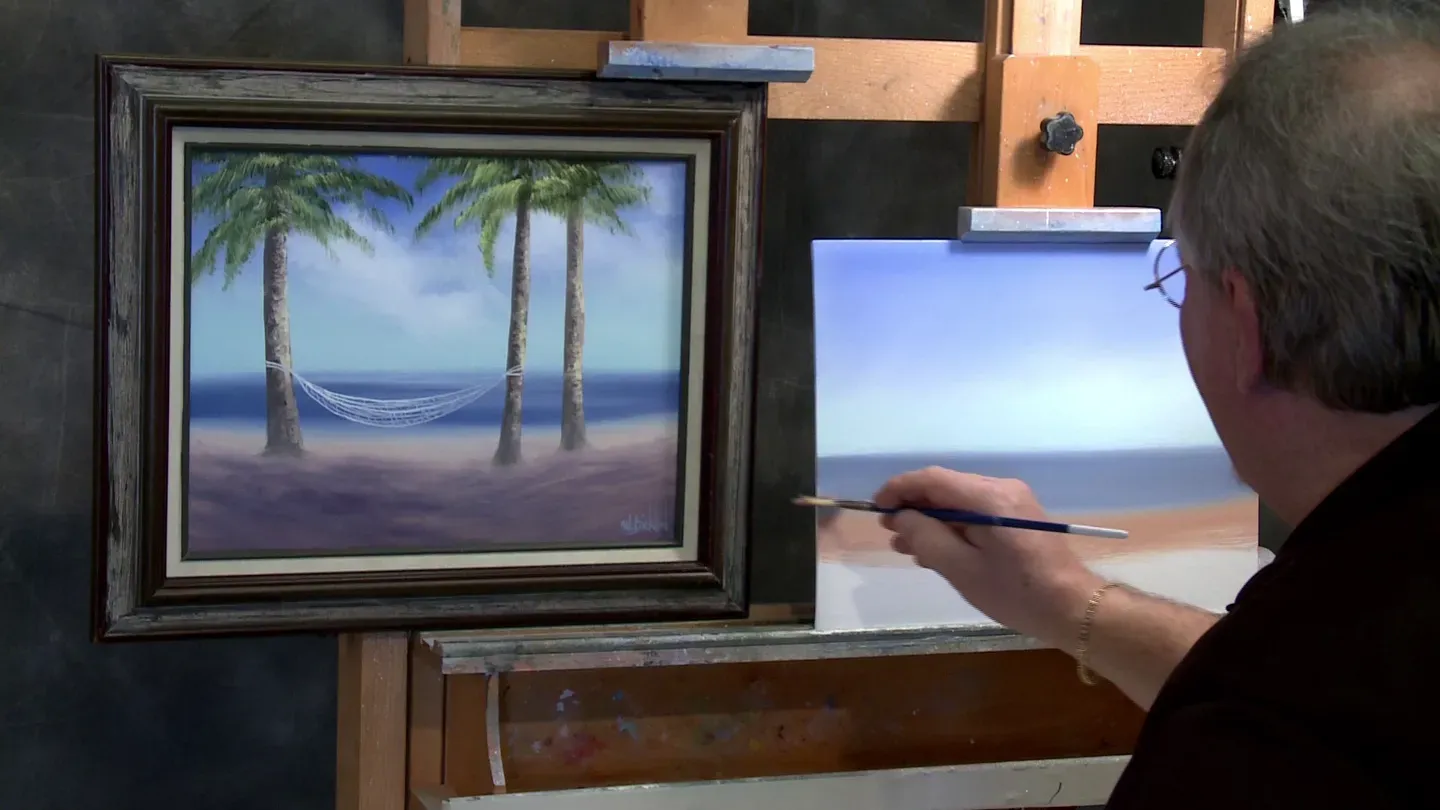
A hammock stretched between two palm trees on a tropical beach is the perfect spot to relax.
Problems playing video? | Closed Captioning Feedback
Problems playing video? | Closed Captioning Feedback
Painting with Wilson Bickford is a local public television program presented by WPBS
Sponsored by: St. Lawrence County &nbps; &nbps; The Daylight Company &nbps; &nbps; J.M. McDonald Foundation
Painting with Wilson Bickford
Wilson Bickford "A Nap on the Beach"
Season 3 Episode 3 | 27m 22sVideo has Closed Captions
A hammock stretched between two palm trees on a tropical beach is the perfect spot to relax.
Problems playing video? | Closed Captioning Feedback
Where to Watch Painting with Wilson Bickford
Painting with Wilson Bickford is available to stream on pbs.org and the PBS app.
Wilson Bickford: Who's up for a dip in the ocean and then a nap on the beach?
Come with with me as we paint A Nap at the Beach.
Join me next on Painting with Wilson Bickford.
[MUSIC] [MUSIC] Hi.
Welcome to Painting with Wilson Bickford.
I'm glad you could join me today.
I thought for today's lesson we'd would take a little stroll to the beach and maybe if we get tired this afternoon we'll take a nap.
We're going to delve right into this project.
I've got a lot to show you on this one today so I'm going to get right at it.
If you go to to the WPBS-TV website you'll be able to download a supply list that tells you all the paints and brushes that we're using today.
I'm going to give you a quick review of those right now.
I'm going to be using my two inch scenery brush, my number four fan brush, my number four filbert brush, my number two long script liner, my number two liner, and my small painting knife.
For oil paints on my palette, I have cerulean blue, ultramarine blue, ivory black, sap green, cadmium yellow pale, burnt sienna, dioxazine purple, and titanium white.
We have a lot of colors today but they all have a purpose.
Also I've got some white base-coat on my palette here that I've already applied to my canvas with my two inch scenery brush so this is all primed and wet.
It gives us nice blendability where we want the subtle value shifts and gradations in the sky, and in the water, and in the beach.
Without further ado here we go.
I'm going to take this brush that still has the white in it and I'll take a little bit of the cerulean blue.
Cerulean blue is a good distance color.
If you go to the ocean or anywhere where you have a vast distance where you can see a long, long ways you'll notice that the sky is usually lighter at the horizon.
That's aerial perspective and it'll be a deeper, darker blue as it comes above your head, so lower on the canvas will be the sky that's farther away.
This represents that lower sky and below this, immediately below this will be the ocean horizon line.
I'm going to put a little bit of this color in with intentions of coming down from the top and blending the darker ultramarine blue into that.
You'll see it gives us a nice deep sky.
It won't look so flat.
If I paint this whole canvas just that one color you'll notice it looks very flat like a wall.
If we grade it with different values, different colors, it makes it look deep, which is what we're shooting for on this canvas.
Now I'm going to take a little bit of the ultramarine blue and I can mix it right into that same little puddle because I'm pretty much done with that cerulean blue color for now.
I'm going to go a little darker with this just so I get a nice contrast.
You can make it as light or as dark as you want but be aware that the idea is to make it darker up here at the top so you get that perspective that we mentioned.
All right.
That's looking pretty good already.
We just need to blend them together.
It looks good to me because I love blue.
It's my favorite color so anytime I can throw some blue on a canvas I'm a happy guy.
Okay, now notice to blend them together I'm going to use more of a crisscross.
Essentially I'm kind of pulling the darker blue down and the lighter blue back up so it weaves them together.
I'm going to go just a hair darker.
That's not a mistake.
It's an adjustment because I'm going to have some white clouds in here as well.
I want those to really have some nice darks behind them so they show up well.
You can always adjust this just like I did there.
Get the colors that you like.
Okay.
I'm going to weave these together and again, take your time blending it.
Get a nice smooth transition.
I'll have some clouds in there that'll kind of hide any little imperfections in it anyway so it's not a big issue for me today.
I'm also going to take a little bit of this ultramarine blue now and a speck of ivory black.
The black is very, very strong, don't need much of it.
I want to darken and gray this blue down a little bit.
This will be my ocean water.
Notice I've got that horizon line a little bit below dead center on the canvas.
Notice how immediately, just putting that on there, already looks like sky and water.
It's amazing.
It doesn't take much.
You want this to be just as straight as you can get it across there.
Another thing I'm considering as I'm doing this is the hammock that's coming later.
The hammock is going to be white, much lighter value so I want this water relatively dark so the hammock will show up.
That wasn't a mistake or a happy accident.
I planned it that way when I designed this painting.
You always have to think of your values and your contrasts.
You want this line to be just as straight as you can possibly get it.
All right.
Now we're going to move down to the beach.
I'm going to set this brush to the side and I'll pick up my fan brush, my number four fan brush, simply because it's clean.
I'm going to take burnt sienna and I'll use a little bit of this base-coat.
I could use the titanium white too.
It really doesn't matter.
I'm going to go with something lighter here out against the water's edge.
I'm going to define my beach line.
I want a little bit of a curve in it, not just a straight edge like a cliff, so I'm going to give it a little bit of a dipsy-doodle here in the middle.
It's always fun to dipsy-doodle once in a while.
All right, I'm going to bring this down.
Now this one was dulled a little bit.
I think if I remember right I put just a speck of black in that but that's okay.
You can do that if you want to dull it down.
Make it your own.
I'm kind of liking this brighter tone today so I'm going to go with it.
Every time you paint you're going to paint what you feel right then, and that's what I'm feeling right now.
Okay, from there I'm going to take more sienna, a speck of black, and a little touch of the dioxazine purple.
The dioxazine purple is the absolute strongest color on our palette today.
You got to tread lightly with that.
I want something with a little more grayed-down.
I don't mind it being a little leaning on the purplish side of things because that's a nice shadow color and later on I'm going to come back and really put some nice shadow pockets in that beach to liven it up.
Right now it's going to look kind of flat and lifeless.
I'm going to put all these little shadows in there, which will be the shadows from the palm fronds.
All right, and just that easy we've got sky, water, and beach.
Okay.
There's the beach area.
Now I'm going to swish out my brush.
I have some odorless mineral spirits here that I use for cleaning and thinning.
I'm going to rinse that out, put the lid back on the bucket.
I'm going to fluff in some nice white clouds.
We want it to be a nice balmy summer day here so I'm going to take some of the titanium white, a fair amount on your brush.
Get enough paint on your brush because you're going to pick up a lot of blue from the canvas which will muddy your color down.
I want to use enough paint so it stays a little bit brighter.
It'll probably never stay pure white but as long as it stays bright enough.
Basically I just want to kind of suggest the tops of the clouds.
You'll notice I take the corner of the brush and I kind of go up and down.
Sometimes I tap.
I flip it around the other corner where there's fresh paint as that corner gets dirty.
The main thing is I want more distinction and character on the top of the clouds, and the bottoms I'm going to fade out.
You'll see I wipe the brush off.
Some of this will be obscured with our palm fronds and whatnot later but still, for the sake of the lesson, you want to see how they're done.
See, I basically fade the bottoms away against the sky.
Notice how that anchors it down, makes it look connected.
I can always come back with a little more white and if I don't like the shape I can toy with it a little bit and get a nice pleasing billowy cloud shape.
With the same idea I wipe it off and I kind of blend away the bottom edge.
That tends to anchor everything to the sky.
These go in pretty easily.
I'll load up with more white and this one's got a lower piece through here but it doesn't matter where you put them.
As you go lower on the horizon you want the cloud shape to be shorter, not as tall from top to bottom.
Those are the clouds that are farther away and that has to do with linear perspective.
We talked about the aerial perspective with a different shades of blue in the sky.
That has to do with color.
Linear perspective has to do with the size of objects, so see as they go farther into the distance they're a little smaller.
Just for the heck of it I'll fluff in a little something up here.
I'll make this more of a cirrus cloud, a little wispy.
See how that livens that sky right up pretty easily.
That one I'm just going to just leave a little bit more of a hazy, soft cirrus type of cloud.
All right.
I'm going to switch over and take my number four filbert brush.
I'm going to take a little bit of white on this too and I'm going to chisel it up to a nice sharp edge on both sides like this.
Then the water, we don't need a lot of character in the water and to be honest I don't want to put a lot of white in there because it's going to compete with the white hammock later, but I'm just going to scuff in a few little suggestions of some wave movements and whitecaps way back here in the distance.
I don't want to get them to light, too bright.
Like I said, they're going to fight with the hammock later.
I want a fairly dark backdrop here for the hammock.
Just to give the water a little interest and some life, there's dolphins swimming out there somewhere.
Okay.
Just enough to say so.
It won't look so flat.
Maybe a little bit up on that edge.
All right.
Just that easy.
Okay.
Moving down to the beach I want to put in some of these darker little scallops.
I want to make it look like maybe people have been walking through there around by the hammock and there's all these little divots and uneven terrain.
I'm going to wipe this off.
I really don't need to wash it.
I'm going to go back to this beach color that I had previously which was the burnt sienna, black.
There's a little bit of white in there as well and the dioxazine purple.
I'm going to go with a little black, a little sienna, a little more purple.
I'm going to make this rather darkish.
Is that a word?
It certainly is darkish.
Then I'm going to chisel this up.
Now, it looks quite dark but you'll see that as I mix it in it's going to lose some of its potency so I'm just going to kind of do this, little scuffs.
Notice I'm not spacing them out like this.
I'm overlapping them, crisscrossing them, working them all together which is the difference.
Now, see how much lighter that getting already?
I'm going to want them a little darker and I knew that.
That's why I mixed extra dark on my palette but I knew it was going to mix in with the wet paint that's already on the canvas here, so I'll come back and darken it down a little more.
Now, these look pretty rough I'll grant you but I'm going to come back and work with them, and blend them, and soften them.
I'm also going to throw some more darks in here.
It's not quite as dark as what I want.
Eventually I'm going to come back with a fan brush and just lightly dust over them.
Building on this same color I'm going to do the same thing only a darker value.
I'm going to take more sienna, a little more black, a little more purple.
I think that purple is a nice color in here.
Looks very shadowy.
See, I'm making it extra dark in here in a few spots.
I know it looks pretty rough right now.
It'll look a lot nicer once I dust over it with that fan brush but I want it to look really pockmarked like it's been walked through.
Take a little more purple in that.
As I pick up the underpaint from the canvas I keep adding a little touch more of color here and there just to keep it darker.
Okay.
Here's the magic.
I'm going to go back with my fan brush.
Now, this is actually still dirty from doing my clouds but if I wipe it it should be good enough to go.
I'm just going to soften all this and fade everything together a little bit.
I don't want to mush it into a solid tone so you don't want to blend it too much.
Blend it just enough.
You'll notice on this one I got a little bit more of a bluish cast to that.
I kind of like that so I'm going to backtrack.
I'm going to put a little bit of ultramarine blue into that.
I'm thinking cool colors in the shadows.
I got some warm tones on those trees in the sunlight.
There's some yellows and burnt sienna in those so I want cooler tones in the shadows.
You'll notice the darker you go with the shadows, the better it looks so I just keep building it up, building it up, building it up to that point.
That's what you have to do as an artist.
You're just going to put your colors on and push them around till they look right.
It's just a series of constant adjusting.
Okay.
I like that a lot better with that extra dark in there.
It looks really nice.
Okay.
It's time for those trees.
Now, there's a lot going on with those trees so I'm going to do one complete tree for you and I'll stop, go off-camera, I'll do the other two but I'm going to show you how to do the tree and then you'll have the recipe for the others.
I'm going to start with this purplish color that I have already.
I'm going to take burnt sienna.
Notice I'm just building on the previous color.
I'm going darker so why not?
I'm going to take burnt sienna and a little bit of black.
I want something like a dark-brownish gray.
I'm going to chisel this filbert brush up.
You've got to figure out where you want them to bottom out.
I'm going to say I'm going to have one maybe right there.
I'm not trying to match that one exactly but I'm going with the flow.
Maybe one there.
Just so I have an idea, put a little bit of a line just to represent where I know they're going to root in.
Okay.
Here we go.
These palm trees tend to bend and curve.
They're not straight like utility poles so give them some character.
Proceed to overlap this.
I overlap it to get it wider and get the width that I want.
Notice it's a little wider at the base just like a tree would be.
I usually wipe the brush and soften it into the sand.
If you wipe the brush and just tap the bristles open to fuzz it out or you could use the corner.
Your fan brush would work too, but see if I just soften that transition a little bit it makes it looks like it's anchored into the sand rather than just plunked on top, which looks very unnatural and you can actually just pull some of those shadow colors around it a little bit to soften that transition pretty easily.
Like I said, you can always come back with your fan brush.
See how that anchors it in there?
To highlight that I'm going to use my painting knife.
This is my small knife.
I'm going to use titanium white, a little bit of burnt sienna to start out.
The light in this painting's coming from the right so I'm going to highlight the right-hand sides.
I'm going to get a little ridge of paint right on the edge of that blade and if I just touch and pull inward.
I'm pulling across.
I'm going to leave some dark spots here and there.
Don't illuminate the whole trunk all the way up.
It gets very boring.
The light is going to be filtering through some of these fronds and the other trees around it so just don't highlight the whole tree.
It looks more natural to leave some of that in the dark.
If I wipe the brush, or the knife, excuse me.
If I wipe the knife and I have nothing on it and I'm just dragging you might be able to even hear my knife scratch.
I'm kind of pulling that around the tree a little more to lose the edge on the inside of the tree so it looks gradually rounded.
To really put some zing in that I'm going to take white now with cadmium yellow pale and just a little bit of this previous color I just used, so it's going to be warmer, more yellowy, more sunshiny and I'm going to do the same thing but I'm going to be a little more selective of where I put it.
A little here.
A little there, but not everywhere so it looks like you're getting a really good shot of sunlight peeking through here and there on those trees.
Just like before, I wipe the blade and then I wrap that around the inside of the tree so there's a softer transition.
That looks pretty darn good for a tree trunk, don't you think?
It's just as easy as what I'm showing you here.
If you haven't tried painting, give it a shot.
Everybody thinks they can't do it but it's one of those things that you learn it by doing it.
Okay, I'm going to come back with my fan brush.
It still dirty but that's okay.
I'm going to take some sap green, a little bit of yellow, definitely some blue.
I want a shadowy blue color, or shadowy green.
Excuse me.
I want a shadowy green color.
I'm going to put just a couple of drops of paint thinner with that and you'll notice I'm going to frazzle the brush.
This is what I call frazzling.
I'm opening the brush right up.
I'm thinking cooler blue-green and then I'm going to put warmer yellow-green over-the-top.
That's a frazzled brush.
See how that's all spread out?
If I come in and just lightly touch and pull over it's pretty easy to get the feeling of palm fronds.
It doesn't take much.
Don't be afraid to let some of them stretch right up there.
All right.
I'm going to swish that brush out and I'm going to come back with a much lighter, yellowy green, and I can work right in this color here.
If I take white, yellow, and a little bit of the sap green I'm going to frazzle the brush just like I did before.
Don't do it everywhere but a little here and a little there really sets this off, gives it a lot of three dimensionality.
That's how we do the palm trees.
I'm going to put a couple more over here and I'll be right back.
[MUSIC] This is a painting I've done recently.
There's a lot more detail in the water but similar theme, Caribbean feel.
This one has a palm tree as well and I wanted to show you if you want more definition and detail on your fronds, once you've put them in with your fan brush you can take a number two liner and with the same greens, thin your paint-rate down.
I'm using mineral spirits here.
Roll it to a point and you can get a lot of definition and detail on your fronds.
I've completed the other two palm trees, and I don't know about you, but I'm kind of frond of them, pun intended.
All right.
I did them the same way that I did the other ones, same exact procedure.
You'll notice they have a nice lighting effect because I didn't highlight the whole things.
I left gaps of shadow in there so it looks like the light's filtering through the fronds and maybe there's other trees over here.
We're going to get on to this hammock.
This is going to take a couple minutes or more to do.
I'm going to demonstrate on this paper right here.
I'll say this is my palm tree on the left.
This is the one on the right.
When you put it in you want just a nice graceful shallow curve to the top line.
I'm going to use my long script liner for that with white paint.
I'm going to put another one below it like this, kind of like a smile almost.
A little bit deeper rather.
Not quite as shallow.
I'll put some indications of some wraps around the trees and then I'm going to fill in a few more rows in here that follow the flow of that curve.
When you put these in try not to just make it look like a window screen.
I'll move up here and do it again.
It's pretty easy to do this and you get in a rut where you're just making it a window screen.
It looks like a window screen.
When I look put these in, I kind of do them in bits and pieces and I give them a little bit of curve so it looks more like netting and not just like a square rigid window screen.
This is all going to be done with the brush.
I'll fill that in just like that.
For that I'm going to take my long script liner.
I'm going to have to thin this down quite generously.
I'm going to take some of this white-base coat I've got sitting here.
I could use the titanium white but you have to thin it down much, much more.
This white base-coat is already halfway thinned to what I already need.
You'll notice that I'm going to load the brush full and I'm going to roll the brush, and pull it back and take some of the excess paint out of it to bring it to the smallest tip that I possibly can.
I might have to use my little steady stick here.
This is just a wooden dowel that I use to steady my hand.
I can lay my hand on it.
Here's the tricky part is getting a nice graceful curve here.
I guess I can lean this on my hand.
You want a nice graceful arc.
That's the tricky part.
When I was talking funny right there it's because I was holding my breath.
This is touchy stuff.
If it happened that you didn't get those as smooth as you want you can take a clean brush and just blend those and blend them right into your background paint.
Okay.
From there I'm going to put a couple little wraps that gets wrapped around the tree to hold it on there.
I'll put a couple more in here.
You'll see that the less paint you have on your brush, the thinner your line, but you'll have a lot of time to tinker with this at home, more so than I do here.
Then I'm going to come in and put these little cross pieces in it.
I'm going to finish this up and we'll step back and analyze it, and I'll be right back.
I finished rendering the hammock.
There's a lot to be said for this brush.
This brush makes nice fine lines.
This is the long script liner.
Make sure you get your paint thin enough.
It takes a steady hand.
That's why I was resting my hand on that stick and I finally got it in here.
It takes a little while.
Take your time doing it.
If you have trouble doing that on the wet background let your canvas dry.
You're going to come in and put it in on the dry background.
That actually will go much smoother for you.
simply just kept following my lines just like I had talked about.
I've got it in there.
That looks pretty good to me.
I'm going to switch over to my number two liner.
This is a much smaller brush and I'm going to take some of this blue-gray that I had way back from the beginning.
I guess it's my water color, the color of my water.
This is oil paint, just to clarify.
If I roll that way off here on the lower horizon I'm going to put a couple little smaller birds.
I say a couple but I'll put a few.
There's always a lot of birds at the ocean.
I'm going to swish that out quickly and I'm going to take some white.
This is the white base-coat.
I'm going to put one a little bigger.
We will definitely know that he's a gull and not just a generic bird.
Put them somewhere where he's going to show.
I'm going to go come up to this darker blue so the white of the bird will show up.
Notice I put the same V-shape.
If I take some of that blue-gray I used for the other birds and I put a little sense of a shadow underneath that one side with his body trailing behind.
A lot of these gulls have distinct markings.
Some of them have black wingtips.
Those are the ones I like to use because they have more contrast.
I'll take a little bit of the ivory black and I'll put a couple little touches on the wingtips.
I hope you enjoyed this lesson.
I'd love to see your version of it.
Send me your copy.
I'd like to see it.
Until next time stay creative and keep painting.
Announcer: All 13 episodes of Painting With Wilson Bickford, Series #300 are now available on DVD in one boxed set for $35 plus $4.95 shipping and handling.
Learn the techniques used to paint "Majestic Mountain" with this new exclusive in-depth Wilson Bickford instructional DVD.
Also available: Wilson Bickford's Rose Painting Techniques DVD with in-depth lessons on painting roses, stems, and leaves.
And Wilson Bickford's Landscapes Techniques DVD -- learn to paint skies, trees, water, and grasses.
Order online at wpbstv.org!
[MUSIC] [MUSIC] [Swoosh Noise]


- Home and How To

Hit the road in a classic car for a tour through Great Britain with two antiques experts.
 New Season





 New Episode
 New Episode



Support for PBS provided by:
Painting with Wilson Bickford is a local public television program presented by WPBS
Sponsored by: St. Lawrence County &nbps; &nbps; The Daylight Company &nbps; &nbps; J.M. McDonald Foundation